8:00 AM CST to EST
8:00 AM CST = 9:00 AM EST
Morning workday kickoff and stock pre-market opening.
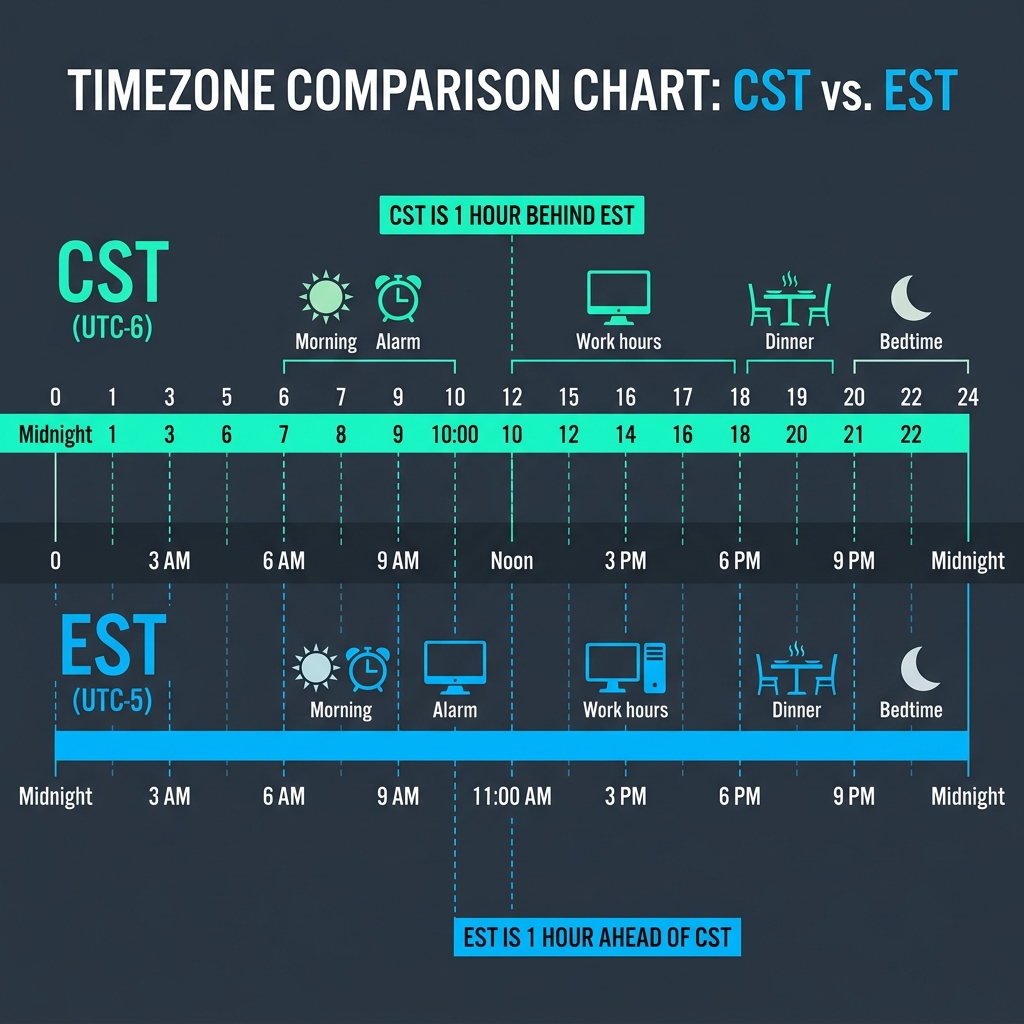
CST is 1 hour behind EST. Add 1 hour to convert CST to EST.
During daylight saving time, Central Time changes from CST to CDT and Eastern Time changes from EST to EDT, but the one-hour difference remains.
Active Zone: ET
Converting Central Standard Time (CST) to Eastern Standard Time (EST) requires adding exactly 1 hour.
EST = CST + 1 hour10:00 AM CST = 11:00 AM ESTBecause both regions follow standard North American daylight saving time schedules, Eastern Time remains 1 hour ahead of Central Time throughout the entire year.
Use this clean 24-hour reference table to look up any hour in Central Standard Time (CST) and see its corresponding Eastern Standard Time (EST) equivalent.
| Central Standard Time (CST, UTC-6) | Eastern Standard Time (EST, UTC-5) |
|---|---|
| 12:00 AM CST | 1:00 AM EST |
| 1:00 AM CST | 2:00 AM EST |
| 2:00 AM CST | 3:00 AM EST |
| 3:00 AM CST | 4:00 AM EST |
| 4:00 AM CST | 5:00 AM EST |
| 5:00 AM CST | 6:00 AM EST |
| 6:00 AM CST | 7:00 AM EST |
| 7:00 AM CST | 8:00 AM EST |
| 8:00 AM CST | 9:00 AM EST |
| 9:00 AM CST | 10:00 AM EST |
| 10:00 AM CST | 11:00 AM EST |
| 11:00 AM CST | 12:00 PM (Noon) EST |
| 12:00 PM (Noon) CST | 1:00 PM EST |
| 1:00 PM CST | 2:00 PM EST |
| 2:00 PM CST | 3:00 PM EST |
| 3:00 PM CST | 4:00 PM EST |
| 4:00 PM CST | 5:00 PM EST |
| 5:00 PM CST | 6:00 PM EST |
| 6:00 PM CST | 7:00 PM EST |
| 7:00 PM CST | 8:00 PM EST |
| 8:00 PM CST | 9:00 PM EST |
| 9:00 PM CST | 10:00 PM EST |
| 10:00 PM CST | 11:00 PM EST |
| 11:00 PM CST | 12:00 AM (Midnight) EST |
Here are the most frequently searched hour-by-hour Central to Eastern conversions for business scheduling, webinars, live broadcasts, and travel:
8:00 AM CST = 9:00 AM EST
Morning workday kickoff and stock pre-market opening.
9:00 AM CST = 10:00 AM EST
Primary business collaboration window opens.
10:00 AM CST = 11:00 AM EST
Peak cross-regional corporate meeting and client call slot.
11:00 AM CST = 12:00 PM EST
Midday status sync before Eastern lunch hour.
12:00 PM CST = 1:00 PM EST
Central lunch hour / Eastern afternoon restart.
1:00 PM CST = 2:00 PM EST
Primary afternoon project review and team standup slot.
2:00 PM CST = 3:00 PM EST
Afternoon cross-office collaboration and client demos.
3:00 PM CST = 4:00 PM EST
US stock market close (NYSE / Nasdaq at 4:00 PM ET).
4:00 PM CST = 5:00 PM EST
Eastern end-of-day handoff / Central late-afternoon focus.
5:00 PM CST = 6:00 PM EST
Central workday wrap-up / Eastern evening transition.
7:00 PM CST = 8:00 PM EST
Prime time broadcasting, sports, and virtual webinars.
10:00 PM CST = 11:00 PM EST
Late-night IT maintenance and scheduled system deployments.
The primary difference between Central Standard Time (CST) and Eastern Standard Time (EST) is their geographical location relative to the Prime Meridian:
Offset: UTC−6
Observed during winter months across the Central US, Canada, and parts of Central America. Centered along the 90th meridian west.
Offset: UTC−5
Observed during winter months across the East Coast of North America. Centered along the 75th meridian west, 15 degrees further east.
Offset Gap: +1 Hour
Because Earth rotates from west to east, the sun rises and sets 1 hour earlier in the Eastern zone than in the Central zone.
It is common to see people refer to Central Time as "CST" and Eastern Time as "EST" year-round. However, both regions observe Daylight Saving Time (DST) during summer months, changing their abbreviations and numeric offsets:
| Time Zone Name | Abbreviation | UTC Offset | Active Season |
|---|---|---|---|
| Central Standard Time | CST | UTC−6 | Winter (Nov – Mar) |
| Central Daylight Time | CDT | UTC−5 | Summer (Mar – Nov) |
| Eastern Standard Time | EST | UTC−5 | Winter (Nov – Mar) |
| Eastern Daylight Time | EDT | UTC−4 | Summer (Mar – Nov) |
Important Note on Summer Offsets: During daylight saving time, Central Time uses CDT (UTC-5) and Eastern Time uses EDT (UTC-4). Because both transitions happen simultaneously on the second Sunday in March and the first Sunday in November, Eastern Time is consistently 1 hour ahead of Central Time year-round.
If you need to calculate the reverse direction from Eastern Time to Central Time, simply subtract 1 hour:
EST is 1 hour ahead of CST. Subtract 1 hour to convert EST to CST.
Formula: CST = EST - 1 hour
9:00 AM EST = 8:00 AM CST
10:00 AM EST = 9:00 AM CST
11:00 AM EST = 10:00 AM CST
12:00 PM EST = 11:00 AM CST
1:00 PM EST = 12:00 PM CST
2:00 PM EST = 1:00 PM CST
4:00 PM EST = 3:00 PM CST
5:00 PM EST = 4:00 PM CST
7:00 PM EST = 6:00 PM CST
8:00 PM EST = 7:00 PM CST
The 1-hour time gap connects major economic and financial centers across North America:
Observes CST (UTC-6) in winter and CDT (UTC-5) in summer:
Observes EST (UTC-5) in winter and EDT (UTC-4) in summer:
NYSE and Nasdaq regular trading hours are 9:30 AM–4:00 PM Eastern Time, corresponding to 8:30 AM–3:00 PM Central Time.
Yes. Central Standard Time (CST, UTC-6) is exactly 1 hour behind Eastern Standard Time (EST, UTC-5). When it is 10:00 AM CST, it is 11:00 AM EST.
To convert CST to EST, add 1 hour to the Central time (EST = CST + 1 hour). For example, 10:00 AM CST + 1 hour = 11:00 AM EST.
CST operates at UTC-6, while EST operates at UTC-5. Eastern Standard Time is always 1 hour ahead of Central Standard Time.
CST (Central Standard Time, UTC-6) is observed in winter, while CDT (Central Daylight Time, UTC-5) is observed in summer when daylight saving time is active.
EST (Eastern Standard Time, UTC-5) is observed in winter, while EDT (Eastern Daylight Time, UTC-4) is observed during daylight saving time in summer.
No. Because both Central Time and Eastern Time transition into daylight saving time (CDT and EDT) on the same dates, Eastern Time remains exactly 1 hour ahead of Central Time year-round.
Yes. Chicago is in the Central Time Zone and New York is in the Eastern Time Zone. Chicago is always 1 hour behind New York.
To convert EST to CST, subtract 1 hour from the Eastern time (CST = EST - 1 hour). For example, 1:00 PM EST becomes 12:00 PM CST.