
Use GMT When...
- Speaking with people living in the UK, Ireland, or West Africa.
- Describing civil clocks and winter hours in London.
- Writing calendar events for local audiences in Greenwich timezone regions.
No, they are not scientifically identical, but for everyday scheduling they function the same. GMT (Greenwich Mean Time) is an astronomical solar time zone based on the rotation of the Earth. UTC (Coordinated Universal Time) is a high-precision scientific time standard based on atomic clocks. Because their clocks show the exact same hours and minutes, you can use them interchangeably when scheduling meetings or flights.
Before diving into the detailed historical and scientific mechanics of timezone standards, let us look at the core differences. The infographic below summarizes the main distinctions in a single view.
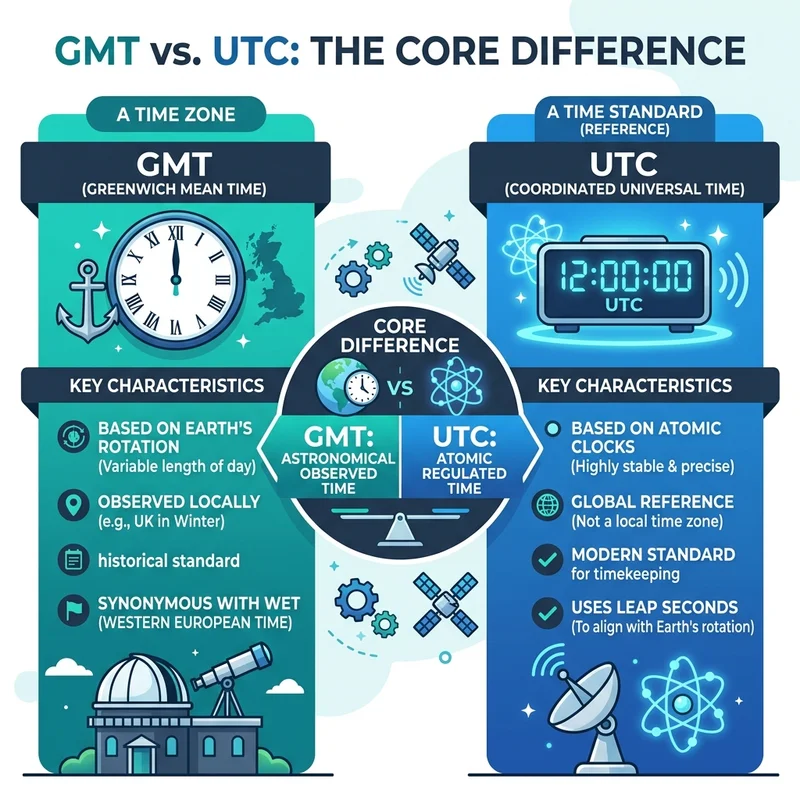
Figure 6: Quick difference infographic highlighting that GMT is a civil timezone observed by countries, while UTC is a scientific reference standard.
As shown in the infographic, Greenwich Mean Time is a regional time zone with seasonal adjustments in the countries that observe it, whereas Coordinated Universal Time is a global reference standard managed by international scientific bodies that does not belong to any country.
Greenwich Mean Time (GMT) is an astronomical timezone based on the rotation of the Earth. It measures the mean solar time at the Royal Observatory in Greenwich, London. Specifically, it is calculated from the exact moment the sun crosses the prime meridian (0° longitude).
Because it is calculated astronomically, GMT is directly tied to the physical rotation of our planet. As the Earth rotates on its axis, astronomers track the passage of stars and the sun to define the exact length of a day. This makes GMT a solar time zone.
Historically, GMT was used as the global time standard. Today, it is no longer the primary scientific reference, but it remains a civil time zone observed by several countries in Europe and Africa during the winter months, including the United Kingdom, Ireland, and Iceland.
The history of Greenwich Mean Time began in 1675. King Charles II founded the Royal Observatory in Greenwich to help British mariners calculate longitude at sea. John Flamsteed was appointed as the first Astronomer Royal, tasked with mapping the stars and tracking the solar system's movements.
Standardizing time became critical with the expansion of the British railway system in the mid-19th century. Before this, each town kept its own local solar time based on the sun's position. This meant that clocks in Bristol were several minutes behind clocks in London. To prevent train collisions and coordinate schedules, railway companies established Railway Time, which was standardized to Greenwich Mean Time in 1847.
In 1884, the International Meridian Conference in Washington, D.C. selected the Greenwich meridian as the official prime meridian (0° longitude) for global navigation. This officially established GMT as the primary solar time standard for the world, setting the baseline from which all other time zones were calculated.
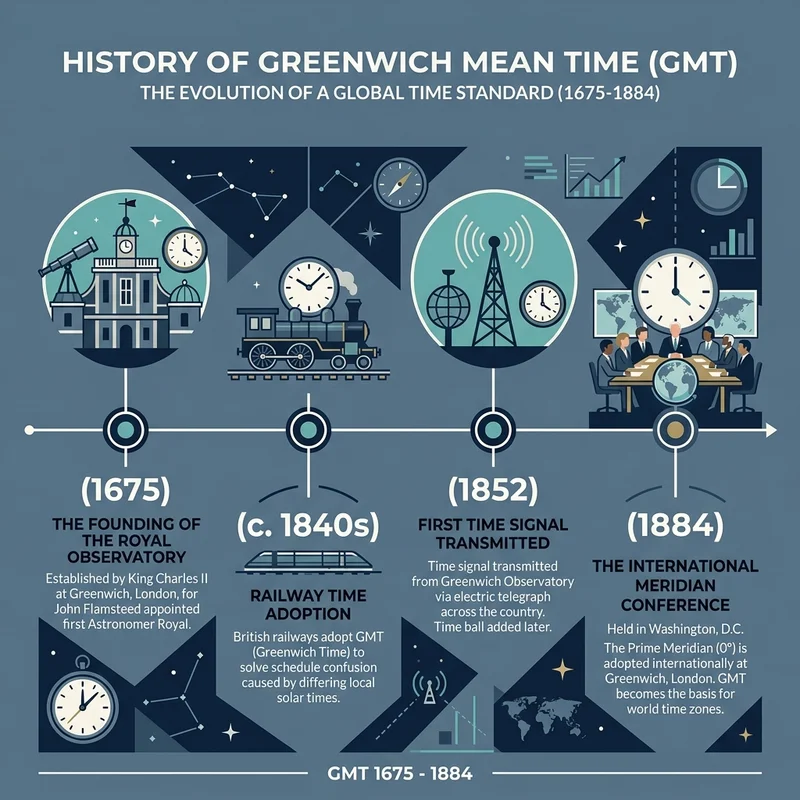
Figure 1: Timeline outlining the milestone events leading to the global standardization of Greenwich Mean Time.
The timeline shows the long journey of GMT, starting from the construction of the Royal Observatory, through the railway standardization era, to its international codification as the world's prime meridian reference in 1884.
Coordinated Universal Time (UTC) is the modern scientific time standard used to regulate clocks and timekeeping around the world. Unlike GMT, UTC is not a timezone and is not tied to any specific geographic location. Instead, it is a highly accurate standard kept by atomic clocks.
UTC is regulated by the International Bureau of Weights and Measures (BIPM). It combines two primary time standards: International Atomic Time (TAI) and Universal Time (UT1). TAI is calculated from the averages of over 400 atomic clocks worldwide, providing extreme stability. UT1 tracks the Earth's actual rotation.
By combining these standards, UTC provides a stable timekeeping method that is synchronized with both atomic clocks and the natural rotation of the Earth. It serves as the baseline from which all civil time zones calculate their local offsets (for example, Eastern Standard Time is written as UTC-5).
The history of Coordinated Universal Time began in the mid-20th century. With the development of telecommunications, satellite navigation, and global computer systems, the scientific community required a time standard more stable and precise than astronomical solar calculations.
In 1960, the International Astronomical Union and the International Radio Consultative Committee began coordinating radio time signals. This initial coordination led to the formal introduction of Coordinated Universal Time in 1967.
In 1972, the modern UTC system was officially established, introducing the concept of leap seconds. Leap seconds were designed to bridge the gap between stable atomic time and the slightly fluctuating rotation of the Earth. This standard replaced GMT as the official global reference, providing the baseline for modern technologies.
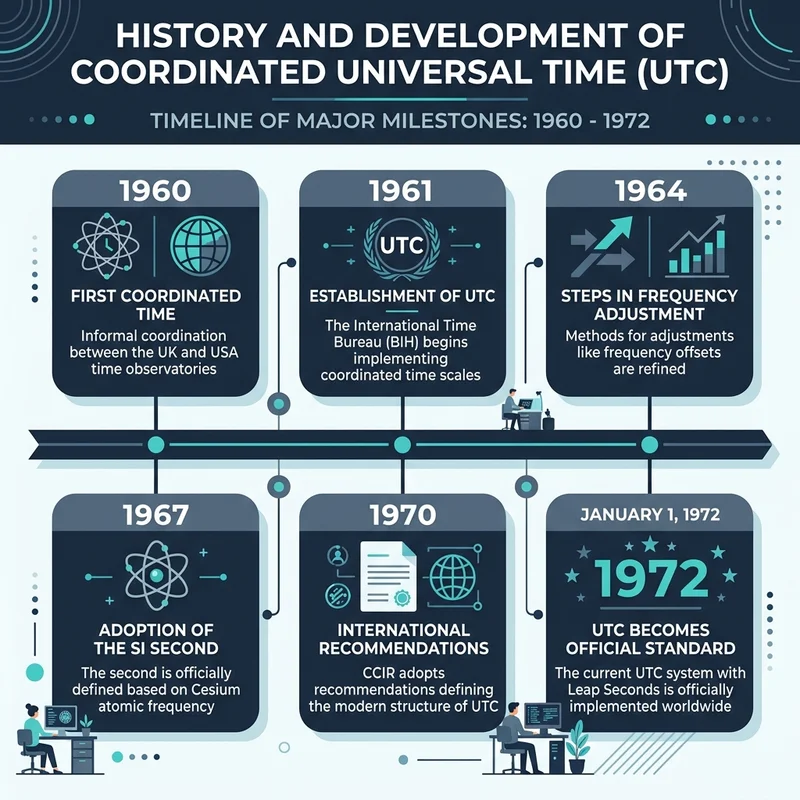
Figure 2: Timeline charting the key steps in the development and standardization of UTC in the mid-20th century.
As illustrated, the development of UTC transitioned timekeeping from the astronomical domain to the atomic domain, ensuring that global communications and navigation systems could operate with sub-millisecond precision.
Although everyday calendars use GMT and UTC to represent the exact same time, they are governed by different rules, authorities, and measurement methods. The table below outlines these distinctions:
| Feature | Greenwich Mean Time (GMT) | Coordinated Universal Time (UTC) |
|---|---|---|
| Definition | A solar time zone based on Earth's rotation. | A scientific time standard based on atomic clocks. |
| Hemisphere / Location | Centered on Greenwich, London (0° Longitude). | Not geographic. Governed globally. |
| Daylight Saving (DST) | Observed seasonally by some regions (e.g., UK BST). | Never shifts. Stays constant all year. |
| Measurement Method | Astronomical solar tracking. | Atomic oscillations (Caesium-133). |
| Accuracy | Varies slightly due to Earth's rotation. | Accurate to within one nanosecond per day. |
| Abbreviation Meaning | Greenwich Mean Time. | Coordinated Universal Time (neutral abbreviation). |
| Establishment Year | Officially adopted in 1884. | Introduced in 1960; standardized in 1972. |
| Primary Use Case | Civil timekeeping in European and African countries. | System administration, aviation, internet standards. |
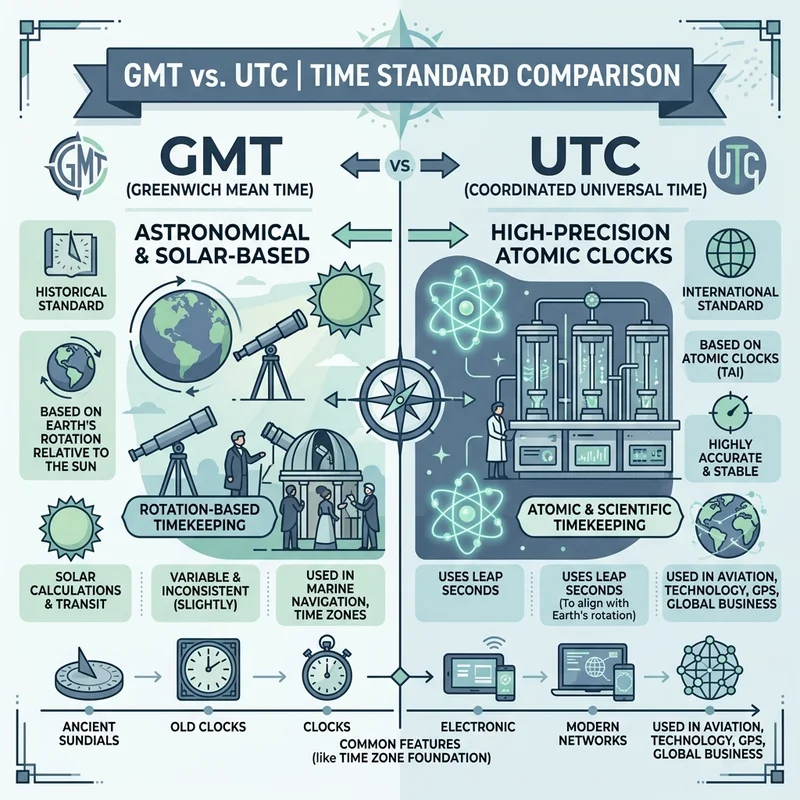
Figure 3: Side-by-side comparison infographic outlining the conceptual difference between GMT and UTC.
The infographic illustrates that while GMT represents a specific geographic zone subject to regional clock changes, UTC represents a stable atomic reference line used to synchronize all global computer networks and time zone offsets.
To understand the technical differences between GMT and UTC, we must look at how time is measured. GMT is an astronomical solar time standard, meaning it is calculated from the Earth's rotation relative to the sun. However, the Earth does not rotate at a perfectly constant speed. Tidal friction, core-mantle interactions, and seasonal changes in polar ice cause our planet's rotation to slow down and fluctuate slightly over time.
UTC resolves this instability by relying on atomic clocks. These clocks measure time using the constant oscillation of Caesium-133 atoms. An SI second is officially defined as the duration of exactly 9,192,631,770 periods of radiation corresponding to the transition between two hyperfine levels of the ground state of the Caesium-133 atom.

Figure 4: Diagram of a caesium atomic clock illustrating the atomic oscillations used to define the length of one SI second.
This atomic tracking provides unmatched stability, allowing scientific labs to coordinate time calculations with nanosecond-level accuracy, completely independent of solar fluctuations.
Because atomic time (TAI) is perfectly constant but Earth's rotation (UT1) is slowing down, atomic clocks run slightly faster than solar time. If left uncorrected, atomic time would eventually drift away from the position of the sun, meaning that over thousands of years, midnight would eventually occur during daylight hours.
To prevent this drift, Coordinated Universal Time (UTC) uses **leap seconds**. Whenever the difference between atomic time and Earth's astronomical rotation approaches 0.9 seconds, the International Earth Rotation and Reference Systems Service (IERS) schedules a leap second adjustment. This second is added at the end of June 30 or December 31, during which the clock shows 23:59:60 before transitioning to 00:00:00. This keep UTC within one second of astronomical time (UT1), bridging the gap between physics and astronomy.
Because UTC is a stable standard not subject to political clock changes or local daylight saving adjustments, it is the primary time reference for high-tech industries, communications, and transport networks.
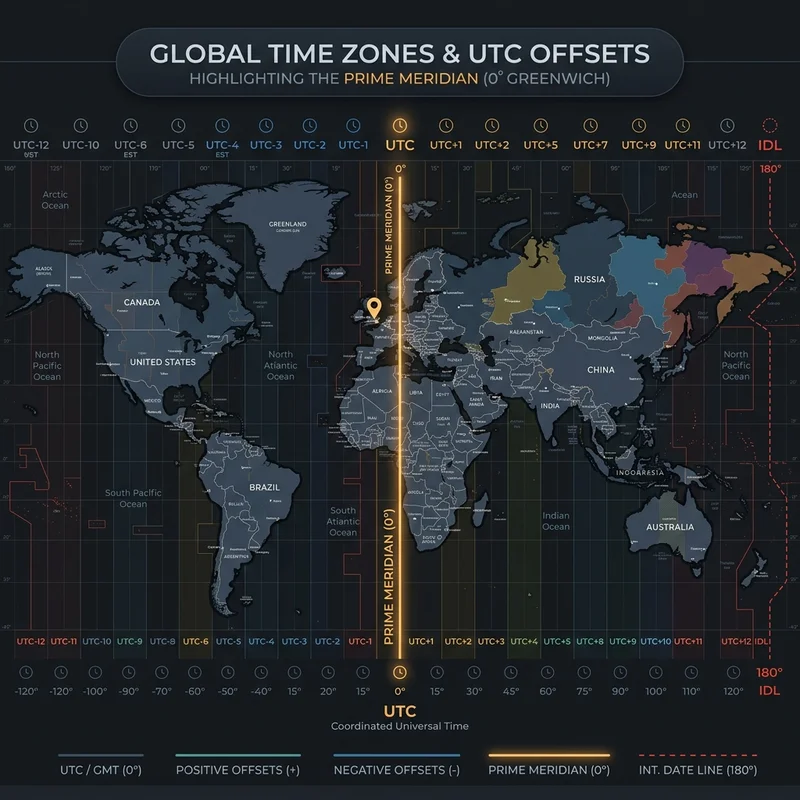
Figure 5: Global map showing the prime meridian at Greenwich (UTC+0) and relative time zone offsets across the world.
As shown on the map, UTC serves as the universal baseline. All local time zones around the world are defined by adding or subtracting hours from the UTC standard.
Military forces coordinate global operations using UTC, which they refer to as **Zulu Time**. In the phonetic alphabet, the letter 'Z' stands for 'Zulu,' representing the zero meridian time zone. By standardizing military logs, flight manifests, and combat operations to Zulu Time, commanders ensure that forces operating across multiple continents are synchronized to the exact same clock.
The aviation industry depends on UTC to coordinate flight paths, air traffic control, and international departures. Pilots and air traffic managers use UTC to prevent scheduling errors during long flights. Similarly, meteorologists use UTC to coordinate weather observations. Synoptic weather maps and radar sweeps are timestamped to UTC, allowing scientists to monitor storm movements across continents concurrently.
In computer science, storing time in local time zones can lead to database errors, especially during daylight saving transitions. To prevent this, standard database systems store transactional records and system logs in UTC.
The **UNIX Epoch** — the system used by computers to count time — measures the number of seconds that have elapsed since January 1, 1970, at 00:00:00 UTC. Internet protocols, security certificates, and ISO 8601 timestamps are governed by UTC to maintain consistent order across servers.
To clarify how these standards operate, let us look at common scenarios where timezone confusion occurs:
Determining whether to use GMT or UTC depends on the context of your communication. Review these guidelines to select the correct standard:
Fact: For civil timekeeping, their clocks show the exact same time. 12:00 PM GMT is 12:00 PM UTC. Their difference lies entirely in the underlying standard and how their time is calculated, not in the clock face.
Fact: London only observes GMT during the winter. In summer, the UK transitions to British Summer Time (BST, UTC+1). This means London's local clock runs one hour ahead of GMT for half the year.
Fact: UTC is a global time standard, not a timezone. Time zones around the world are calculated as positive or negative offsets relative to UTC.
Review these comprehensive answers to resolve common questions about Coordinated Universal Time and Greenwich Mean Time:
No, they are not the same. GMT (Greenwich Mean Time) is an astronomical solar time zone based on the Earth's rotation, centered on Greenwich, London. UTC (Coordinated Universal Time) is a scientific time standard based on atomic clocks that does not adjust for locations. However, for everyday scheduling, their offsets are identical.
No. Coordinated Universal Time (UTC) is a fixed scientific standard. It never changes for Daylight Saving Time (DST) or seasonal adjustments in any country. It remains constant throughout the entire year.
Computer servers use UTC because it is based on atomic time (TAI) and is internationally standardized. Unlike GMT, which is astronomically calculated and varies slightly as Earth's rotation fluctuates, UTC provides a stable and non-shifting timestamp that prevents server log errors.
No. The UK observes Greenwich Mean Time (GMT, UTC+0) during the winter months. In the summer, the UK shifts to British Summer Time (BST, UTC+1), which means clocks are moved forward by one hour.
A leap second is a one-second adjustment added to UTC to keep it aligned with Earth's astronomical rotation (UT1). Because the Earth's rotation is gradually slowing down due to tidal forces, atomic clocks (UTC) run faster than solar time. Adding a leap second prevents the standards from drifting apart.
No, UTC is not a timezone. It is a global time standard. Time zones around the world are calculated as positive (+) or negative (-) offsets relative to UTC (e.g., Eastern Standard Time is UTC-5).
GMT was established much earlier. Greenwich Mean Time was officially recognized in 1884 at the International Meridian Conference, while Coordinated Universal Time (UTC) was introduced in 1960 and officially standardized in 1972.
Technically, a UTC offset refers to the difference in hours and minutes from the atomic standard, while a GMT offset refers to the difference from Greenwich solar time. In practice, because GMT and UTC share the same baseline, these offsets are identical.
The abbreviation UTC is a compromise. English speakers wanted CUT (Coordinated Universal Time), while French speakers wanted TUC (Temps Universel Coordonné). The International Telecommunication Union (ITU) adopted UTC as a neutral abbreviation for all languages.
Zulu Time is the military and aviation designation for UTC. In the military phonetic alphabet, the letter 'Z' stands for 'Zulu,' representing the zero meridian time zone.
There is no conversion necessary. 12:00 PM GMT is exactly equivalent to 12:00 PM UTC. They share the same clock time, even though they are regulated by different standards.
The military uses UTC, which they refer to as Zulu Time. This ensures that operations across multiple continents are synchronized to a single, non-shifting standard.
Use our free, daylight-saving-aware tools to calculate time offsets and schedule meetings across global regions: