Quick Answer: How Many Time Zones does Canada Have?
Canada has six primary standard time zones.
These standard zones are Pacific Standard Time (PST, UTC-8), Mountain Standard Time (MST, UTC-7), Central Standard Time (CST, UTC-6), Eastern Standard Time (EST, UTC-5), Atlantic Standard Time (AST, UTC-4), and Newfoundland Standard Time (NST, UTC-3:30).
However, the actual timezone landscape is more complex because timekeeping is regulated at the provincial and territorial levels.
Recent 2026 changes saw British Columbia and Alberta transition to permanent Daylight Saving Time (PDT/UTC-7 and MDT/UTC-6 year-round), aligning them with Saskatchewan and Yukon which also observe permanent offsets.
Canada is the second-largest country in the world by land area, stretching over 9,306 kilometers from Cape Spear in Newfoundland to the boundary of Alaska.
This vast geographic expanse covers nearly 88 degrees of longitude. Because of this massive horizontal footprint, a single unified clock is impossible.
Canada utilizes six primary standard time zones to align community schedules with the daily path of the sun.
Pro Tip: Under the Canadian Constitution, timekeeping is a provincial and territorial jurisdiction.
This means local municipal councils and provincial legislative assemblies—not the federal government in Ottawa—have the legal power to decide timezone boundaries and seasonal Daylight Saving Time rules.
This decentralization explains why boundaries do not always align with provincial borders.
For example, northwestern Ontario uses Central Time to stay in sync with Manitoba, while the eastern portion of the province uses Eastern Time.
Additionally, the National Research Council (NRC) in Ottawa maintains Canada's official atomic clocks, but it has no legislative authority to dictate which offsets local communities must observe.
Our calculations relative to Coordinated Universal Time (UTC) and Greenwich Mean Time (GMT) are officially referenced against these standards.
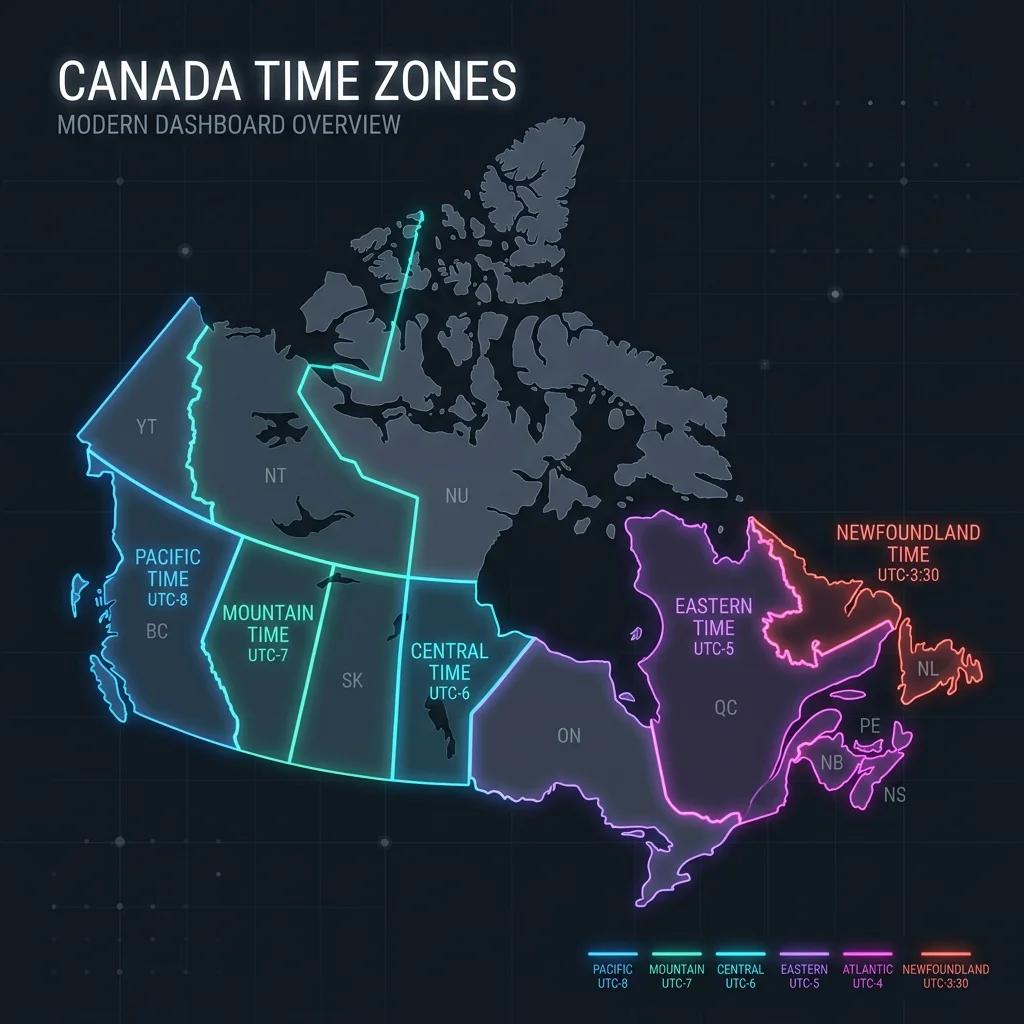
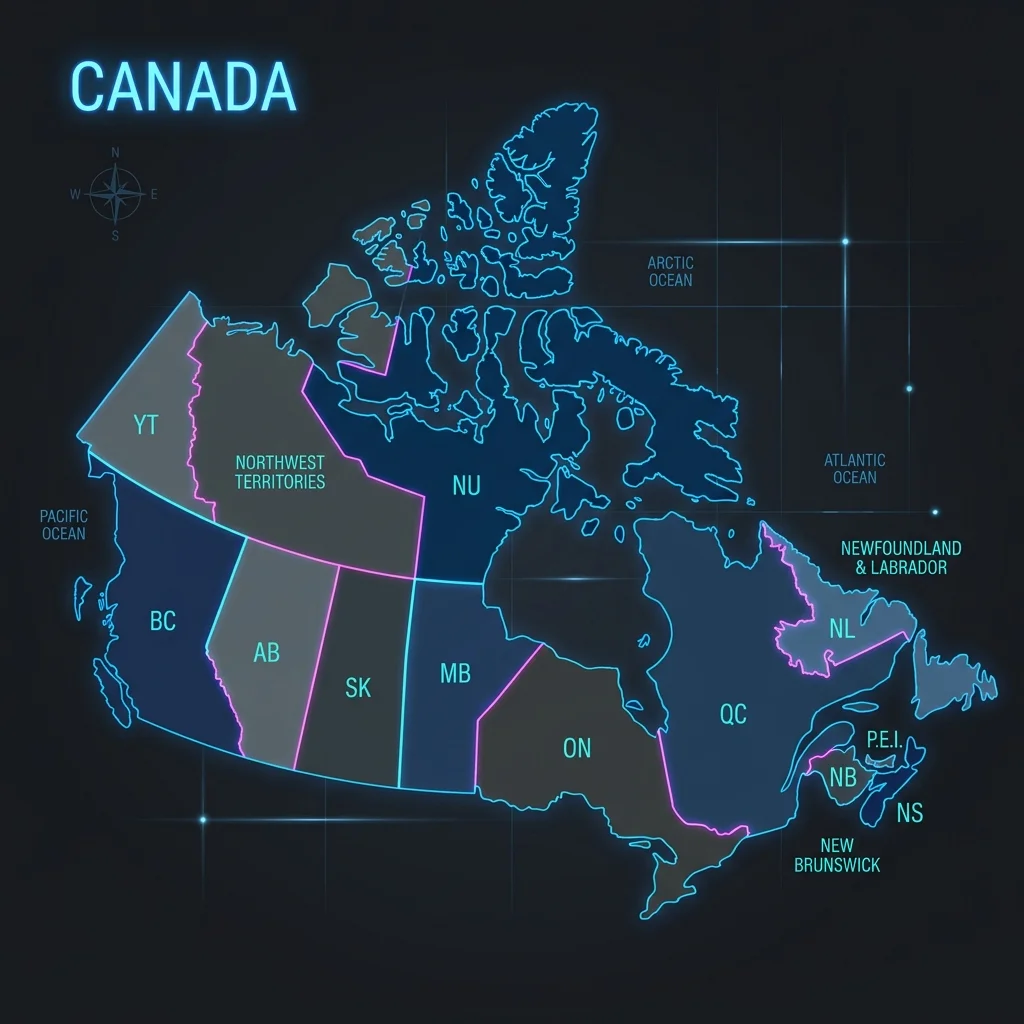
Figure 1: Canada Time Zone Map. A comprehensive visualization of Canada's six standard time zones and their respective boundaries, highlighting regional exceptions and offsets from Coordinated Universal Time (UTC).
Understanding these divisions is essential for cross-country logistics, transportation scheduling, broadcasting, financial operations, and telecommunications.
With the rise of remote work and cloud-based business systems, navigating these offsets has become a daily requirement for professionals and organizations worldwide.
For comparison with neighboring structures, you may also review our comprehensive USA Time Zones guide.
2. History of Canadian Time Zones
Prior to the late 19th century, Canadian communities observed local solar time.
Clocks were set to 12:00 PM when the sun reached its highest point in the sky.
This meant that every town and city had its own unique time.
For example, when it was noon in Toronto, it was 12:12 PM in Montreal and 11:45 AM in Windsor.
While this localized system was sufficient for agricultural communities, the expansion of transcontinental transport made it highly problematic.
Did You Know?
The concept of Standard Time was proposed by a Canadian.
Sir Sandford Fleming, a Scottish-born Canadian engineer and surveyor, was frustrated by a missed train connection in Ireland in 1876.
This led him to propose a worldwide system of 24 standard time zones, each spanning 15 degrees of longitude.
He presented his ideas to the Royal Canadian Institute in Toronto in 1879, laying the foundation for modern global standard time.
The transcontinental railways, particularly the Canadian Pacific Railway (CPR), were the primary drivers of timezone synchronization.
Operating trains across hundreds of local time zones created severe safety hazards and scheduling chaos.
On November 18, 1883, major North American railways unilaterally adopted a standardized system of four time zones (Eastern, Central, Mountain, and Pacific), aligning their schedules with standard meridians.
Figure 4: Canadian Timekeeping History and DST Timeline. Chronology of milestones in Canadian time regulation, from Sandford Fleming's standard time proposal in 1879 to the recent permanent DST adoptions in British Columbia and Alberta in 2026.
Provincial and territorial governments gradually formalized these railway boundaries into law.
Over the decades, boundaries shifted to accommodate regional commerce and transportation corridors.
The creation of Nunavut in 1999 required dividing the new territory across three time zones to allow local administrative hubs to coordinate with national services.
In recent years, the movement to eliminate seasonal clock changes has gained momentum, leading to permanent transitions.
3. Canada's Six Primary Time Zones
Canada's standard time zones are calculated relative to Coordinated Universal Time (UTC), which has replaced Greenwich Mean Time (GMT) as the primary scientific time standard.
Below is a detailed breakdown of each of the six primary zones:
Pacific Time Zone
Standard Offset: UTC-8 (Pacific Standard Time - PST)
Daylight Offset: UTC-7 (Pacific Daylight Time - PDT)
2026 Status: Most of British Columbia observes permanent PDT (UTC-7) year-round.
Major Cities: Vancouver, Victoria, Kelowna, Prince George.
Coverage: The majority of British Columbia.
The Pacific Time Zone covers Canada's West Coast, a major hub for technology, forestry, film production, and international trade.
Because British Columbia transitioned to permanent Pacific Daylight Time (UTC-7) in 2026, residents no longer adjust their clocks.
This keeps Vancouver permanently aligned with Yukon and the western United States.
Business Scheduling Example: A tech company in Vancouver (PDT, UTC-7) coordinating a system deployment with a database team in Toronto (EDT, UTC-4) must account for a 3-hour difference.
A morning scrum scheduled for 9:00 AM PDT in Vancouver occurs at 12:00 PM EDT in Toronto.
For more information on Eastern offsets, see our guide on What is EST.
Travel Example: A traveler boarding a flight from Toronto Pearson (YYZ) at 2:00 PM EDT to Vancouver International (YVR) will fly for approximately 5 hours.
They will arrive in Vancouver at 4:00 PM local time due to the 3-hour time-zone shift, making the trip feel shorter.
Mountain Time Zone
Standard Offset: UTC-7 (Mountain Standard Time - MST)
Daylight Offset: UTC-6 (Mountain Daylight Time - MDT)
2026 Status: Alberta observes permanent MDT (UTC-6) year-round. Yukon observes permanent MST (UTC-7) year-round.
Major Cities: Calgary, Edmonton, Yellowknife, Whitehorse, Inuvik.
Coverage: Alberta, Yukon, Northwest Territories, parts of BC, and Nunavut's Kitikmeot region.
The Mountain Time Zone spans a vast geographical area including the Rocky Mountains, the boreal forests of the Northwest Territories, and the arctic tundra of western Nunavut.
Alberta's transition to permanent Mountain Daylight Time (UTC-6) in 2026 has aligned it year-round with Saskatchewan's Central Standard Time, simplifying agricultural and energy logistics across the prairie border.
This is equivalent to the Eastern Daylight Time (EDT) offset in standard timezone tables.
Business Scheduling Example: An oil and gas consultancy in Calgary (MDT, UTC-6) scheduling a pipeline safety review with a regulatory department in Ottawa (EDT, UTC-4) must coordinate across a 2-hour offset.
A 2:00 PM meeting in Ottawa corresponds to 12:00 PM in Calgary.
Travel Example: Driving from Calgary to Vancouver involves crossing the Rocky Mountains.
Since Alberta is on MDT (UTC-6) and BC is on PDT (UTC-7), travelers cross the border and gain an hour.
Leaving Calgary at 10:00 AM MDT means arriving in Vancouver's timezone corridor at 9:00 AM local equivalent.
Central Time Zone
Standard Offset: UTC-6 (Central Standard Time - CST)
Daylight Offset: UTC-5 (Central Daylight Time - CDT)
2026 Status: Saskatchewan remains on permanent CST (UTC-6) year-round. Manitoba observes seasonal DST changes.
Major Cities: Winnipeg, Regina, Saskatoon, Prince Albert, Brandon.
Coverage: Manitoba, Saskatchewan, northwestern Ontario, and Nunavut's Kivalliq region.
The Central Time Zone represents Canada's agricultural heartland and a major transportation corridor.
Saskatchewan's unique stance of observing CST (UTC-6) year-round means it shares the same time as Manitoba in the winter, but matches Alberta in the summer.
This requires close attention from logistics operators and schedule planners.
Business Scheduling Example: A grain export firm in Winnipeg (CDT, UTC-5 in summer) coordinating shipping timetables with a terminal in Vancouver (PDT, UTC-7) must manage a 2-hour offset.
An 8:00 AM call in Vancouver is 10:00 AM in Winnipeg.
Travel Example: A flight from Winnipeg Richardson (YWG) to Montreal Trudeau (YUL) takes about 2.5 hours.
Because Montreal is in the Eastern Time Zone (1 hour ahead of Winnipeg), a traveler departing Winnipeg at 1:00 PM CDT will arrive in Montreal at 4:30 PM EDT.
Eastern Time Zone
Standard Offset: UTC-5 (Eastern Standard Time - EST)
Daylight Offset: UTC-4 (Eastern Daylight Time - EDT)
2026 Status: Seasonal DST changes are observed in most regions.
Major Cities: Toronto, Montreal, Ottawa, Quebec City, London, Iqaluit.
Coverage: Most of Ontario, most of Quebec, and Nunavut's eastern Qikiqtaaluk region.
The Eastern Time Zone is Canada's economic, political, and cultural center.
It houses the federal government in Ottawa, the financial markets in Toronto, and the corporate headquarters of Montreal.
Eastern Time serves as the primary benchmark for national media broadcasts and financial market hours.
For calculations with UTC, see our detailed UTC vs EST Guide.
Business Scheduling Example: The Toronto Stock Exchange (TSX) operates from 9:30 AM to 4:00 PM Eastern Time.
Brokers in Calgary must begin trading at 7:30 AM Mountain Time to align with the opening bell on Bay Street.
Travel Example: Flying from Toronto (YYZ) to Halifax (YHZ) involves a 1-hour jump forward.
A passenger departing Toronto at 9:00 AM EDT on a 2-hour flight will land in Halifax at 12:00 PM ADT.
Atlantic Time Zone
Standard Offset: UTC-4 (Atlantic Standard Time - AST)
Daylight Offset: UTC-3 (Atlantic Daylight Time - ADT)
2026 Status: Seasonal DST changes are observed in the Maritime provinces. Eastern Quebec (Blanc-Sablon) uses AST year-round.
Major Cities: Halifax, Dartmouth, Moncton, Saint John, Fredericton, Charlottetown.
Coverage: Nova Scotia, New Brunswick, Prince Edward Island, Labrador (except southeastern tip), and easternmost Quebec.
Atlantic Time covers the Maritime provinces and Labrador.
The region is heavily integrated with marine transport, fisheries, and offshore energy.
Atlantic Canada maintains close economic ties with New England in the United States, which uses Eastern Time.
Business Scheduling Example: A shipping coordinator in Halifax (ADT, UTC-3 in summer) scheduling a cargo container pickup with a logistics broker in Chicago (CDT, UTC-5) must manage a 2-hour difference.
A pickup scheduled for 10:00 AM CDT in Chicago occurs at 12:00 PM ADT in Halifax.
Travel Example: Taking the Marine Atlantic ferry from North Sydney, Nova Scotia (ADT) to Port aux Basques, Newfoundland (NDT) involves crossing into a new timezone.
The 7-hour crossing departs Nova Scotia at 11:45 PM ADT and arrives in Newfoundland at 7:15 AM NDT, adding 30 minutes to the clock during the voyage.
Newfoundland Time Zone
Standard Offset: UTC-3:30 (Newfoundland Standard Time - NST)
Daylight Offset: UTC-2:30 (Newfoundland Daylight Time - NDT)
2026 Status: Seasonal DST changes are observed.
Major Cities: St. John's, Mount Pearl, Corner Brook, Gander.
Coverage: The island of Newfoundland and the southeastern tip of Labrador.
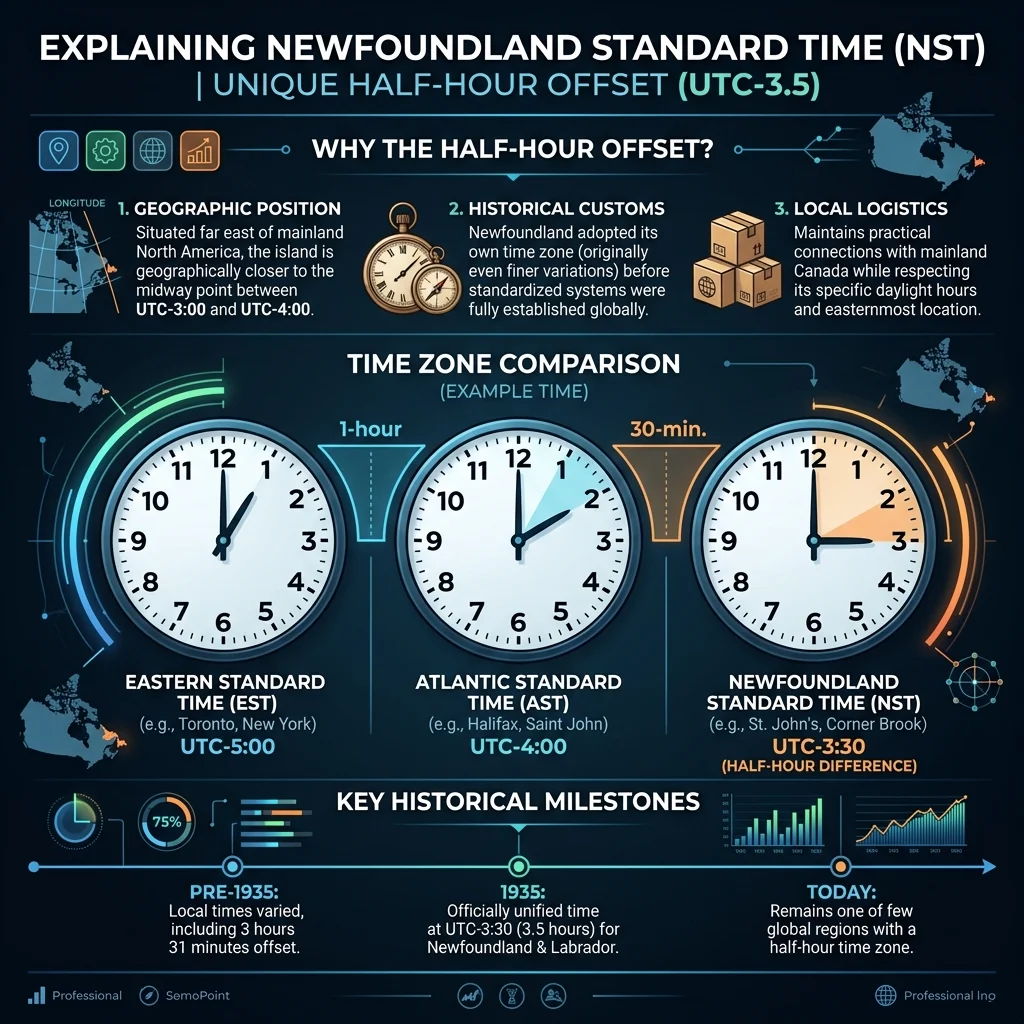
The Newfoundland Time Zone is one of the most famous timezone anomalies in the world due to its half-hour offset.
Prior to joining Canada in 1949, the Dominion of Newfoundland was an independent nation and established its own standard meridian to align local clocks with solar cycles, resulting in a 30-minute shift from Atlantic Time.
Figure 5: Newfoundland Time Explained. Graphical explanation of the historical and geographical reasons behind Newfoundland's unique half-hour offset (UTC-3:30 / UTC-2:30), compared with adjacent Eastern and Atlantic time zones.
Business Scheduling Example: A software developer in St. John's (NDT, UTC-2:30) hosting a training webinar for a client in Vancouver (PDT, UTC-7) must coordinate across a 4.5-hour difference.
To hold the webinar at 10:00 AM PDT for the West Coast client, the developer must schedule it for 2:30 PM NDT local time.
Travel Example: Flying from St. John's (YYT) to Toronto (YYZ) takes about 3 hours.
Because Toronto is 1.5 hours behind St. John's, a traveler departing at 8:00 AM NST will land at 9:30 AM EST, making the flight feel exceptionally short.
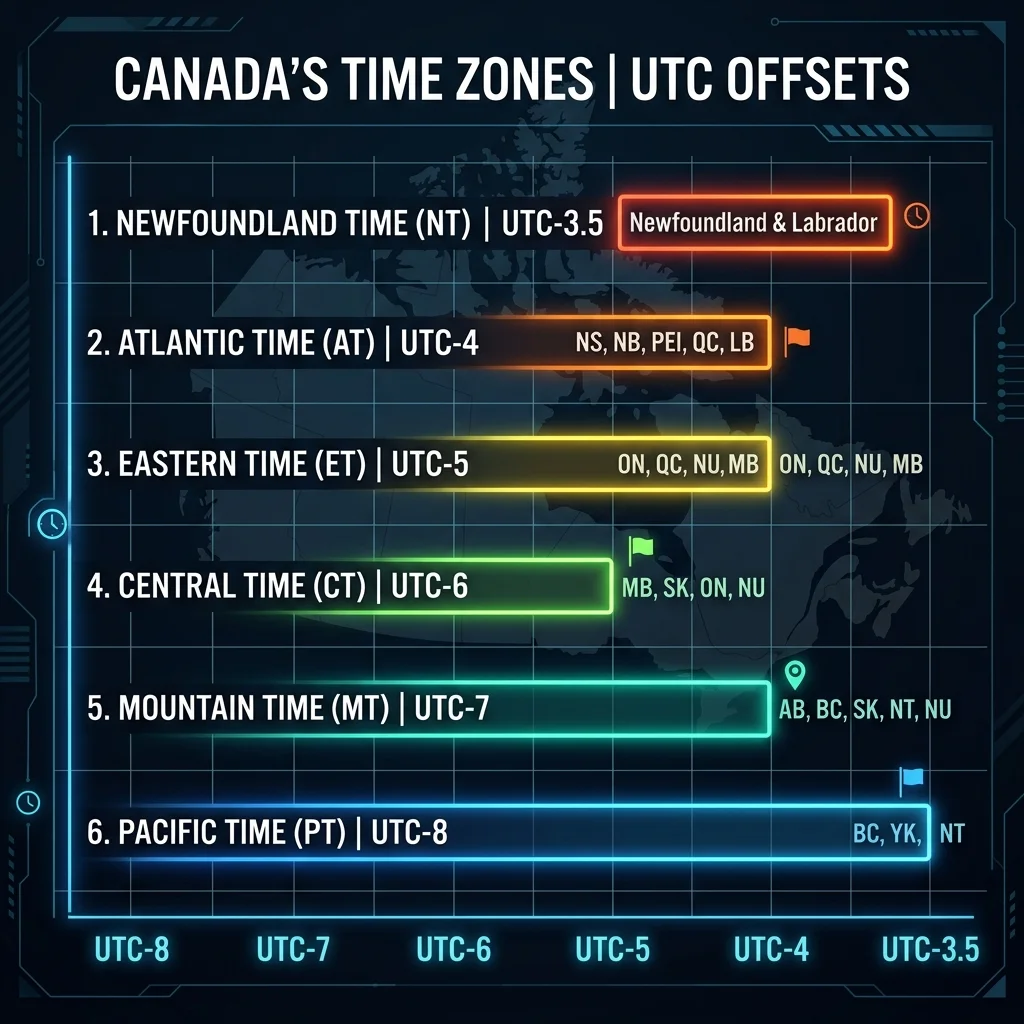
Figure 3: Canadian Time Zones and UTC Offsets. Graphic summary illustrating the transition between standard and daylight saving offsets across all six Canadian time zones.
4. Province & Territory Time Zone Guide
Because time rules are governed locally, it is critical to look at the exact boundaries for each of Canada's ten provinces and three territories:
British Columbia: The vast majority of the province observes permanent Pacific Daylight Time (PDT, UTC-7) year-round. However, the Peace River region (including Dawson Creek) and Creston observe Mountain Standard Time (MST, UTC-7) year-round. The East Kootenay region observes Mountain Time with standard DST shifts.
Alberta: Adopted permanent Mountain Daylight Time (MDT, UTC-6) in 2026, eliminating clock changes. The only exception is Lloydminster, which observes Alberta's standard Mountain Time rules.
Saskatchewan: Observes Central Standard Time (CST, UTC-6) year-round. The border town of Lloydminster is the only major exception, aligning with Alberta's Mountain Time to prevent municipal scheduling division.
Manitoba: Observes Central Time (CST/CDT) and participates in seasonal Daylight Saving Time shifts.
Ontario: The majority of the province east of 90° W longitude observes Eastern Time (EST/EDT) with seasonal DST changes. Northwestern Ontario (including Kenora and Rainy River) uses Central Time (CST/CDT).
Quebec: Most of the province observes Eastern Time (EST/EDT). The Côte-Nord region east of the 63rd meridian W and Blanc-Sablon observe Atlantic Standard Time (AST, UTC-4) year-round, while the Magdalen Islands use Atlantic Time with seasonal changes.
New Brunswick: Observes Atlantic Time (AST/ADT) with standard seasonal DST changes.
Nova Scotia: Observes Atlantic Time (AST/ADT) with standard seasonal DST changes.
Prince Edward Island: Observes Atlantic Time (AST/ADT) with standard seasonal DST changes.
New Newfoundland and Labrador: The island of Newfoundland and the southeastern tip of Labrador observe Newfoundland Time (NST/NDT) with seasonal DST. The remainder of Labrador observes Atlantic Time (AST/ADT).
Yukon: Observes Mountain Standard Time (MST, UTC-7) year-round, which is referred to locally as Yukon Standard Time.
Northwest Territories: Observes Mountain Time (MST/MDT) and participates in seasonal DST shifts.
Nunavut: Spans three time zones: Mountain Time (Kitikmeot region), Central Time (Kivalliq region), and Eastern Time (Qikiqtaaluk region). Coral Harbour remains on EST (UTC-5) year-round.
Figure 2: Provinces & Territories Time Zone Map. Regional breakdown of timezone boundaries and municipal exceptions within individual Canadian provinces and territories.
Province / Territory
Primary Time Zone
Standard Offset
Daylight Offset
DST Observance
British Columbia
Pacific / Mountain
UTC-8 / UTC-7
UTC-7 / UTC-6
Permanent PDT (UTC-7) for most in 2026
Alberta
Mountain
UTC-7
UTC-6
Permanent MDT (UTC-6) as of 2026
Saskatchewan
Central
UTC-6
UTC-6
No (Permanent CST year-round)
Manitoba
Central
UTC-6
UTC-5
Yes (March to November)
Ontario
Eastern / Central
UTC-5 / UTC-6
UTC-4 / UTC-5
Yes (March to November)
Quebec
Eastern / Atlantic
UTC-5 / UTC-4
UTC-4 / UTC-3
Yes (except Blanc-Sablon AST year-round)
New Brunswick
Atlantic
UTC-4
UTC-3
Yes (March to November)
Nova Scotia
Atlantic
UTC-4
UTC-3
Yes (March to November)
Prince Edward Island
Atlantic
UTC-4
UTC-3
Yes (March to November)
Newfoundland & Labrador
Newfoundland / Atlantic
UTC-3:30 / UTC-4
UTC-2:30 / UTC-3
Yes (March to November)
Yukon
Mountain (Yukon Time)
UTC-7
UTC-7
No (Permanent UTC-7 year-round)
Northwest Territories
Mountain
UTC-7
UTC-6
Yes (March to November)
Nunavut
Eastern / Central / Mountain
UTC-5 / -6 / -7
UTC-4 / -5 / -6
Yes (except Coral Harbour EST year-round)
5. Provinces and Territories with Multiple Time Zones
Several Canadian provinces and territories span multiple time zones due to their massive size or local trade patterns.
This requires residents and businesses in those regions to pay close attention to county and municipal boundaries.
Warning: Never assume that a province uses a single time zone.
For example, if you are traveling west from Thunder Bay to Kenora in Ontario, you will cross the 90° W timezone boundary and lose one hour, transitioning from Eastern Time to Central Time.
Ontario's Division
Ontario is divided by the 90th meridian west.
Areas east of this line (including Toronto, Ottawa, and Thunder Bay) observe Eastern Time.
Areas west of this line (including Kenora, Rainy River, and Dryden) observe Central Time, keeping them synchronized with neighboring Manitoba, which is their primary trading partner.
British Columbia's Regional Offsets
Although British Columbia uses Pacific Time as its primary standard, eastern sections of the province are aligned with Mountain Time.
The Peace River region (including Dawson Creek) remains on Mountain Standard Time (UTC-7) year-round.
This aligns them with Pacific Daylight Time in the summer and Alberta's Mountain Time in the winter.
The town of Creston also observes MST year-round, while the East Kootenay region (including Cranbrook) follows standard Mountain Time with DST shifts.
Quebec's Atlantic Strip
While the vast majority of Quebec uses Eastern Time, the Côte-Nord region east of the 63rd meridian W (including Blanc-Sablon and the Magdalen Islands) uses Atlantic Time.
Blanc-Sablon remains on Atlantic Standard Time (UTC-4) year-round, meaning it does not observe seasonal clock changes.
6. Daylight Saving Time (DST) in Canada
Daylight Saving Time (DST) was first introduced in Canada during World War I to conserve coal and electricity.
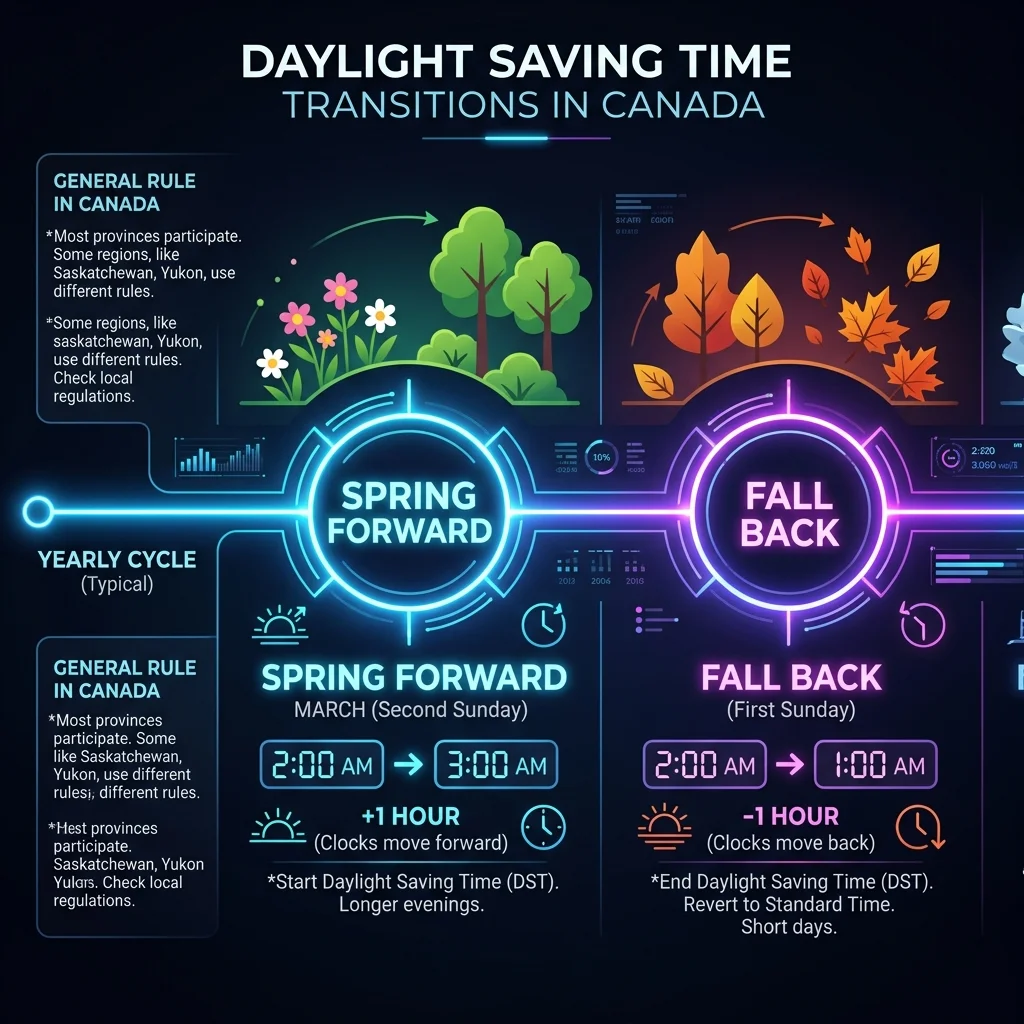
Today, in the areas that observe seasonal shifts, DST begins on the second Sunday of March and ends on the first Sunday of November.
On the second Sunday of March at 2:00 AM, clocks "spring forward" one hour to 3:00 AM.
On the first Sunday of November at 2:00 AM, clocks "fall back" one hour to 1:00 AM.
To understand this concept further, read our guide on Daylight Saving Time Explained.
However, the practice of changing clocks has faced growing public opposition.
In 2020, Yukon eliminated seasonal clock changes.
In 2026, British Columbia and Alberta followed suit, adopting permanent Pacific Daylight Time (PDT, UTC-7) and permanent Mountain Daylight Time (MDT, UTC-6) respectively.
This has created a new timezone landscape in Western Canada.
You can read a detailed EST vs EDT comparison to see how standard and daylight timings compare globally.
Region
Standard Offset (Winter)
Daylight Offset (Summer)
DST Active?
BC (Populated Areas)
UTC-7 (Permanent)
UTC-7 (Permanent)
No (Permanent PDT)
Alberta
UTC-6 (Permanent)
UTC-6 (Permanent)
No (Permanent MDT)
Saskatchewan
UTC-6 (Permanent)
UTC-6 (Permanent)
No (Permanent CST)
Yukon
UTC-7 (Permanent)
UTC-7 (Permanent)
No (Permanent MST)
Ontario (Toronto)
UTC-5 (EST)
UTC-4 (EDT)
Yes (March to November)
Quebec (Montreal)
UTC-5 (EST)
UTC-4 (EDT)
Yes (March to November)
Manitoba (Winnipeg)
UTC-6 (CST)
UTC-5 (CDT)
Yes (March to November)
7. Canada Time Zone Map Explained
A close examination of the Canadian timezone map reveals how boundaries are drawn to keep regional economic centers in sync.
Rather than drawing straight vertical lines, boundaries curve around municipal borders to prevent local commercial division.
For example, the boundary between Central and Eastern Time in Ontario runs just west of Shebandowan and Upsala, allowing major regional forestry and mining communities to remain on the same time as Thunder Bay.
Similarly, in Nunavut, timezone boundaries are aligned with the borders of the territory's three administrative regions (Kitikmeot, Kivalliq, and Qikiqtaaluk) to prevent administrative confusion.
Travel Tip: If you are planning a road trip across Canada via the Trans-Canada Highway, you will cross five timezone boundaries.
Be prepared to adjust your watch and dashboard clocks when crossing between British Columbia, Alberta, Saskatchewan, Manitoba, Ontario, Quebec, New Brunswick, and Newfoundland.
8. Canada and International Time Zones
Canada's time zones are highly integrated with international trade corridors, particularly with the United States.
Below are comparative tables illustrating how key Canadian cities align with international hubs:
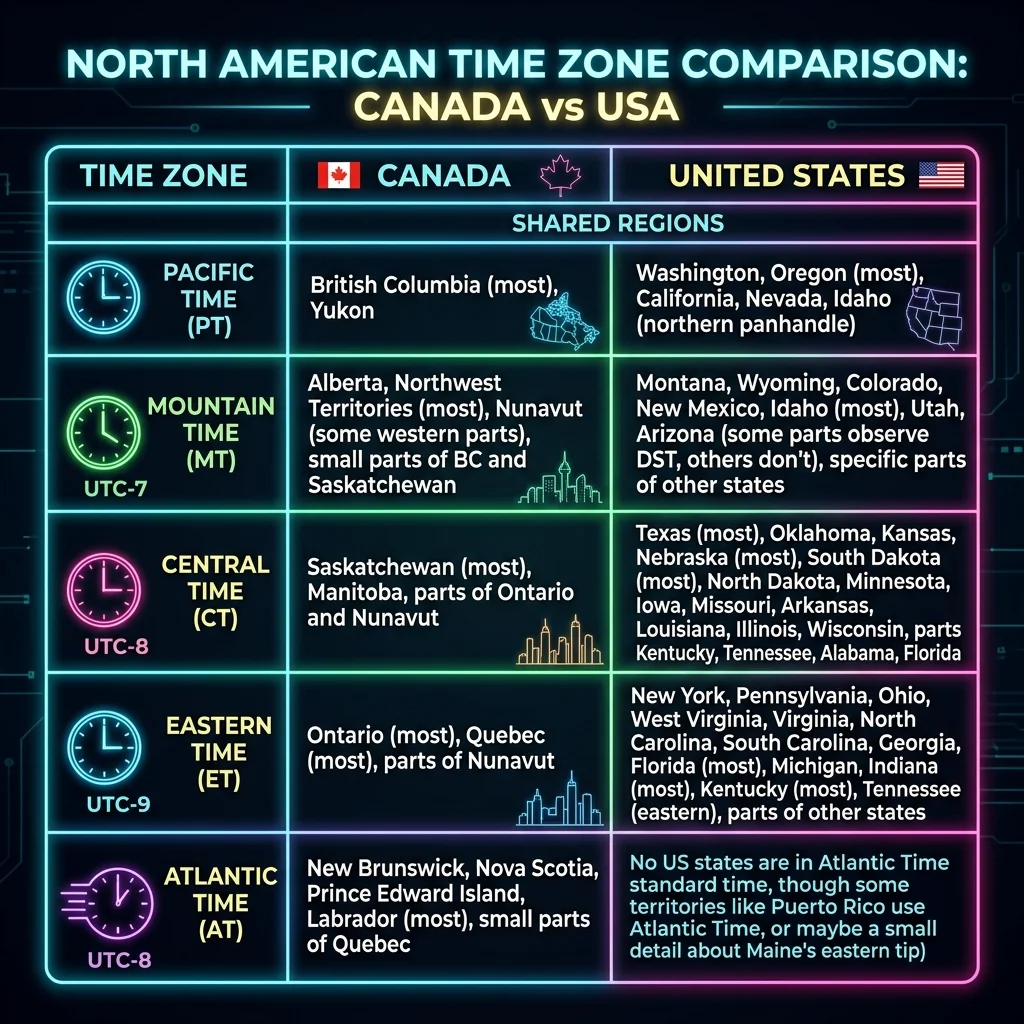
Figure 6: Canada and United States Time Zone Alignment. Graphic comparison matching major Canadian cities with US timezone corridors, outlining how seasonal DST changes impact cross-border schedules.
Canada vs USA Time Zones
Cross-border business operations frequently depend on direct alignment with American corridors.
For a complete mapping of US regions, refer to our USA Time Zones guide.
Canadian City
Local Time Zone
US Equivalent City
Standard Offset
Daylight Offset
Vancouver
Pacific Time
Seattle / Los Angeles
UTC-8
UTC-7
Calgary
Mountain Time
Denver / Salt Lake City
UTC-7
UTC-6
Winnipeg
Central Time
Chicago / Minneapolis
UTC-6
UTC-5
Toronto
Eastern Time
New York / Boston
UTC-5
UTC-4
Halifax
Atlantic Time
Puerto Rico (AST year-round)
UTC-4
UTC-3
Canada vs Major Global Hubs
Canadian City
London (GMT/BST)
Paris (CET/CEST)
Sydney (AEST/AEDT)
Tokyo (JST)
Vancouver (PDT, UTC-7)
London is 8 hrs ahead
Paris is 9 hrs ahead
Sydney is 17 hrs ahead
Tokyo is 16 hrs ahead
Toronto (EDT, UTC-4)
London is 5 hrs ahead
Paris is 6 hrs ahead
Sydney is 14 hrs ahead
Tokyo is 13 hrs ahead
St. John's (NDT, UTC-2:30)
London is 3.5 hrs ahead
Paris is 4.5 hrs ahead
Sydney is 12.5 hrs ahead
Tokyo is 11.5 hrs ahead
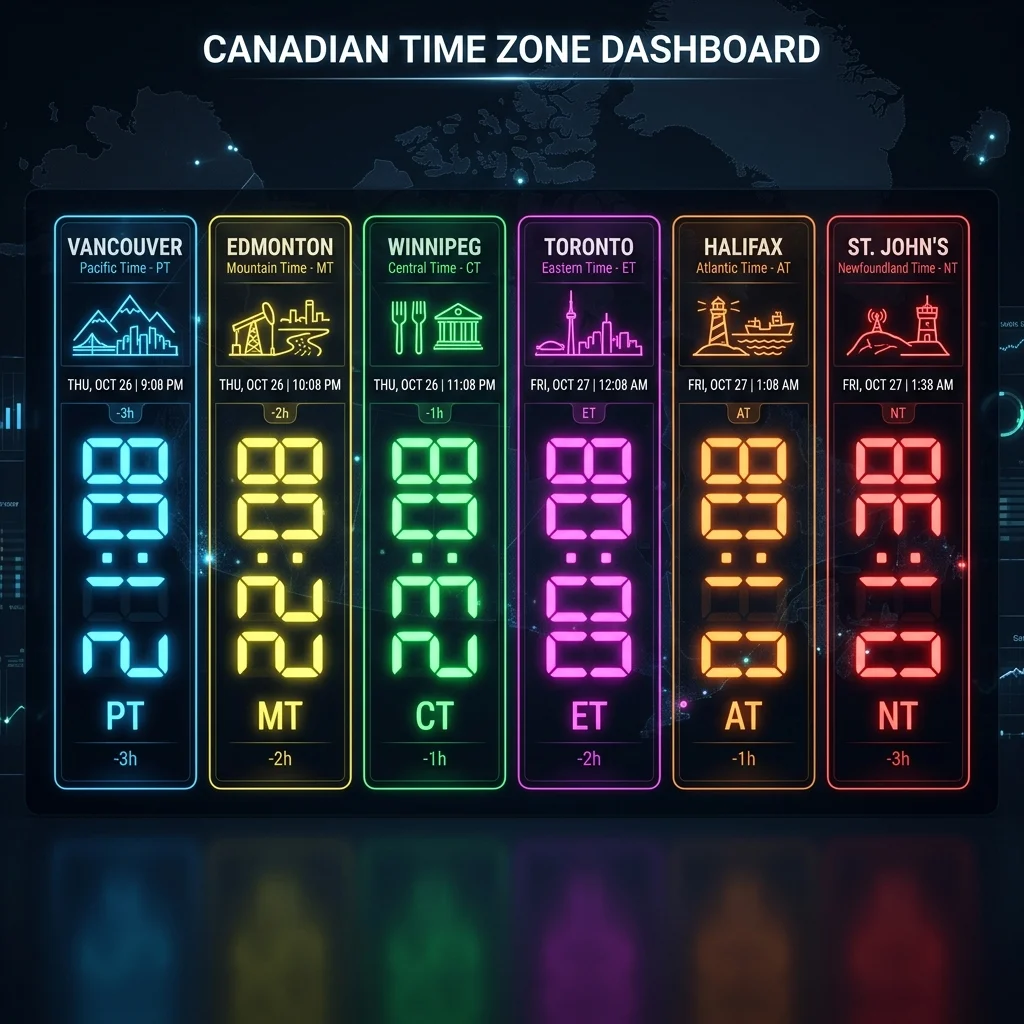
Figure 10: Canadian Cities Time Comparison Dashboard. Comparative clock dashboard showing local times in Vancouver, Edmonton, Winnipeg, Toronto, Halifax, and St. John's simultaneously.
9. Business Operations Across Canadian Time Zones
Operating a business across a country that spans six time zones requires robust scheduling systems, clear communication policies, and flexible hours for remote teams.
Key industry sectors face distinct operational challenges:
Figure 7: Business Meeting Coordination Across Canada. Illustration showing the optimal business meeting overlap windows for teams distributed across Vancouver, Calgary, Toronto, and Halifax.
Remote Work: Organizations with employees in Vancouver and Halifax must manage a 4-hour time difference.
To prevent meeting fatigue, companies often establish core collaboration hours (e.g., 12:00 PM to 4:00 PM Eastern Time), allowing all team members to participate during their standard working hours.
Customer Support: National service providers must structure support shifts to cover the "8-to-8" window.
A support center operating from 8:00 AM Eastern Time in Toronto will only cover customers up to 5:00 PM Pacific Time in Vancouver.
Staffing support teams across multiple regional hubs is the standard solution.
Banking and Financial Markets: The Toronto Stock Exchange (TSX) sets the national pace.
Banking transactions and clearing services must align with Eastern Time hours.
West Coast commercial clients must finalize their wire transfers and major transactions before the early afternoon cut-off times.
Healthcare and Logistics: National telemedicine networks and courier services (like Canada Post or Purolator) use Coordinated Universal Time (UTC) or Eastern Time as their core logistics standard to track package flows and coordinate overnight air freight schedules.
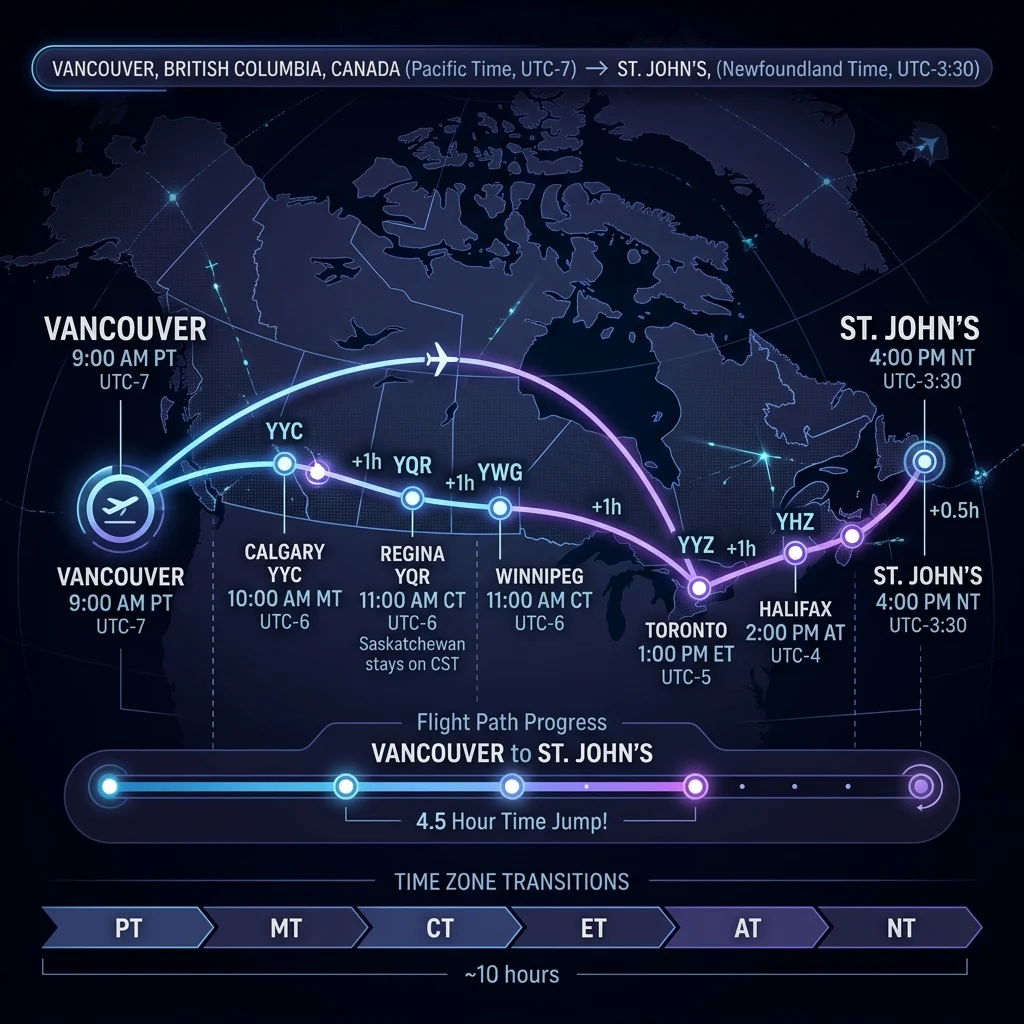
Figure 8: Cross-Canada Travel and Transit Timeline. Visual walkthrough of timezone transitions and local time adjustments experienced during transcontinental travel from Vancouver (Pacific Time) to St. John's (Newfoundland Time).
10. Programming & Technology Guidelines
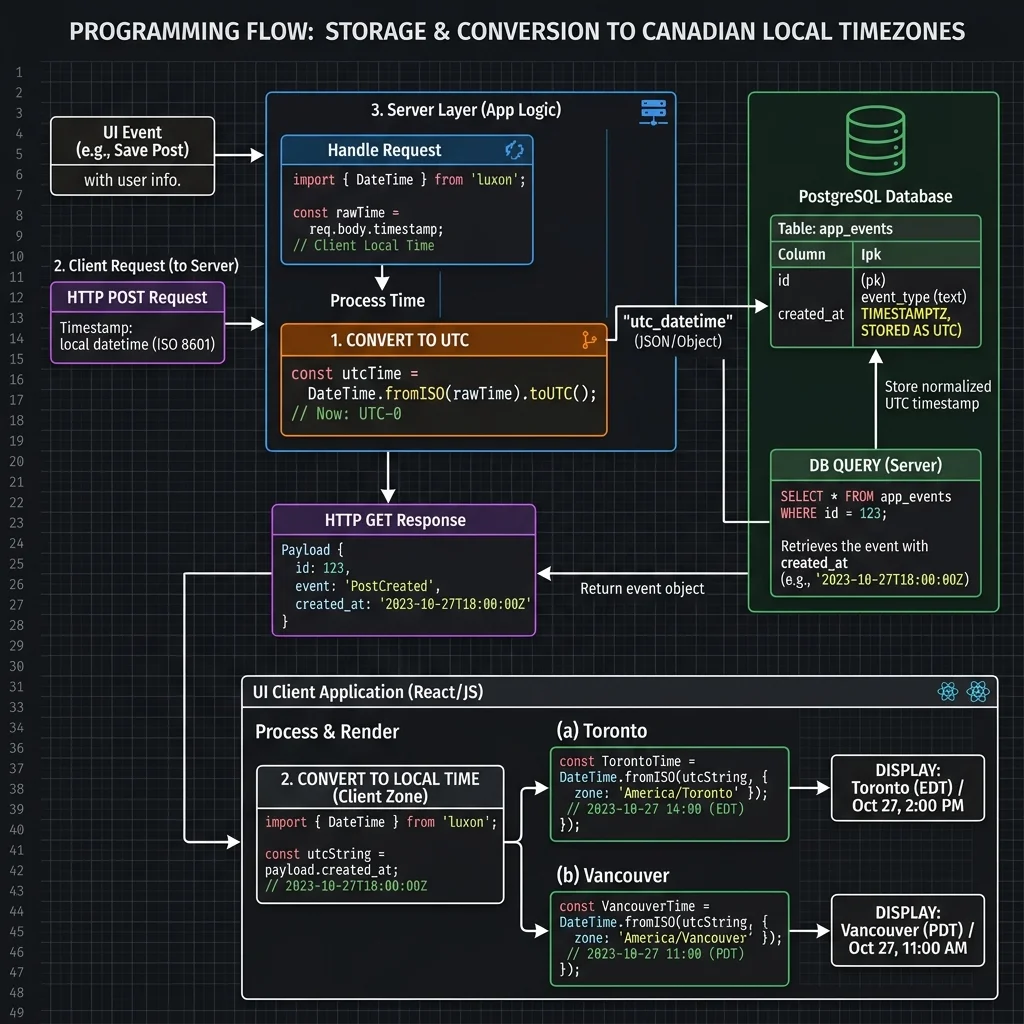
In software development, managing Canadian time zones requires strict adherence to international standards to prevent scheduling bugs, data corruption, and logging errors.
This is especially critical due to the regional exceptions and permanent DST adoptions in BC and Alberta.
Figure 9: Developer Timezone Database Workflow. Structural diagram demonstrating the best practice of storing timezone-agnostic Coordinated Universal Time (UTC) in databases and translating to local IANA zone names in user interfaces.
1. Database Storage
Always store timestamps in Coordinated Universal Time (UTC).
Use the standard ISO 8601 format: `YYYY-MM-DDTHH:MM:SSZ`.
Avoid storing local times directly in database fields, as this makes queries across different provinces nearly impossible.
2. Use IANA Time Zone Identifiers
Do not hardcode offsets (like -5 or -8) in your codebase.
Offsets change seasonally and legislatively. Instead, use the official IANA Time Zone Database names.
Examples for Canada include:
`America/Vancouver` (Pacific Time)
`America/Edmonton` (Mountain Time)
`America/Regina` (Saskatchewan Central Time)
`America/Winnipeg` (Central Time)
`America/Toronto` (Eastern Time)
`America/Halifax` (Atlantic Time)
`America/St_Johns` (Newfoundland Time)
3. JavaScript Localization Example
To display a database UTC timestamp in Toronto's local time, utilize the native `Intl.DateTimeFormat` API:
const utcDate = new Date('2026-07-15T12:00:00Z');
const formatter = new Intl.DateTimeFormat('en-CA', {
  timeZone: 'America/Toronto',
  dateStyle: 'medium',
  timeStyle: 'long'
});
console.log(formatter.format(utcDate));
// Output will render in Toronto local time (EDT)
11. Common Time Zone Mistakes to Avoid
Working and traveling across Canada involves navigating several unique timezone rules.
Avoid these common pitfalls:
Neglecting the 30-minute Newfoundland Offset: Many automated schedulers and developers forget that Newfoundland Time uses a half-hour offset.
If you schedule a national meeting and assume all offsets are in whole hours, you will exclude participants in St. John's.
Assuming Saskatchewan Changes Clocks: Saskatchewan remains on Central Standard Time (CST) year-round.
Do not send calendar invites that automatically shift Saskatchewan participants' clocks in March or November.
Confusing Border Town Rules: Double-check municipal rules for border communities.
For example, Lloydminster uses Mountain Time to align with Alberta, even though it is physically located on the Saskatchewan border.
Ignoring Ontario's 90° W Split: If you are coordinating with teams in northwestern Ontario, remember they are in the Central Time Zone, while the rest of the province is in the Eastern Time Zone.
12. Frequently Asked Questions (FAQ)
Review these comprehensive answers to resolve common questions about Canadian time zones, standard offsets, and transitions:
How many time zones does Canada have?
Canada spans six primary standard time zones: Pacific Time (UTC-8), Mountain Time (UTC-7), Central Time (UTC-6), Eastern Time (UTC-5), Atlantic Time (UTC-4), and Newfoundland Time (UTC-3:30). However, due to regional exceptions and local legislation (such as British Columbia and Alberta adopting permanent DST, and Saskatchewan remaining on standard time year-round), the country features several distinct time zones and local offsets.
Which Canadian provinces observe Daylight Saving Time?
As of 2026, the provinces that observe seasonal Daylight Saving Time (DST) changes are Manitoba, Ontario, Quebec, New Brunswick, Nova Scotia, Prince Edward Island, and Newfoundland and Labrador. British Columbia (most parts) and Alberta have adopted permanent DST (PDT/UTC-7 and MDT/UTC-6 year-round), while Saskatchewan, Yukon, and certain local municipalities do not adjust their clocks.
Why does Saskatchewan not change its clocks?
Under the Time Act of 1966, Saskatchewan officially adopted Central Standard Time (CST, UTC-6) year-round. This keeps the province aligned with neighboring Manitoba during the winter months and Alberta during the summer, eliminating twice-yearly clock shifts. The only major exception is the border city of Lloydminster, which synchronizes with Alberta's Mountain Time.
What is the time difference between Toronto (Eastern Time) and Vancouver (Pacific Time)?
Generally, Toronto is 3 hours ahead of Vancouver. For example, when it is 12:00 PM in Vancouver, it is 3:00 PM in Toronto. Because British Columbia (including Vancouver) observes permanent Pacific Daylight Time (PDT, UTC-7) year-round, while Toronto observes Eastern Standard Time (EST, UTC-5) in the winter and Eastern Daylight Time (EDT, UTC-4) in the summer, the offset can vary. During the winter (when Toronto is on EST), the difference narrows to 2 hours.
Does Yukon observe Daylight Saving Time?
No. In 2020, Yukon permanently transitioned to Mountain Standard Time (MST, UTC-7) year-round, meaning it does not observe seasonal Daylight Saving Time. This aligns Yukon's time permanently with Pacific Daylight Time (PDT) observed in neighboring British Columbia.
What is the Newfoundland Time Zone half-hour offset?
Newfoundland Standard Time (NST) is UTC-3:30, and Newfoundland Daylight Time (NDT) is UTC-2:30. This unique half-hour offset exists for historical reasons: prior to joining the Canadian Confederation in 1949, Newfoundland was an independent dominion and chose to set its clock exactly in the middle of the Atlantic Time Zone (UTC-4) and the ocean meridian.
Which parts of British Columbia do not observe Daylight Saving Time?
While most of British Columbia observes permanent PDT, the Peace River region (including Dawson Creek and Fort St. John) and the town of Creston observe Mountain Standard Time (MST, UTC-7) year-round. Additionally, the East Kootenay region (including Cranbrook and Golden) observes Mountain Time with standard DST shifts.
What timezone does Nunavut use?
Nunavut is so geographically expansive that it spans three different time zones: Mountain Time (UTC-7/-6) in the Kitikmeot region, Central Time (UTC-6/-5) in the Kivalliq region, and Eastern Time (UTC-5/-4) in the Qikiqtaaluk region (including the capital, Iqaluit).
Does Quebec have multiple time zones?
Yes. Most of Quebec observes Eastern Time (EST/EDT). However, areas east of the 63rd meridian W (such as the Côte-Nord region and Blanc-Sablon) observe Atlantic Standard Time (AST, UTC-4) year-round, while the Magdalen Islands observe Atlantic Time with standard DST changes.
What timezone is observed in Lloydminster, Saskatchewan?
Lloydminster is a border city split between Saskatchewan and Alberta. By municipal charter, the Saskatchewan portion of Lloydminster legally observes Mountain Time (MST/MDT) and shifts clocks with Alberta, rather than using Saskatchewan's year-round CST.
Which time zone is observed in Kenora and northwestern Ontario?
Ontario west of 90° West longitude (including Kenora, Rainy River, and Dryden) observes Central Time (CST/CDT), keeping clocks aligned with neighboring Manitoba. The rest of Ontario observes Eastern Time.
How does Daylight Saving Time work in Nunavut?
Nunavut follows standard Canadian DST transition dates in most of its territory. However, Coral Harbour (Southampton Island) remains on Eastern Standard Time (EST, UTC-5) year-round and does not observe Daylight Saving Time.
What is the difference between EST and EDT in Canada?
EST stands for Eastern Standard Time (UTC-5), which is observed during the winter months. EDT stands for Eastern Daylight Time (UTC-4), which is observed during the spring and summer months when Daylight Saving Time is active.
How do BC and Alberta's 2026 permanent DST laws affect offsets?
With British Columbia adopting permanent Pacific Daylight Time (PDT, UTC-7) and Alberta adopting permanent Mountain Daylight Time (MDT, UTC-6) in 2026, both provinces no longer change their clocks. This means BC remains at UTC-7 year-round (matching Yukon) and Alberta remains at UTC-6 year-round (matching Saskatchewan).
What are the official start and end dates for DST in Canada?
For regions that observe seasonal clock changes, DST starts on the second Sunday of March (clocks go forward one hour at 2:00 a.m.) and ends on the first Sunday of November (clocks go back one hour at 2:00 a.m.).
How do Canadian and US time zones align?
Canada and the US share five major time zones: Pacific, Mountain, Central, Eastern, and Atlantic. They synchronize DST change dates, although regional exemptions (like Arizona in the US or Saskatchewan in Canada) remain distinct.
What timezone does Coral Harbour (Southampton Island) observe?
Coral Harbour observes Eastern Standard Time (EST, UTC-5) year-round. Because it does not observe DST, its clocks align with New York and Toronto during winter, and Chicago during summer.
Who regulates time zones in Canada?
Time zone boundaries and Daylight Saving Time rules in Canada are regulated by provincial and territorial governments under their constitutional authority over municipal institutions and local matters.
How does the 24-hour clock compare to military time in Canada?
The 24-hour clock is widely used in Canada for logistics, transportation, and military operations. It formats time from 00:00 to 23:59. Military time uses the same 24-hour basis but omits the colon (e.g., 1430 instead of 14:30) and appends a timezone letter (e.g., 'R' for Eastern Standard Time).
What is the best way to handle Canadian time zones in databases?
The industry best practice is to store all timestamps in Coordinated Universal Time (UTC) using ISO 8601 format (`YYYY-MM-DDTHH:MM:SSZ`) and use the IANA Time Zone database names (such as `America/Toronto` or `America/Vancouver`) to format times locally for users.
Understanding these details is critical for web development, server coordination, international business operations, and general navigation. Utilizing standard international time formats (such as the 24-hour clock and ISO 8601 specifications) guarantees that your schedules, communications, and database logs remain accurate and free from timezone errors.
Explore Time Zone Converters & Guides
Use our free, daylight-saving-aware tools to calculate Canadian offsets and schedule meetings across regions: