
GMT to EST Day and night rhythm
See why GMT business hours land later in the Eastern day.
UTC+0 Standard Baseline
Current Active Offset: ET
Welcome to the authoritative, flagship GMT to EST Converter portal. This resource and our comprehensive Time Zone Guide are designed as a comprehensive pillar reference for Greenwich Mean Time (GMT, UTC+0, which is closely compared in our GMT vs UTC section) and North American Eastern Standard Time (EST, UTC-5) / Eastern Daylight Time (EDT, UTC-4).
Understanding timezone offsets is critical for international business, software deployments, and remote collaboration. Because Eastern Time transitions between standard time (GMT to EST or EST) and daylight saving time (EST to GMT or EDT) twice a year, a static converter can lead to scheduling errors. Our interactive tool resolves these challenges by dynamically detecting the correct offset using the IANA Time Zone Database. For adjacent North American regions, you can also access our specialized CST to EST Converter and CDT to EST Converter.
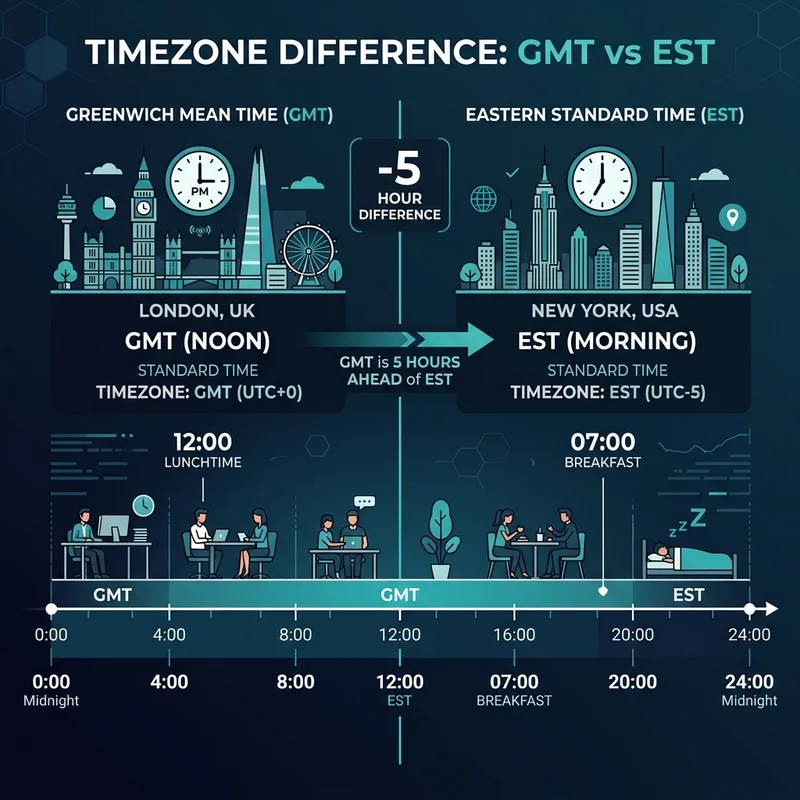
Figure 1: Visual timeline comparison showing Greenwich Mean Time (GMT) baseline against Eastern Standard Time (EST) offset difference.
This timeline chart visualizes the 5-hour gap between London (GMT/UTC+0) and New York (EST/UTC-5). Subtracting 5 hours from Greenwich time calculates the U.S. East Coast local clock time during standard winter months.

Figure 2: Global timezone connection corridor demonstrating the geographic link between London (GMT) and Eastern Standard Time regions.
The meridian link establishes the primary path for transatlantic data, financial trading, and commerce between Western Europe and North America's Eastern Time zone.
Select a date and time below to convert between Greenwich Mean Time (GMT) and Eastern Standard Time (EST) or Eastern Daylight Time (EDT). The calculator automatically detects daylight saving rules based on the selected date.
Toggle between 12-hour and 24-hour formats, copy results to your clipboard, and share schedules with your remote teams.
Visual planner
See why GMT business hours land later in the Eastern day.
The offset changes between 5 hours and 4 hours when Eastern Time uses daylight saving.
Scan useful windows before you send a calendar invite.
Many people search for "EST" as a catch-all term for the U.S. and Canadian Eastern Time zone. However, Eastern Standard Time (EST) specifically refers to the winter offset of UTC-5. During the summer, the region transitions to Eastern Daylight Time (EDT), which operates at UTC-4.
Our converter automatically handles this shift based on the chosen date. Below is a summary of the offsets and transition rules:
GMT - 5 Hours Active during winter. Highlights the standard difference between Greenwich and the East Coast.
GMT - 4 Hours Active during summer. Clocks shift forward to extend evening daylight.
March & November Daylight saving transitions occur at 2:00 AM local time, shifting the offset by 1 hour.
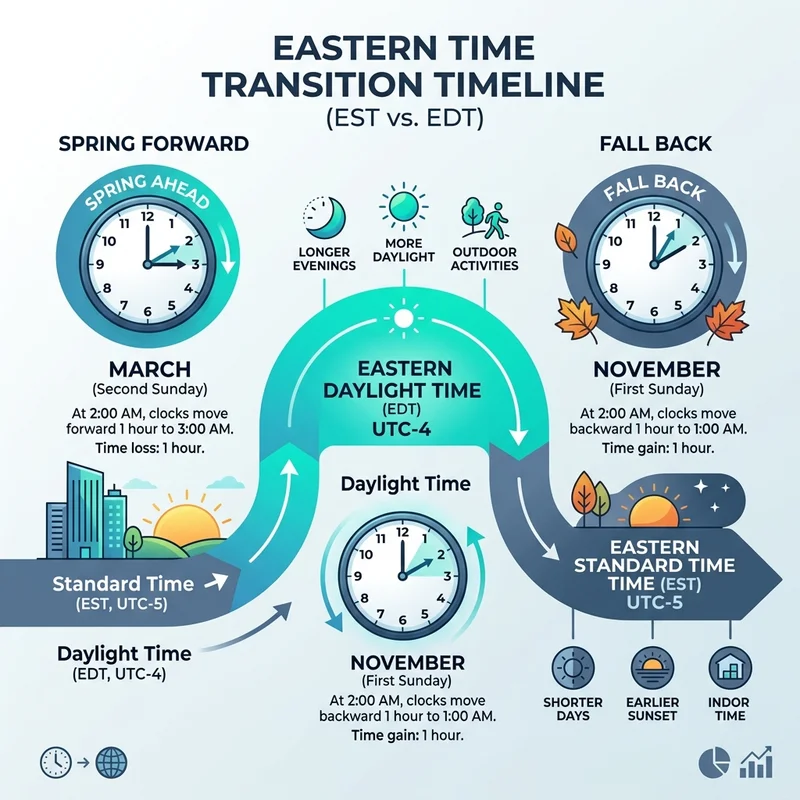
Figure 3: Detailed shift calendar showing the transition weeks in March (Spring Forward to EDT) and November (Fall Back to EST).
Twice a year, North American Eastern Time transitions: standard winter hours operate at UTC-5 (EST), while daylight saving summer hours operate at UTC-4 (EDT), altering the relative difference with GMT.
The following table outlines the exact equivalent times between Coordinated Universal Time (UTC)/Greenwich Mean Time (GMT) and Eastern Standard Time (EST) and Eastern Daylight Time (EDT).
Below is a quick lookup reference for the most popular user search queries involving Greenwich Mean Time (GMT) to Eastern Standard Time (EST, UTC-5) and Eastern Daylight Time (EDT, UTC-4), including 12-hour AM/PM formats, half-hour increments, and 24-hour military notation (0000, 0200, 0400, 0500, 0635, 0700, 1000 GMT).
| Greenwich Mean Time (GMT) | Eastern Standard Time (EST) | Eastern Daylight Time (EDT) |
|---|---|---|
| 12:00 AM | 7:00 PM EST (Previous day) | 8:00 PM EDT (Previous day) |
| 1:00 AM | 8:00 PM EST (Previous day) | 9:00 PM EDT (Previous day) |
| 2:00 AM | 9:00 PM EST (Previous day) | 10:00 PM EDT (Previous day) |
| 3:00 AM | 10:00 PM EST (Previous day) | 11:00 PM EDT (Previous day) |
| 4:00 AM | 11:00 PM EST (Previous day) | 12:00 AM EDT (Same day) |
| 5:00 AM | 12:00 AM EST (Same day) | 1:00 AM EDT (Same day) |
| 6:00 AM | 1:00 AM EST (Same day) | 2:00 AM EDT (Same day) |
| 7:00 AM | 2:00 AM EST (Same day) | 3:00 AM EDT (Same day) |
| 8:00 AM | 3:00 AM EST (Same day) | 4:00 AM EDT (Same day) |
| 9:00 AM | 4:00 AM EST (Same day) | 5:00 AM EDT (Same day) |
| 10:00 AM | 5:00 AM EST (Same day) | 6:00 AM EDT (Same day) |
| 11:00 AM | 6:00 AM EST (Same day) | 7:00 AM EDT (Same day) |
| 12:00 PM | 7:00 AM EST (Same day) | 8:00 AM EDT (Same day) |
| 1:00 PM | 8:00 AM EST (Same day) | 9:00 AM EDT (Same day) |
| 2:00 PM | 9:00 AM EST (Same day) | 10:00 AM EDT (Same day) |
| 3:00 PM | 10:00 AM EST (Same day) | 11:00 AM EDT (Same day) |
| 4:00 PM | 11:00 AM EST (Same day) | 12:00 PM EDT (Same day) |
| 5:00 PM | 12:00 PM EST (Same day) | 1:00 PM EDT (Same day) |
| 6:00 PM | 1:00 PM EST (Same day) | 2:00 PM EDT (Same day) |
| 7:00 PM | 2:00 PM EST (Same day) | 3:00 PM EDT (Same day) |
| 8:00 PM | 3:00 PM EST (Same day) | 4:00 PM EDT (Same day) |
| 9:00 PM | 4:00 PM EST (Same day) | 5:00 PM EDT (Same day) |
| 10:00 PM | 5:00 PM EST (Same day) | 6:00 PM EDT (Same day) |
| 11:00 PM | 6:00 PM EST (Same day) | 7:00 PM EDT (Same day) |
| GMT Time (12-Hour / 24-Hour Military) | Eastern Standard Time (EST, UTC-5) | Eastern Daylight Time (EDT, UTC-4) | Context & Practical Use Case |
|---|---|---|---|
| 12:00 AM GMT (0000 GMT) | 7:00 PM EST (Prev Day) | 8:00 PM EDT (Prev Day) | Midnight Greenwich baseline; US East Coast evening relax time. |
| 1:00 AM GMT (0100 GMT) | 8:00 PM EST (Prev Day) | 9:00 PM EDT (Prev Day) | European overnight server backup window. |
| 2:00 AM GMT (0200 GMT) | 9:00 PM EST (Prev Day) | 10:00 PM EDT (Prev Day) | Early European batch processing & Asian pre-market prep. |
| 4:00 AM GMT (0400 GMT) | 11:00 PM EST (Prev Day) | 12:00 AM EDT (Midnight) | European exchange pre-opening routines. |
| 5:00 AM GMT (0500 GMT) | 12:00 AM EST (Midnight) | 1:00 AM EDT | London early morning desk preparation. |
| 6:35 AM GMT (0635 GMT) | 1:35 AM EST | 2:35 AM EDT | Aviation departure slot & maritime shipping sync. |
| 7:00 AM GMT (0700 GMT) | 2:00 AM EST | 3:00 AM EDT | London financial morning wake-up & market prep. |
| 10:00 AM GMT (1000 GMT) | 5:00 AM EST | 6:00 AM EDT | UK mid-morning business & US East Coast early riser sync. |
| 10:30 AM GMT | 5:30 AM EST | 6:30 AM EDT | Mid-morning UK coffee break & morning report distribution. |
| 12:00 PM GMT (1200 GMT) | 7:00 AM EST | 8:00 AM EDT | London noon lunch start; US East Coast workday kickoff. |
| 1:00 PM GMT (1300 GMT) | 8:00 AM EST | 9:00 AM EDT | Peak transatlantic business meeting window opens. |
| 10:00 PM GMT (2200 GMT) | 5:00 PM EST | 6:00 PM EDT | London night telemetry; US East Coast office close. |
| 10:30 PM GMT | 5:30 PM EST | 6:30 PM EDT | Late-night UK maintenance & US East Coast evening shift wrap. |
Review these reference examples to understand how specific hours translate between Greenwich and Eastern Time, with specific context-rich use cases:
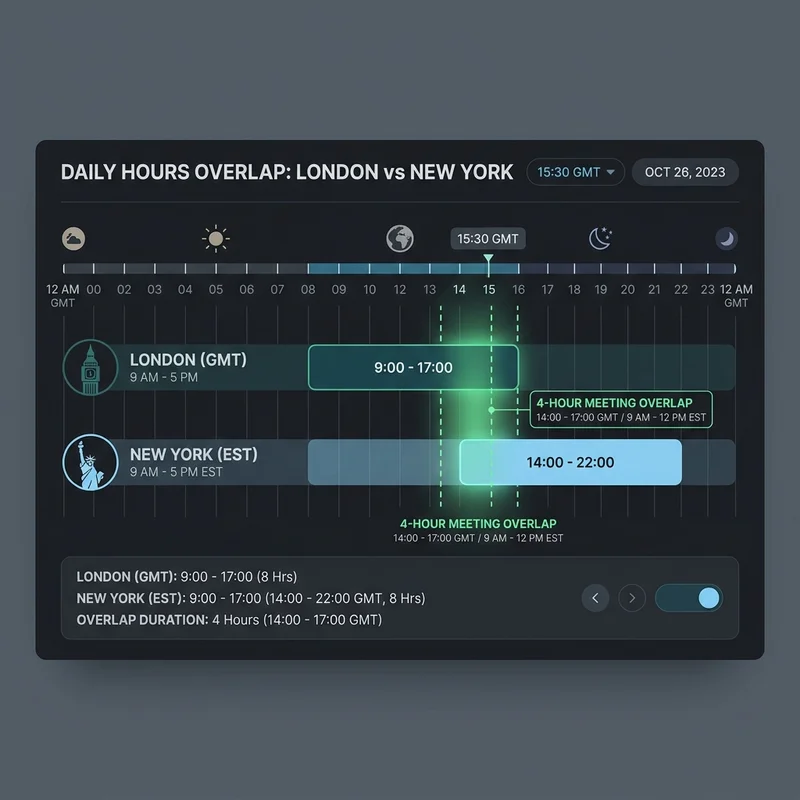
Figure 4: Work day schedule overlap showing peak collaborative windows between European end-of-day and U.S. morning hours.
The standard business overlap is a 4-hour window from 1:00 PM to 5:00 PM GMT, corresponding to 8:00 AM to 12:00 PM EST, which is ideal for scheduling international conference calls and meetings.
Coordinating schedules across global offices requires understanding when standard working hours intersect. Below is a comparative table showing the overlap window (9:00 AM to 5:00 PM local time) between London (GMT/BST) and major Eastern Time cities.
| City | Standard Offset | Peak Overlap Window (GMT) | Peak Overlap Window (Local) |
|---|---|---|---|
| New York City | UTC-5 / UTC-4 | 1:00 PM – 5:00 PM GMT | 8:00 AM – 12:00 PM EST |
| Toronto | UTC-5 / UTC-4 | 1:00 PM – 5:00 PM GMT | 8:00 AM – 12:00 PM EST |
| Washington DC | UTC-5 / UTC-4 | 1:00 PM – 5:00 PM GMT | 8:00 AM – 12:00 PM EST |
| Boston | UTC-5 / UTC-4 | 1:00 PM – 5:00 PM GMT | 8:00 AM – 12:00 PM EST |
| Atlanta | UTC-5 / UTC-4 | 1:00 PM – 5:00 PM GMT | 8:00 AM – 12:00 PM EST |
| Miami | UTC-5 / UTC-4 | 1:00 PM – 5:00 PM GMT | 8:00 AM – 12:00 PM EST |
| Detroit | UTC-5 / UTC-4 | 1:00 PM – 5:00 PM GMT | 8:00 AM – 12:00 PM EST |
| Montreal | UTC-5 / UTC-4 | 1:00 PM – 5:00 PM GMT | 8:00 AM – 12:00 PM EST |
| Ottawa | UTC-5 / UTC-4 | 1:00 PM – 5:00 PM GMT | 8:00 AM – 12:00 PM EST |

Figure 5: Meeting planner illustration showing timezone synchronization for international teams coordinating project deliverables.
Using a calendar-aware converter prevents scheduling slip-ups during seasonal transitions, facilitating seamless collaboration across London, Toronto, and New York offices.
Eastern Time is observed by millions of people across key financial, political, and cultural centers:
Greenwich Mean Time (GMT) was originally established in 1675 when King Charles II founded the Royal Observatory in Greenwich, London, to help mariners calculate longitude at sea.
In 1884, the International Meridian Conference selected the Greenwich meridian as the official prime meridian (0° longitude) for global navigation and timekeeping. This established GMT as the primary solar time standard for the world.
Before standard time zones were established, municipalities in North America kept local solar time, leading to scheduling confusion on railroad networks. In 1883, railroads coordinated to establish four regional time zones.
The U.S. Congress formally codified these zones in the Standard Time Act of 1918, which officially defined Eastern Standard Time (EST) and established national daylight saving rules.
In 1972, Coordinated Universal Time (UTC) replaced GMT as the scientific atomic time standard. While GMT is based on the Earth's rotation, UTC is measured by highly precise atomic clocks.
For general scheduling, GMT and UTC are practically identical, but UTC is the standard used by modern operating systems, server logs, and software development frameworks.
SaaS companies routinely coordinate database migrations and software releases using GMT/UTC timestamps to avoid downtime during business hours.
Customer support teams use timezone conversions to manage shift handovers between UK, US, and Asian desks, ensuring 24/7 service coverage.
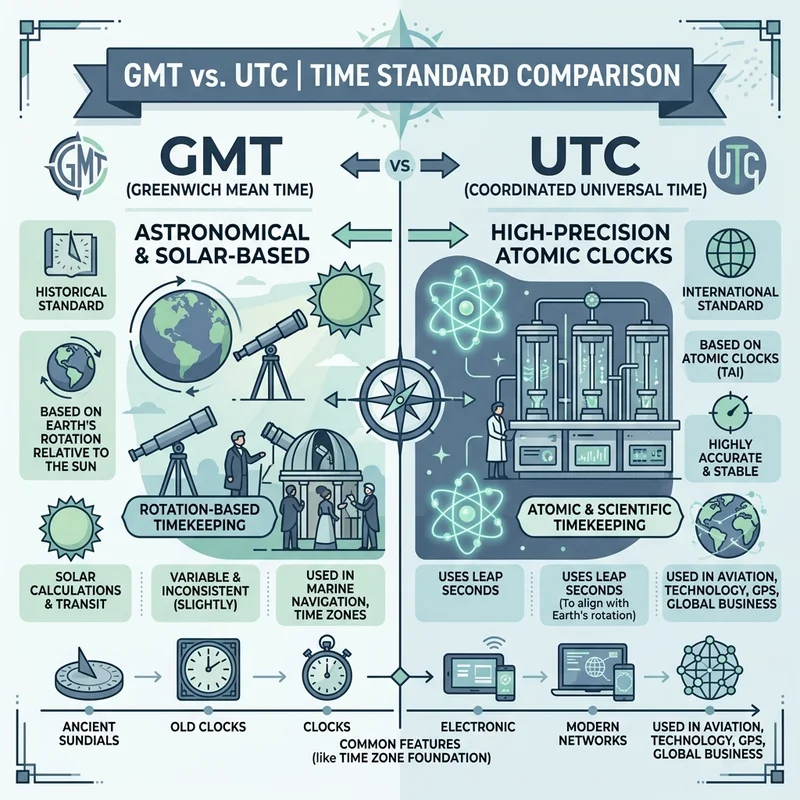
Figure 6: Scientific timekeeping infographic comparing astronomical solar calculations with atomic clock time references.
Greenwich Mean Time (GMT) is a solar time zone, whereas Coordinated Universal Time (UTC) is the atomic time reference used globally in computer systems, cloud servers, and network protocols.
Timezone terminology can be confusing. Let's clarify the key definitions and differences:
Review these detailed answers to resolve common questions regarding Greenwich Mean Time and Eastern Time:
Greenwich Mean Time (GMT) is a fixed time standard at UTC+0, centered on London. Eastern Standard Time (EST) is a U.S. time zone at UTC-5. Thus, the standard offset difference is exactly 5 hours. Learn more on our GMT vs EST Difference page.
Yes. From mid-March to early November, Eastern Time observes Daylight Saving Time (DST) and shifts to Eastern Daylight Time (EDT), which is UTC-4. During this period, Eastern Time is only 4 hours behind GMT. Check our Time Zone Guide for full details.
No. Greenwich Mean Time (GMT) is a fixed time standard and never changes. However, the United Kingdom shifts from GMT to British Summer Time (BST, UTC+1) during the summer, which changes London's local offset relative to Eastern Time. Read our detailed history on the Time Zone Guide.
To convert GMT to Eastern Standard Time (EST), subtract 5 hours from the GMT clock. For example, if it is 10:00 AM GMT, subtracting 5 hours gives 5:00 AM EST. You can use our GMT to EST Converter for automatic calculation.
To convert GMT to Eastern Daylight Time (EDT) during daylight saving, subtract 4 hours from the GMT clock. For example, 10:00 AM GMT minus 4 hours is 6:00 AM EDT. Swap direction on our EST to GMT page to calculate in reverse.
In 2026, Eastern Time springs forward to EDT (UTC-4) on Sunday, March 8 at 2:00 AM local time, and falls back to EST (UTC-5) on Sunday, November 1 at 2:00 AM.
EST refers specifically to Eastern Standard Time (UTC-5), which is the winter offset. Eastern Time (ET) is the general term for the zone, encompassing both EST (winter) and EDT (summer).
States observing Eastern Time include New York, Washington DC, Massachusetts, Pennsylvania, Georgia, Florida, Michigan, Ohio, and parts of Indiana and Kentucky.
Yes. Eastern provinces such as Ontario, Quebec, and parts of Nunavut follow Eastern Time, including major cities like Toronto, Montreal, and Ottawa.
The standard IANA timezone database identifier for Eastern Time is America/New_York. In Canada, America/Toronto and America/Montreal are also commonly used.
Because Eastern Time shifts between UTC-5 and UTC-4 twice a year, a static calculation can result in scheduling errors. A date-aware converter automatically checks the chosen date to apply the correct offset.
12:00 AM GMT converts to 7:00 PM EST (previous day) in the winter, and 8:00 PM EDT (previous day) in the summer.
8:00 PM GMT converts to 3:00 PM EST in the winter, and 4:00 PM EDT in the summer.
The New York Stock Exchange (NYSE) and NASDAQ operate from 9:30 AM to 4:00 PM Eastern Time. This corresponds to 2:30 PM to 9:00 PM GMT (standard time) or 1:30 PM to 8:00 PM GMT (daylight saving time).
The peak overlap occurs between 8:00 AM and 12:00 PM EST (1:00 PM and 5:00 PM GMT), which is when both European and US financial centers are open concurrently.
Not always. The US shifts to daylight saving on the second Sunday of March, while the UK shifts on the last Sunday of March. In autumn, the US shifts on the first Sunday of November, while the UK shifts on the last Sunday of October. During these brief windows, the relative offset changes.
Developers store database timestamps in UTC (GMT) and translate them to local time zones like America/New_York on the client side using date-time libraries.
Standard practice is to store transactional records and system logs in UTC (GMT) to avoid chronological confusion during DST transitions.
No. New York is in EST (UTC-5) from early November to mid-March, and in EDT (UTC-4) from mid-March to early November.
Yes. Toronto, Ontario, follows Eastern Time (EST/EDT) and matches New York's clocks throughout the year.
Yes. Montreal, Quebec, observes Eastern Time and matches Toronto and New York's clocks.
Yes. Washington DC follows Eastern Time and observes DST transitions year-round.
Yes. Boston, Massachusetts, observes Eastern Time and switches between EST and EDT.
Yes. Atlanta, Georgia, is in the Eastern Time Zone.
Yes. Miami, Florida, follows Eastern Standard Time in the winter and Eastern Daylight Time in the summer.
Yes. Detroit, Michigan, is in the Eastern Time Zone.
Yes. Ottawa, Canada's capital, observes Eastern Time.
UTC (Coordinated Universal Time) is the scientific atomic time standard, while GMT (Greenwich Mean Time) is the astronomical time standard. For general scheduling purposes, their offsets are identical (+0).
Irish Standard Time (IST) is UTC+1 (observed in summer in Ireland), while GMT is UTC+0. They are separate time zones.
Although both share the 'IST' abbreviation, Israel Standard Time is UTC+2 or UTC+3, while India Standard Time is UTC+5:30. They are completely separate.
Prior to the late 19th century, cities kept local solar time. To avoid rail collisions and coordinate nationwide timetables, railroads established standard time zones in 1883.
The standard overlap occurs between 1:00 PM and 5:00 PM GMT, which is 8:00 AM to 12:00 PM EST (or 9:00 AM to 1:00 PM EDT). This provides 4 hours of concurrent office time.
Yes. Scheduling a webinar at 3:00 PM GMT allows participants in New York to attend at 10:00 AM EST (or 11:00 AM EDT) during their morning focus hours.
Airlines coordinate international flight paths and logs using UTC (GMT) to maintain consistent timetables across multiple jurisdictions.
Yes. Supply chain managers must adjust transit manifests and delivery windows when regions transition between EST and EDT.
Yes. Several Caribbean nations follow Eastern Standard Time, though some (like Jamaica) remain on EST (UTC-5) year-round without observing daylight saving.
If the system is not configured to use UTC, the cron job might execute twice because the 2:00 AM hour occurs twice when clocks fall back.
As major financial centers shift between standard and daylight saving hours, the overlap times for trading sessions adjust, shifting peak market liquidity.
Most of Indiana observes Eastern Time (EST/EDT), though several counties near Chicago and Evansville follow Central Time.
Yes. The interactive calendar allows project managers to select future dates and see the correct local times, avoiding scheduling conflicts during transition weeks.
10:00 PM GMT (2200 GMT) converts to 5:00 PM EST (same day) during standard winter time and 6:00 PM EDT (same day) during daylight saving summer time.
12:00 PM GMT (1200 GMT) converts to 7:00 AM EST in winter and 8:00 AM EDT in summer, marking the morning office opening on the U.S. East Coast.
1:00 PM GMT (1300 GMT) converts to 8:00 AM EST in winter and 9:00 AM EDT in summer, opening the transatlantic business meeting overlap window.
1:00 AM GMT (0100 GMT) converts to 8:00 PM EST (previous day) in winter and 9:00 PM EDT (previous day) in summer.
10:30 AM GMT converts to 5:30 AM EST in winter and 6:30 AM EDT in summer.
10:30 PM GMT converts to 5:30 PM EST in winter and 6:30 PM EDT in summer.
10:00 AM GMT (1000 GMT) converts to 5:00 AM EST in winter and 6:00 AM EDT in summer.
In 24-hour military notation: 0000 GMT is 19:00 EST (7 PM prev day), 0200 GMT is 21:00 EST (9 PM prev day), 0400 GMT is 23:00 EST (11 PM prev day), 0500 GMT is 00:00 EST (Midnight), 0635 GMT is 01:35 EST, 0700 GMT is 02:00 EST, and 1000 GMT is 05:00 EST.
Need other conversions? Explore our other dedicated timezone resources:
GMT to EST Converter (Live) + Current Time & 24-Hour Chart gives instant, date-aware GMT to EST conversion with live clocks, DST handling, meeting presets, and a 24-hour chart.