Quick Answer: How Many Time Zones does Australia Have?
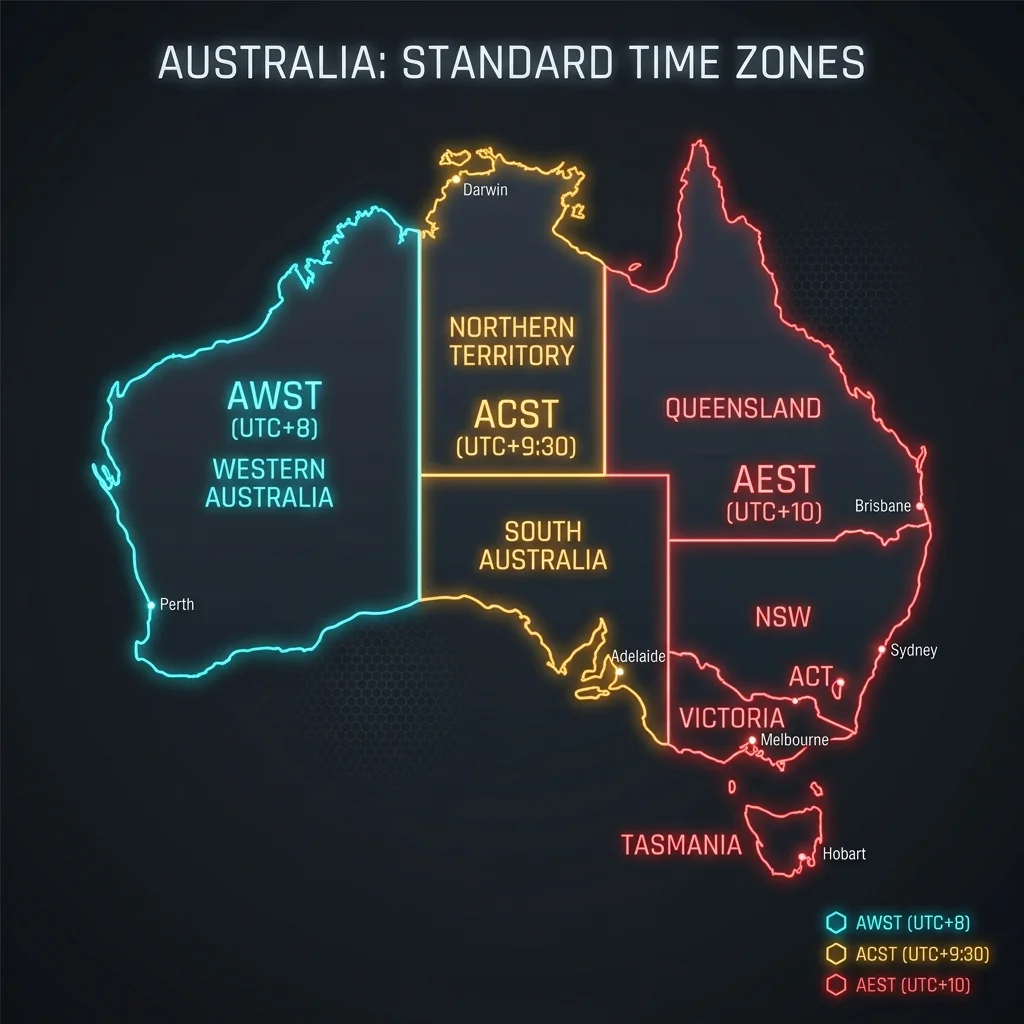
Mainland Australia is divided into three primary standard time zones:
Australian Western Standard Time (AWST, UTC+8), Australian Central Standard Time (ACST, UTC+9:30), and Australian Eastern Standard Time (AEST, UTC+10).
However, the administrative timezone structure is much more complex.
When counting seasonal Daylight Saving Time shifts (which divide the country into five zones in the summer) and including special regional offsets (like Eucla's UTC+8:45) and external territories (such as Norfolk Island's UTC+11/UTC+12 and Lord Howe Island's half-hour shift), Australia operates across nine distinct civil offsets.
Australia is a massive continent spanning over 4,000 kilometers from east to west.
This vast horizontal footprint covers nearly 40 degrees of longitude, making standard time zones necessary to align local activities with standard daylight patterns.
Without standard time, clocks in Perth would be completely out of sync with the solar cycles of Sydney.
Pro Tip: Under the Australian Constitution, timekeeping and Daylight Saving Time legislation are the sole responsibility of individual state and territory governments.
This decentralization explains why boundaries do not always align with state lines and why some states observe seasonal changes while others do not.
This regional division creates unique scheduling dynamics.
For example, during winter, the country operates on three standard offsets: UTC+8, UTC+9:30, and UTC+10.
During summer, because only some states choose to shift their clocks, the mainland divides into five distinct offsets: UTC+8, UTC+9:30, UTC+10, UTC+10:30, and UTC+11.
These standard alignments are officially registered in the IANA Time Zone Database and referenced against global standards like Coordinated Universal Time (UTC) and Greenwich Mean Time (GMT).
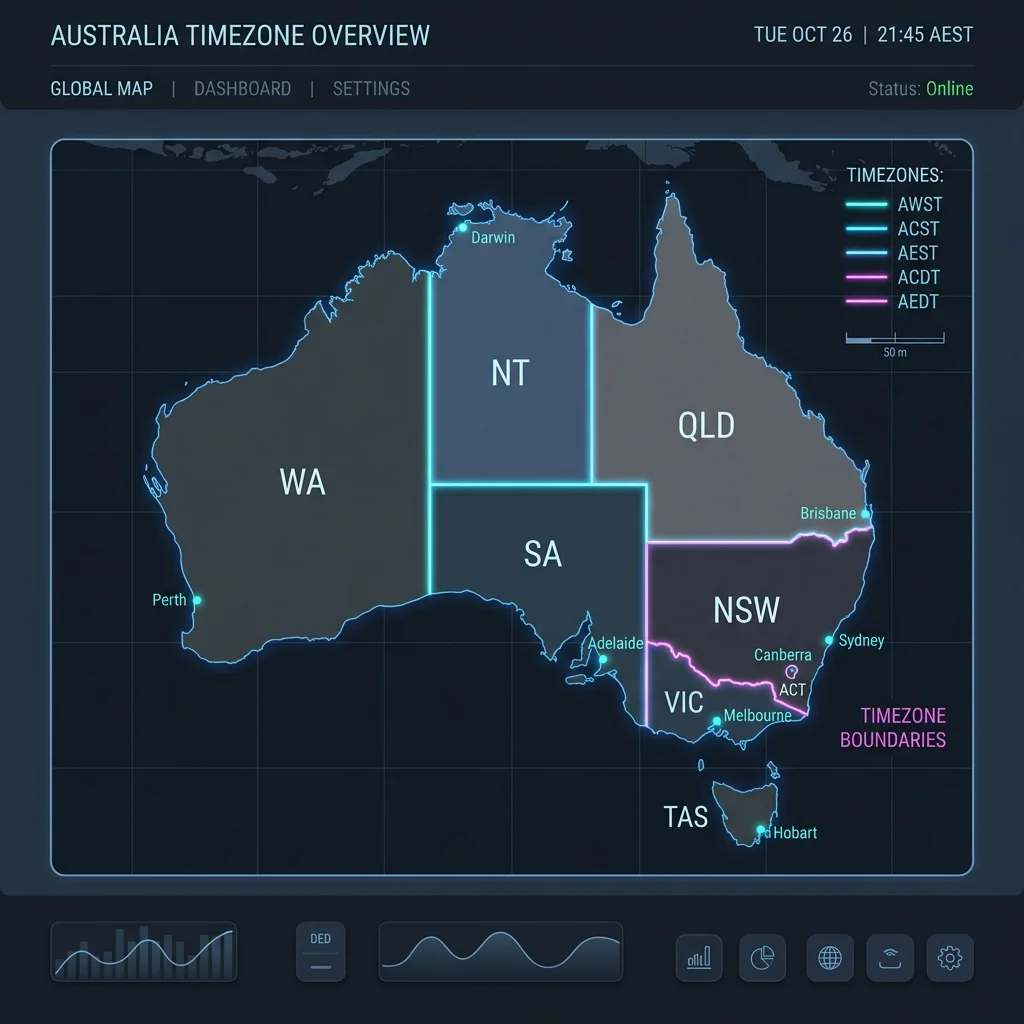
Figure 1: Australia Time Zone Map. A comprehensive visualization of Australia's primary standard time zones, showing boundaries, state coverage, and standard offsets from Coordinated Universal Time (UTC).
Navigating these divisions is essential for national business operations, interstate logistics, flight schedules, and telecommunications.
For professionals managing schedules across different countries, aligning Australian hours with other regions (like the US or Canada) requires close attention to seasonal changes.
You can compare these regional corridors with our detailed USA Time Zones guide and Canada Time Zones guide.
2. History of Australian Time Zones
Before the late 19th century, Australian colonies observed local mean time based on the meridian of their local observatory.
Every major town set its own clocks, which made train scheduling and telegraph communication extremely difficult.
As railway networks expanded across colonial borders, standardizing time became a priority for colonial administrators.
Did You Know?
The standardization of time in Australia occurred during the colonial conference in 1892.
It was agreed to adopt three standard time zones based on standard meridians: 120° E (Western Australia), 135° E (South Australia and Northern Territory), and 150° E (Queensland, New South Wales, Victoria, and Tasmania).
The colonies officially enacted this agreement in 1895 through individual Standard Time Acts, several years before the Australian Federation in 1901.
Historical adjustments continued after Federation.
In 1899, South Australia decided to shift its standard meridian to 142.5° E, moving its clock 30 minutes forward to UTC+9:30.
This was done to bring Adelaide's clocks closer to the eastern states, but it created Australia's famous half-hour offset.
The Northern Territory inherited this half-hour offset, continuing to use it even after administrative separation.
Figure 3: Australian Timekeeping and DST History. Timeline of key legislative developments in Australian time synchronization, from standard time acts in 1895 to modern daylight saving agreements.
Daylight Saving Time rules evolved independently across states.
During World War I and II, the federal government enforced nationwide DST to conserve energy.
However, in peacetime, states resumed independent control.
In 1971, the eastern states (NSW, VIC, QLD, TAS, and ACT) ran a trial of DST.
Following the trial, NSW, VIC, TAS, and SA decided to adopt it permanently, while Queensland rejected the seasonal shift, creating the modern summer timezone division.
3. Australia's Primary Time Zones (Mainland)
Mainland Australia is governed by three primary standard time zones, calculated relative to Coordinated Universal Time (UTC):
Australian Western Standard Time (AWST)
Standard Offset: UTC+8 year-round (No Daylight Saving Time)
Major Cities: Perth, Fremantle, Bunbury, Geraldton, Broome.
Coverage: The entire state of Western Australia.
AWST covers Western Australia, the country's resource-rich gateway to Asia.
Because Western Australia does not observe Daylight Saving Time, Perth remains on UTC+8 year-round.
This keeps WA aligned with major Asian business centers like Singapore, Hong Kong, and Beijing.
Business Scheduling Example: A mining company based in Perth (AWST, UTC+8) hosting a financial audit with a bank in Sydney (AEST, UTC+10 in winter) must manage a 2-hour offset.
A meeting scheduled for 9:00 a.m. in Perth corresponds to 11:00 a.m. in Sydney.
In summer, when Sydney shifts to AEDT (UTC+11), the difference expands to 3 hours, meaning the same 9:00 a.m. Perth meeting occurs at 12:00 p.m. in Sydney.
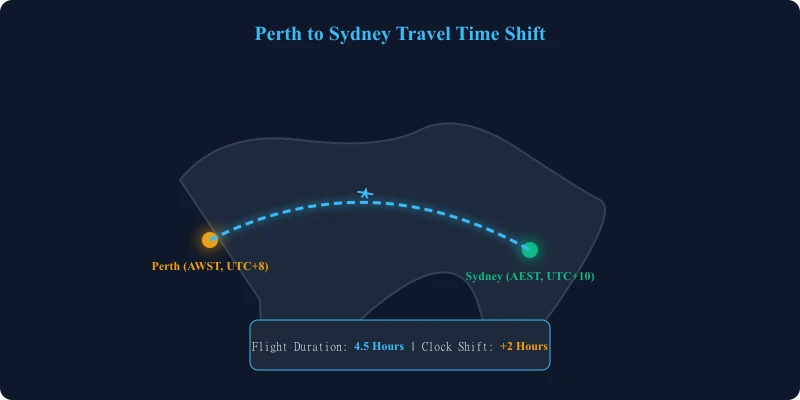
Travel Example: A flight from Sydney to Perth takes approximately 5 hours.
If a traveler departs Sydney at 3:00 p.m. AEDT in December (UTC+11), they will land in Perth (UTC+8) at 5:00 p.m. local time, making the travel time feel like only 2 hours.
Australian Central Standard Time (ACST) / Central Daylight Time (ACDT)
Standard Offset (Winter): UTC+9:30 (Australian Central Standard Time - ACST)
Daylight Offset (Summer): UTC+10:30 (Australian Central Daylight Time - ACDT)
Major Cities: Adelaide, Darwin, Alice Springs, Broken Hill.
Coverage: South Australia, Northern Territory, and Broken Hill (NSW).
The Central Time Zone features a unique half-hour offset.
During winter standard time, South Australia and the Northern Territory use ACST (UTC+9:30).
During summer, South Australia observes Daylight Saving Time, shifting to ACDT (UTC+10:30).
The Northern Territory does not observe DST, remaining on UTC+9:30 year-round.
Business Scheduling Example: A medical researcher in Adelaide (ACDT, UTC+10:30 in summer) calling a regional clinic in Darwin (ACST, UTC+9:30 year-round) must account for a 1-hour shift.
A call at 10:00 a.m. in Adelaide occurs at 9:00 a.m. in Darwin.
Travel Example: Driving north from Adelaide to Darwin via the Stuart Highway involves crossing from South Australia into the Northern Territory.
If traveling in December, crossing the state border requires setting dashboard clocks back 1 hour, as South Australia observes DST while the Northern Territory does not.
Australian Eastern Standard Time (AEST) / Eastern Daylight Time (AEDT)
Standard Offset (Winter): UTC+10 (Australian Eastern Standard Time - AEST)
Daylight Offset (Summer): UTC+11 (Australian Eastern Daylight Time - AEDT)
Major Cities: Sydney, Melbourne, Brisbane, Canberra, Hobart, Gold Coast.
Coverage: New South Wales (except Broken Hill), Victoria, Queensland, Tasmania, and the ACT.
The Eastern Time Zone covers Australia's eastern seaboard, housing the majority of the population and the country's primary economic hubs.
In winter, the entire eastern seaboard is aligned on AEST (UTC+10).
In summer, New South Wales, Victoria, Tasmania, and the ACT observe Daylight Saving Time, moving to AEDT (UTC+11).
Queensland does not observe DST, remaining on AEST (UTC+10) year-round.
This is comparable to standard transitions like EST vs EDT in other global guides.
Business Scheduling Example: The Australian Securities Exchange (ASX) operates from 10:00 a.m. to 4:00 p.m. Sydney Time.
Brokers in Brisbane (AEST, UTC+10 year-round) must start trading at 9:00 a.m. local time during summer to align with the opening bell in Sydney.
Travel Example: Crossing the border from Coolangatta (Queensland, AEST) to Tweed Heads (New South Wales, AEDT) on foot during summer involves a 1-hour time jump.
Walking across the street can literally change the hour on your phone, requiring close attention from local commuters.
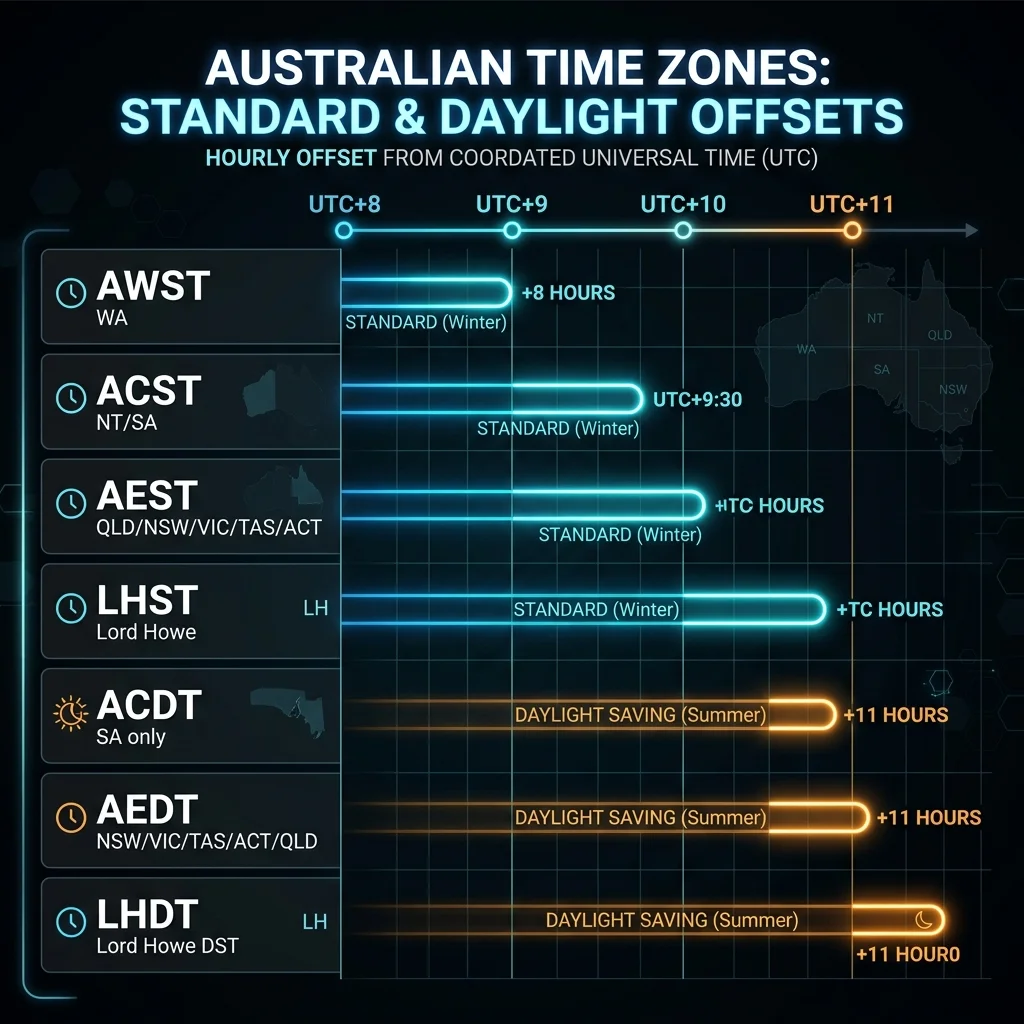
Figure 2: Australian Time Zones and UTC Offsets. Graphic summary illustrating standard (winter) and daylight saving (summer) offsets across all mainland Australian jurisdictions.
4. Daylight Saving Time (DST) in Australia
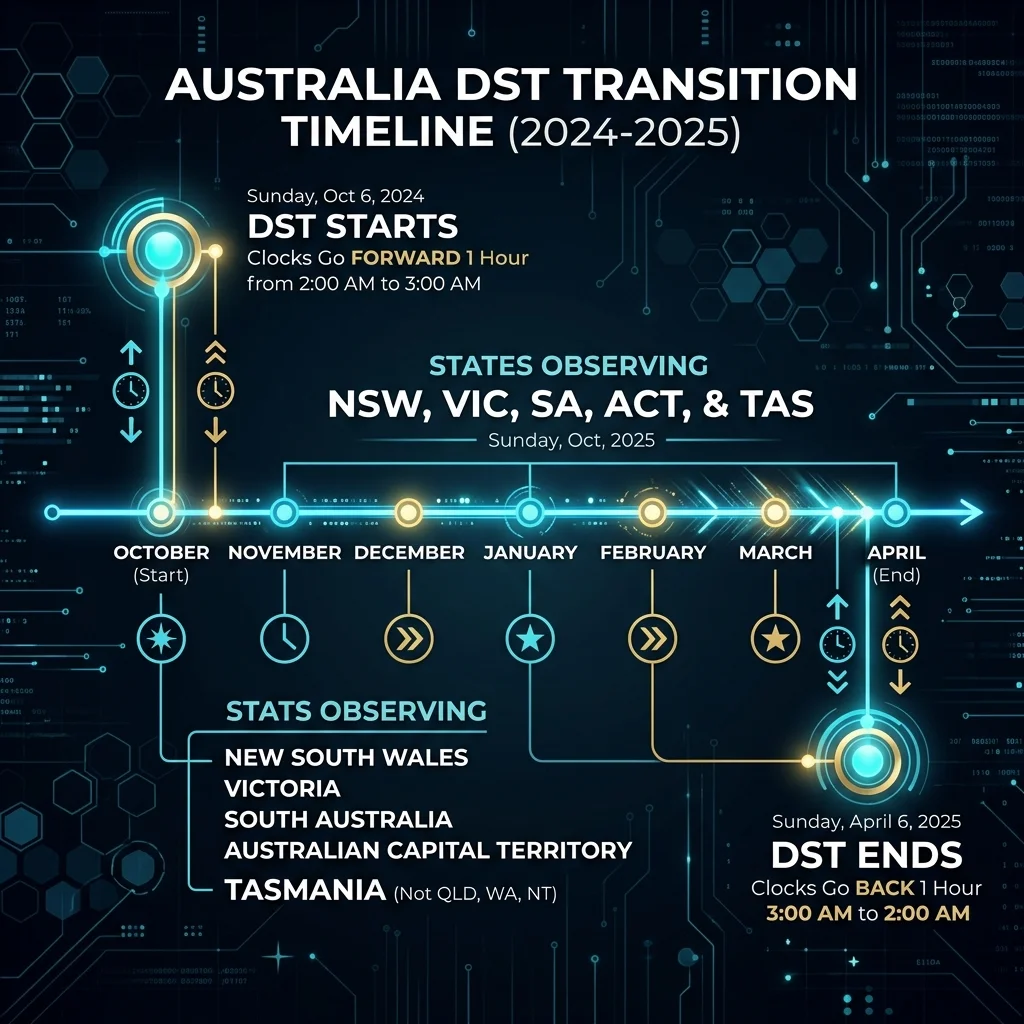
Daylight Saving Time (DST) is observed in South Australia, New South Wales, Victoria, Tasmania, and the Australian Capital Territory.
In these regions, clocks advance by one hour on the first Sunday of October and return to standard time on the first Sunday of April.
This is designed to extend evening daylight during the warmer summer months.
To understand this concept further, read our guide on Daylight Saving Time Explained.
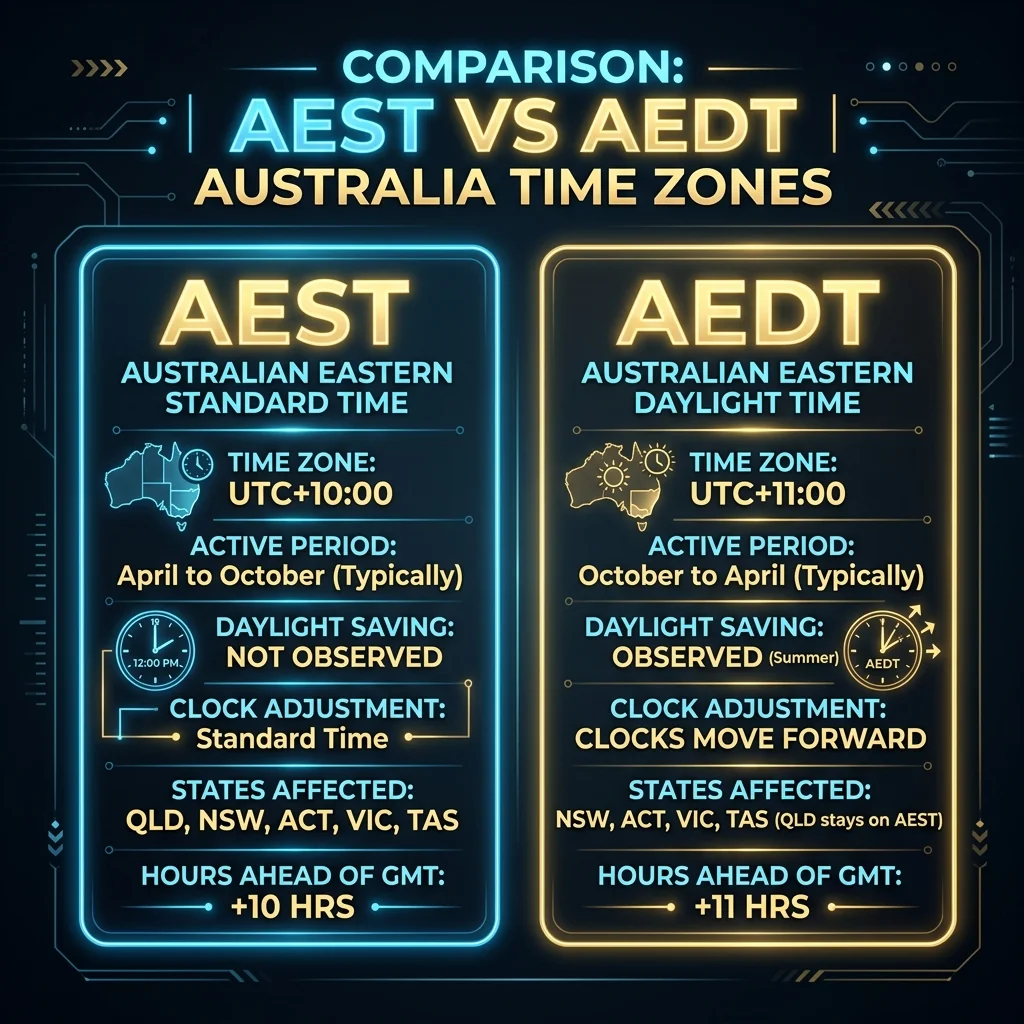
Figure 5: AEST vs AEDT Comparison. Graphical explanation showing how the eastern states shift from Australian Eastern Standard Time (AEST) to Eastern Daylight Time (AEDT) in October.
However, Western Australia, Queensland, and the Northern Territory do not observe DST.
This creates a summer timezone split across the continent:
The Latitudinal Factor: In northern Australia (Queensland and Northern Territory), daylight hours remain relatively constant year-round due to the tropical latitude.
Adding DST would push sunset past 8:00 p.m. in the summer, which is unpopular due to extreme heat.
Agricultural Opposition: Farming communities in Western Australia and Queensland oppose DST.
They argue that changing clocks disrupts harvest schedules, livestock routines, and coordinates poorly with natural daylight cycles.
Warning: During the summer DST period, Australia operates on five distinct offsets rather than three.
Brisbane remains on UTC+10 (AEST), while Sydney shifts to UTC+11 (AEDT).
Ensure your calendars account for this state division between October and April.
5. Australian States & Territories Guide
Because time keeping is a state responsibility, it is important to analyze the exact time zone and DST rules for each Australian state, territory, and external dependency:
Western Australia (WA): Observes AWST (UTC+8) year-round. It does not observe DST.
A small border area near the South Australian border (including Eucla) observes Central Western Standard Time (CWST, UTC+8:45) year-round.
Northern Territory (NT): Observes ACST (UTC+9:30) year-round. It does not observe DST.
South Australia (SA): Observes ACST (UTC+9:30) in winter and ACDT (UTC+10:30) in summer. It participates in standard seasonal DST changes.
Queensland (QLD): Observes AEST (UTC+10) year-round. It does not observe DST.
New South Wales (NSW): Observes AEST (UTC+10) in winter and AEDT (UTC+11) in summer.
The border community of Broken Hill observes Central Time (ACST/ACDT), and Lord Howe Island observes UTC+10:30 in winter with a 30-minute shift to UTC+11 in summer.
Victoria (VIC): Observes AEST (UTC+10) in winter and AEDT (UTC+11) in summer.
Tasmania (TAS): Observes AEST (UTC+10) in winter and AEDT (UTC+11) in summer.
Australian Capital Territory (ACT): Observes AEST (UTC+10) in winter and AEDT (UTC+11) in summer.
External Territories:
Norfolk Island: Observes UTC+11 Standard / UTC+12 Daylight (participates in DST).
Christmas Island: Observes UTC+7 year-round (no DST).
Cocos (Keeling) Islands: Observes UTC+6:30 year-round (no DST).
Macquarie Island: Observes UTC+11 year-round (no DST).
Heard and McDonald Islands: Observes UTC+5 year-round.
Antarctic Stations: Mawson Station uses UTC+5, Davis Station uses UTC+7, and Casey Station uses UTC+8.
Figure 4: Australian States Time Zone Map. Detailed regional map displaying state boundaries, external dependencies, and local offset exceptions.
State / Territory
Standard Time Zone
Standard Offset (Winter)
Daylight Offset (Summer)
DST Observance
Western Australia
AWST
UTC+8
UTC+8
No (CWT UTC+8:45 exception)
Northern Territory
ACST
UTC+9:30
UTC+9:30
No
South Australia
ACST / ACDT
UTC+9:30
UTC+10:30
Yes (October to April)
Queensland
AEST
UTC+10
UTC+10
No
New South Wales
AEST / AEDT
UTC+10
UTC+11
Yes (Broken Hill, Lord Howe exceptions)
Victoria
AEST / AEDT
UTC+10
UTC+11
Yes (October to April)
Tasmania
AEST / AEDT
UTC+10
UTC+11
Yes (October to April)
ACT
AEST / AEDT
UTC+10
UTC+11
Yes (October to April)
Norfolk Island
NFST / NFDT
UTC+11
UTC+12
Yes (October to April)
Christmas Island
CIFT
UTC+7
UTC+7
No
Cocos Islands
CCT
UTC+6:30
UTC+6:30
No
6. Australia Time Zone Map Explained
The Australian timezone map reveals how standard meridians correspond with regional population centers.
Instead of using simple vertical divisions, boundaries curve around local government areas to maintain community integration.
For example, the boundary between Eastern and Central Time in New South Wales bends around Broken Hill.
Because Broken Hill is located near the South Australian border and is economically integrated with Adelaide, it legally observes Central Standard and Daylight Time rather than New South Wales Eastern Time.
Travel Tip: If you are driving across the Nullarbor Plain along the Eyre Highway from Western Australia to South Australia, you will cross several timezone boundaries.
Ensure you adjust your vehicle and mobile device clocks when passing through Eucla's UTC+8:45 corridor and entering South Australia's UTC+9:30/10:30 zone.
Figure 8: Australian Travel Timezone Transitions. Visual timeline showing timezone jumps and travel duration during transcontinental flights from Western Australia to the eastern states.
7. Australia vs Other Major Time Zones
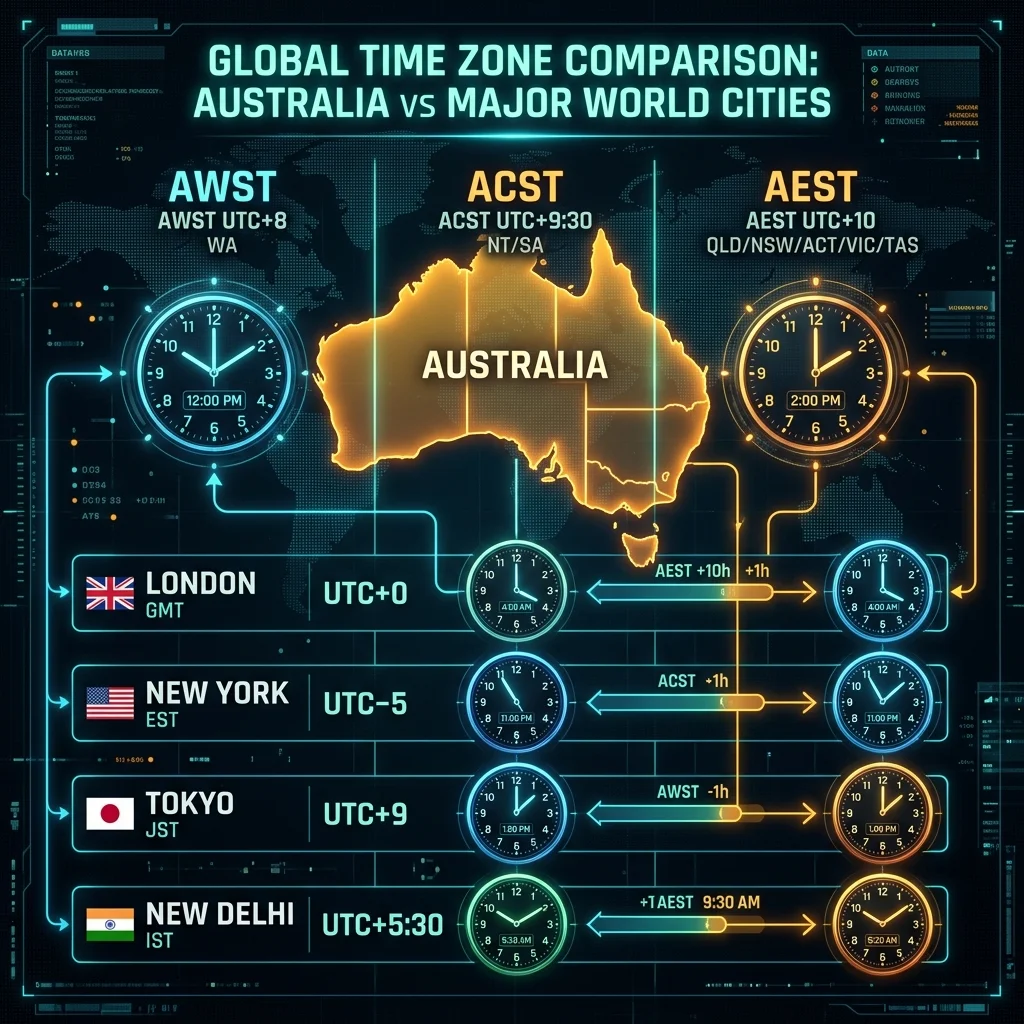
Because Australia is located in the Southern Hemisphere, its Daylight Saving Time transitions occur in opposite months compared to the Northern Hemisphere.
When Australia "springs forward" in October, the US and Canada are preparing to "fall back" in November, creating significant seasonal offset shifts.
Figure 6: Australia and Global Time Zone Alignment. Graphic comparison displaying how Australia's primary offsets align with other major global trading hubs.
Australia vs US and Canadian Time Zones
Australian City
Local Time Zone
US / Canadian Equivalent
Winter Offset (Winter in both)
Summer Offset (Summer in both)
Sydney
Eastern Time
New York / Toronto (Eastern Time)
Sydney is 15 hours ahead
Sydney is 14 hours ahead
Adelaide
Central Time
Chicago / Winnipeg (Central Time)
Adelaide is 15.5 hours ahead
Adelaide is 15.5 hours ahead
Perth
Western Time
Los Angeles / Vancouver (Pacific Time)
Perth is 16 hours ahead
Perth is 15 hours ahead
Australia vs UK and India
Australian City
London (GMT / BST)
New Delhi (IST)
Sydney (AEDT, UTC+11 in summer)
London is 11 hours behind
New Delhi is 5.5 hours behind
Adelaide (ACDT, UTC+10:30 in summer)
London is 9.5 hours behind
New Delhi is 5 hours behind
Perth (AWST, UTC+8 year-round)
London is 7 hours behind (summer)
New Delhi is 2.5 hours behind
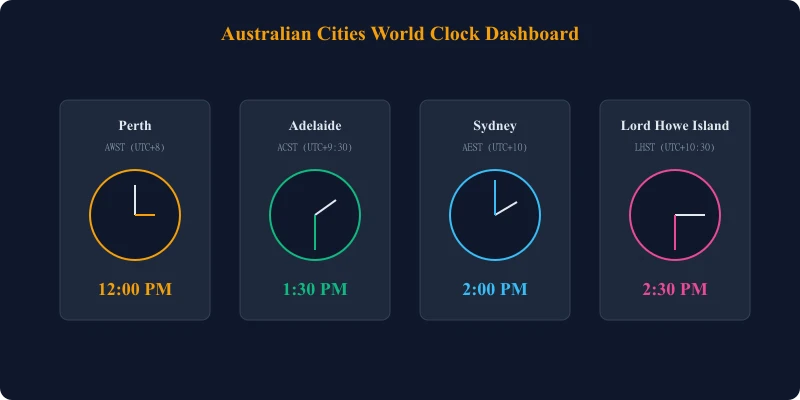
Figure 10: Australian Cities World Clock Dashboard. Graphic dashboard comparing local times in Perth, Adelaide, Sydney, and Lord Howe Island simultaneously.
8. Business Operations Across Australian Time Zones
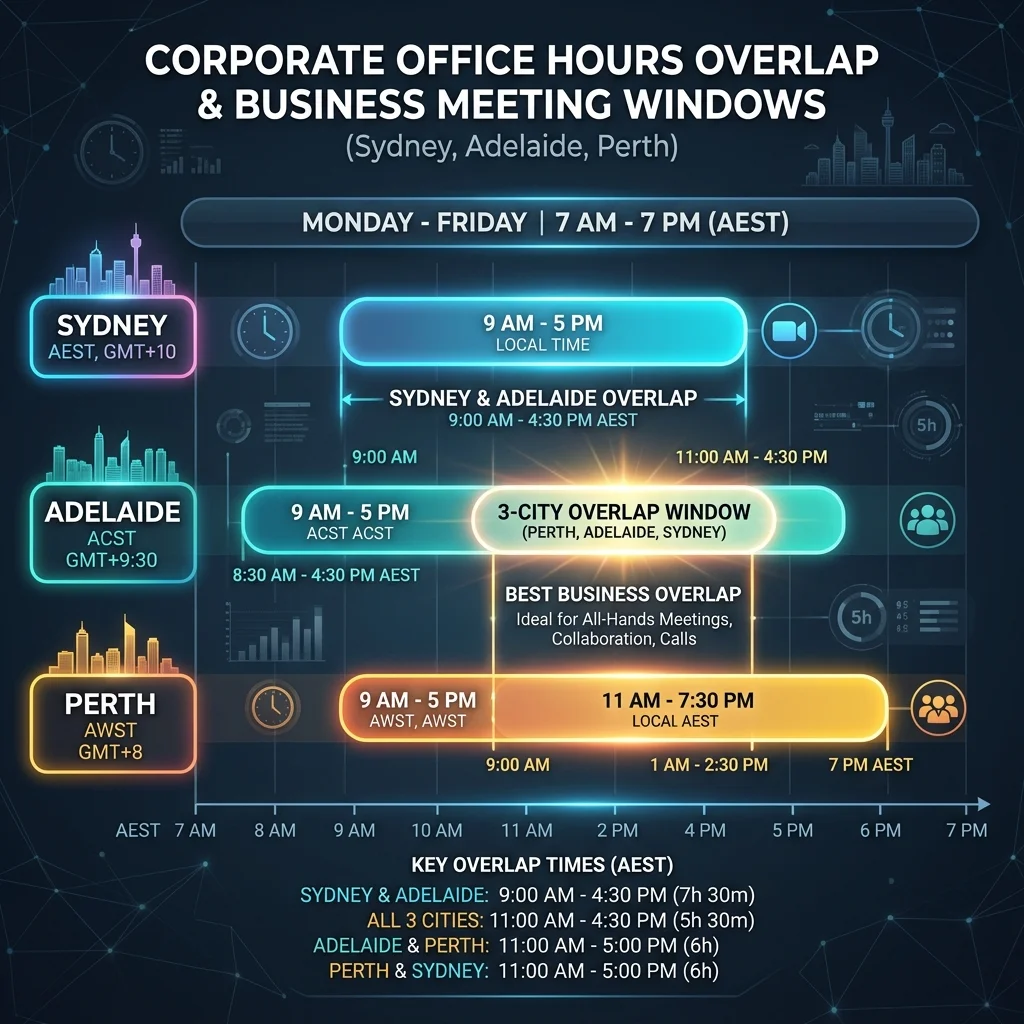
Managing corporate workflows across Australia requires scheduling systems that account for the 3-hour east-west timezone split and the seasonal DST changes that divide the eastern seaboard.
Figure 7: Business Hour Overlaps Across Australia. Infographic displaying the optimal business meeting slots for remote teams located in Sydney, Adelaide, and Perth.
Remote Work Coordination: Collaborative hours must be set carefully.
During summer, when it is 9:00 a.m. in Perth (AWST), it is already 12:00 p.m. in Sydney (AEDT).
To hold meetings during standard working hours, teams must target the 12:00 p.m. to 4:00 p.m. AEDT window, which corresponds to 9:00 a.m. to 1:00 p.m. AWST in Western Australia.
Financial Markets: The Australian Securities Exchange (ASX) in Sydney dictates national financial activities.
Brokers on the West Coast must begin their daily work at 7:00 a.m. local time during summer to ensure they can trade from the opening bell.
National Support Operations: Support centers must align their shifts to cover the national business window.
Operating hours starting at 8:00 a.m. AEDT in Melbourne will only cover Perth customers up to 5:00 p.m. AWST, requiring shift handovers.
Logistics and Supply Chain: National freight systems use Coordinated Universal Time (UTC) or Eastern Standard Time (AEST) to coordinate transcontinental rail transport and flight schedules.
9. Programming & Technology Guidelines
In software engineering, handling Australian time zones requires strict compliance with international standards to prevent calendar errors, log mismatches, and data corruption.
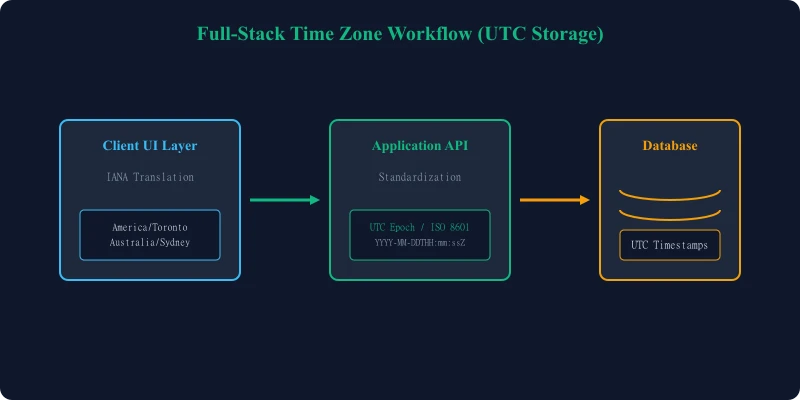
Figure 9: Developer Timezone Database Workflow. Structural diagram demonstrating the best practice of storing timezone-agnostic Coordinated Universal Time (UTC) in databases and translating to local IANA zone names in user interfaces.
1. Storing Dates in UTC
Always store timestamps in Coordinated Universal Time (UTC) using the ISO 8601 standard formatting: `YYYY-MM-DDTHH:MM:SSZ`.
Do not store local timestamps directly, as it makes database queries across SA, WA, and NSW nearly impossible.
2. Use IANA Identifiers
Do not hardcode offsets (like +10 or +8) in your codebase.
Offsets change seasonally and can be modified by legislation. Instead, use the official IANA Time Zone Database names.
Examples for Australia include:
`Australia/Perth` (AWST)
`Australia/Adelaide` (ACST/ACDT)
`Australia/Darwin` (ACST year-round)
`Australia/Sydney` (AEST/AEDT)
`Australia/Brisbane` (AEST year-round)
`Australia/Hobart` (AEST/AEDT in Tasmania)
`Australia/Lord_Howe` (Lord Howe Island)
`Australia/Eucla` (Central Western Time)
3. JavaScript Localization Example
To display a database UTC timestamp in Sydney's local daylight time (AEDT), utilize the native `Intl.DateTimeFormat` API:
const utcDate = new Date('2026-07-15T12:00:00Z');
const formatter = new Intl.DateTimeFormat('en-AU', {
  timeZone: 'Australia/Sydney',
  dateStyle: 'medium',
  timeStyle: 'long'
});
console.log(formatter.format(utcDate));
// Output will render in Sydney local time (AEST/AEDT)
10. Common Time Zone Mistakes to Avoid
Working, coding, or traveling across Australia involves navigating several unique timezone rules.
Avoid these common pitfalls:
Neglecting Half-Hour Offsets: Many automated schedulers assume all time zones use whole-hour offsets.
Forgetting that South Australia and the Northern Territory use a half-hour offset (UTC+9:30) can lead to scheduling errors for Adelaide and Darwin.
Confusing AEST with AEDT: Do not use these terms interchangeably.
AEST is standard winter time (UTC+10), while AEDT is summer daylight time (UTC+11).
Using AEST in summer will result in meetings being scheduled one hour late.
Assuming Queensland Changes Clocks: Queensland remains on AEST (UTC+10) year-round.
Ensure your calendars do not shift Brisbane clocks in October or April.
Forgetting the 45-Minute Eucla Offset: If your business operates logistics along the Eyre Highway, ensure you account for Eucla's UTC+8:45 offset, which is observed by local roadhouses.
11. Frequently Asked Questions (FAQ)
Review these comprehensive answers to resolve common questions about Australian time zones, standard offsets, and transitions:
How many time zones does Australia have?
On the mainland, Australia has three primary standard time zones: Australian Western Standard Time (AWST, UTC+8), Australian Central Standard Time (ACST, UTC+9:30), and Australian Eastern Standard Time (AEST, UTC+10). However, when including Daylight Saving Time changes and the external territories (such as Norfolk Island, Lord Howe Island, Christmas Island, and Cocos Islands), Australia uses more than nine distinct time zones and local offsets.
Which Australian states observe Daylight Saving Time?
Daylight Saving Time (DST) is observed in South Australia, New South Wales, Victoria, Tasmania, and the Australian Capital Territory. Queensland, Western Australia, and the Northern Territory do not observe DST, meaning their clocks remain on standard time year-round.
What are the standard dates for Daylight Saving Time in Australia?
For the jurisdictions that observe DST, the period begins on the first Sunday of October (clocks go forward one hour at 2:00 a.m. standard time to 3:00 a.m. daylight time) and ends on the first Sunday of April (clocks go back one hour at 3:00 a.m. daylight time to 2:00 a.m. standard time).
Why doesn't every Australian state observe Daylight Saving Time?
Time zone regulation is a state and territory responsibility under the Australian Constitution. States like Queensland, Western Australia, and the Northern Territory have chosen not to observe DST due to their closer proximity to the equator, where day length remains relatively constant year-round, and because of strong opposition from agricultural communities.
What is the unique offset of Eucla in Western Australia?
Eucla, a small border community in the southeastern corner of Western Australia, observes an unofficial time zone called Central Western Standard Time (CWST) with an offset of UTC+8:45 year-round. It does not observe Daylight Saving Time.
What timezone does Lord Howe Island use?
Lord Howe Island observes Lord Howe Standard Time (LHST, UTC+10:30) during the winter months. During the summer, it moves to Lord Howe Daylight Time (LHDT, UTC+11). This represents a unique 30-minute Daylight Saving Time adjustment rather than the standard one hour.
Does Norfolk Island observe Daylight Saving Time?
Yes. Norfolk Island observes Daylight Saving Time, switching from Norfolk Island Standard Time (NFST, UTC+11) in winter to Norfolk Island Daylight Time (NFDT, UTC+12) in summer. The transition dates synchronize with the Australian mainland states.
What time zone is Christmas Island in?
Christmas Island observes Christmas Island Time (CIFT, UTC+7) year-round. It does not observe Daylight Saving Time.
What time zone is Cocos (Keeling) Islands in?
The Cocos (Keeling) Islands observe Cocos Islands Time (CCT, UTC+6:30) year-round. They do not observe Daylight Saving Time.
What timezone does Broken Hill in New South Wales use?
Although Broken Hill is located in New South Wales (which primarily uses Eastern Time), the town legally observes Australian Central Standard Time (ACST, UTC+9:30) and Australian Central Daylight Time (ACDT, UTC+10:30) to remain aligned with Adelaide, its main commercial hub.
What is the time difference between Perth and Sydney?
During the winter, Sydney (AEST, UTC+10) is 2 hours ahead of Perth (AWST, UTC+8). During the summer, because Sydney observes AEDT (UTC+11) and Perth does not change its clocks, Sydney is 3 hours ahead of Perth.
Does the Northern Territory observe Daylight Saving Time?
No. The Northern Territory remains on Australian Central Standard Time (ACST, UTC+9:30) year-round and does not adjust its clocks seasonally.
What is the time difference between Brisbane and Sydney in summer?
During the summer, Sydney (AEDT, UTC+11) is 1 hour ahead of Brisbane (AEST, UTC+10) because New South Wales observes DST while Queensland does not. In the winter, they share the same time (AEST, UTC+10).
Who regulates time zones and DST in Australia?
Time zones and Daylight Saving Time policies are regulated by the individual state and territory governments of Australia under their constitutional authority over local matters.
What is the time zone of the Australian Capital Territory (ACT)?
The ACT observes Australian Eastern Standard Time (AEST, UTC+10) in the winter and Australian Eastern Daylight Time (AEDT, UTC+11) in the summer.
What timezone does Macquarie Island use?
Macquarie Island, situated in the Southern Ocean and administered by Tasmania, observes UTC+11 year-round. It does not observe seasonal Daylight Saving Time shifts.
How do Australian Antarctic stations handle time zones?
Australian Antarctic stations use different offsets depending on their logistics connections: Mawson Station uses UTC+5, Davis Station uses UTC+7, and Casey Station uses UTC+8 year-round.
How does Australia's stock exchange handle timezone differences?
The Australian Securities Exchange (ASX) is located in Sydney and operates from 10:00 a.m. to 4:00 p.m. AEST/AEDT. West Coast traders in Perth must align their activities starting at 7:00 a.m. local time during summer.
What is the best format for database timestamps in Australia?
Database timestamps should always be stored in Coordinated Universal Time (UTC) using ISO 8601 formatting (`YYYY-MM-DDTHH:MM:SSZ`). Local UI layers can translate these to specific IANA timezone names (like `Australia/Sydney` or `Australia/Perth`).
What does AEST stand for?
AEST stands for Australian Eastern Standard Time, which is calculated at UTC+10 and observed during the winter months in the eastern states.
Understanding these details is critical for web development, server coordination, international business operations, and general navigation. Utilizing standard international time formats (such as the 24-hour clock and ISO 8601 specifications) guarantees that your schedules, communications, and database logs remain accurate and free from timezone errors.
Explore Time Zone Converters & Guides
Use our free, daylight-saving-aware tools to calculate Australian offsets and schedule meetings across regions: