
2026 UK and US Daylight Saving Clock Change Dates
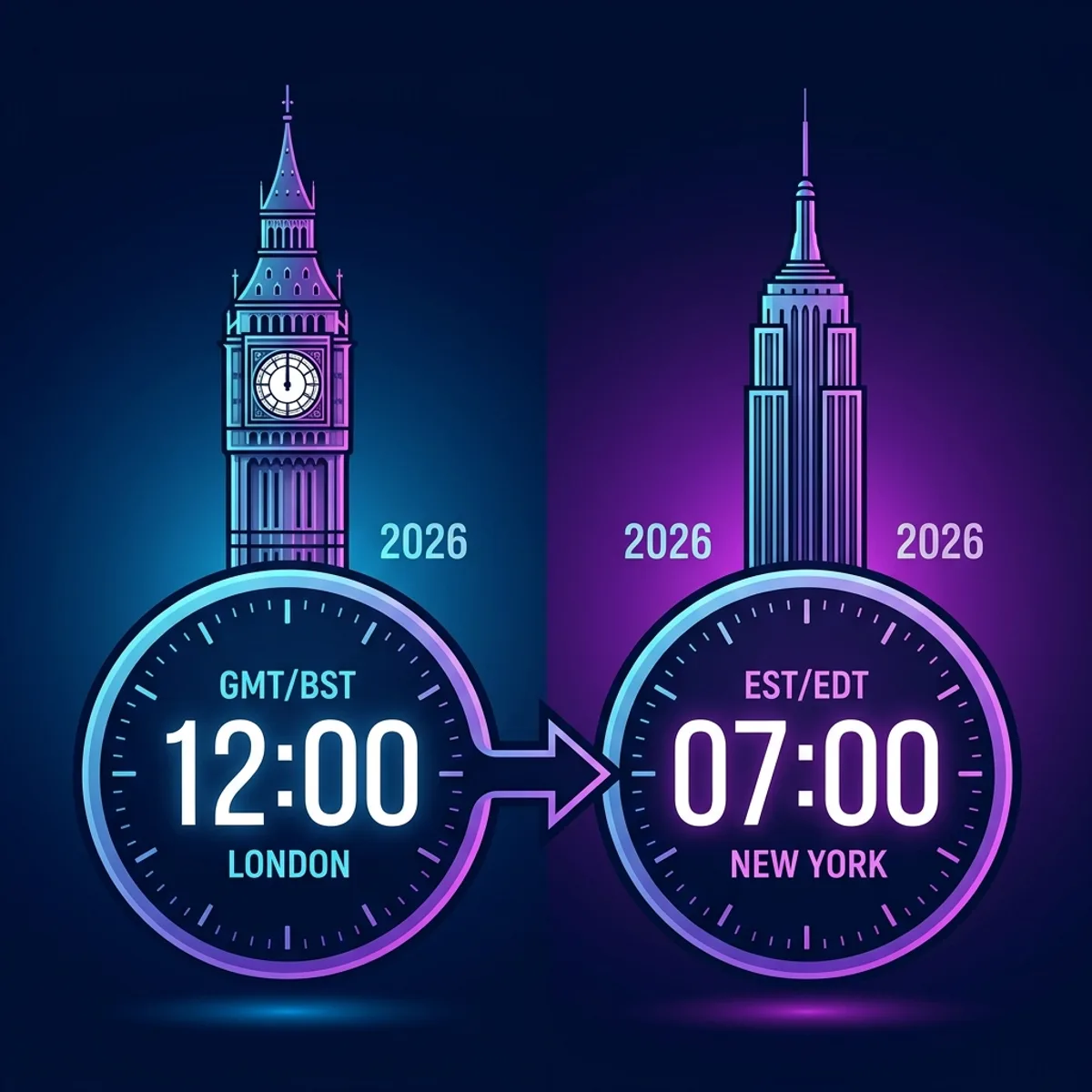
In 2026, UK clocks go back 1 hour on Sunday, October 25 at 2:00 AM BST (marking the end of BST and return to GMT). US clocks go back 1 hour on Sunday, November 1 at 2:00 AM EDT (marking the end of EDT and return to EST). This creates a 1-week gap where London is only 4 hours ahead of New York instead of the standard 5 hours.
Every autumn, the United Kingdom and the United States both turn their clocks back by one hour — but not on the same day. This one-week gap creates a temporary, predictable shift in the time difference between GMT and EST that catches many people off guard, particularly anyone scheduling international calls, flights, or online meetings during late October and early November.
This guide lays out the confirmed 2026 clock change dates for both countries and explains exactly how the GMT-to-EST offset is affected during the transition period.
Quick Answer: 2026 Clock Change Dates
| Country/Region | Clocks Change | Date | Time | Direction |
|---|---|---|---|---|
| United Kingdom | BST → GMT | Sunday, October 25, 2026 | 2:00 AM | Clocks go back 1 hour |
| United States | EDT → EST | Sunday, November 1, 2026 | 2:00 AM | Clocks go back 1 hour |
The UK clocks go back by one hour at 2:00 AM on Sunday, October 25, 2026, marking the end of British Summer Time and the return to Greenwich Mean Time. In the US, daylight saving time ends on the first Sunday of November — in 2026, that is November 1, the day after Halloween.
Why This One-Week Gap Matters
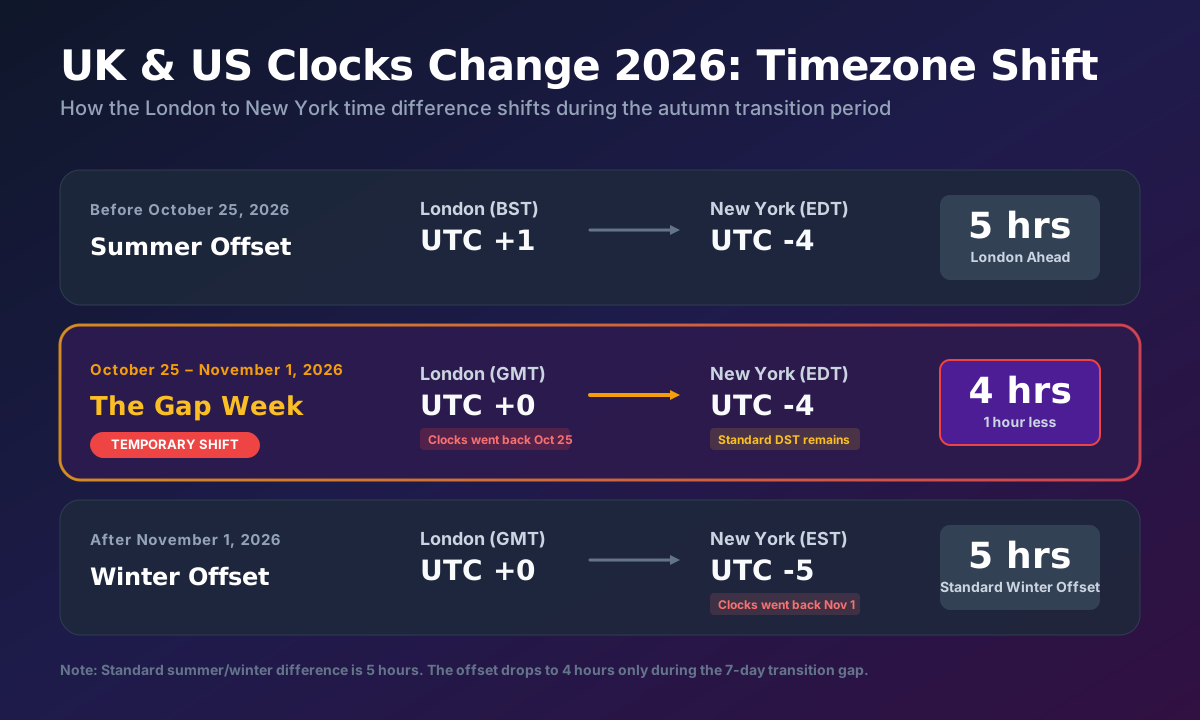
Because the UK reverts to GMT a full week before the US reverts to EST, there is a seven-day window — October 25 to November 1, 2026 — during which the time difference between London and New York changes.
Before October 25, 2026
UK is on BST (GMT+1), US East Coast is on EDT (UTC−4). The difference between London and New York is 5 hours.
October 25 – November 1, 2026 (the gap week)
UK has already moved to GMT (UTC+0), while the US East Coast is still on EDT (UTC−4) until November 1. During this one-week window, the difference between London and New York is only 4 hours — one hour less than usual.
After November 1, 2026
US East Coast moves to EST (UTC−5). UK is already on GMT (UTC+0). The difference returns to 5 hours — the standard winter offset.
This temporary shift is one of the most common sources of scheduling errors for international teams, travelers, and anyone coordinating across the Atlantic during late October.
Full Breakdown: How the Offset Changes Week by Week
| Period | UK Time Zone | US East Coast Time Zone | London–New York Difference |
|---|---|---|---|
| Before Oct 25, 2026 | BST (UTC+1) | EDT (UTC−4) | 5 hours |
| Oct 25 – Nov 1, 2026 | GMT (UTC+0) | EDT (UTC−4) | 4 hours |
| After Nov 1, 2026 | GMT (UTC+0) | EST (UTC−5) | 5 hours |
When Do Other Countries Change Their Clocks?
Daylight saving time is not observed everywhere, and even among countries that do observe it, the exact change dates vary by region. Here is a general reference for major regions in 2026:
| Region | DST Ends (Clocks Back) | 2026 Date |
|---|---|---|
| United Kingdom | Last Sunday in October | October 25, 2026 |
| European Union (most member states) | Last Sunday in October | October 25, 2026 |
| United States | First Sunday in November | November 1, 2026 |
| Canada | First Sunday in November | November 1, 2026 |
| Australia (most states) | First Sunday in April (clocks go back; DST starts in October for southern summer) | Differs — Southern Hemisphere reverses the pattern |
Most of continental Europe follows the same schedule as the UK, changing clocks on the last Sunday in October. This means the UK and EU generally move together, while North America shifts a week later.
Note: Countries near the equator and most of South Asia, including Pakistan and India, do not observe daylight saving time at all — their offset from GMT remains constant year-round.
Why Do the UK and US Change Clocks on Different Dates?
The two countries follow entirely separate legislation. In the UK and EU, the clock change is governed by regional summer time directives, with the period running from the last Sunday in March to the last Sunday in October.
In the US, daylight saving time is set by the Energy Policy Act of 2005, which mandated that daylight saving time begin on the second Sunday in March and end on the first Sunday in November. This law shifted the US schedule from the previous arrangement and is the reason the American clock change now falls roughly a week after the UK’s.
Because the underlying laws were written independently, with different reference points (“last Sunday” vs. “first Sunday” of different months), the two schedules don’t align every year — and in some years, like 2026, the gap is a full week.
What Time Do the Clocks Actually Change?
United Kingdom — Sunday, October 25, 2026: At 2:00 AM BST, clocks move back to 1:00 AM GMT. This gives an extra hour of sleep, as the same hour (1:00–2:00 AM) effectively repeats.
United States — Sunday, November 1, 2026: At 2:00 AM EDT, clocks move back to 1:00 AM EST — the same “fall back” pattern, an hour earlier in the early morning when most people are asleep, minimizing disruption to transport and business.
Most smartphones, computers, and internet-connected devices adjust automatically. Standalone clocks, car dashboards, and older appliances need to be changed manually.
Practical Tips for the Transition Period
If you regularly schedule UK–US calls or meetings: Double-check your calendar invites during the October 25 – November 1 window specifically. A recurring meeting set for “9:00 AM EST” before October 25 may display incorrectly if your calendar software doesn’t automatically adjust for the one-week gap.
If you’re booking flights between the UK and US in this period: Airline schedules account for local time zones automatically, but it’s worth double-checking arrival and departure times if you’re manually converting between time zones for connecting plans.
If you use a timezone converter: Always select the specific date of your event, not just the general time difference, since the offset itself changes within this period. A converter that accounts for exact dates — rather than a fixed “GMT is always 5 hours behind EST” rule — will give you the correct result during the gap week.
For broadcasters and event organizers: If you’re publishing schedules for events spanning late October into November, clearly state the time zone abbreviation (GMT, BST, EDT or EST) rather than just an offset, since the offset itself is in flux during this period.
Frequently Asked Questions
When do UK clocks go back in 2026?
At 2:00 AM on Sunday, October 25, 2026, when British Summer Time ends and the UK returns to Greenwich Mean Time.
When do US clocks go back in 2026?
At 2:00 AM on Sunday, November 1, 2026, when the US East Coast moves from Eastern Daylight Time (EDT) to Eastern Standard Time (EST).
Why is there a difference between when the UK and US change their clocks?
The two countries follow separate legislation with different reference dates. The UK and most of Europe change on the last Sunday in October, while the US and Canada change on the first Sunday in November, per the Energy Policy Act of 2005.
Is the time difference between the UK and US always 5 hours?
Not always. It is 5 hours during most of the year, but drops to 4 hours during the one-week gap between the UK’s clock change (October 25, 2026) and the US clock change (November 1, 2026).
Do all US states observe daylight saving time?
No. Most of Arizona and Hawaii do not observe daylight saving time and remain on standard time year-round.
Does Pakistan or India observe daylight saving time?
No. Pakistan, India, and most countries near the equator do not observe daylight saving time, so their time difference from GMT or EST remains constant throughout the year.
When do clocks go forward again in 2026?
Clocks went forward in the UK at 1:00 AM on Sunday, March 29, 2026, and in the US at 2:00 AM on Sunday, March 8, 2026 — these are the spring “spring forward” dates earlier in the year, separate from the autumn dates covered in this guide.
Use the Converter for Exact Dates
Because the GMT-to-EST offset temporarily shifts during the gap week between October 25 and November 1, 2026, the safest way to confirm any specific time conversion is to check the exact date of your event rather than relying on a general rule of thumb.
Use the GMT to EST Converter at the top of this page, which accounts for the correct daylight saving status on any given date — so you always get an accurate result, whether you’re checking a time in July, late October, or December.
Published: June 20, 2026. Dates confirmed for 2026 based on UK and US government and official timekeeping sources. This article is intended for general informational purposes; always confirm specific event times directly with organizers for time-sensitive plans.
Frequently Asked Questions (FAQ)
When do UK clocks go back in 2026?
At 2:00 AM on Sunday, October 25, 2026, when British Summer Time ends and the UK returns to Greenwich Mean Time.
When do US clocks go back in 2026?
At 2:00 AM on Sunday, November 1, 2026, when the US East Coast moves from Eastern Daylight Time (EDT) to Eastern Standard Time (EST).
Why is there a difference between when the UK and US change their clocks?
The two countries follow separate legislation with different reference dates. The UK and most of Europe change on the last Sunday in October, while the US and Canada change on the first Sunday in November, per the Energy Policy Act of 2005.
Is the time difference between the UK and US always 5 hours?
Not always. It is 5 hours during most of the year, but drops to 4 hours during the one-week gap between the UK's clock change (October 25, 2026) and the US clock change (November 1, 2026).
Do all US states observe daylight saving time?
No. Most of Arizona and Hawaii do not observe daylight saving time and remain on standard time year-round.
Does Pakistan or India observe daylight saving time?
No. Pakistan, India, and most countries near the equator do not observe daylight saving time, so their time difference from GMT or EST remains constant throughout the year.
When do clocks go forward again in 2026?
Clocks went forward in the UK at 1:00 AM on Sunday, March 29, 2026, and in the US at 2:00 AM on Sunday, March 8, 2026 — these are the spring "spring forward" dates earlier in the year, separate from the autumn dates covered in this guide.
Sources & References
- When do the clocks change? - GOV.UK — UK Government
- Daylight Saving Time Rules - NIST — National Institute of Standards and Technology