
What Is EST? Eastern Standard Time Explained
Whether you are scheduling an international conference call, booking a flight to New York, streaming a live broadcast from Wall Street, or calculating match times for major sports leagues, you have almost certainly encountered the abbreviation EST. Standing for Eastern Standard Time, EST anchors the daily rhythm of over 150 million people in North America and serves as the temporal baseline for world stock exchanges, national broadcasting networks, and federal governments.
However, despite its ubiquity, Eastern Standard Time is frequently misunderstood. Misconceptions regarding its exact UTC offset, its seasonal shift into Eastern Daylight Time (EDT), and its geographic reach cause confusion for international remote workers and global travelers.
In this comprehensive guide, we explain everything you need to know about Eastern Standard Time—its definition, mathematical offsets, historical origins, seasonal daylight saving shifts, geographic coverage, global comparisons, and practical tools like our primary GMT to EST Converter to master your scheduling.
In This Guide
- What Does EST Stand For?
- A Brief History of Eastern Time
- EST vs. EDT: Understanding the Difference
- Where Is EST Used?
- EST Around the World
- EST Compared With Major Cities
- Why EST Matters
- Common Misconceptions About EST
- How to Convert EST to Your Local Time
- Frequently Asked Questions
- Final Thoughts
What Does EST Stand For?
EST stands for Eastern Standard Time. It is the standard winter civil time zone observed in the eastern region of North America.
Mathematically, EST is defined by its offset from Coordinated Universal Time (UTC) and Greenwich Mean Time (GMT):
- UTC Offset: UTC-05:00 (5 hours behind UTC)
- GMT Offset: GMT-5 (5 hours behind Greenwich Mean Time)
- Longitudinal Anchor: 75° West Meridian (centered near Philadelphia and Washington D.C.)
When Coordinated Universal Time marks 12:00 PM (noon) in Greenwich, London, clocks in the Eastern Standard Time zone show 07:00 AM EST.
UTC Baseline:   12:00 PM (12:00 UTC)
EST Offset:     -5 Hours
EST Clock Time: 07:00 AM (07:00 EST)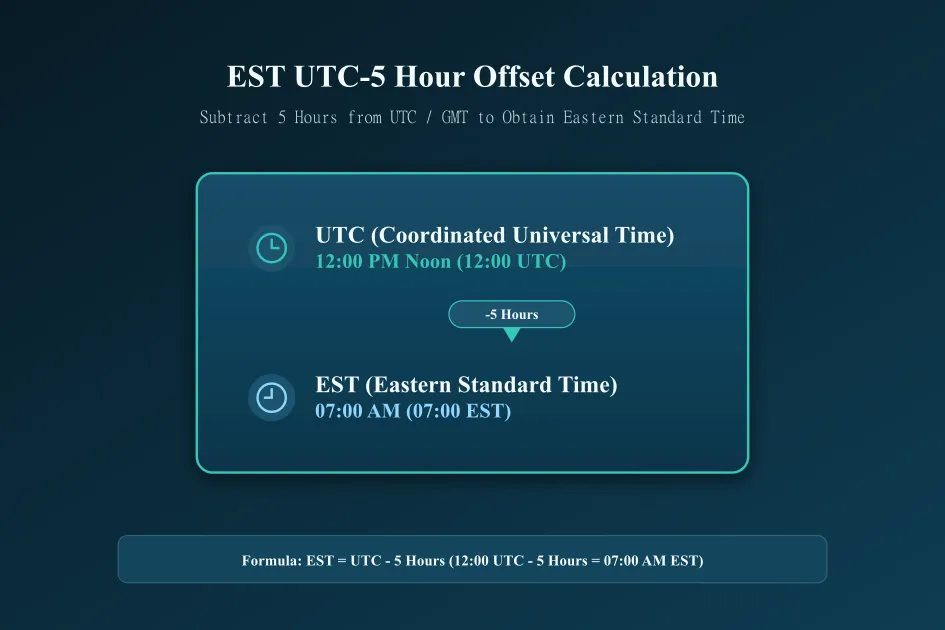
Important Terminology Distinctions:
- EST (Eastern Standard Time): Specifically refers to the standard winter time offset at UTC-5.
- EDT (Eastern Daylight Time): Specifically refers to the summer daylight saving time offset at UTC-4.
- ET (Eastern Time): The generic, umbrella regional designation that automatically encompasses EST in winter and EDT in summer.
Outside regional contexts, using “EST” during the summer months when daylight saving time is active is technically inaccurate. When summer clock shifts are in effect, New York and Toronto operate on EDT (UTC-4), not EST.
A Brief History of Eastern Time
Before standard time zones existed, every town across North America set its own local solar time based on the sun’s position at high noon. In the mid-19th century, over 300 local solar time baselines existed in the United States alone.
As railway lines expanded across the American continent, local solar time caused dangerous confusion. Trains traveling east or west between cities encountered conflicting clock schedules, leading to station misconnects and fatal train collisions.
The General Time Convention of 1883
On November 18, 1883—known historically as “The Day of Two Noons”—major North American railroad companies adopted a standardized time system proposed by railway manager William F. Allen. They divided the continent into four standardized time zones anchored to 15-degree longitudinal meridians:
- Eastern Time: Anchored at 75°W (UTC-5)
- Central Time: Anchored at 90°W (UTC-6)
- Mountain Time: Anchored at 105°W (UTC-7)
- Pacific Time: Anchored at 120°W (UTC-8)
At noon on that historic Sunday, telegraph signals sent from the Allegheny Observatory in Pittsburgh reset clocks across Eastern train stations simultaneously.
Federal Legislation: 1918 to 2005
- Standard Time Act of 1918: U.S. Congress formally legalized standardized time zones and introduced nationwide Daylight Saving Time during World War I to conserve fuel.
- Uniform Time Act of 1966: Standardized national start and end dates for daylight saving time across participating U.S. states.
- Energy Policy Act of 2005: Extended daylight saving time in North America to its modern schedule—starting on the second Sunday of March and ending on the first Sunday of November.
EST vs. EDT: Understanding the Difference
The most frequent source of error when converting Eastern time is confusing Eastern Standard Time (EST) with Eastern Daylight Time (EDT).
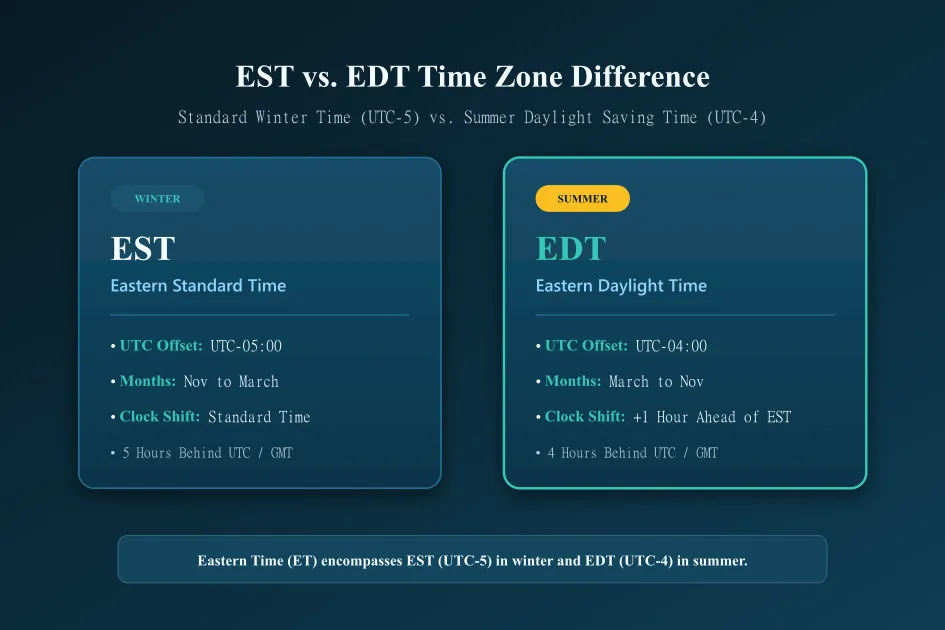
Comparison Summary
| Attribute | Eastern Standard Time (EST) | Eastern Daylight Time (EDT) |
|---|---|---|
| Seasonal Window | Early November to Mid-March (Winter) | Mid-March to Early November (Summer) |
| UTC Offset | UTC-05:00 | UTC-04:00 |
| GMT Offset | 5 Hours Behind GMT | 4 Hours Behind GMT |
| Daylight Saving Status | Standard Time (Clocks Fall Back) | Daylight Saving Time (Clocks Spring Forward) |
| Example (Noon UTC) | 07:00 AM EST | 08:00 AM EDT |
The Annual Transition Schedule
- Spring Forward (EST → EDT): On the second Sunday of March at 2:00 AM, local clocks advance 1 hour from 02:00 EST to 03:00 EDT.
- Fall Back (EDT → EST): On the first Sunday of November at 2:00 AM, local clocks shift back 1 hour from 02:00 EDT to 01:00 EST.
For a detailed breakdown of DST transition dates, explore our standalone EST vs EDT Guide.
Where Is EST Used?
The Eastern Time Zone covers a vast geographical corridor stretching from the Canadian Arctic down through eastern U.S. states to the Caribbean and South America.
EST and the United States
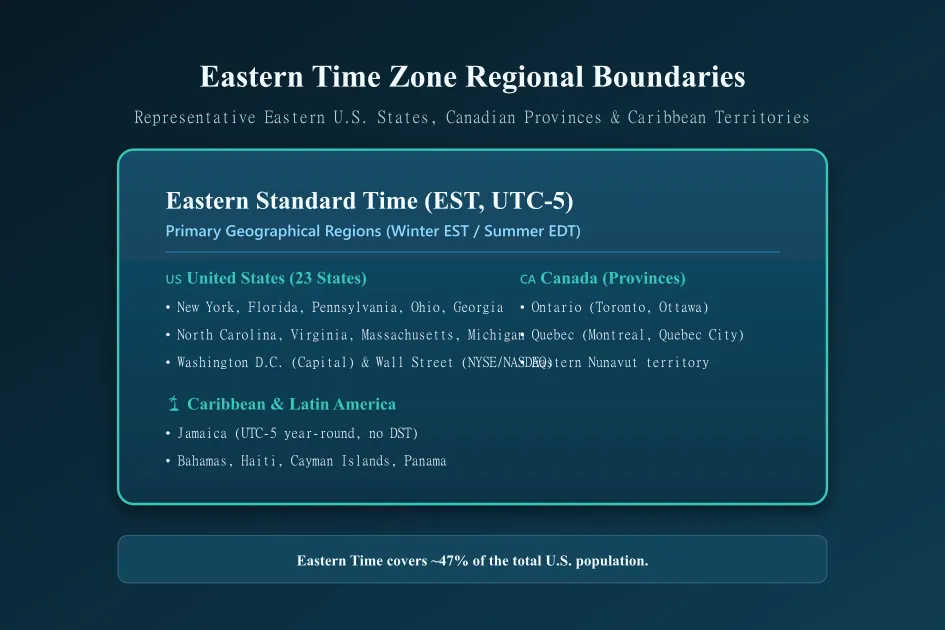
Approximately 47% of the U.S. population resides within the Eastern Time Zone. A total of 23 U.S. states operate on Eastern Time:
- Entirely on Eastern Time (17 States): Connecticut, Delaware, Georgia, Maine, Maryland, Massachusetts, New Hampshire, New Jersey, New York, North Carolina, Ohio, Pennsylvania, Rhode Island, South Carolina, Vermont, Virginia, West Virginia.
- Partially on Eastern Time (6 States): Florida, Indiana, Kentucky, Michigan, Tennessee, Alabama (Phenix City area).
- Federal Capital: Washington D.C. operates fully on Eastern Time.
EST and Canada
In Canada, Eastern Time is observed across the country’s most populous commercial provinces:
- Ontario: Including Toronto, Ottawa, and Mississauga (excluding western border areas near Thunder Bay).
- Quebec: Including Montreal, Quebec City, and Gatineau.
- Nunavut: Eastern regions including the territorial capital Iqaluit.
EST in the Caribbean and Central America
Several island nations and territories operate within the UTC-5 meridian coordinate:
- Seasonal DST Observers: The Bahamas, Haiti, and Bermuda transition between EST (UTC-5) and EDT (UTC-4).
- Year-Round UTC-5 Observers (No DST): Jamaica, the Cayman Islands, and Panama maintain UTC-5 year-round. During northern winter months, their clock time matches EST exactly. In northern summer, when New York advances to EDT (UTC-4), Jamaica remains at UTC-5 (1 hour behind EDT).
EST Around the World
Understanding how EST connects with international regional baselines is vital for cross-border workflows.
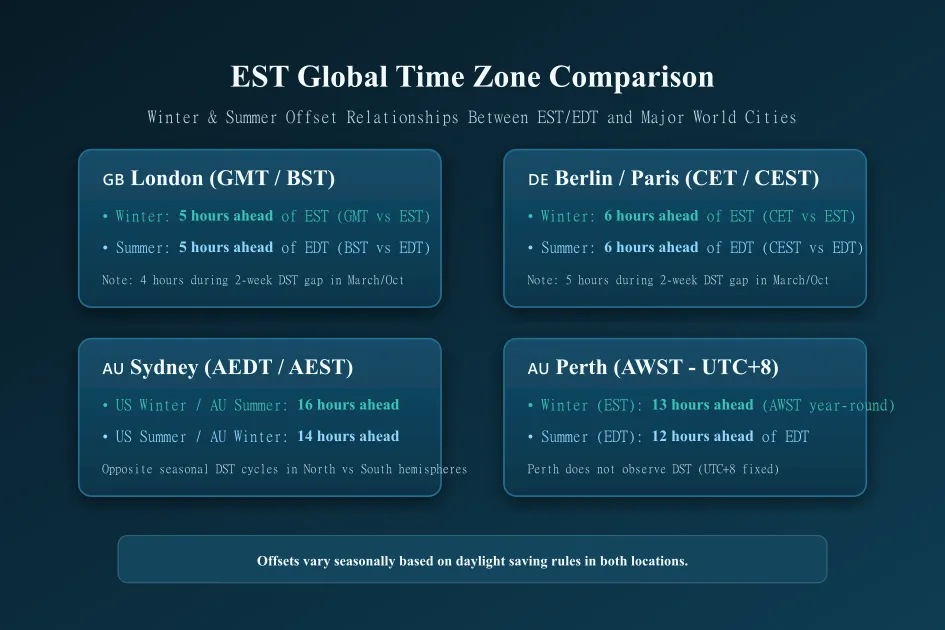
EST and the United Kingdom
The United Kingdom operates on Greenwich Mean Time (GMT, UTC+0) during winter and British Summer Time (BST, UTC+1) during summer.
- Winter Relationship: When London is on GMT (UTC+0) and New York is on EST (UTC-5), London is 5 hours ahead of EST. (e.g., 5:00 PM GMT = 12:00 PM EST). Check our dedicated GMT to EST Converter for live winter conversions.
- Summer Relationship: When London shifts to BST (UTC+1) and New York shifts to EDT (UTC-4), London is 5 hours ahead of EDT.
- The 2-Week DST Asymmetry: Because the U.S. shifts to daylight saving time in mid-March (before the UK shifts in late March), and shifts back in early November (after the UK shifts in late October), there are two two-week periods each year where the time gap between London and New York narrows to 4 hours.
EST and Europe
Central European countries (France, Germany, Italy, Spain) operate on Central European Time (CET, UTC+1) in winter and Central European Summer Time (CEST, UTC+2) in summer.
- Winter: Berlin and Paris are 6 hours ahead of EST (CET vs EST).
- Summer: Berlin and Paris are 6 hours ahead of EDT (CEST vs EDT).
- Check our GMT to CET Converter and GMT to CEST Converter to navigate European time shifts.
EST and Australia
Australia spans multiple time zones across the Southern Hemisphere. Because seasons are inverted, when North America enters winter (EST), Australia enters summer daylight saving time.
- Sydney / Melbourne (AEDT, UTC+11): During northern winter (EST), Sydney operates on AEDT. Sydney is 16 hours ahead of EST (e.g., 10:00 AM Monday in Sydney = 6:00 PM Sunday EST).
- Perth (AWST, UTC+8): Western Australia maintains UTC+8 year-round without DST. Perth is 13 hours ahead of EST in winter and 12 hours ahead of EDT in summer.
EST Compared With Major Cities
The reference table below illustrates how 12:00 PM (noon) in New York (EST/EDT) aligns with key global cities during northern winter and northern summer:
| Global City | Region / Zone | Winter Local Time (When NYC is 12:00 PM EST) | Summer Local Time (When NYC is 12:00 PM EDT) | Time Difference vs NYC |
|---|---|---|---|---|
| New York City | USA (ET) | 12:00 PM EST (UTC-5) | 12:00 PM EDT (UTC-4) | Base Location (0 hrs) |
| London | UK (GMT/BST) | 5:00 PM GMT (UTC+0) | 5:00 PM BST (UTC+1) | +5 Hours |
| Paris / Berlin | Europe (CET/CEST) | 6:00 PM CET (UTC+1) | 6:00 PM CEST (UTC+2) | +6 Hours |
| Lagos | Nigeria (WAT) | 6:00 PM WAT (UTC+1) | 5:00 PM WAT (UTC+1) | +5 hrs (Winter) / +4 hrs (Summer) |
| Karachi | Pakistan (PKT) | 10:00 PM PKT (UTC+5) | 9:00 PM PKT (UTC+5) | +10 hrs (Winter) / +9 hrs (Summer) |
| New Delhi | India (IST) | 10:30 PM IST (UTC+5:30) | 9:30 PM IST (UTC+5:30) | +10.5 hrs (Winter) / +9.5 hrs (Summer) |
| Tokyo | Japan (JST) | 2:00 AM JST (Next Day, UTC+9) | 1:00 AM JST (Next Day, UTC+9) | +14 hrs (Winter) / +13 hrs (Summer) |
| Sydney | Australia (AEST/AEDT) | 4:00 AM AEDT (Next Day, UTC+11) | 2:00 AM AEST (Next Day, UTC+10) | +16 hrs (Winter) / +14 hrs (Summer) |
Why EST Matters
Eastern Standard Time exerts a disproportionate influence on global commerce, communications, and government workflows.
Financial Markets
The world’s largest equity exchanges—the New York Stock Exchange (NYSE) and NASDAQ—are headquartered in New York City. Regular trading sessions operate strictly between 9:30 AM and 4:00 PM Eastern Time. Financial institutions in London, Frankfurt, Tokyo, and Hong Kong align their trading desks around Wall Street’s Eastern bell.
U.S. Government and Politics
Washington D.C. sits in the Eastern Time Zone. Presidential addresses, Congressional votes, Supreme Court rulings, federal policy releases, and economic indicators (such as employment figures from the Bureau of Labor Statistics) are released on Eastern Time schedules.
Media and Entertainment
Major U.S. television networks (ABC, CBS, NBC, FOX, HBO) anchor their broadcast schedules on Eastern Time. Prime-time entertainment programming traditionally airs at 8:00 PM Eastern. Major sports leagues (NFL, NBA, MLB, NHL) list national game schedules in Eastern Time.
Global Scheduling
Because Eastern Time bridges European afternoon hours with West Coast morning hours, multinational corporations frequently host global town halls and earnings calls between 10:00 AM and 11:30 AM EST, allowing participants in London (3:00 PM GMT) and San Francisco (7:00 AM PST) to join simultaneously.
Common Misconceptions About EST
- “EST is used year-round in New York.”
Fact: New York only uses EST during the 4 winter months (November to March). During the 8 summer months (March to November), New York uses EDT (UTC-4). - “EST and UTC are the same.”
Fact: UTC is the zero-offset atomic reference (UTC+0). EST is 5 hours behind UTC (UTC-5). - “EST is 5 hours behind London all year.”
Fact: While London (GMT) is 5 hours ahead of EST in winter, during the 2-week spring and autumn DST transition gaps, the difference briefly becomes 4 hours. - “Jamaica changes clocks for DST.”
Fact: Jamaica observes UTC-5 year-round and does not adjust clocks for daylight saving time.
How to Convert EST to Your Local Time
To convert Eastern Standard Time (EST, UTC-5) to any local time zone manually:
- Determine your target time zone’s UTC offset. (e.g., GMT = UTC+0; CET = UTC+1; PST = UTC-8).
- Calculate the offset difference between your zone and UTC-5.
- Example (EST to GMT): GMT (0) minus EST (-5) = +5 hours.
- Example (EST to PST): PST (-8) minus EST (-5) = -3 hours.
- Add or subtract the difference from the EST clock time.
- 2:00 PM EST + 5 hours = 7:00 PM GMT in London.
- 2:00 PM EST - 3 hours = 11:00 AM PST in Los Angeles.
Recommended Timezone Tools
For automated, error-free conversions that account for daylight saving shifts, leverage our verified interactive tools:
- GMT to EST Converter – Our primary real-time converter with DST-aware calculations.
- EST to GMT Converter – Reverse conversion tool for UK and European scheduling.
- GMT vs EST Comparison – Structural breakdown of Greenwich and Eastern time differences.
- UTC to EST Converter – Convert atomic Coordinated Universal Time directly to EST.
- EST vs EDT Guide – Complete guide to North American daylight saving rules.
- What Is GMT Guide – Explore Greenwich Mean Time history and baseline principles.
Frequently Asked Questions
What does EST stand for?
EST stands for Eastern Standard Time. It is the standard winter civil time zone observed across eastern North America, operating at UTC-5.
What is the UTC offset of EST?
Eastern Standard Time operates at an offset of UTC-05:00 (5 hours behind Coordinated Universal Time).
What is the difference between EST and EDT?
EST (Eastern Standard Time) is winter standard time (UTC-5). EDT (Eastern Daylight Time) is summer daylight saving time (UTC-4). Clocks advance 1 hour from EST to EDT on the second Sunday of March and shift back on the first Sunday of November.
Is Eastern Time (ET) the same as EST?
Eastern Time (ET) is the generic regional umbrella term encompassing both EST (winter, UTC-5) and EDT (summer, UTC-4).
Which major cities operate on Eastern Time?
Major cities include New York City, Washington D.C., Boston, Atlanta, Miami, Philadelphia, Pittsburgh, Toronto, Montreal, and Ottawa.
Is New York City always on EST?
No. New York City operates on EST (UTC-5) from early November to mid-March, and on EDT (UTC-4) from mid-March to early November.
Does Jamaica observe EST year-round?
Yes. Jamaica operates on UTC-5 year-round without daylight saving clock shifts, matching EST in winter.
When was Eastern Standard Time established?
North American railroads established Eastern Standard Time on November 18, 1883, to standardize train schedules.
What is the difference between EST and GMT?
GMT is Greenwich Mean Time (UTC+0). EST is UTC-5. EST is 5 hours behind GMT in winter.
How many U.S. states use Eastern Time?
23 U.S. states (17 fully and 6 partially) operate within the Eastern Time Zone.
Why do financial markets use Eastern Time?
The NYSE and NASDAQ are located in New York. Wall Street trading hours (9:30 AM to 4:00 PM ET) serve as the benchmark for world financial markets.
What is the difference between EST and UTC?
UTC is the atomic reference baseline (UTC+0). EST is a regional civil offset fixed at 5 hours behind UTC (UTC-5).
How do I convert EST to London time?
In winter, London (GMT, UTC+0) is 5 hours ahead of EST (UTC-5). Add 5 hours to EST to calculate London GMT.
Does Eastern Time change on the same date as European daylight saving time?
No. North America shifts to EDT on the second Sunday of March, while Europe shifts to BST/CEST on the last Sunday of March. This creates a 2-week offset shift twice a year.
What timezone identifier should developers use for Eastern Time?
Software developers should use location-based IANA keys like America/New_York or America/Toronto to handle daylight saving shifts automatically.
Final Thoughts
Eastern Standard Time is far more than a local clock setting—it is the temporal anchor for global finance, international governance, media broadcasting, and North American commerce. By understanding its fixed UTC-5 offset, its seasonal transition into EDT (UTC-4), and its relationship with Greenwich Mean Time, you can eliminate scheduling errors and streamline your international communications.
Bookmark our GMT to EST Converter to instantly convert times between London, New York, and global destinations with date-aware precision.
Frequently Asked Questions (FAQ)
What does EST stand for?
EST stands for Eastern Standard Time. It is the standard winter time observed across eastern North America, operating at UTC-5.
What is the UTC offset of EST?
Eastern Standard Time is UTC-5 (Coordinated Universal Time minus 5 hours). It is 5 hours behind Greenwich Mean Time (GMT).
What is the difference between EST and EDT?
EST (Eastern Standard Time) is standard winter time at UTC-5. EDT (Eastern Daylight Time) is summer daylight saving time at UTC-4. Clocks advance 1 hour from EST to EDT in March and shift back in November.
Is Eastern Time (ET) the same as EST?
Not entirely. Eastern Time (ET) is the umbrella term for the regional time zone. It refers to EST (UTC-5) during winter and EDT (UTC-4) during summer daylight saving months.
Which major cities operate on Eastern Time?
Major metropolitan areas on Eastern Time include New York City, Washington D.C., Boston, Atlanta, Miami, Philadelphia, Toronto, Montreal, and Ottawa.
Is New York City always on EST?
No. New York City operates on Eastern Standard Time (EST, UTC-5) from early November to mid-March, and on Eastern Daylight Time (EDT, UTC-4) from mid-March to early November.
Does Jamaica observe EST year-round?
Yes. Jamaica is located in the Eastern Time coordinates and observes UTC-5 year-round without daylight saving clock shifts.
When was Eastern Standard Time established?
Standard time zones in North America were established on November 18, 1883, by major railroad companies to replace confusing local solar times.
What is the difference between EST and GMT?
GMT is Greenwich Mean Time (UTC+0). EST is UTC-5. EST is 5 hours behind GMT in winter.
How many U.S. states use Eastern Time?
23 U.S. states (17 fully and 6 partially) operate within the Eastern Time Zone.
Why do financial markets use Eastern Time?
The New York Stock Exchange (NYSE) and NASDAQ are located in New York City. Wall Street trading hours (9:30 AM to 4:00 PM ET) serve as the benchmark for global financial markets.
What is the difference between EST and UTC?
UTC is the scientific atomic reference baseline (UTC+0). EST is a regional civil time offset fixed at 5 hours behind UTC (UTC-5).
How do I convert EST to London time?
In winter, London (GMT, UTC+0) is 5 hours ahead of EST (UTC-5). Add 5 hours to EST to get London GMT time.
Does Eastern Time change on the same date as European daylight saving time?
No. North America transitions to EDT on the second Sunday of March, whereas Europe transitions to Summer Time (BST/CEST) on the last Sunday of March. This creates a 2-week offset shift twice a year.
What timezone identifier should developers use for Eastern Time?
Developers should use location-based IANA keys like America/New_York or America/Toronto rather than static EST strings to automatically account for daylight saving changes.
Sources & References
- Time Zone Boundaries & Standard Time Act History — U.S. Department of Transportation
- Coordinated Universal Time (UTC) and Time Scales — National Institute of Standards and Technology (NIST)
- IANA Time Zone Database (America/New_York) — IANA Time Zone Database
- The History of Standard Time in the United States — U.S. Naval Observatory (USNO)