
Understanding the GMT to NST Conversion
Coordinating communications, flights, maritime logistics, software deployments, and remote meetings between the United Kingdom or Europe and the island of Newfoundland in Eastern Canada requires accounting for one of North America's most unique time zones: Newfoundland Standard Time (NST).
Unlike the majority of North American time zones that operate on whole-hour offsets (such as Eastern Standard Time at UTC-5 or Atlantic Standard Time at UTC-4), Newfoundland operates on a half-hour offset of UTC−3:30. Greenwich Mean Time (GMT) serves as the zero-degree longitudinal reference point (UTC+0).
Because NST sits at UTC−3:30, Newfoundland is 3 hours and 30 minutes behind GMT. When it is 12:00 PM noon in Greenwich, London, it is 08:30 AM in St. John's, Newfoundland. Our dedicated converter ensures the 30-minute minute-field precision is preserved while accurately computing date rollovers when converting early GMT morning hours.
GMT to NST Time Difference
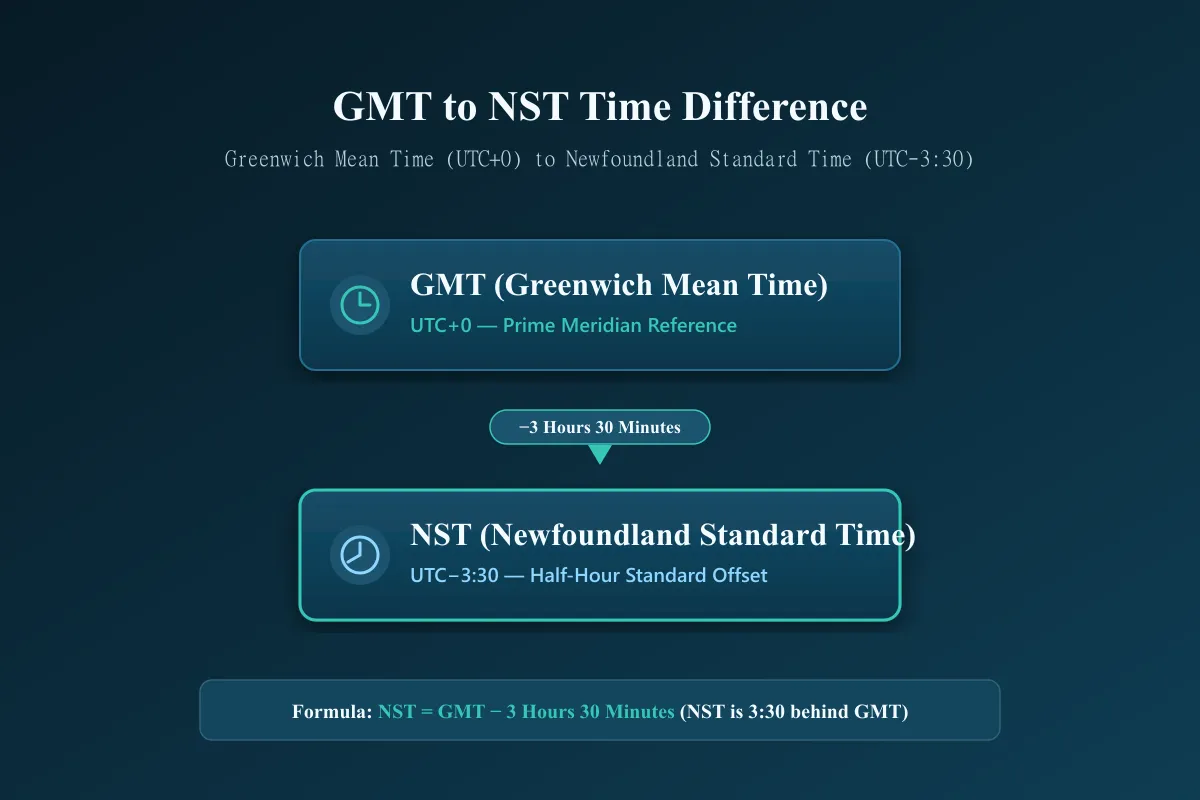
The precise time difference between Greenwich Mean Time and Newfoundland Standard Time is 3 hours and 30 minutes. Newfoundland Standard Time is 3 hours 30 minutes behind Greenwich Mean Time.
The mathematical formula for converting GMT to NST is:
NST = GMT − 3 Hours 30 Minutes
UTC+0 (Prime Meridian) → UTC−3:30 (Newfoundland Standard Time)
Because the offset is negative (−3:30), Newfoundland clocks show an earlier hour than Greenwich clocks on any given day. Furthermore, subtracting 3 hours and 30 minutes from early morning GMT times (between 00:00 and 03:29 GMT) shifts the local clock back into the previous calendar day in Newfoundland.
How to Convert GMT to NST
To convert Greenwich Mean Time to Newfoundland Standard Time manually, follow this step-by-step procedure:
- Start with the GMT date and time: Note the clock time in 24-hour or 12-hour format (e.g., 14:30 GMT).
- Confirm the GMT baseline: Ensure the starting figure uses UTC+0 without daylight saving modifications.
- Identify NST's offset: Recognize that Newfoundland Standard Time uses UTC−3:30.
- Subtract 3 hours and 30 minutes: Subtract 3 hours from the hour value, and 30 minutes from the minute value (14:30 − 3:30 = 11:00).
- Check for previous-day rollover: If the calculated time goes prior to 00:00 (midnight), add 24 hours to the time value.
- Adjust the calendar date if needed: If the time crossed midnight backward, roll back the day, month, or year by one calendar day.
- Confirm final NST output: Record the converted time, date, and NST abbreviation (e.g., 11:00 AM NST).
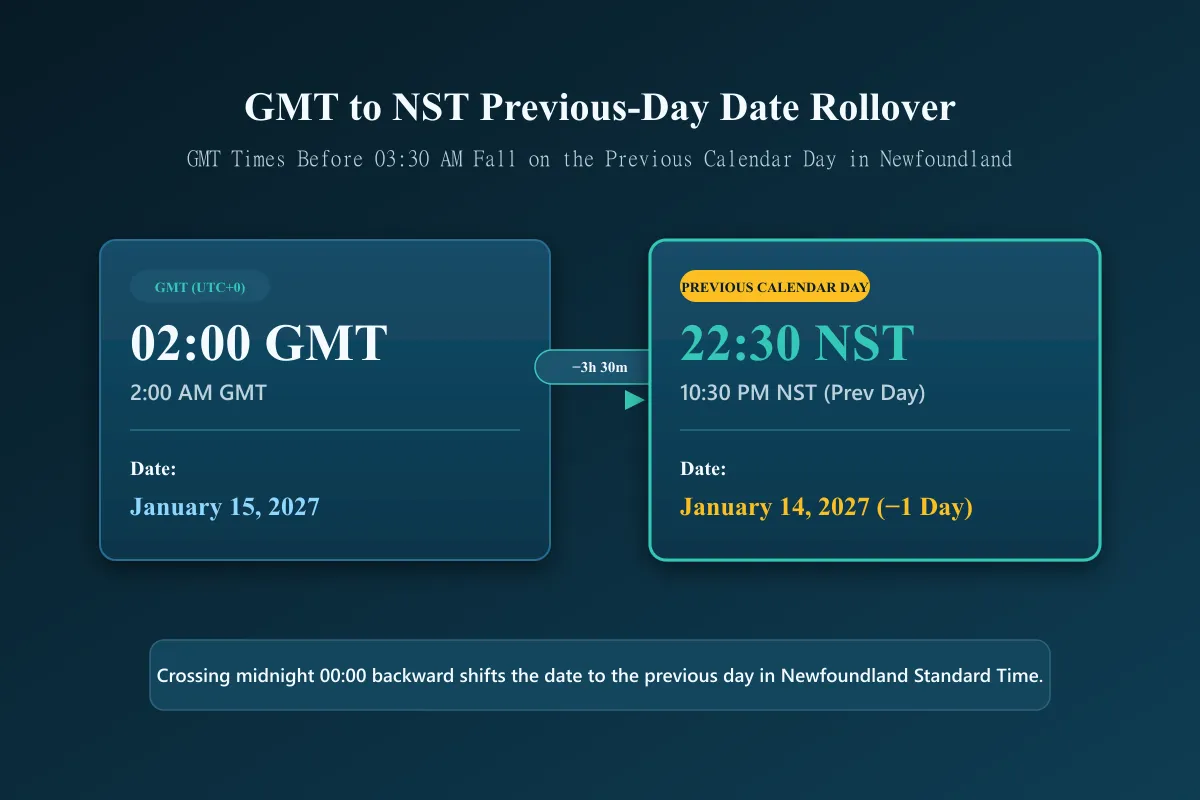
For example, converting 14:30 GMT gives 11:00 NST on the exact same date. However, converting 02:00 GMT requires subtracting 3 hours 30 minutes: 02:00 − 3:30 = −1:30. Adding 24 hours yields 22:30 NST (10:30 PM NST) on the previous calendar day.
GMT to NST 24-Hour Conversion Table
The comprehensive reference table below provides an hour-by-hour map converting Greenwich Mean Time (00:00 through 23:00) to Newfoundland Standard Time (UTC−3:30). Rows highlighted in colored styling indicate GMT hours that fall on the previous calendar day in Newfoundland.
| GMT (12-Hour) | GMT (24-Hour) | NST (12-Hour) | NST (24-Hour) | Calendar Status |
|---|---|---|---|---|
| 12:00 AM | 00:00 | 8:30 PM | 20:30 | Previous day |
| 1:00 AM | 01:00 | 9:30 PM | 21:30 | Previous day |
| 2:00 AM | 02:00 | 10:30 PM | 22:30 | Previous day |
| 3:00 AM | 03:00 | 11:30 PM | 23:30 | Previous day |
| 4:00 AM | 04:00 | 12:30 AM | 00:30 | Same day |
| 5:00 AM | 05:00 | 1:30 AM | 01:30 | Same day |
| 6:00 AM | 06:00 | 2:30 AM | 02:30 | Same day |
| 7:00 AM | 07:00 | 3:30 AM | 03:30 | Same day |
| 8:00 AM | 08:00 | 4:30 AM | 04:30 | Same day |
| 9:00 AM | 09:00 | 5:30 AM | 05:30 | Same day |
| 10:00 AM | 10:00 | 6:30 AM | 06:30 | Same day |
| 11:00 AM | 11:00 | 7:30 AM | 07:30 | Same day |
| 12:00 PM | 12:00 | 8:30 AM | 08:30 | Same day |
| 1:00 PM | 13:00 | 9:30 AM | 09:30 | Same day |
| 2:00 PM | 14:00 | 10:30 AM | 10:30 | Same day |
| 3:00 PM | 15:00 | 11:30 AM | 11:30 | Same day |
| 4:00 PM | 16:00 | 12:30 PM | 12:30 | Same day |
| 5:00 PM | 17:00 | 1:30 PM | 13:30 | Same day |
| 6:00 PM | 18:00 | 2:30 PM | 14:30 | Same day |
| 7:00 PM | 19:00 | 3:30 PM | 15:30 | Same day |
| 8:00 PM | 20:00 | 4:30 PM | 16:30 | Same day |
| 9:00 PM | 21:00 | 5:30 PM | 17:30 | Same day |
| 10:00 PM | 22:00 | 6:30 PM | 18:30 | Same day |
| 11:00 PM | 23:00 | 7:30 PM | 19:30 | Same day |
Note: Notice how every converted NST time ends in :30 when converting full GMT hours, preserving the 30-minute offset.
GMT to NST Conversion Examples
Explore these 15 practical conversion examples illustrating full clock and date transitions:
Example 1: Midnight GMT
00:00 GMT → 20:30 NST (Previous Day)
When a new calendar day begins at 00:00 midnight GMT, it is 8:30 PM (20:30) NST on the previous evening in St. John's.
Example 2: 01:00 GMT
01:00 GMT → 21:30 NST (Previous Day)
01:00 AM GMT on January 15 corresponds to 9:30 PM (21:30) NST on January 14.
Example 3: 02:00 GMT
02:00 GMT → 22:30 NST (Previous Day)
02:00 AM GMT on December 1 translates to 10:30 PM (22:30) NST on November 30.
Example 4: 03:00 GMT
03:00 GMT → 23:30 NST (Previous Day)
03:00 AM GMT equals 11:30 PM (23:30) NST on the previous evening in Newfoundland.
Example 5: 04:00 GMT
04:00 GMT → 00:30 NST (Same Day)
04:00 AM GMT is the first full hour of the day that reaches the same calendar date in Newfoundland (12:30 AM NST).
Example 6: 06:00 GMT
06:00 GMT → 02:30 NST (Same Day)
06:00 AM GMT equals 02:30 AM NST pre-dawn hours in Newfoundland.
Example 7: 08:00 GMT
08:00 GMT → 04:30 NST (Same Day)
08:00 AM GMT corresponds to 04:30 AM NST.
Example 8: 10:00 GMT
10:00 GMT → 06:30 NST (Same Day)
10:00 AM GMT equals 06:30 AM NST as early risers prepare in St. John's.
Example 9: Noon GMT
12:00 GMT → 08:30 NST (Same Day)
12:00 PM noon GMT equals 08:30 AM NST as offices open across Newfoundland.
Example 10: 14:30 GMT
14:30 GMT → 11:00 NST (Same Day)
14:30 (2:30 PM) GMT minus 3 hours 30 minutes equals 11:00 AM NST mid-morning.
Example 11: 16:00 GMT
16:00 GMT → 12:30 NST (Same Day)
16:00 (4:00 PM) GMT equals 12:30 PM NST lunch hour in Newfoundland.
Example 12: 18:00 GMT
18:00 GMT → 14:30 NST (Same Day)
18:00 (6:00 PM) GMT equals 14:30 (2:30 PM) NST afternoon hours.
Example 13: 20:00 GMT
20:00 GMT → 16:30 NST (Same Day)
20:00 (8:00 PM) GMT equals 16:30 (4:30 PM) NST late afternoon.
Example 14: 22:00 GMT
22:00 GMT → 18:30 NST (Same Day)
22:00 (10:00 PM) GMT equals 18:30 (6:30 PM) NST early evening.
Example 15: New Year Boundary
01:00 GMT (Jan 1, 2027) → 21:30 NST (Dec 31, 2026)
A 01:00 AM GMT event on New Year's Day 2027 in Greenwich occurs at 9:30 PM NST on New Year's Eve 2026 in Newfoundland!
What Is GMT?
Greenwich Mean Time (GMT) is the historic solar time standard measured at the Royal Observatory in Greenwich, London, situated at 0° longitude (the Prime Meridian).
GMT serves as the international reference benchmark for UTC+0. Although Coordinated Universal Time (UTC) has replaced GMT as the formal atomic time standard in technology and navigation, GMT remains the standard civil reference name in the UK and worldwide conversion software. You can learn more about GMT on our What Is GMT guide or use our primary GMT to EST Converter.
What Is NST?
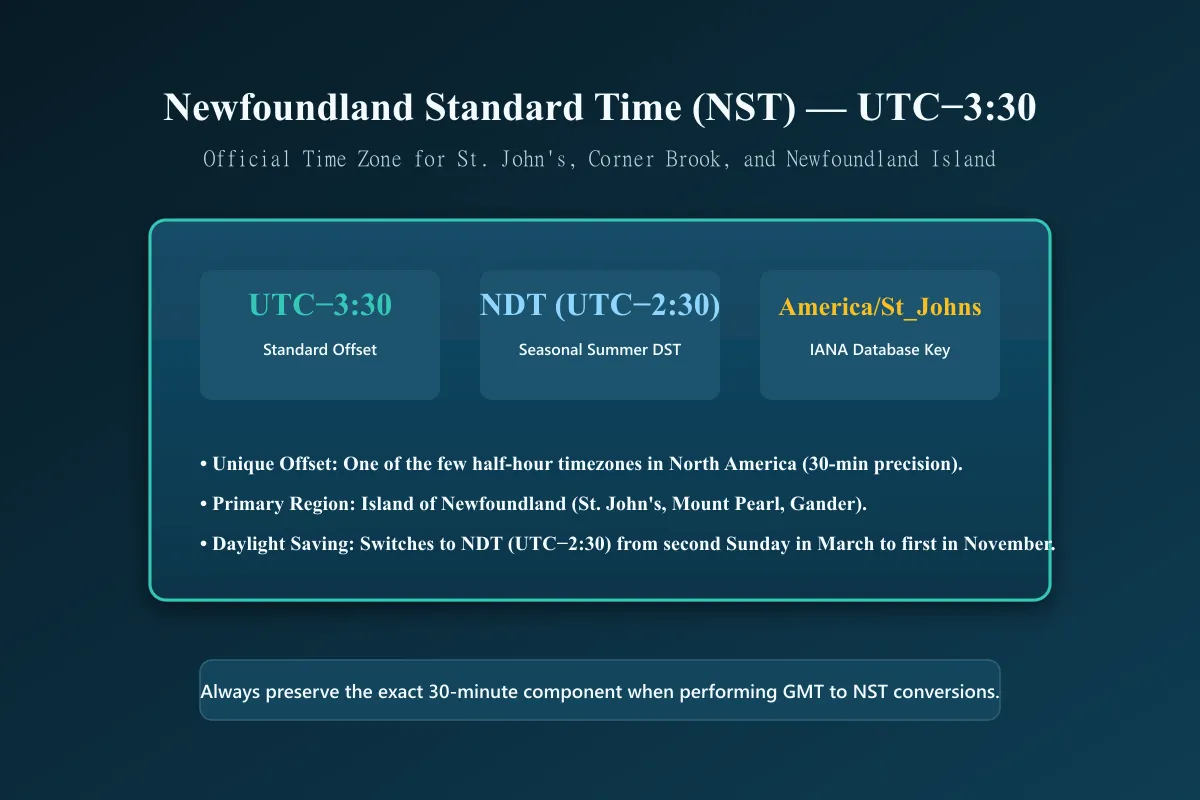
Newfoundland Standard Time (NST) is the official standard time zone observed on the island of Newfoundland in the province of Newfoundland and Labrador, Canada.
NST operates at UTC−3:30 (Coordinated Universal Time minus 3 hours and 30 minutes). In international software systems (the IANA Time Zone Database), Newfoundland Standard Time is represented by the location string America/St_Johns.
What Is NDT?
Newfoundland Daylight Time (NDT) is the seasonal daylight saving time zone observed in Newfoundland during the spring, summer, and early autumn months.
NDT operates at UTC−2:30 (Coordinated Universal Time minus 2 hours and 30 minutes). Clocks in Newfoundland advance 1 hour forward from NST (UTC−3:30) to NDT (UTC−2:30) on the second Sunday in March and return to NST on the first Sunday in November.
GMT vs NST Comparison
| Feature | Greenwich Mean Time (GMT) | Newfoundland Standard Time (NST) |
|---|---|---|
| Full Name | Greenwich Mean Time | Newfoundland Standard Time |
| UTC Offset | UTC+0 | UTC−3:30 |
| Relative Difference | 3 hours 30 minutes ahead of NST | 3 hours 30 minutes behind GMT |
| Offset Structure | Whole-hour baseline | Half-hour (30-minute) offset |
| Seasonal Partner | BST (UTC+1 in UK summer) | NDT (UTC−2:30 in Newfoundland summer) |
| IANA Key | Etc/GMT or UTC | America/St_Johns |
Why NST Has a 30-Minute Offset
In 1935, prior to Newfoundland joining the Canadian Confederation in 1949, the Dominion of Newfoundland established its own official time zone. Because the island sits geographically between 52°W and 59°W longitude, standard noon solar time in St. John's lies approximately 3 hours and 30 minutes behind Greenwich longitude.
To align civil time closer to natural solar daylight, Newfoundland chose UTC−3:30 instead of rounding up to Atlantic Time (UTC-4) or down to Greenland Time (UTC-3). Today, it remains one of North America's most distinctive half-hour time zones.
Why GMT to NST Sometimes Changes the Date
Because NST is 3 hours 30 minutes behind GMT, early morning hours in GMT (from 00:00 to 03:29 GMT) correspond to the late evening hours of the previous calendar day in Newfoundland.
- 00:00 GMT: Equals 20:30 (8:30 PM) NST on the PREVIOUS calendar day.
- 02:00 GMT: Equals 22:30 (10:30 PM) NST on the PREVIOUS calendar day.
- 03:29 GMT: Equals 23:59 (11:59 PM) NST on the PREVIOUS calendar day.
- 03:30 GMT: Reaches 00:00 midnight NST on the SAME calendar day.
For instance, an automated database task running at 01:00 AM GMT on January 1 occurs at 9:30 PM NST on December 31 in Newfoundland.
GMT to NST During Daylight Saving Time
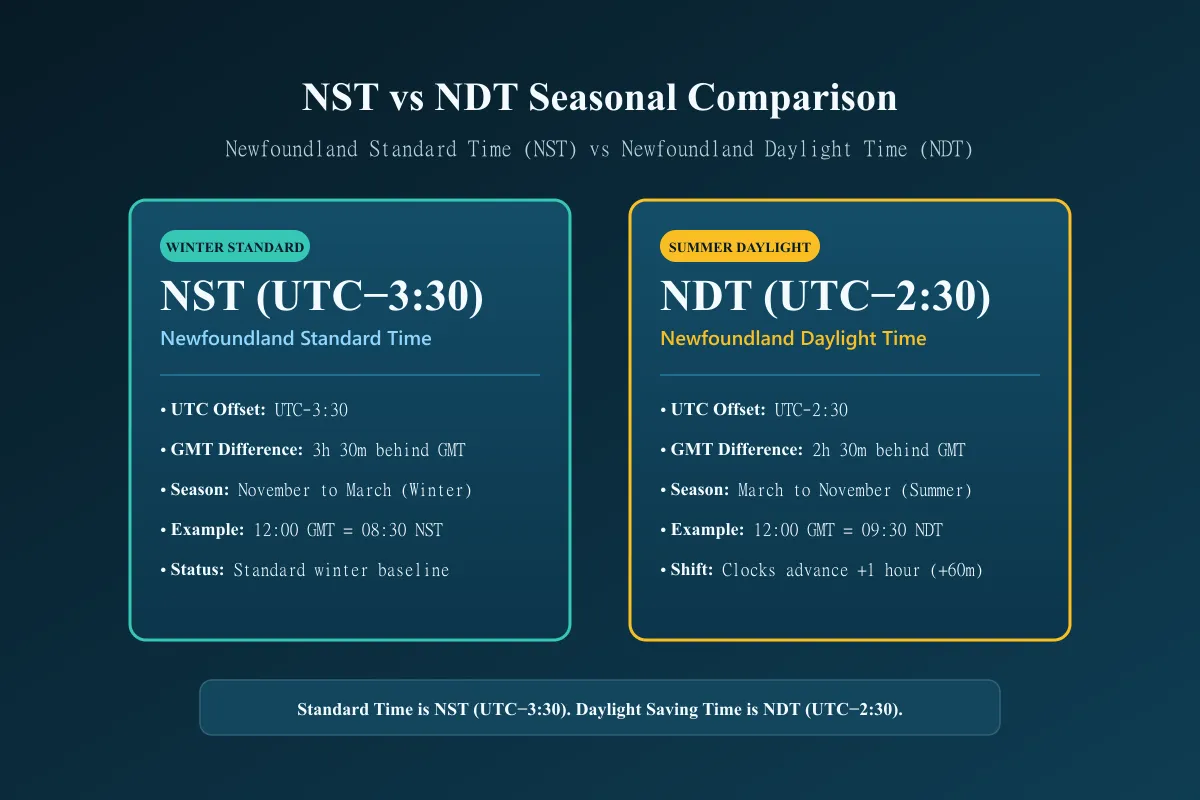
Newfoundland observes Daylight Saving Time from the second Sunday in March to the first Sunday in November. During this summer period, Newfoundland uses NDT (UTC−2:30).
• Standard Time (Winter): NST = UTC−3:30 (Difference: GMT − 3:30)
• Daylight Time (Summer): NDT = UTC−2:30 (Difference: GMT − 2:30)
When scheduling summer events, remember that Newfoundland local time moves 1 hour ahead (NDT).
GMT to NST for Business Meetings
Scheduling meetings between London or European teams and Newfoundland offices requires coordinating across the 3.5-hour difference:
Newfoundland Workday (08:30–17:00 NST) = 12:00–20:30 GMT
The prime live collaboration window occurs between 12:00 GMT and 16:30 GMT, which corresponds to 08:30 NST to 13:00 NST in St. John's.
GMT to NST Working Hours Comparison
| Phase of Day | GMT Time | NST Time | Collaboration Feasibility |
|---|---|---|---|
| GMT Morning | 08:00 – 11:30 GMT | 04:30 – 08:00 NST | GMT Active / Newfoundland Early Morning |
| Prime Overlap | 12:00 – 16:30 GMT | 08:30 – 13:00 NST | Optimal Live Meeting Window |
| GMT Afternoon | 17:00 – 20:30 GMT | 13:30 – 17:00 NST | Newfoundland Afternoon / GMT End of Day |
GMT to NST for Remote Work
Remote professionals working between North America and Europe must account for Newfoundland's 30-minute offset when setting calendar events:
- Meeting Invitations: Always specify the exact time with minutes (e.g., "Meeting at 14:00 GMT / 10:30 NST").
- Calendar Softwares: Ensure Google Calendar or Outlook is configured with
America/St_Johnsto prevent rounding to Atlantic or Eastern time.
GMT to NST for Technology
Software applications and database developers handling timestamp conversions must accommodate half-hour offsets:
- ISO 8601 Strings: Represent GMT as
2027-01-15T12:00:00Zand NST as2027-01-15T08:30:00-03:30. - Minute Math: Ensure date libraries add or subtract 210 minutes (3 hours × 60 + 30 minutes) rather than integer hour offsets.
GMT to NST for Travel and Events
Travelers flying into St. John's International Airport (YYT) or tuning in to live European broadcasts must remember:
Airline schedules print local arrival and departure times. A flight departing London Heathrow at 12:00 GMT lands in St. John's at 14:30 NST local time for a 6-hour flight duration.
GMT, UTC, NST and NDT Breakdown
| Time Zone | UTC Offset | Status / Season |
|---|---|---|
| GMT | UTC+0 | Greenwich Mean Time Baseline |
| UTC | UTC+0 | Coordinated Universal Time Atomic Baseline |
| NST | UTC−3:30 | Newfoundland Standard Time (Winter) |
| NDT | UTC−2:30 | Newfoundland Daylight Time (Summer) |
Common GMT to NST Conversion Mistakes
1. Subtracting Only 3 Hours
Forgetting the 30-minute component causes a 30-minute error on all calculations.
2. Forgetting Previous-Day Rollover
Failing to move early GMT times (00:00–03:29) back to the previous calendar day.
3. Confusing NST with NDT
Using NST (UTC−3:30) for summer dates when Newfoundland is observing NDT (UTC−2:30).
4. Adding Instead of Subtracting
Adding 3.5 hours instead of subtracting 3.5 hours yields a 7-hour calculation error.
GMT to NST Conversion Tips
📌 Memory Rule: −3h 30m
Subtract 3 hours and 30 minutes to move from GMT back to Newfoundland Standard Time.
📅 Check Date Before 03:30 GMT
Any GMT time prior to 03:30 AM falls on the previous calendar date in NST.
☀️ Check Summer DST Offset
Verify whether Newfoundland is using NDT (UTC−2:30) on your targeted summer date.
⚡ Use Our Interactive Tool
Rely on our date-aware converter at the top of this page for instant precise outputs.
Frequently Asked Questions (FAQ)
Related Time Zone Converters
Explore other verified time zone conversion tools across our platform: