
Quick Answer: What Time Zone does India Use?
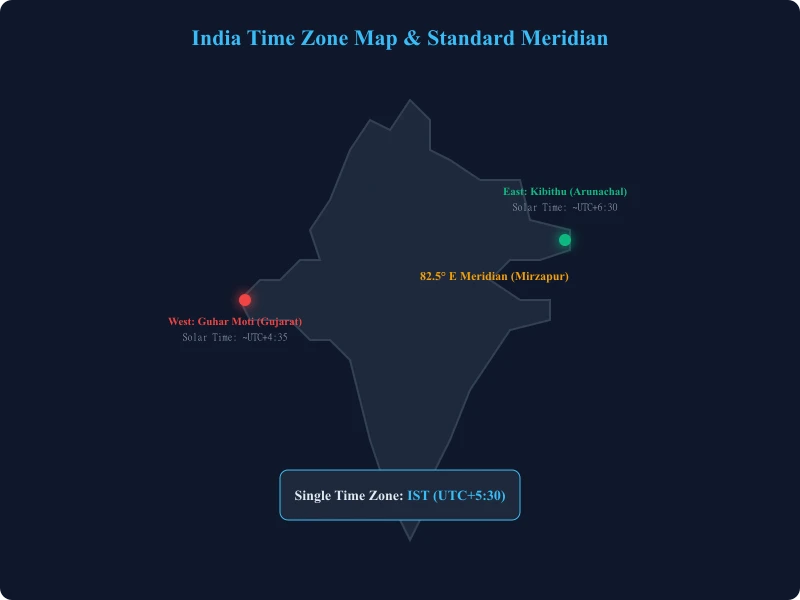
India observes a single national time zone known as Indian Standard Time (IST). The offset for IST is exactly **UTC+5:30** (5 hours and 30 minutes ahead of Coordinated Universal Time). India does not observe Daylight Saving Time (DST), meaning its clocks remain standard year-round. This standard is calculated based on the 82.5° E longitude line passing through Mirzapur in Uttar Pradesh, providing a unified time system for the entire country.
Guide Contents
- 1. What Is India's Time Zone?
- 2. What Is Indian Standard Time (IST)?
- 3. Why India Uses a Single Time Zone
- 4. Why UTC+5:30? The Half-Hour Offset Explained
- 5. Does India Use Daylight Saving Time?
- 6. Who Maintains Indian Standard Time?
- 7. India vs Major World Time Zones
- 8. Business & Technology Integration
- 9. Travel & Daily Life in India
- 10. Programming & Computing Guidelines
- 11. Common Time Zone Mistakes to Avoid
- 12. Frequently Asked Questions (FAQ)
- 13. Summary & Related Tools
1. What Is India's Time Zone?
India is home to over 1.4 billion people and occupies a major geographical footprint in South Asia. The country stretches from the mountains of Jammu and Kashmir in the north to the tropical tip of Kanyakumari in the south, and from the deserts of Gujarat in the west to the forests of Arunachal Pradesh in the east. To manage schedules, transport, and commerce across this vast area, India observes a single time zone.
This single timezone standard simplifies federal administration, national broadcasting, and transportation logistics. However, it also presents geographical challenges, particularly in the eastern states, where the sun rises and sets significantly earlier than in the west. Understanding how this offset functions is essential for anyone doing business with India, scheduling international flights, or managing offshore software development teams.
2. What Is Indian Standard Time (IST)?
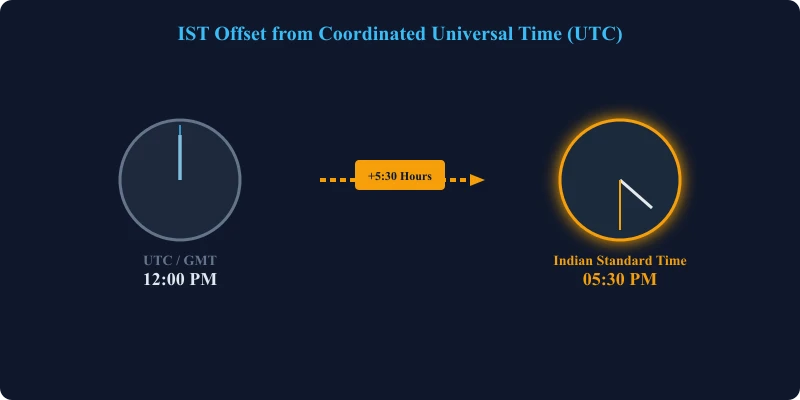
Indian Standard Time (IST) is the official time standard observed throughout the Republic of India. The offset for IST is calculated at exactly **UTC+5:30** (5 hours and 30 minutes ahead of Coordinated Universal Time). This makes India one of the major nations in the world to observe a half-hour offset rather than a whole-hour interval.
The history of standard time in India is closely linked with the colonial era:
- Colonial Presidencies: Prior to the late 19th century, major cities observed their own local mean times. The three presidency towns established distinct standards: Bombay Time (UTC+4:51), Calcutta Time (UTC+5:53), and Madras Time (which lay in between).
- The Railway Standard: As railway lines expanded across the country, local times created safety hazards. In the late 19th century, railway networks adopted Madras Time (UTC+5:21) as a compromise railroad standard, which was maintained by the Madras Observatory.
- Introduction of IST: Indian Standard Time was officially established on January 1, 1906, using the 82.5° E meridian as the central reference. Despite its introduction, Bombay and Calcutta maintained their local times for decades. Bombay Time was kept until 1948, shortly after India achieved independence, when IST became the sole national standard.
For international coordination, comparing IST with other primary zones requires close attention. For example, you can read our comparison guides on GMT vs UTC and UTC vs EST to see how standard offsets align.
3. Why India Uses a Single Time Zone
India spans approximately 30 degrees of longitude, from the western border of Gujarat (68° 7' E) to the eastern border of Arunachal Pradesh (97° 25' E). From a purely geographical standpoint, this horizontal span represents a physical solar time difference of about **1 hour and 45 minutes**. This means that when the sun is rising in the eastern hills of Arunachal Pradesh, it is still dark in the western plains of Gujarat.
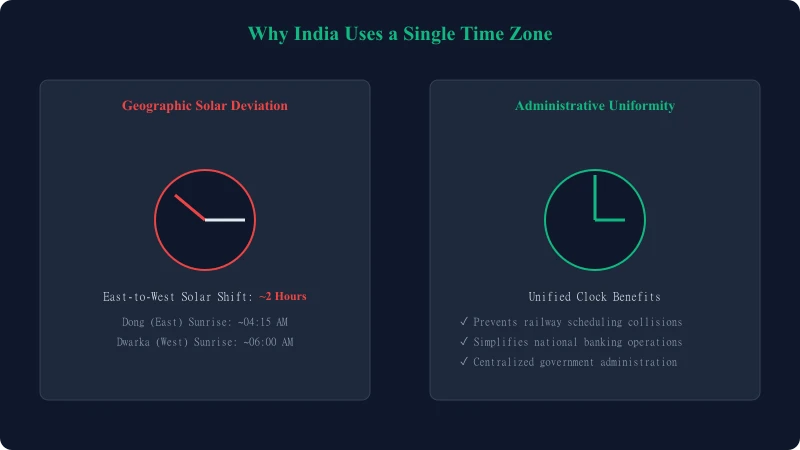
Despite this solar gap, the government has maintained a single timezone policy due to major administrative, safety, and economic factors:
- Railway Safety: The Indian railway network is one of the largest in the world. Managing thousands of trains daily on single-track lines would be extremely dangerous if local railway workers had to coordinate across multiple timezone boundaries, greatly increasing the risk of scheduling errors and collisions.
- Economic Integration: Having a single time zone ensures that national stock exchanges (BSE and NSE) and the banking sector operate on the same schedule, preventing market division and transaction delays.
- Administrative Simplicity: A single clock allows federal government ministries, national broadcasting networks, and logistics providers to operate seamlessly without regional coordination challenges.
Did You Know? The Debate Over Two Time Zones
The single timezone policy has faced growing criticism from India's northeastern states (including Assam, Nagaland, and Arunachal Pradesh). Because the sun sets as early as 4:00 p.m. in the winter in the northeast, offices and schools must operate in darkness, leading to high electricity consumption and reduced productivity. Many tea plantations in Assam observe an unofficial local standard called Chaibagaan Time (Tea Garden Time), which is set 1 hour ahead of IST, to maximize morning daylight. Scientists from the National Physical Laboratory have proposed dividing India into two zones (IST-I, UTC+5:30 and IST-II, UTC+6:30), but the government has not implemented this due to concerns over local administrative division.
4. Why UTC+5:30? The Half-Hour Offset Explained
Standard timezone boundaries are generally drawn at intervals of 15 degrees of longitude east or west of the Prime Meridian in Greenwich, with each 15-degree step representing exactly one hour. If India followed this standard whole-hour system, it would have to choose between UTC+5 (based on 75° E) and UTC+6 (based on 90° E).
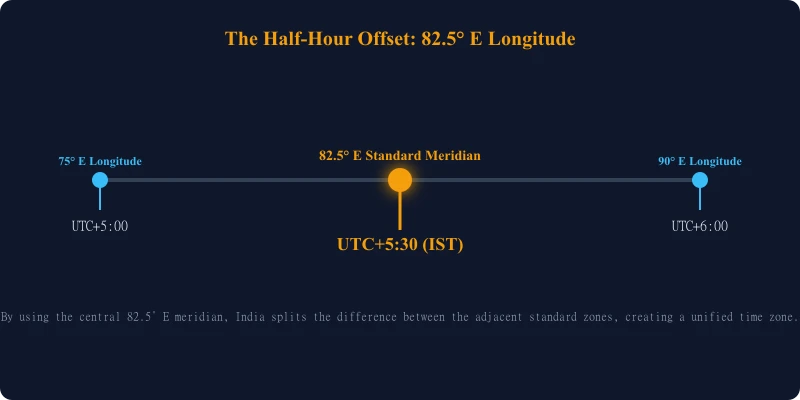
Neither option is ideal. Choosing UTC+5 would place the standard clock too far behind the solar cycle of the eastern states, while choosing UTC+6 would place it too far ahead of the western states. To compromise, administrators chose the **82.5° E longitude line** as the national reference meridian. This meridian passes through Shankargarh Fort in Mirzapur, near Prayagraj (Allahabad) in Uttar Pradesh. Because 82.5° E is exactly halfway between 75° E and 90° E, its corresponding offset is exactly 5 hours and 30 minutes ahead of UTC (UTC+5:30), splitting the difference for the entire country.
While this half-hour offset works well domestically, it requires international schedulers and software developers to carefully program their systems, as standard whole-hour increments do not apply. You can review our EST vs EDT guide to see how daylight saving shifts further complicate these half-hour offsets.
5. Does India Use Daylight Saving Time?
No, India does not observe Daylight Saving Time (DST). Clocks remain on Indian Standard Time (IST, UTC+5:30) year-round.
The reasons India does not observe DST include:
- Tropical Latitude: Most of India lies in the tropical and subtropical zones. Because it is close to the equator, the length of daylight experiences very minimal seasonal variation compared to high-latitude countries (like Canada or the UK), making seasonal clock adjustments unnecessary.
- Wartime History: India has only observed DST during extreme national emergencies. The government temporarily enforced DST during the Sino-Indian War of 1962 and the Indo-Pakistani Wars of 1965 and 1971 to reduce civilian energy consumption and conserve resources for the military. Once these conflicts ended, standard time was immediately restored.
For more details on seasonal clock adjustments globally, check out our guide on Daylight Saving Time Explained.
6. Who Maintains Indian Standard Time?
The official maintenance and transmission of Indian Standard Time is the responsibility of the **CSIR-National Physical Laboratory (NPL)** located in New Delhi. NPL is the custodian of India's national measurement standards under the authority of the Bureau of Indian Standards (BIS).
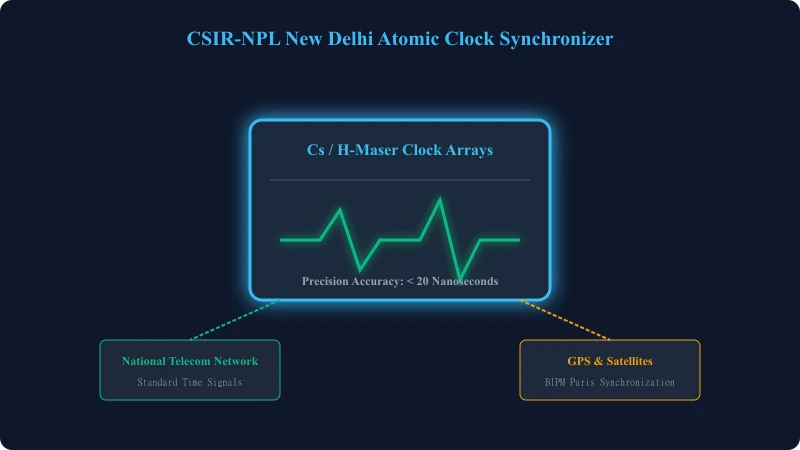
Key details regarding NPL's timekeeping operations:
- Atomic Clock Array: NPL generates IST using an array of highly precise Cesium (Cs) atomic clocks and Hydrogen Maser clocks. These clocks measure the stable oscillations of cesium atoms to maintain accuracy within nanoseconds.
- Satellite Synchronization: NPL coordinates continuously with the Bureau International des Poids et Mesures (BIPM) in Paris via GPS satellite links, ensuring India's time standard remains aligned with Coordinated Universal Time (UTC) standards.
- Public Transmission: Standard time signals are broadcasted through national telecommunications networks, internet time protocols (NTP), and television signals to synchronize computer networks, mobile towers, and public infrastructure across the country.
7. India vs Major World Time Zones
Because India does not observe Daylight Saving Time, its time differences with other countries shift seasonally. Below are comparative tables illustrating these relationships:
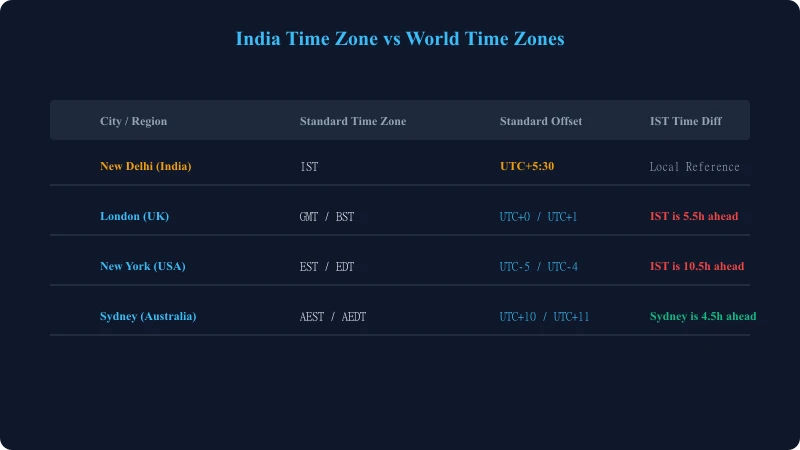
India vs US and Canada
| Indian Standard Time (IST) | US / Canada Eastern Time (EST / EDT) | US / Canada Pacific Time (PST / PDT) |
|---|---|---|
| UTC+5:30 (Year-Round) | UTC-5 (EST) / UTC-4 (EDT) | UTC-8 (PST) / UTC-7 (PDT) |
| Winter Standard Time | India is 10.5 hours ahead | India is 13.5 hours ahead |
| Summer Daylight Saving | India is 9.5 hours ahead | India is 12.5 hours ahead |
India vs UK and Australia
| Indian Standard Time (IST) | London (GMT / BST) | Sydney (AEST / AEDT) |
|---|---|---|
| UTC+5:30 (Year-Round) | UTC+0 (GMT) / UTC+1 (BST) | UTC+10 (AEST) / UTC+11 (AEDT) |
| Winter Standard Time | India is 5.5 hours ahead | Sydney is 4.5 hours ahead |
| Summer Daylight Saving | India is 4.5 hours ahead | Sydney is 5.5 hours ahead |
8. Business & Technology Integration
India is a global powerhouse for information technology, software outsourcing, and customer service. Managing business operations across the 5.5-hour offset requires clear scheduling rules and robust systems:
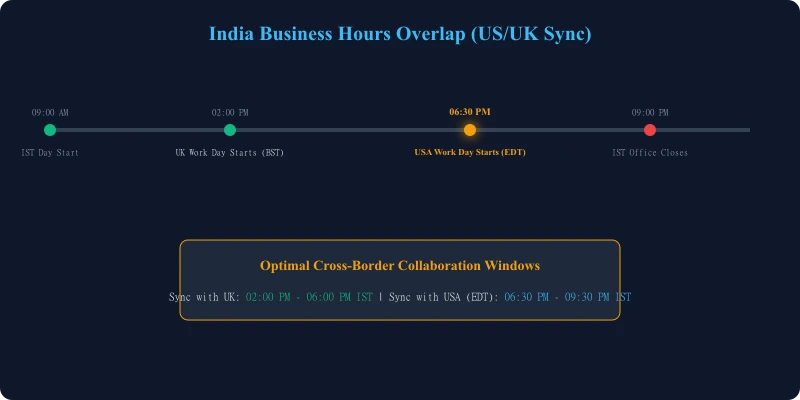
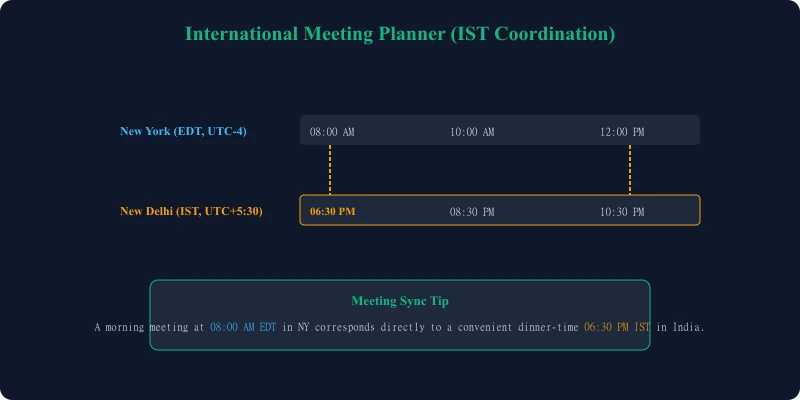
- The 30-Minute Shift Challenge: Because India uses a half-hour offset, meetings scheduled on the hour in the US or UK land on the half-hour in India. For example, a meeting scheduled at 9:00 a.m. in London (BST, UTC+1) starts at 1:30 p.m. IST in India. This requires international schedulers to double-check meeting invites to prevent confusion.
- BPO & Outsource Shifts: To support US clients, many Indian technology firms operate on night shifts (e.g., 6:30 p.m. to 3:30 a.m. IST) to align with standard East Coast business hours (9:00 a.m. to 6:00 p.m. EDT).
- Stock Market Coordination: The National Stock Exchange (NSE) and Bombay Stock Exchange (BSE) in Mumbai operate from 9:15 a.m. to 3:30 p.m. IST. International institutional investors must align their trading algorithms with these hours.
9. Travel & Daily Life in India
Traveling across India involves navigating its vast geography without ever changing your watch. However, the physical solar difference means daily routines vary significantly between states:
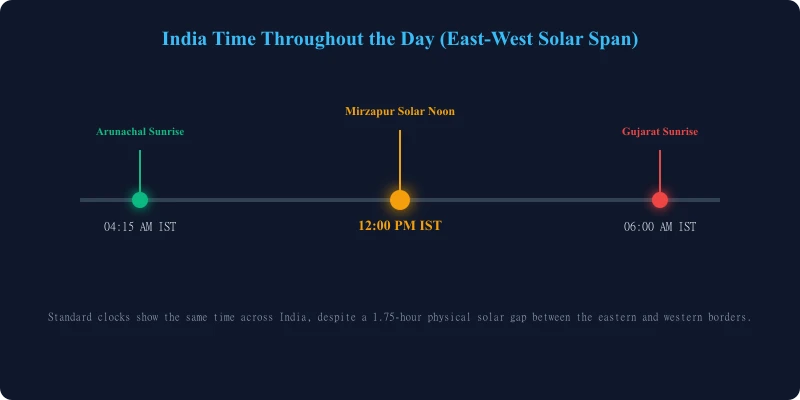
- No Watch Adjustments: Because India uses a single national time zone, domestic travelers flying between Mumbai (west) and Kolkata (east) do not need to adjust their clocks upon arrival.
- The Early Sunrise of the East: If you are traveling to northeastern states (like Assam or Arunachal Pradesh), be prepared for the sun to rise as early as 4:15 a.m. in the summer. Local commercial activities and farm work often begin much earlier than in western cities like Mumbai, where sunrise occurs around 6:00 a.m.
- Jet Lag Management: International travelers arriving from the US or Europe must adjust to both a large time shift and a half-hour offset. Gradually shifting sleep schedules by 30-minute steps prior to departure can help reduce jet lag.
10. Programming & Technology Guidelines
In software development, managing Indian Standard Time requires strict adherence to international standards to prevent scheduling bugs and database corruption.
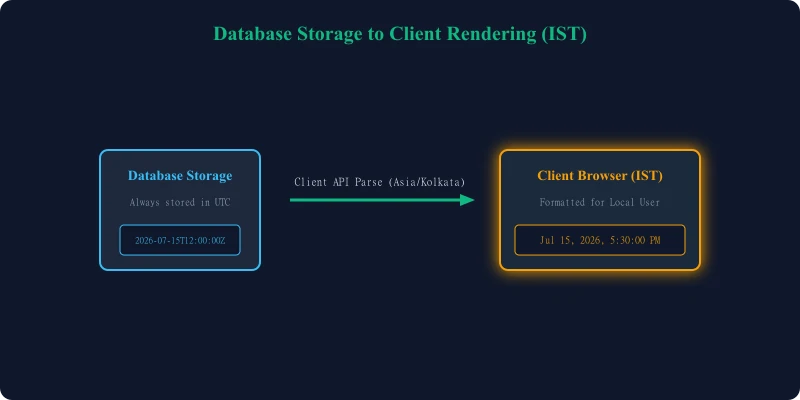
1. Database Storage
Always store timestamps in Coordinated Universal Time (UTC) using the ISO 8601 standard formatting: `YYYY-MM-DDTHH:MM:SSZ`. Do not store local timestamps directly, as it makes queries across different global client regions highly problematic.
2. Use IANA Identifiers
Do not hardcode offsets (like +5.5 or +5:30) in your codebase. Offsets can change due to legislative decisions. Instead, use the official IANA Time Zone Database name for India: **`Asia/Kolkata`** (formerly registered as `Asia/Calcutta`).
3. JavaScript Localization Example
To display a database UTC timestamp in India's local standard time, utilize the native `Intl.DateTimeFormat` API:
const utcDate = new Date('2026-07-15T12:00:00Z');
const formatter = new Intl.DateTimeFormat('en-IN', {
  timeZone: 'Asia/Kolkata',
  dateStyle: 'medium',
  timeStyle: 'long'
});
console.log(formatter.format(utcDate));
// Output will render in India local time (IST)
11. Common Time Zone Mistakes to Avoid
Working or scheduling meetings with India involves navigating its unique timezone rules. Avoid these common pitfalls:
- Confusing IST with Irish Standard Time: The abbreviation 'IST' is also used for Irish Standard Time (UTC+1 in summer) and Israel Standard Time (UTC+2 / UTC+3). Always verify the country or specify the UTC offset (UTC+5:30) in your communications to prevent scheduling errors.
- Ignoring the 30-Minute Offset: Many schedulers forget that India uses a half-hour offset. Assuming that all offsets are in whole hours will result in meetings being scheduled 30 minutes early or late.
- Assuming Seasonal Clock Changes: India does not observe Daylight Saving Time. Do not send calendar invites that automatically adjust India participants' clocks in March or November.
- Incorrect Offset Formatting in Code: When configuring server offsets, ensure you use the proper fractional format (e.g., `+05:30` or `5.5`), rather than assuming integers.
12. Frequently Asked Questions (FAQ)
Review these comprehensive answers to resolve common questions about India's time zone, standard offsets, and history:
What time zone does India use?
India uses a single national time zone known as Indian Standard Time (IST). It is calculated at an offset of UTC+5:30 and is observed year-round across the entire country.
What is IST?
IST stands for Indian Standard Time. It is the official standard time zone observed throughout the Republic of India, calculated relative to Coordinated Universal Time (UTC).
Why does India have only one time zone?
India uses a single time zone for administrative, economic, and safety reasons. Implementing one unified clock prevents scheduling collisions on the extensive railway network, simplifies national banking, and streamlines federal government operations, despite the physical 2-hour solar time difference between the eastern and western borders.
Why is IST UTC+5:30 instead of a whole hour?
IST is set at UTC+5:30 because it is calculated based on the 82.5° E longitude line, which passes through Mirzapur in Uttar Pradesh. This meridian was chosen during the colonial era because it lies exactly halfway between the 75° E (UTC+5) and 90° E (UTC+6) meridians, splitting the difference for the nation.
Does India observe Daylight Saving Time?
No. India does not observe Daylight Saving Time (DST). Because of its tropical location near the equator, daylight hours remain relatively constant year-round, making seasonal clock changes unnecessary.
Who maintains Indian Standard Time?
IST is officially maintained by the CSIR-National Physical Laboratory (NPL) in New Delhi. NPL uses a network of cesium and hydrogen maser atomic clocks to generate and synchronize standard time, maintaining accuracy within nanoseconds.
Has India ever used Daylight Saving Time in the past?
Yes. India briefly observed Daylight Saving Time during the Sino-Indian War of 1962 and the Indo-Pakistani Wars of 1965 and 1971 to reduce civilian energy consumption during wartime emergencies.
What is the IANA time zone identifier for India?
The official IANA Time Zone Database identifier for India is `Asia/Kolkata` (formerly registered as `Asia/Calcutta`).
What is the time difference between India and New York?
During the winter (when New York is on EST, UTC-5), India (IST, UTC+5:30) is 10.5 hours ahead of New York. During the summer (when New York is on EDT, UTC-4), India is 9.5 hours ahead of New York.
What is the time difference between India and London?
During the winter (when London is on GMT, UTC+0), India (IST, UTC+5:30) is 5.5 hours ahead of London. During the summer (when London is on BST, UTC+1), India is 4.5 hours ahead of London.
What is the time difference between India and Sydney?
During the winter in Sydney (AEST, UTC+10), Sydney is 4.5 hours ahead of India. During the summer in Sydney (AEDT, UTC+11), Sydney is 5.5 hours ahead of India.
What is 'Chaibagaan time' or Tea Garden Time?
Chaibagaan Time is an informal, unofficial time zone observed in the tea gardens of Assam. It is set 1 hour ahead of Indian Standard Time (IST) to maximize the use of early daylight, improving agricultural productivity and saving energy.
Which meridian is used to calculate Indian Standard Time?
The standard meridian for India is 82.5° East longitude, which passes through Mirzapur in Uttar Pradesh, near Allahabad (Prayagraj).
Does India share its timezone offset with any other country?
Yes. Sri Lanka also observes India's timezone offset of UTC+5:30 year-round, which is referred to as Sri Lanka Standard Time (SLST).
How does the 30-minute offset affect international business scheduling?
The 30-minute offset means meetings scheduled on the hour in the US or UK land on the half-hour in India. For example, a 9:00 a.m. meeting in London (BST, UTC+1) starts at 1:30 p.m. in India, requiring schedulers to carefully check the half-hour alignment.
What is the difference between IST and GMT?
GMT (Greenwich Mean Time) is a solar-based timezone offset at UTC+0. IST (Indian Standard Time) is 5.5 hours ahead of GMT. For example, when it is 12:00 PM GMT in London, it is 5:30 PM IST in India.
How does domestic travel in India handle time differences?
Because India uses a single national time zone, domestic travelers do not need to adjust their watches when flying or traveling by train between states. However, they will notice that sunrise and sunset occur much earlier in the eastern states (like Assam) compared to the western states (like Gujarat).
What are the trading hours of the Indian stock markets?
The National Stock Exchange (NSE) and Bombay Stock Exchange (BSE) in India operate from 9:15 a.m. to 3:30 p.m. IST, Monday through Friday.
Why is the abbreviation IST sometimes confusing?
The abbreviation 'IST' is also used for Irish Standard Time (UTC+1 in summer) and Israel Standard Time (UTC+2 / UTC+3). Software developers and schedulers must specify the country or the exact UTC offset (UTC+5:30) to prevent errors.
How do software developers prevent timezone bugs when working with India?
Developers should store all application timestamps in UTC and use the IANA timezone identifier `Asia/Kolkata` to parse and format local dates for users in India, rather than hardcoding a +5:30 offset.
Understanding these details is critical for web development, server coordination, international business operations, and general navigation. Utilizing standard international time formats (such as the 24-hour clock and ISO 8601 specifications) guarantees that your schedules, communications, and database logs remain accurate and free from timezone errors.
Explore Time Zone Converters & Guides
Use our free, daylight-saving-aware tools to calculate Indian offsets and schedule meetings across regions: