

MET to EST Time Difference
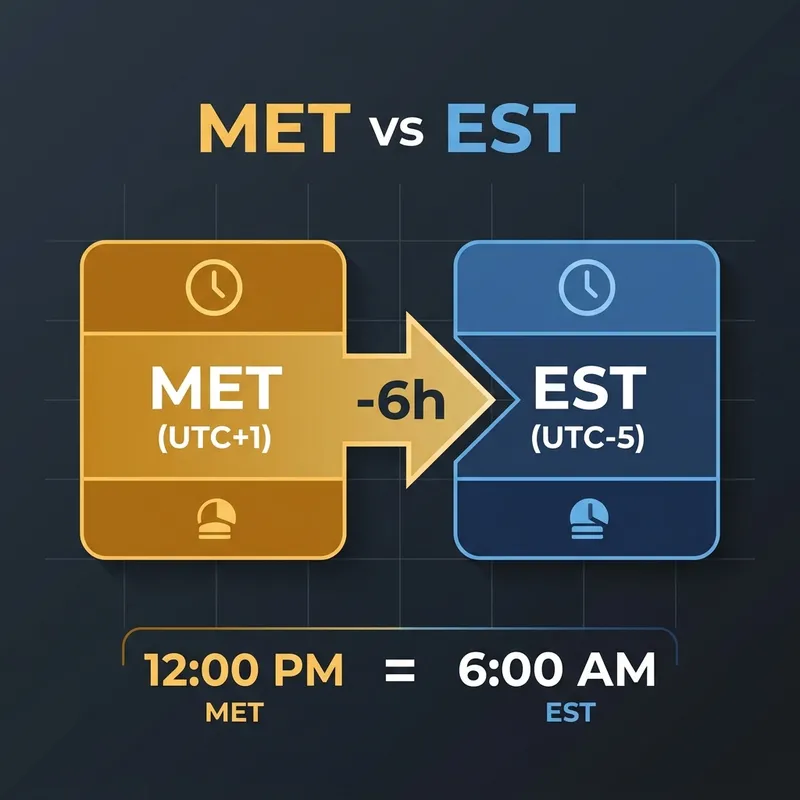
The relationship between Middle European Time and Eastern Standard Time involves a 6-hour offset during standard time. MET operates at UTC+1, while EST operates at UTC−5. This means that when both regions are observing their standard-time designations, MET is exactly 6 hours ahead of EST.
MET − 6 hours = EST
UTC+1 → UTC−5 • During standard time (typically November through March)
However, this 6-hour difference is not permanently fixed throughout the entire year. Both European and North American regions observe daylight saving time, but they switch on different dates. European summer time begins on the last Sunday in March and ends on the last Sunday in October. North American daylight saving begins on the second Sunday in March and ends on the first Sunday in November. During the brief transition periods between these dates, the effective offset between European and Eastern U.S. time can temporarily change to 5 hours.
Our converter uses the IANA timezone database identifiers Europe/Paris and America/New_York to calculate the exact offset for any given date, ensuring accuracy even during these transitional periods.
How to Convert MET to EST
Converting Middle European Time to Eastern Standard Time requires awareness of the date because daylight-saving rules can affect the calculation. Here is the general process:
- Select the MET date. The date determines whether standard time or daylight-saving time is in effect for each region.
- Enter the MET time. Note the hour and minute in Middle European Time (UTC+1 during standard time).
- Subtract 6 hours (standard time). During the standard-time period (roughly November through March), subtract 6 hours from MET to get EST.
- Check for date rollback. If subtracting 6 hours crosses midnight backward, move the calendar date back by one day.
- Verify the result. Confirm whether EST (UTC−5) or EDT (UTC−4) applies to the destination date. Our converter handles this distinction automatically.
Quick Standard-Time Examples
- 12:00 PM MET → 12 − 6 = 6:00 AM EST (same day)
- 8:00 PM MET → 20 − 6 = 2:00 PM EST (same day)
- 3:00 AM MET → 3 − 6 = 9:00 PM EST (previous day)
For conversions involving dates near daylight-saving transitions, always use the converter tool above rather than manual subtraction to ensure the correct offset is applied.
MET to EST Conversion Table (Standard Time)
The table below shows every hour converted from MET to EST during the standard-time period (approximately November through March), when MET is UTC+1 and EST is UTC−5. During daylight-saving periods, offsets may differ — use the converter tool for date-specific accuracy.
| MET (UTC+1) | EST (UTC−5) | Date |
|---|---|---|
| 12:00 AM | 6:00 PM (-1 day) | Previous day |
| 1:00 AM | 7:00 PM (-1 day) | Previous day |
| 2:00 AM | 8:00 PM (-1 day) | Previous day |
| 3:00 AM | 9:00 PM (-1 day) | Previous day |
| 4:00 AM | 10:00 PM (-1 day) | Previous day |
| 5:00 AM | 11:00 PM (-1 day) | Previous day |
| 6:00 AM | 12:00 AM | Same day |
| 7:00 AM | 1:00 AM | Same day |
| 8:00 AM | 2:00 AM | Same day |
| 9:00 AM | 3:00 AM | Same day |
| 10:00 AM | 4:00 AM | Same day |
| 11:00 AM | 5:00 AM | Same day |
| 12:00 PM | 6:00 AM | Same day |
| 1:00 PM | 7:00 AM | Same day |
| 2:00 PM | 8:00 AM | Same day |
| 3:00 PM | 9:00 AM | Same day |
| 4:00 PM | 10:00 AM | Same day |
| 5:00 PM | 11:00 AM | Same day |
| 6:00 PM | 12:00 PM | Same day |
| 7:00 PM | 1:00 PM | Same day |
| 8:00 PM | 2:00 PM | Same day |
| 9:00 PM | 3:00 PM | Same day |
| 10:00 PM | 4:00 PM | Same day |
| 11:00 PM | 5:00 PM | Same day |
Note: MET times from 12:00 AM to 5:00 AM produce EST times on the previous calendar day. This table uses standard-time offsets (MET = UTC+1, EST = UTC−5).
MET to EST Practical Conversion Examples
Below are real-world scenarios showing how MET converts to EST during standard time:
Morning Stand-Up
9:00 AM MET → 3:00 AM EST
A 9 AM European stand-up falls at 3 AM EST — far too early for U.S. Eastern colleagues. Consider scheduling after 2 PM MET for reasonable EST hours.
Midday Sync
12:00 PM MET → 6:00 AM EST
A noon MET meeting translates to 6 AM EST — early morning on the U.S. East Coast.
Optimal Overlap
3:00 PM MET → 9:00 AM EST
A 3 PM MET call is 9 AM EST — the sweet spot where both European and U.S. teams are in working hours.
Late Afternoon
5:00 PM MET → 11:00 AM EST
End of the European workday corresponds to mid-morning EST — still well within U.S. business hours.
Evening Webinar
8:00 PM MET → 2:00 PM EST
An evening MET event is mid-afternoon EST — great for reaching both audiences.
Date Change Example
2:00 AM MET, Jan 15 → 8:00 PM EST, Jan 14
Subtracting 6 hours from early morning MET crosses midnight backward, placing EST on the previous day.
Half-Hour and Minute Conversions
- 2:30 PM MET → 8:30 AM EST (same day)
- 6:45 PM MET → 12:45 PM EST (same day)
- 1:15 AM MET → 7:15 PM EST (previous day)
- 4:30 AM MET → 10:30 PM EST (previous day)
What Is MET?
MET (Middle European Time) is a time zone abbreviation designating UTC+1 standard time as used across much of continental Europe. The term originates from the German expression Mitteleuropäische Zeit (MEZ), which has been used in Central European timekeeping since the late 19th century when standard time zones were formalized across the region.
In modern usage, CET (Central European Time) is more commonly encountered than MET in international contexts. Both abbreviations refer to the same UTC+1 offset during winter standard time. However, MET continues to appear in legacy software systems, aviation schedules, meteorological data, scientific instruments, and older reference documents. Users may also encounter MET in the IANA timezone database, where the MET identifier is recognized and maps to the Europe/Paris timezone data.
During summer months, the European regions that use MET/CET switch to daylight saving time, known variously as MEST (Middle European Summer Time) or CEST (Central European Summer Time), which operates at UTC+2. This shift occurs on the last Sunday in March and reverts on the last Sunday in October.
Countries that observe MET/CET standard time include Germany, France, Italy, Spain, the Netherlands, Belgium, Austria, Switzerland, Poland, Czech Republic, Hungary, Sweden, Norway, Denmark, and many others across continental Europe.
What Is EST?
EST (Eastern Standard Time) is the standard-time designation for the U.S. and Canadian Eastern Time Zone, defined as UTC−5. EST is used during winter months — specifically from the first Sunday in November through the second Sunday in March in the United States.
It is important to distinguish EST from the broader concept of "Eastern Time." The Eastern Time Zone as a region observes two different offsets throughout the year: EST (UTC−5) during winter and EDT (Eastern Daylight Time, UTC−4) during summer. When someone says "Eastern Time" without specifying standard or daylight, they are referring to whichever offset currently applies. This page specifically targets the MET → EST conversion.
Major cities in the EST/Eastern Time Zone include New York, Washington D.C., Toronto, Miami, Boston, Philadelphia, Atlanta, and Montreal. The timezone is the most populous in North America and is commonly referenced in global business, financial markets, media broadcasts, and international scheduling.
For converting MET to EDT during North American summer months, the offset changes from −6 hours to −5 hours. Our converter detects this automatically based on the selected date. For a dedicated converter, see our GMT to EDT Converter.

MET vs CET vs CEST
These three abbreviations are closely related but represent different aspects of European timekeeping. Understanding their distinctions helps prevent conversion errors:
| Abbreviation | Full Name | UTC Offset | Period |
|---|---|---|---|
| MET | Middle European Time | UTC+1 | Winter standard time |
| CET | Central European Time | UTC+1 | Winter standard time |
| MEST | Middle European Summer Time | UTC+2 | Summer daylight saving |
| CEST | Central European Summer Time | UTC+2 | Summer daylight saving |
MET and CET are functionally identical — both designate UTC+1 standard time in continental Europe. The key distinction is that MET originates from the German-language tradition (Mitteleuropäische Zeit), while CET is the more internationally standardized English-language term. Similarly, MEST and CEST both represent UTC+2 summer time. When converting to EST, the critical factor is whether the source time is in standard time (UTC+1) or summer time (UTC+2), regardless of which abbreviation is used.
For European summer time conversions to EST, see our CEST to EST Converter.
EST vs EDT
On the destination side of MET-to-EST conversion, it is equally important to understand the difference between EST and EDT:
| Abbreviation | Full Name | UTC Offset | Approx. Period (U.S.) |
|---|---|---|---|
| EST | Eastern Standard Time | UTC−5 | November – March |
| EDT | Eastern Daylight Time | UTC−4 | March – November |
Users searching for "MET to EST" most often intend the winter standard-time conversion. However, if you are scheduling for a summer date, the U.S. Eastern Time Zone will be observing EDT (UTC−4) rather than EST (UTC−5). Our converter applies the correct offset automatically based on the date you select. For a dedicated EDT converter, visit our GMT to EDT Converter.
Why MET to EST Can Change by Date
One of the most common sources of scheduling errors between Europe and North America is the assumption that the time difference is always fixed. In reality, the offset between European and U.S. Eastern time can vary because their daylight-saving transitions occur on different dates:
| Period | Europe | U.S. East | Offset |
|---|---|---|---|
| Jan–early Mar | MET/CET (UTC+1) | EST (UTC−5) | 6 hours |
| Early Mar–late Mar | MET/CET (UTC+1) | EDT (UTC−4) | 5 hours |
| Late Mar–late Oct | MEST/CEST (UTC+2) | EDT (UTC−4) | 6 hours |
| Late Oct–early Nov | MET/CET (UTC+1) | EDT (UTC−4) | 5 hours |
As the table shows, during most of the year the difference between European time and U.S. Eastern time is 6 hours. But during the transition weeks in spring and autumn, the gap narrows to 5 hours because one region has switched to daylight saving while the other has not yet changed. This is why a date-aware converter is essential for accurate scheduling.
MET to EST Date Changes
Because MET is 6 hours ahead of EST during standard time, early-morning MET times can fall on the previous calendar day when converted to EST. This is a critical detail for deadline management, contract execution, and event scheduling.
When Does the Date Roll Back?
- MET 6:00 AM to 11:59 PM → EST on the same calendar day
- MET 12:00 AM (midnight) to 5:59 AM → EST on the previous calendar day
Date Rollback Examples
Example 1: 7:00 PM MET on February 10 → 1:00 PM EST on February 10 (same day)
Example 2: 4:00 AM MET on February 10 → 10:00 PM EST on February 9 (previous day)
Example 3: 12:30 AM MET on January 1 → 6:30 PM EST on December 31 (previous year!)
Always verify both the time and date when converting early-morning MET hours to EST. Our converter tool at the top of this page handles date transitions automatically.
MET to EST for Business and Scheduling
The MET-to-EST conversion is one of the most common transatlantic time zone calculations. European companies regularly coordinate with U.S. East Coast offices, and understanding the 6-hour offset is essential for productive collaboration.
Overlapping Business Hours
Standard MET business hours (9:00 AM to 6:00 PM) correspond to 3:00 AM to 12:00 PM EST. The comfortable overlap window for both sides is approximately 3:00 PM to 6:00 PM MET / 9:00 AM to 12:00 PM EST — a 3-hour window in the morning for EST and late afternoon for MET.
Scheduling Best Practices
- Always include the timezone abbreviation: 15:00 MET / 9:00 AM EST
- Use calendar tools that display multiple time zones simultaneously
- Be aware of DST transition periods in spring and autumn when the offset may temporarily change
- Schedule recurring meetings during the 3:00–6:00 PM MET / 9:00 AM–12:00 PM EST overlap
- For U.S. participants, morning meetings are generally preferable; for European participants, afternoon is better
Common Use Cases
- Financial markets — European exchanges overlap with U.S. market pre-open hours
- Corporate meetings — transatlantic teams need consistent scheduling windows
- Software deployments — coordinating release windows across European and U.S. servers
- Customer support — handoff timing between European and American support teams
- Travel planning — flights between European cities and U.S. East Coast destinations
- Academic collaboration — research teams at European and American universities
Common MET to EST Conversion Mistakes
❌ Confusing MET with CET
MET and CET are functionally identical (both UTC+1), so the conversion result is the same. However, confusing either with CEST (UTC+2) creates a 1-hour error.
❌ Confusing EST with EDT
Using EST (UTC−5) when EDT (UTC−4) applies creates a 1-hour error. Always check whether the destination date falls in standard or daylight-saving time.
❌ Ignoring the Date
A fixed "−6 hours" calculation works most of the time but fails during DST transition weeks when the offset changes to −5 hours.
❌ Forgetting Date Rollback
Early morning MET times (midnight to 5:59 AM) convert to the previous calendar day in EST. Missing this can cause a full day's scheduling error.
❌ One Fixed Offset All Year
The 6-hour gap applies during standard time, but not necessarily during March/October transition weeks. Always verify with a date-aware tool.
❌ Omitting the Timezone
Writing "3 PM" without specifying the timezone causes confusion. Always state: 3:00 PM MET / 9:00 AM EST.
GMT and UTC Context
This website focuses primarily on GMT to EST conversions. GMT (Greenwich Mean Time) and UTC (Coordinated Universal Time) both represent the UTC±0 baseline from which all other time zones are calculated. MET (UTC+1) is 1 hour ahead of GMT/UTC, while EST (UTC−5) is 5 hours behind GMT/UTC.
Understanding this relationship can help cross-verify conversions: if you know the GMT time, you can add 1 hour to get MET and subtract 5 hours to get EST. The total difference between MET and EST is therefore 1 − (−5) = 6 hours during standard time. For more on the GMT-to-EST relationship, visit our GMT vs EST comparison page.
MET to EST Conversion Tips
📌 Remember −6
During standard time, subtract 6 hours from MET to get EST. This works for the majority of the year.
📅 Always Include the Date
Early-morning MET times roll back to the previous calendar day in EST. Verify the date in every conversion.
🔄 Watch DST Transitions
In March and October/November, European and U.S. clocks change on different dates. The offset may temporarily be 5 hours.
🕐 Optimal Meeting Window
3:00–6:00 PM MET (9:00 AM–12:00 PM EST) is the ideal overlap for transatlantic business calls.