
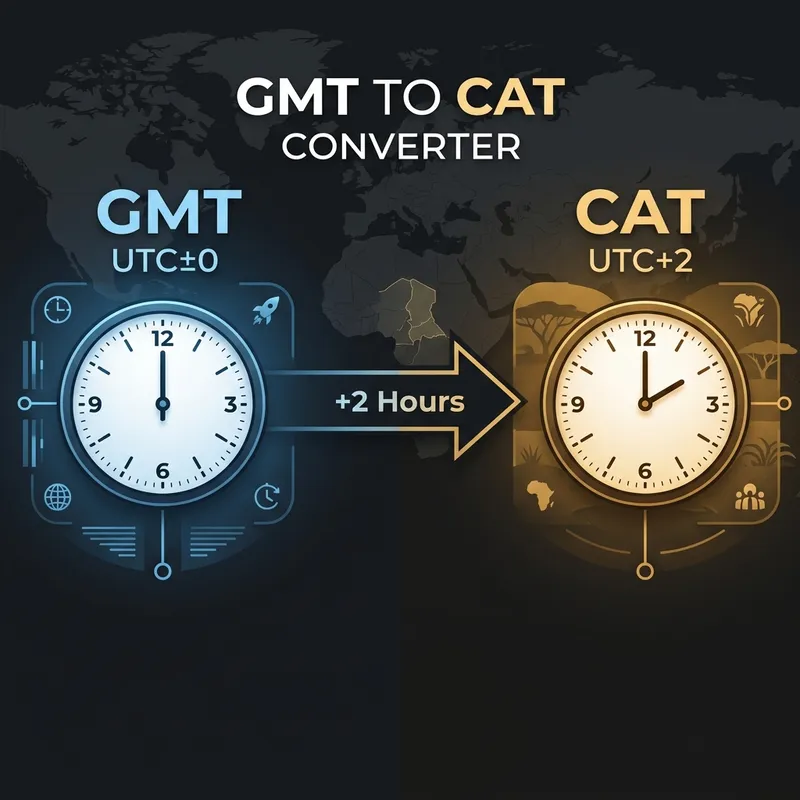
GMT to CAT Time Difference
The time difference between GMT and CAT is straightforward: CAT is always 2 hours ahead of GMT. Greenwich Mean Time (GMT) uses the UTC+0 offset, serving as the baseline reference for global timekeeping. Central Africa Time (CAT) uses the UTC+2 offset, which places it 2 hours ahead of GMT throughout the entire year.
Unlike many time zone pairs that shift during daylight saving transitions, the GMT-to-CAT offset remains constant. CAT-observing countries do not adjust their clocks seasonally, so the 2-hour difference applies every day of the year. This consistency makes scheduling between GMT and CAT regions predictable and reliable.
GMT + 2 hours = CAT
UTC+0 → UTC+2 • Central Africa Time is always 2 hours ahead
The 2-hour offset can cause the calendar date to change. When GMT is between 10:00 PM and 11:59 PM, adding 2 hours crosses midnight, meaning the CAT time falls on the following calendar day. Our converter accounts for this automatically.
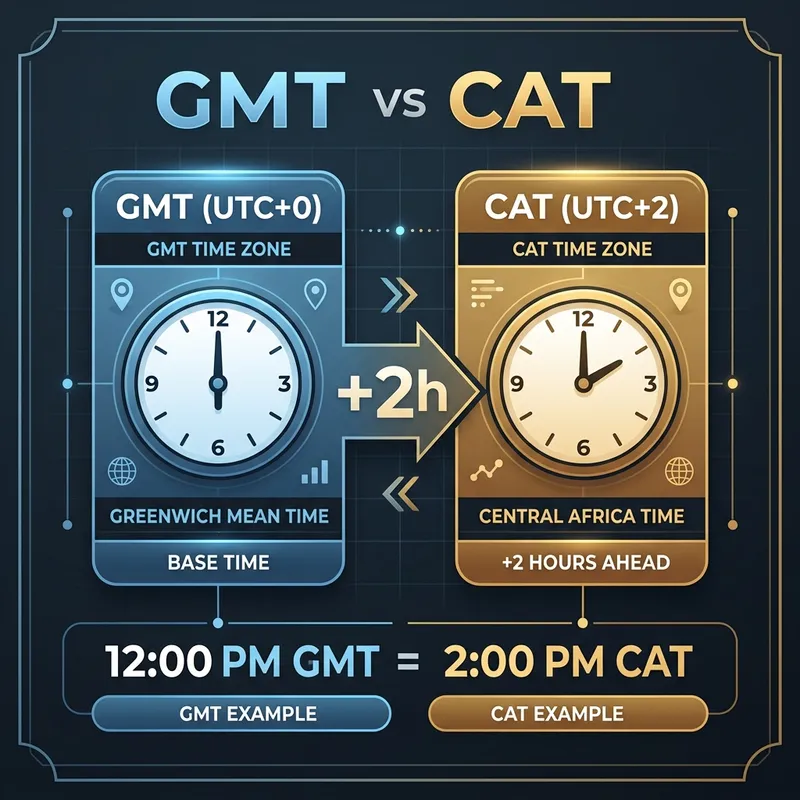
How to Convert GMT to CAT
Converting GMT to Central Africa Time requires a single calculation: add 2 hours to the GMT time. Here is the step-by-step process:
- Start with the GMT time. Identify the exact hour and minute in Greenwich Mean Time (UTC+0).
- Add 2 hours. This shifts the time forward to the UTC+2 offset used by CAT.
- Check the date. If adding 2 hours causes the time to pass midnight (00:00), advance the calendar date by one day.
- Read the CAT result. The final value is the time in Central Africa Time (UTC+2).
Quick Examples
- 10:00 AM GMT → 10 + 2 = 12:00 PM CAT (same day)
- 3:00 PM GMT → 15 + 2 = 5:00 PM CAT (same day)
- 11:00 PM GMT → 23 + 2 = 1:00 AM CAT (next day)
For precise conversions that account for specific dates, use the converter tool above. It handles all calculations including date-boundary transitions automatically.
GMT to CAT Conversion Table (24 Hours)
The table below shows every hour of the day converted from GMT to Central Africa Time. The final two rows highlight date changes where the CAT time moves to the following calendar day.
| GMT (UTC+0) | CAT (UTC+2) | Date |
|---|---|---|
| 12:00 AM | 2:00 AM | Same day |
| 1:00 AM | 3:00 AM | Same day |
| 2:00 AM | 4:00 AM | Same day |
| 3:00 AM | 5:00 AM | Same day |
| 4:00 AM | 6:00 AM | Same day |
| 5:00 AM | 7:00 AM | Same day |
| 6:00 AM | 8:00 AM | Same day |
| 7:00 AM | 9:00 AM | Same day |
| 8:00 AM | 10:00 AM | Same day |
| 9:00 AM | 11:00 AM | Same day |
| 10:00 AM | 12:00 PM | Same day |
| 11:00 AM | 1:00 PM | Same day |
| 12:00 PM | 2:00 PM | Same day |
| 1:00 PM | 3:00 PM | Same day |
| 2:00 PM | 4:00 PM | Same day |
| 3:00 PM | 5:00 PM | Same day |
| 4:00 PM | 6:00 PM | Same day |
| 5:00 PM | 7:00 PM | Same day |
| 6:00 PM | 8:00 PM | Same day |
| 7:00 PM | 9:00 PM | Same day |
| 8:00 PM | 10:00 PM | Same day |
| 9:00 PM | 11:00 PM | Same day |
| 10:00 PM | 12:00 AM (+1 day) | Next day |
| 11:00 PM | 1:00 AM (+1 day) | Next day |
Note: GMT times from 10:00 PM to 11:00 PM produce CAT times on the following calendar day.
GMT to CAT Practical Examples
Here are real-world conversion scenarios to illustrate how GMT converts to Central Africa Time:
Morning Conference Call
9:00 AM GMT → 11:00 AM CAT
A 9 AM GMT meeting starts at 11 AM in Harare, Lusaka, or Kigali — well within working hours.
Midday Deadline
12:00 PM GMT → 2:00 PM CAT
A noon GMT deadline translates to a 2 PM cutoff in CAT countries, giving teams a manageable afternoon window.
Afternoon Sync
3:00 PM GMT → 5:00 PM CAT
An afternoon sync at 3 PM GMT falls at the end of the standard CAT business day.
Evening Event
6:00 PM GMT → 8:00 PM CAT
An evening GMT event starts at 8 PM in CAT regions — suitable for virtual social events.
Late Night Handoff
9:00 PM GMT → 11:00 PM CAT
A late GMT handoff reaches CAT at 11 PM — suitable for automated system transfers.
Date Change Example
11:00 PM GMT, Jan 15 → 1:00 AM CAT, Jan 16
Adding 2 hours crosses midnight. Always verify the date when converting late GMT times.
Half-Hour and Minute Conversions
The same +2 hour rule applies to any minute value:
- 7:30 AM GMT → 9:30 AM CAT
- 2:45 PM GMT → 4:45 PM CAT
- 10:15 PM GMT → 12:15 AM CAT (next day)
- 11:30 PM GMT → 1:30 AM CAT (next day)
What Is GMT?
Greenwich Mean Time (GMT) is the time standard historically based on solar observations at the Royal Observatory in Greenwich, London. GMT sits at the UTC+0 offset, which means it has zero hours of deviation from Coordinated Universal Time (UTC). For most practical purposes, GMT and UTC are interchangeable, although UTC is the modern technical standard based on atomic clock measurements rather than astronomical observation.
GMT serves as the reference point from which all other time zones are calculated. Zones east of the Prime Meridian are ahead of GMT (positive UTC offsets), while zones west are behind GMT (negative UTC offsets). CAT at UTC+2 is positioned 2 hours east of GMT.
Many international organizations, aviation systems, weather forecasts, and maritime operations use GMT (or its equivalent UTC) as the common baseline for scheduling. When converting to any regional time zone, including CAT, you start from this zero-offset anchor. Learn more about Greenwich Mean Time on our GMT to EST Converter homepage.
What Is CAT?
Central Africa Time (CAT) is the time zone designation for UTC+2 as used in several countries across central and southern Africa. The abbreviation CAT specifically represents Central Africa Time and should not be confused with unrelated abbreviations or North American time zone names.
CAT operates at a fixed UTC+2 offset throughout the year. Unlike many Western time zones that adjust by one hour during seasonal daylight saving time transitions, CAT remains constant. Countries in the CAT zone keep their clocks at UTC+2 during both summer and winter months, which simplifies scheduling for anyone converting from GMT or other reference time zones.
The IANA time zone database uses identifiers such as Africa/Maputo (Mozambique), Africa/Harare (Zimbabwe), and Africa/Lusaka (Zambia) for CAT. These identifiers all resolve to UTC+2 without daylight saving adjustments.
CAT is commonly encountered in international business communications, NGO operations coordinating with African field offices, software timestamp displays, and travel itineraries involving flights to or from central and southern African destinations.
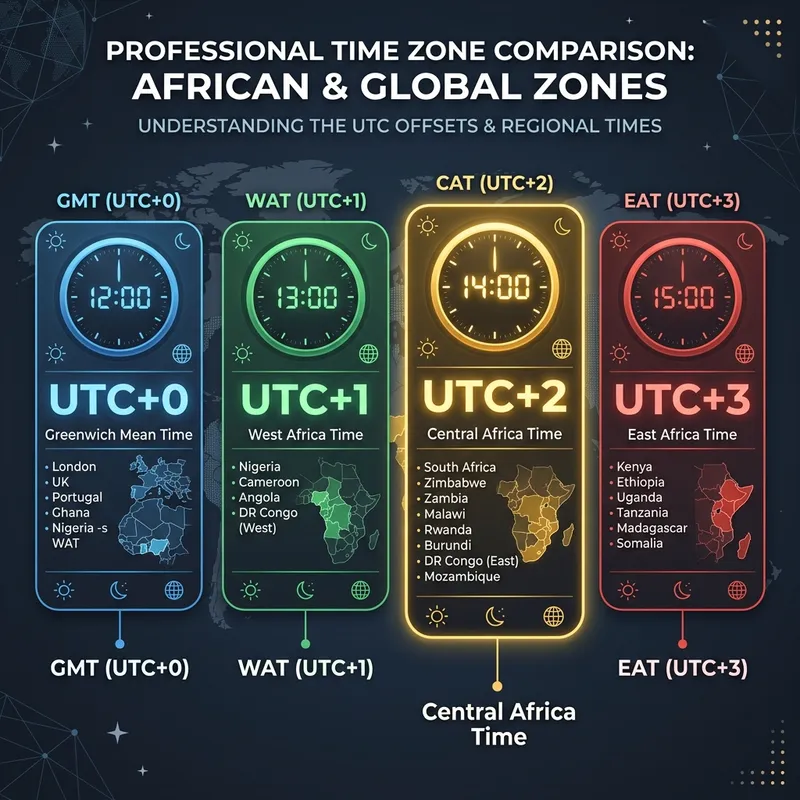
Countries and Regions That Use CAT
Central Africa Time is observed by a number of countries in the central and southern portions of the African continent. The following countries use CAT as their standard time zone:
Capital: Gaborone
Capital: Gitega
Lubumbashi, Bukavu
Capital: Lilongwe
Capital: Maputo
Capital: Windhoek
Capital: Kigali
Capital: Lusaka
Capital: Harare
Note that the Democratic Republic of the Congo spans two time zones: the western part uses WAT (West Africa Time, UTC+1), while the eastern part uses CAT (UTC+2). Not all African countries use CAT — neighboring zones include WAT (UTC+1) to the west and EAT (East Africa Time, UTC+3) to the east. South Africa Standard Time (SAST) also shares the UTC+2 offset but is classified separately under its own designation.
GMT vs CAT
Here is a direct comparison of Greenwich Mean Time and Central Africa Time across key attributes:
| Feature | GMT | CAT |
|---|---|---|
| Full Name | Greenwich Mean Time | Central Africa Time |
| UTC Offset | UTC±0 | UTC+2 |
| Difference | — | 2 hours ahead of GMT |
| Primary Region | United Kingdom, global reference | Central & Southern Africa |
| Daylight Saving | UK switches to BST in summer | No seasonal DST change |
| IANA Identifier | UTC / Etc/GMT | Africa/Maputo, Africa/Harare |
| Common Uses | Aviation, maritime, global IT systems | Regional business, NGO operations, travel |
Does CAT Observe Daylight Saving Time?
No. Central Africa Time (CAT) is a fixed UTC+2 offset that does not change seasonally. The countries using CAT do not observe daylight saving time (DST). Their clocks remain at UTC+2 throughout the entire year, including both the southern hemisphere summer and winter periods.
This is in contrast to many European and North American time zones, where clocks shift forward by one hour during spring and back again in autumn. For GMT-to-CAT conversion, this means the calculation is always the same: add 2 hours to GMT, regardless of the date.
However, note that the United Kingdom itself switches from GMT (UTC+0) to BST (British Summer Time, UTC+1) during summer months. If you are located in the UK during summer, you would need to convert from BST rather than GMT. Our GMT to BST Converter can help with that distinction.
GMT to CAT Date Changes
Since CAT is 2 hours ahead of GMT, late-evening GMT times can cross midnight and fall on the next calendar day in CAT. This is an important detail for scheduling, contract deadlines, and any time-sensitive operations.
When Does the Date Change?
- GMT 00:00 to 21:59 → CAT 02:00 to 23:59 → Same calendar day
- GMT 22:00 → CAT 00:00 (midnight) → Next calendar day
- GMT 23:00 → CAT 01:00 AM → Next calendar day
- GMT 23:30 → CAT 01:30 AM → Next calendar day
Date Change Examples
Example 1: 9:00 PM GMT on March 10 → 11:00 PM CAT on March 10 (same day)
Example 2: 10:00 PM GMT on March 10 → 12:00 AM CAT on March 11 (date advances)
Example 3: 11:30 PM GMT on December 31 → 1:30 AM CAT on January 1 (new year in CAT)
Always verify both the time and date when converting late GMT hours to CAT. Our converter tool at the top of this page handles date transitions automatically.
GMT to CAT for Meetings and Scheduling
If you work with colleagues, clients, or partners in CAT countries, coordinating meeting times across the 2-hour offset is essential. Here are practical approaches:
Overlapping Business Hours
Standard business hours in GMT (9:00 AM to 5:00 PM) correspond to 11:00 AM to 7:00 PM in CAT. The overlap window for comfortable working hours (assuming CAT business hours of 8:00 AM to 5:00 PM) is approximately 9:00 AM to 3:00 PM GMT / 11:00 AM to 5:00 PM CAT.
Best Practices for Cross-Zone Scheduling
- Always include the time zone abbreviation when sharing meeting times: 14:00 GMT / 16:00 CAT
- Use calendar applications that support time zone display to avoid manual conversion errors
- For recurring meetings, note that the offset does not change seasonally — the same GMT time always converts to the same CAT time
- When sending meeting invitations to CAT participants, consider that their afternoon ends at 5:00 PM CAT (3:00 PM GMT)
- For international conferences spanning multiple African zones, confirm whether participants are in EAT (UTC+3), CAT (UTC+2), or WAT (UTC+1)
Use Cases
GMT-to-CAT conversion is commonly needed for:
- International development and NGO coordination — many organizations headquartered in GMT-aligned countries operate field offices in CAT regions
- Corporate operations — mining, telecommunications, and financial companies with offices in Botswana, Zambia, or Zimbabwe
- Travel planning — flights between London and Harare, Lusaka, Maputo, or Kigali
- Remote work — distributed teams spanning European and African time zones
- Software development — server maintenance windows and deployment schedules across GMT and CAT
- Event broadcasting — live streams and webinars targeting both GMT and CAT audiences
GMT to CAT Conversion Tips
📌 Remember +2
CAT is always exactly 2 hours ahead of GMT. There is no seasonal variation to track.
📅 Check the Date
Late GMT times (10 PM onward) roll into the next calendar day in CAT. Always verify the date.
🔤 Confirm the Abbreviation
CAT means Central Africa Time (UTC+2). Do not confuse it with CST, CDT, or other Central-prefixed zones.
🌍 Identify the Region
Verify whether your contact is in a CAT (UTC+2), WAT (UTC+1), or EAT (UTC+3) country before converting.
🔄 No DST Adjustments
CAT countries do not observe daylight saving time. The +2 offset is constant year-round.
🛫 Include Date in Scheduling
When scheduling across GMT and CAT, always include the full date, time, and timezone abbreviation to avoid confusion.
GMT to Harare Time
Harare, the capital of Zimbabwe, observes Central Africa Time (CAT, UTC+2) year-round. Converting GMT to Harare time follows the standard GMT + 2 hours = Harare time formula. Zimbabwe does not use daylight saving time, so the 2-hour offset is consistent throughout the year. Harare is a major hub for business, international organizations, and tourism in southern Africa.
GMT to Lusaka Time
Lusaka, the capital of Zambia, also uses Central Africa Time (CAT, UTC+2). Like other CAT countries, Zambia does not observe daylight saving time. The conversion from GMT to Lusaka time is always GMT + 2 hours. Lusaka serves as a central business hub for the southern African region and hosts numerous international conferences and operations.
CAT vs Other African Time Zones
Africa uses several different time zone designations. Understanding how CAT relates to its neighbors helps avoid confusion:
| Time Zone | Full Name | UTC Offset | Example Countries |
|---|---|---|---|
| WAT | West Africa Time | UTC+1 | Nigeria, Ghana (some), Cameroon |
| CAT | Central Africa Time | UTC+2 | Zambia, Zimbabwe, Botswana |
| SAST | South Africa Standard Time | UTC+2 | South Africa, Eswatini, Lesotho |
| EAT | East Africa Time | UTC+3 | Kenya, Ethiopia, Tanzania |
While CAT and SAST share the same UTC+2 numeric offset, they are distinct designations representing different geographic regions. When communicating internationally, specifying the exact abbreviation (CAT vs SAST) helps clarify which region you are referring to. For conversions involving East Africa, see our GMT to EAT Converter. For South Africa conversions, see our GMT to SAST Converter.