
GMT vs EST: What's the Difference?
When coordinating across international borders, scheduling global webinars, or tracking overseas financial markets, GMT and EST are two of the most frequently referenced time terms in the world. Yet they are often confused or incorrectly compared.
Understanding the difference between Greenwich Mean Time (GMT) and Eastern Standard Time (EST) is essential for anyone dealing with cross-Atlantic business, international flights, or live global broadcasts.
This guide breaks down how GMT and EST compare, why their time difference is not always five hours, how seasonal daylight saving changes affect them, and how to convert between them accurately.
The Quick Answer: GMT vs EST at a Glance
The core difference is straightforward:
- GMT (Greenwich Mean Time) is the universal time baseline at UTC+0, centered on the Prime Meridian in Greenwich, London. It never changes for daylight saving time.
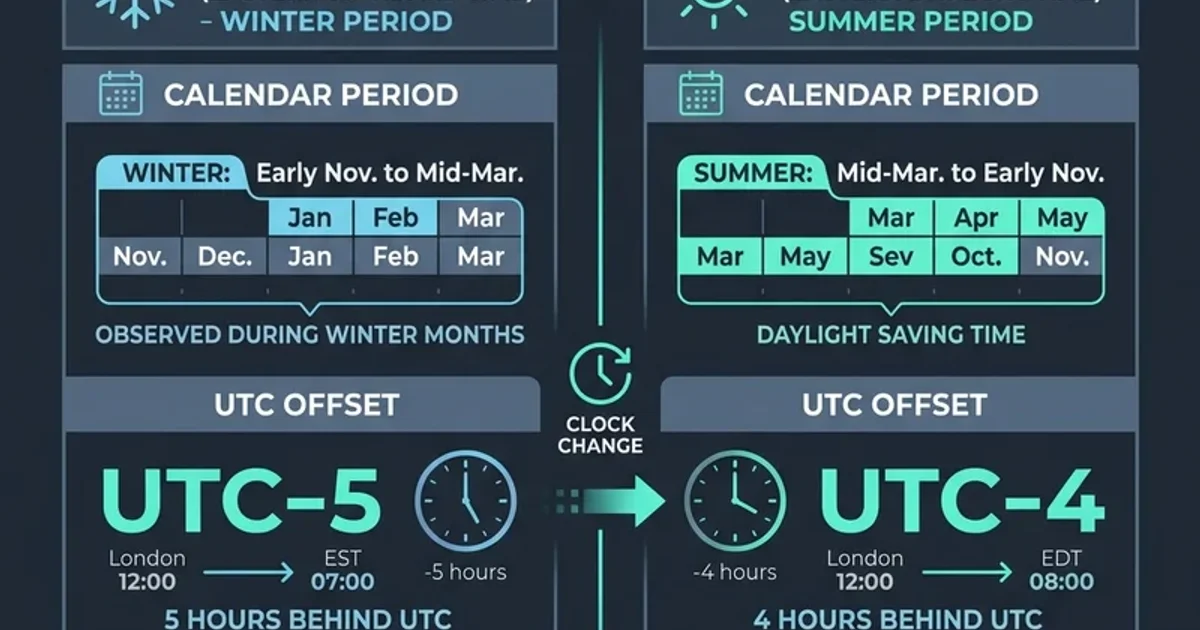
- EST (Eastern Standard Time) is a North American regional time zone operating at UTC−5, which is 5 hours behind GMT.
- The baseline difference: When both regions are in standard winter time, GMT is 5 hours ahead of EST (or EST is 5 hours behind GMT).
- Example: When it is 3:00 PM GMT, it is 10:00 AM EST in New York and Toronto.
Quick Comparison Table
| Feature | Greenwich Mean Time (GMT) | Eastern Standard Time (EST) |
|---|---|---|
| Full Name | Greenwich Mean Time | Eastern Standard Time |
| UTC Offset | UTC±0 (Zero offset) | UTC−5 (5 hours behind UTC) |
| Time Gap | Baseline reference | 5 hours behind GMT |
| Daylight Saving Time | Never shifts (Fixed UTC+0) | Changes to EDT (UTC−4) in summer |
| Primary Hubs | London, Reykjavik, Accra, Lisbon | New York, Toronto, Miami, Atlanta, Boston |
| Active Season | Constant baseline / UK Winter | North American Winter (Nov – Mar) |
| Common Use Cases | Aviation, UTC standard, shipping, scientific data | US stock markets, national television, corporate syncs |
A Quick Recap: What Is GMT?
Greenwich Mean Time (GMT) is the mean solar time measured at the Royal Observatory in Greenwich, London, situated along the Prime Meridian (0° longitude).
Historically established in 1884 as the international standard of time, GMT served as the world’s primary reference point before atomic timekeeping introduced Coordinated Universal Time (UTC).
Key facts about GMT:
- It is an absolute zero offset: GMT sits permanently at UTC+0.
- It never observes daylight saving: Unlike civil time zones, the GMT standard never springs forward or falls back.
- It remains the reference standard: Aviation, international maritime operations, space telemetry, and global weather forecasting rely on GMT / UTC as an unvarying baseline.
A Quick Recap: What Is EST?
Eastern Standard Time (EST) is the standard civil time zone observed across eastern North America during the winter months. Operating at UTC−5, EST is five hours behind UTC and GMT.
EST spans 23 US states, several eastern Canadian provinces, and Caribbean regions. Major metropolitan hubs operating on Eastern Standard Time include New York City, Washington D.C., Boston, Philadelphia, Atlanta, Miami, and Toronto.
Key facts about EST:
- It is a seasonal standard: EST is specifically the winter designation for Eastern Time.
- It transitions to EDT: In the spring, regions observing daylight saving time advance their clocks by one hour to Eastern Daylight Time (EDT, UTC−4).
- It governs major markets: Major financial exchanges, including the New York Stock Exchange (NYSE) and Nasdaq, benchmark their official trading schedules against Eastern Time.
The Core Difference: A Fixed Reference vs. a Regional Zone
The fundamental distinction between GMT and EST lies in their operational nature:
- GMT is an unshifting reference standard. It serves as the geographic origin of world time measurement (0° longitude) and stays at UTC+0 every second of the year.
- EST is a regional civil time zone. It is geographically centered on the 75th meridian west (UTC−5) and represents local civil time for specific countries during standard winter months.
Because GMT does not shift, comparing GMT to local civil time requires understanding what the regional clocks in both locations are actually doing throughout the calendar year.
Why the Gap Isn’t Always 5 Hours
While the mathematical difference between GMT (UTC+0) and EST (UTC−5) is strictly 5 hours, the practical time difference between the UK / Europe and the North American East Coast fluctuates between 4, 5, and sometimes 6 hours throughout the year due to Daylight Saving Time (DST).
Here is how the seasonal shifts work:
1. Winter (November to March): 5-Hour Gap
- London and the UK observe GMT (UTC+0).
- New York and Eastern North America observe EST (UTC−5).
- Difference: GMT is 5 hours ahead of EST.
- Calculation: 4:00 PM GMT = 11:00 AM EST.
2. Summer (April to October): 5-Hour Gap Between UK and US (with different abbreviations)
- The UK advances clocks to British Summer Time (BST, UTC+1).
- Eastern North America advances clocks to Eastern Daylight Time (EDT, UTC−4).
- Difference: BST is 5 hours ahead of EDT.
- Note: If you compare true GMT (UTC+0) to EDT (UTC−4) in the summer, GMT is 4 hours ahead of Eastern Daylight Time.
3. The 2–3 Week Spring and Autumn Transition Gaps
The United States and the United Kingdom do not change their clocks on the same weekend:
- Spring Transition (March): The US switches to EDT on the second Sunday in March, while the UK switches to BST on the last Sunday in March. During these 2–3 weeks, Eastern Time is on EDT (UTC−4) while the UK is still on GMT (UTC+0), temporarily making the difference 4 hours.
- Autumn Transition (October/November): The UK returns to GMT on the last Sunday in October, while the US remains on EDT until the first Sunday in November. For this one-week window, the UK is on GMT (UTC+0) while the US is on EDT (UTC−4), again creating a 4-hour gap.
To learn more about these exact transition dates, see our detailed guide on clock change dates and daylight saving time.
How This Plays Out for Different Regions
When comparing GMT and EST, the practical conversion depends on which geographic locations are involved:
For the UK
The United Kingdom sits on the Prime Meridian and uses GMT as its national winter civil time. In summer, the UK uses BST (UTC+1). When someone in London sets up a call with a colleague in New York, the time gap is 5 hours for most of the year, but drops to 4 hours during the March transition period.
For Canada
Canadian provinces within the Eastern Time zone (such as Ontario and Quebec) follow the exact same daylight saving schedule as the United States, shifting between EST (UTC−5) in winter and EDT (UTC−4) in summer. However, parts of Nunavut (e.g., Southampton Island) observe EST year-round without daylight saving.
For Europe
Most of Western and Central Europe operates on Central European Time (CET, UTC+1) in winter and Central European Summer Time (CEST, UTC+2) in summer. Consequently, Paris, Berlin, and Frankfurt are 6 hours ahead of EST in winter and 6 hours ahead of EDT in summer.
For Australia
Australian Eastern Standard Time (AEST, UTC+10) and Australian Eastern Daylight Time (AEDT, UTC+11) are located on the opposite side of the globe. AEST is 10 hours ahead of GMT and 15 hours ahead of EST, meaning Sydney is almost an entire calendar day ahead of New York.
Real-World Situations Where This Comparison Matters
Understanding the difference between GMT and EST is vital across numerous professional and personal scenarios:
- Global Business and Remote Work: Scheduling cross-Atlantic meetings between European teams and North American offices requires finding overlapping business hours. The best collaboration window usually falls between 2:00 PM and 5:00 PM GMT (which corresponds to 9:00 AM to 12:00 PM EST).
- Financial Markets: The London Stock Exchange (LSE) opens at 8:00 AM GMT (3:00 AM EST), while the New York Stock Exchange (NYSE) opens at 9:30 AM EST (2:30 PM GMT). Cross-market traders rely on this 5-hour offset to manage arbitrage and opening bell volatility.
- Aviation and Maritime Travel: Flight tickets, airline itineraries, and marine vessel logs frequently display departure and arrival times in UTC / GMT to prevent regional daylight confusion.
- International Sports & Gaming: Major events such as Premier League matches, Formula 1 Grand Prix races, and global esports tournaments publish official broadcast schedules in GMT. Knowing your EST offset ensures you never miss live coverage.
How to Convert Between GMT and EST
Converting between Greenwich Mean Time and Eastern Standard Time is straightforward once you know the direction:
Converting GMT to EST (Subtract 5 Hours)
To convert from GMT to EST, subtract 5 hours from the GMT time:
$$\text{EST} = \text{GMT} - 5\text{ hours}$$
Step-by-step example:
- You have a meeting scheduled for 3:00 PM GMT (15:00 in 24-hour time).
- Subtract 5 hours: $15:00 - 5 = 10:00$.
- The converted time is 10:00 AM EST.
If the subtraction crosses midnight into the previous day, subtract from 24 and roll back the calendar date by one day (e.g., 2:00 AM GMT on Tuesday = 9:00 PM EST on Monday).
Converting EST to GMT (Add 5 Hours)
To convert from EST to GMT, add 5 hours to the Eastern time:
$$\text{GMT} = \text{EST} + 5\text{ hours}$$
Step-by-step example:
- You want to know what 11:00 AM EST is in GMT.
- Add 5 hours: $11:00 + 5 = 16:00$ (4:00 PM).
- The converted time is 4:00 PM GMT.
For instant, date-aware calculations that automatically detect whether daylight saving time is active, use our free GMT to EST Converter or EST to GMT Converter.
Common Misconceptions
Several widespread misunderstandings about GMT and EST persist:
- “EST is used all year in New York.”
Incorrect. New York only uses EST for about four months during winter. For the remaining eight months, it uses Eastern Daylight Time (EDT, UTC−4). - “GMT and UTC are completely different clock times.”
Incorrect. While UTC is based on atomic clocks and GMT is based on solar time, both share the exact same current clock time (0 hours offset) for everyday civilian and commercial purposes. - “GMT changes its clocks in the summer.”
Incorrect. GMT never changes. It is the United Kingdom that changes its national clock to British Summer Time (BST, UTC+1). GMT itself remains fixed at UTC+0. - “EST and EDT have the same UTC offset.”
Incorrect. EST is UTC−5, while EDT is UTC−4. Confusing the two causes one-hour scheduling errors.
Frequently Asked Questions
What is the main difference between GMT and EST?
Greenwich Mean Time (GMT) is a fixed global time reference at UTC+0 centered on the Prime Meridian in London. Eastern Standard Time (EST) is a regional North American time zone operating at UTC−5 (5 hours behind GMT).
How many hours is GMT ahead of EST?
GMT is 5 hours ahead of EST during standard winter time. When it is 5:00 PM GMT, it is 12:00 PM (Noon) EST.
Why is the difference between GMT and Eastern Time sometimes 4 hours?
During summer, Eastern North America observes Eastern Daylight Time (EDT, UTC−4). Because GMT remains at UTC+0, the gap between GMT and Eastern civil time is 4 hours instead of 5.
Does GMT change for Daylight Saving Time?
No. GMT is a fixed time standard that never changes. The UK switches from GMT to British Summer Time (BST) during the summer, but GMT remains at UTC+0.
Is London always on GMT?
No. London uses GMT only from late October to late March. During the spring and summer months, London operates on BST (UTC+1).
Is New York always on EST?
No. New York operates on EST (UTC−5) from early November to mid-March, and on EDT (UTC−4) from mid-March to early November.
What is the difference between EST and EDT?
EST (Eastern Standard Time) is the winter standard time at UTC−5. EDT (Eastern Daylight Time) is the summer daylight saving time at UTC−4.
How do I convert a time from GMT to EST?
Subtract 5 hours from the GMT time. For example, 1:00 PM GMT minus 5 hours is 8:00 AM EST.
Final Thoughts
The distinction between GMT vs EST comes down to understanding the difference between a fixed universal baseline (GMT at UTC+0) and a regional civil time zone (EST at UTC−5).
During the winter months, the calculation is a simple 5-hour offset. In the summer, keeping track of regional daylight saving shifts (EDT in North America and BST in the UK) ensures you avoid costly scheduling mishaps.
Whenever you need fast, date-accurate conversions between any time zone, our GMT to EST Converter automatically accounts for seasonal daylight saving adjustments in real time.
Frequently Asked Questions (FAQ)
What is the main difference between GMT and EST?
Greenwich Mean Time (GMT) is a fixed time reference at UTC+0 centered on the Prime Meridian, whereas Eastern Standard Time (EST) is a regional North American time zone operating at UTC-5. GMT is 5 hours ahead of EST.
How many hours is GMT ahead of EST?
GMT is 5 hours ahead of Eastern Standard Time (EST). When it is 3:00 PM GMT, it is 10:00 AM EST in New York, Toronto, and Miami.
Why is the difference between GMT and Eastern Time sometimes 4 hours?
During summer months, North America shifts from EST (UTC-5) to Eastern Daylight Time (EDT, UTC-4) for daylight saving time. Because GMT remains fixed at UTC+0, the time gap narrows from 5 hours to 4 hours.
Does GMT change for Daylight Saving Time?
No. GMT is a fixed astronomical offset (UTC+0) that never changes. The United Kingdom shifts to British Summer Time (BST, UTC+1) in summer, but GMT itself stays at UTC+0.
Is London always on GMT?
No. London observes GMT (UTC+0) only during the winter months (late October to late March). From late March to late October, London operates on British Summer Time (BST, UTC+1).
Is New York always on EST?
No. New York operates on Eastern Standard Time (EST, UTC-5) during winter and switches to Eastern Daylight Time (EDT, UTC-4) during summer daylight saving time.
What is the difference between EST and EDT?
EST (Eastern Standard Time) is the winter standard time at UTC-5, while EDT (Eastern Daylight Time) is the summer daylight saving time at UTC-4. Both represent the Eastern Time (ET) zone at different times of the year.
How do I convert a time from GMT to EST?
To convert GMT to EST, subtract 5 hours from the GMT time (EST = GMT - 5 hours). For example, 2:00 PM (14:00) GMT minus 5 hours equals 9:00 AM EST.
Sources & References
- The Prime Meridian and Greenwich Mean Time — Royal Museums Greenwich
- Daylight Saving Time and Time Zones — National Institute of Standards and Technology (NIST)
- Time Zone Database (tzdb) — IANA Time Zone Database
- Astronomical Applications and Time Systems — U.S. Naval Observatory (USNO)