
Newfoundland Time Zone Explained: Why Canada Has a 30-Minute Offset (NST/NDT)
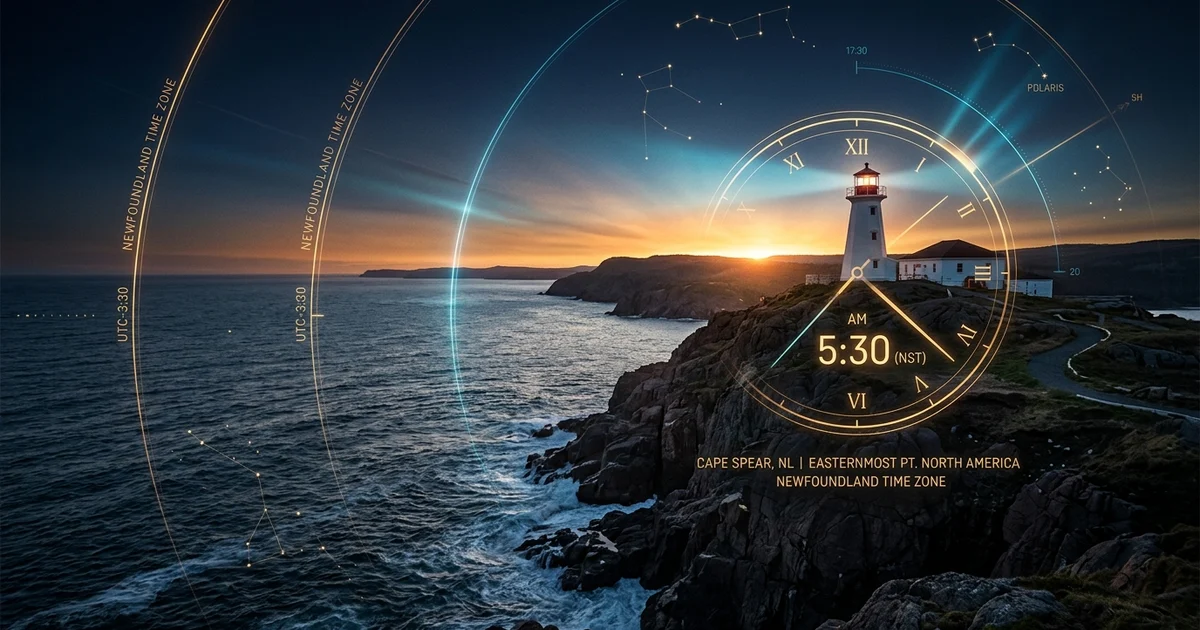
Picture this. You have scheduled a video call with a colleague in St. John’s. You are based in Toronto, so you do the quick mental math: Atlantic Time is one hour ahead of you, so you book 3:00 PM your time, assuming it will be 4:00 PM for them. Then your colleague replies: “Great, see you at 4:30!”
Welcome to the Newfoundland time zone, one of the most distinctive corners of global timekeeping.
The Newfoundland Time Zone operates at UTC−3:30 (NST) in winter and UTC−2:30 (NDT) in summer. Its clocks run exactly 30 minutes ahead of Atlantic Time and 90 minutes (1 hour 30 minutes) ahead of Eastern Time year-round.
Most of the world’s time zones are separated by neat, round, one-hour increments. Newfoundland refuses to play along. In winter, Newfoundland Standard Time (NST) sits at UTC−3:30. In summer, Newfoundland Daylight Time (NDT) moves to UTC−2:30.
As detailed in our comprehensive guide to Canada time zones, Canada spans six standard time zones rather than five: Pacific, Mountain, Central, Eastern, Atlantic, and Newfoundland. Newfoundland is the unique outlier, not out of stubbornness, but because physical geography, solar astronomy, and constitutional history placed it there.
In this guide, we cover:
- What the Newfoundland time zone actually is, with exact UTC offsets
- Why it is offset by 30 minutes (and the solar astronomy behind it)
- How and when Newfoundland handles daylight saving time
- How it compares with Eastern, Atlantic, Central, Mountain, and Pacific time
- Regional exceptions, including the split across Labrador
- Real conversion tables for business meetings and travel
- Common scheduling pitfalls and quick answers to frequent questions
What Time Zone Is Newfoundland In?
Newfoundland is in the Newfoundland Time Zone, officially designated as Newfoundland Time (NT). Like most Canadian jurisdictions, it alternates between two operational offsets depending on the season.
Newfoundland Standard Time (NST)
Newfoundland Standard Time (NST) is the standard winter time. It runs from the first Sunday in November to the second Sunday in March. Its official offset is UTC−3:30, meaning local clocks run three hours and thirty minutes behind Coordinated Universal Time (UTC).
Newfoundland Daylight Time (NDT)
Newfoundland Daylight Time (NDT) is the summer daylight saving time. It runs from the second Sunday in March to the first Sunday in November. Its official offset is UTC−2:30. When daylight saving starts, clocks advance one hour forward, shrinking the offset from UTC−3:30 to UTC−2:30.
Quick Reference: Newfoundland Time Codes
| Name | Abbreviation | UTC Offset | Active Months |
|---|---|---|---|
| Newfoundland Standard Time | NST | UTC−3:30 | First Sunday in Nov to Second Sunday in March |
| Newfoundland Daylight Time | NDT | UTC−2:30 | Second Sunday in March to First Sunday in Nov |
St. John’s Time Zone
St. John’s, the provincial capital and the largest metropolitan area in Newfoundland and Labrador, is the reference anchor for the Newfoundland time zone. When people search online for “time in St. John’s”, they are checking NST or NDT depending on the date.
Because Newfoundland observes Daylight Saving Time concurrently with other Canadian provinces, you can convert between local Newfoundland time and other major world hubs instantly with our GMT to NST converter and NST to EST converter.
Why Is Newfoundland 30 Minutes Different?
The short answer: Newfoundland sits so far east into the North Atlantic that picking either of the adjacent one-hour standard time zones would have put its clocks noticeably out of step with the sun. A 30-minute half-hour offset provided a mathematically near-perfect fit.
The Half-Hour Time Zone Concept
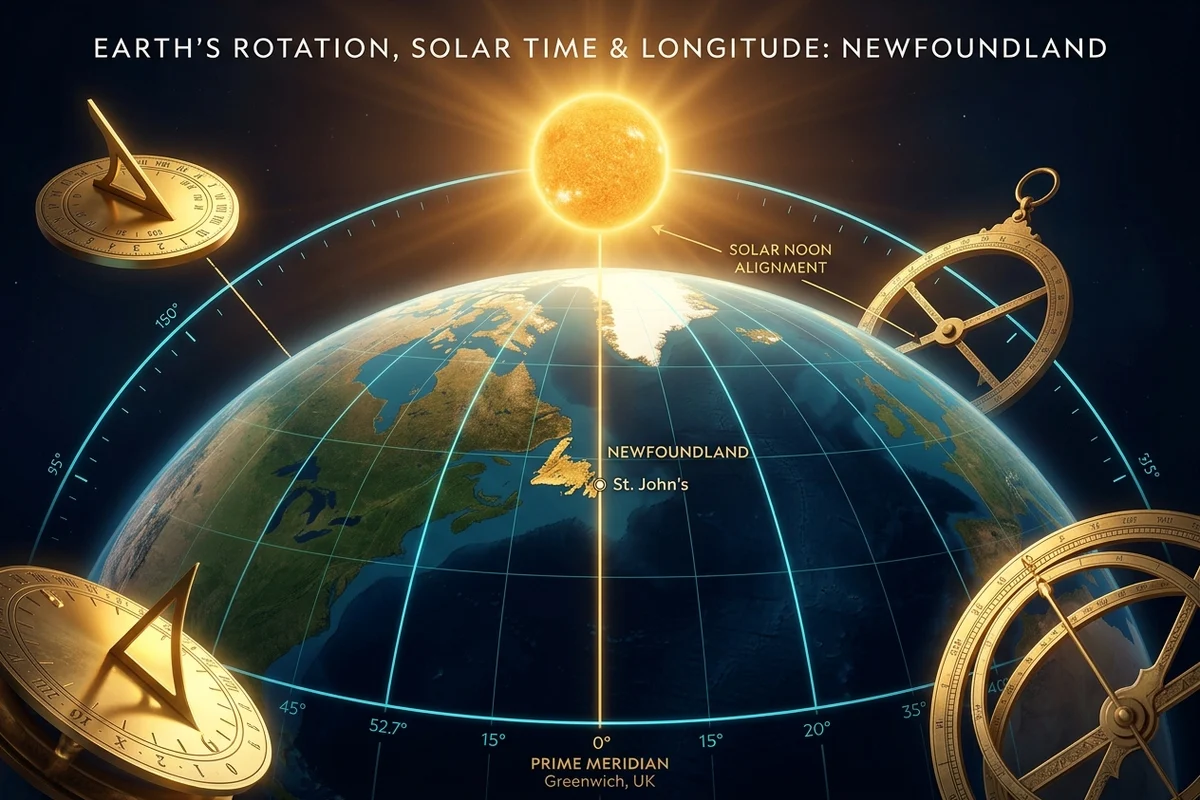
Standard international time zones are theoretically designed to be 15 degrees of longitude wide, because Earth completes a 360-degree rotation every 24 hours ($360^\circ \div 24 = 15^\circ$ per hour). In an ideal geometric model, Earth would divide neatly into 24 one-hour slices.
In practice, borders and human settlements rarely follow straight lines of longitude. Several nations around the globe adopted fractional half-hour or 45-minute offsets to align their clocks with true solar midday:
- India: UTC+5:30 (covers the entire nation)
- Iran: UTC+3:30
- Afghanistan: UTC+4:30
- Myanmar: UTC+6:30
- Central Australia (Adelaide, Darwin): UTC+9:30 (ACST) / UTC+10:30 (ACDT)
- Newfoundland (Canada): UTC−3:30 (NST) / UTC−2:30 (NDT)
- Nepal: UTC+5:45 (45-minute offset)
- Chatham Islands (New Zealand): UTC+12:45 / UTC+13:45
Newfoundland is not alone globally, but it is the only half-hour time zone in Canada and one of very few in the Western Hemisphere.
The Geography and Longitude Behind It
The scientific explanation lies in longitude. St. John’s is situated at approximately 52.71° West longitude.
Dividing $52.71^\circ$ by $15^\circ$ yields:
$$\frac{52.71^\circ}{15^\circ/\text{hour}} \approx 3.514\text{ hours} = 3\text{ hours}, 30\text{ minutes}, 50\text{ seconds}$$
In other words, Newfoundland Standard Time matches the real solar time of St. John’s within less than a single minute! When the sun culminates at its highest zenith in the sky over St. John’s Harbour, the clock on the wall reads almost exactly 12:00 PM noon.
Consider what would happen if authorities had forced Newfoundland into a standard full-hour zone:
- If Newfoundland used Atlantic Time (UTC−4): Clocks would run 30 minutes behind the sun. Solar noon would occur at 12:30 PM. In high summer, this is tolerable, but in mid-winter, afternoons would become dark extraordinarily early.
- If Newfoundland used UTC−3 (matching West Greenland): Clocks would run 30 minutes ahead of the sun. Solar noon would not occur until 11:30 AM, and sunrise in December would be pushed past 8:30 AM or 9:00 AM, forcing school children and workers into pitch-black morning commutes.
The half-hour offset split the difference, harmonizing human clocks with the natural daylight cycle of the island.
Why Does Newfoundland Have a Half-Hour Time Zone? History & Confederation
To understand why this system persists, one must look at Canadian history.
The Historical Explanation: A Self-Governing Dominion
In the late 19th century, standard time zones spread across the globe, spearheaded by Canadian railway engineer Sir Sandford Fleming. While standard zones were adopted across continental North America, Newfoundland was not part of Canada. It was an independent British colony, and later a self-governing Dominion with its own parliament, currency, postage, and laws.
When Newfoundland chose its standard time system, it prioritized its own commercial hub: St. John’s. In 1935, the Newfoundland government formally codified UTC−3:30 as its legal standard time.
Joining Canadian Confederation in 1949
In 1949, Newfoundland joined Canada as the nation’s tenth province. By that time, island life, shipping routes, railway timetables, schools, and coastal ferries had operated on the half-hour system for generations.
Provincial leaders and citizens saw no practical reason to disrupt their daily routines. The Canadian federal government respected provincial jurisdiction over local timekeeping, and the Standard Time Act has maintained Newfoundland Time ever since.
Why the Half-Hour Difference Still Exists Today
Three key reasons keep the half-hour offset intact:
- Local Identity and Pride: Newfoundland has a unique maritime culture and history. Having its own time zone is a recognized hallmark of provincial heritage.
- Economic and Logistical Costs of Change: Shifting an entire province’s time zone would force massive reconfigurations across civil aviation, maritime navigation, broadcast telecommunications, legal contracts, and digital databases without providing tangible benefits to locals.
- Astronomical Reality: The island has not moved. St. John’s is still located at 52.7° W longitude, and UTC−3:30 remains the most daylight-efficient schedule for its population.
Newfoundland Time Zone UTC Offset
When configuring servers, travel itineraries, or calendar invites, exact offsets are paramount:
- Newfoundland Standard Time (NST): UTC−3:30 (3.5 hours behind Coordinated Universal Time)
- When it is 12:00 PM (Noon) UTC, it is 8:30 AM NST in St. John’s.
- Newfoundland Daylight Time (NDT): UTC−2:30 (2.5 hours behind Coordinated Universal Time)
- When it is 12:00 PM (Noon) UTC, it is 9:30 AM NDT in St. John’s.
A handy mnemonic: take the Atlantic Time offset and add 30 minutes. Atlantic Standard Time is UTC−4, so Newfoundland Standard Time is UTC−3:30. Atlantic Daylight Time is UTC−3, so Newfoundland Daylight Time is UTC−2:30. Newfoundland is consistently 30 minutes ahead of Atlantic Canada.
Does Newfoundland Use Daylight Saving Time?
Yes. Newfoundland observes Daylight Saving Time (DST) alongside most Canadian provinces and the United States, following the standard North American schedule.
As explained in our guide to Standard Time vs Daylight Saving Time, the seasonal transition alters the offset by exactly one hour:
- Baseline Standard Time (NST): UTC−3:30
- Summer Daylight Time (NDT): UTC−2:30
Daylight Saving Time Dates (2026–2027)
Clocks advance on the second Sunday in March and fall back on the first Sunday in November at 2:00 AM local time:
| Year | Spring Forward (NST → NDT) | Fall Back (NDT → NST) |
|---|---|---|
| 2026 | Sunday, March 8, 2026 (at 2:00 AM NST to 3:00 AM NDT) | Sunday, November 1, 2026 (at 2:00 AM NDT to 1:00 AM NST) |
| 2027 | Sunday, March 14, 2027 (at 2:00 AM NST to 3:00 AM NDT) | Sunday, November 7, 2027 (at 2:00 AM NDT to 1:00 AM NST) |
Because Newfoundland shifts clocks in tandem with Ontario, Quebec, New York, and the Maritime provinces, the operational difference between Newfoundland and Eastern or Atlantic Time never shifts during daylight saving transitions.
Newfoundland Time Zone vs. Eastern Time (EST / EDT)
For professionals, remote teams, and travellers coordinating between Atlantic Canada and Ontario, Quebec, or the US East Coast, the comparison with Eastern Standard Time (EST) is the most critical:
- Winter Comparison (NST vs. EST):
- Newfoundland Standard Time: UTC−3:30
- Eastern Standard Time: UTC−5:00
- Difference: Newfoundland is 1 hour 30 minutes ahead of EST.
- Summer Comparison (NDT vs. EDT):
- Newfoundland Daylight Time: UTC−2:30
- Eastern Daylight Time: UTC−4:00
- Difference: Newfoundland is 1 hour 30 minutes ahead of EDT.
The Golden Rule: The 90-Minute Gap Never Changes
Because both regions switch into and out of daylight saving time on the identical Sundays in March and November, Newfoundland is always 1.5 hours ahead of Eastern Time, 365 days a year.
Eastern Time (ET)  + 1 Hour 30 Minutes  = Newfoundland Time (NT)
Newfoundland Time (NT) - 1 Hour 30 Minutes = Eastern Time (ET)
Converting Eastern Time to Newfoundland Time (ET → NT)
To convert, add 1 hour and 30 minutes:
- 9:00 AM Eastern $\rightarrow$ 10:30 AM Newfoundland
- 1:00 PM Eastern $\rightarrow$ 2:30 PM Newfoundland
- 4:45 PM Eastern $\rightarrow$ 6:15 PM Newfoundland
- 9:30 PM Eastern $\rightarrow$ 11:00 PM Newfoundland
Converting Newfoundland Time to Eastern Time (NT → ET)
To convert, subtract 1 hour and 30 minutes:
- 10:00 AM Newfoundland $\rightarrow$ 8:30 AM Eastern
- 3:00 PM Newfoundland $\rightarrow$ 1:30 PM Eastern
- 7:30 PM Newfoundland $\rightarrow$ 6:00 PM Eastern
- 11:00 PM Newfoundland $\rightarrow$ 9:30 PM Eastern
If you are organizing an interprovincial company meeting from Toronto or Montreal, avoid scheduling calls prior to 8:00 AM Eastern. While 8:00 AM ET is 9:30 AM in Newfoundland, early 7:30 AM ET sessions force participants in Western Canada (e.g. Vancouver at 4:30 AM PT) into impossible hours.
Newfoundland Time Zone vs. Other Canadian Time Zones
How does Newfoundland compare across all six Canadian time zones?
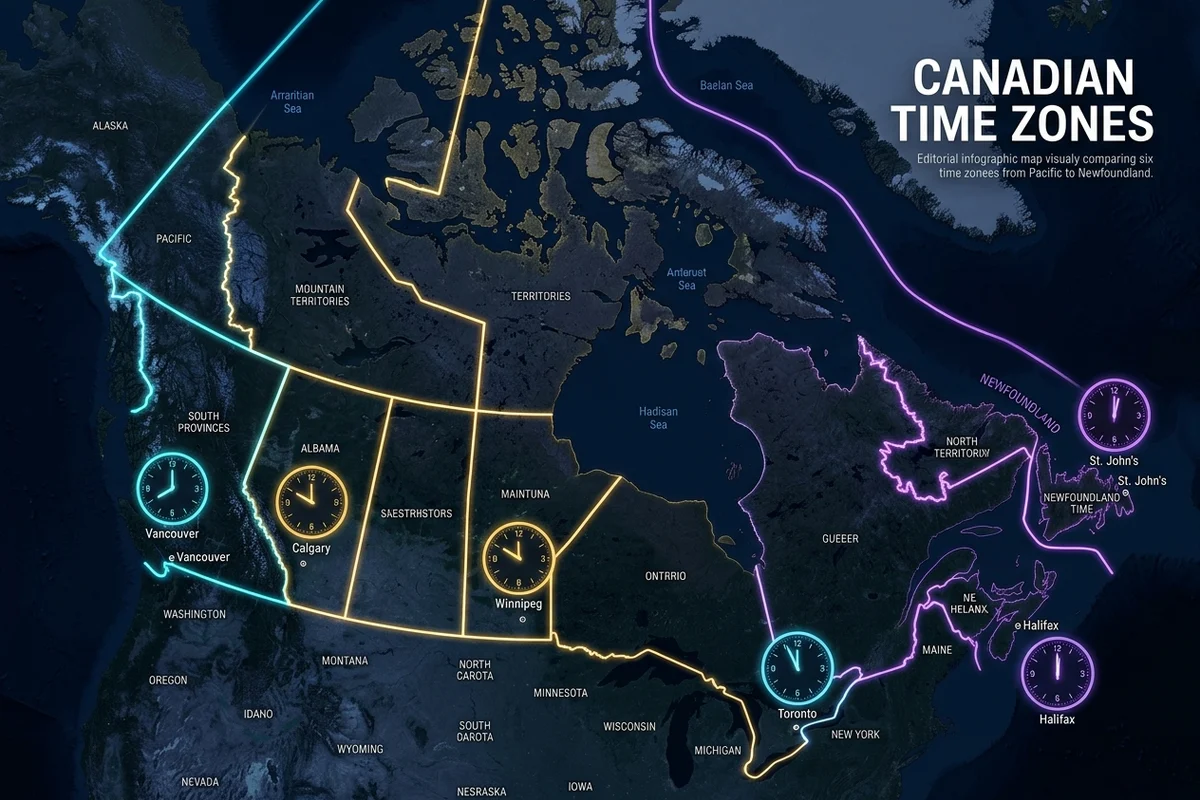
Cross-Canada Comparison Table
| Canadian Time Zone | Standard Offset | Daylight Offset | Newfoundland Comparison | Example Time (when 12:30 PM in St. John’s) |
|---|---|---|---|---|
| Newfoundland (NT) | UTC−3:30 | UTC−2:30 | Reference Base | 12:30 PM |
| Atlantic (AT) | UTC−4:00 | UTC−3:00 | NL is 30 min ahead | 12:00 PM (Halifax, Moncton) |
| Eastern (ET) | UTC−5:00 | UTC−4:00 | NL is 1 hr 30 min ahead | 11:00 AM (Toronto, Montreal) |
| Central (CT) | UTC−6:00 | UTC−5:00 | NL is 2 hr 30 min ahead | 10:00 AM (Winnipeg, Chicago) |
| Mountain (MT) | UTC−7:00 | UTC−6:00 | NL is 3 hr 30 min ahead | 9:00 AM (Calgary, Edmonton) |
| Pacific (PT) | UTC−8:00 | UTC−7:00 | NL is 4 hr 30 min ahead | 8:00 AM (Vancouver, Victoria) |
Key Regional Observations
- Newfoundland vs. Atlantic Time (30 Minutes Ahead): Atlantic Canada (Nova Scotia, New Brunswick, and Prince Edward Island) is just half an hour behind Newfoundland. If you take the ferry from North Sydney, Nova Scotia to Port aux Basques, Newfoundland, you advance your watch by 30 minutes upon arrival.
- Newfoundland vs. Central Time (2.5 Hours Ahead): As explored in our CST vs EST comparison, Central Time is 2 hours behind Eastern Time, placing it 2 hours and 30 minutes behind Newfoundland.
- Newfoundland vs. Pacific Time (4.5 Hours Ahead): The coast-to-coast span between St. John’s and Vancouver is 4 hours and 30 minutes. When Vancouver offices start their workday at 8:30 AM PT, St. John’s is already at 1:00 PM NT.
- Provincial Non-DST Exceptions: Keep in mind that Saskatchewan remains on permanent Central Standard Time (UTC−6) year-round, and Yukon observes permanent Mountain Standard Time (UTC−7). During summer months, Saskatchewan is 3.5 hours behind Newfoundland, and Yukon is 4.5 hours behind Newfoundland.
Newfoundland Time Zone by Location: The Island vs. Labrador Split
One of the most frequent misconceptions is assuming the province of Newfoundland and Labrador shares a single time zone throughout its entire territory. In reality, the province is divided across two distinct zones.
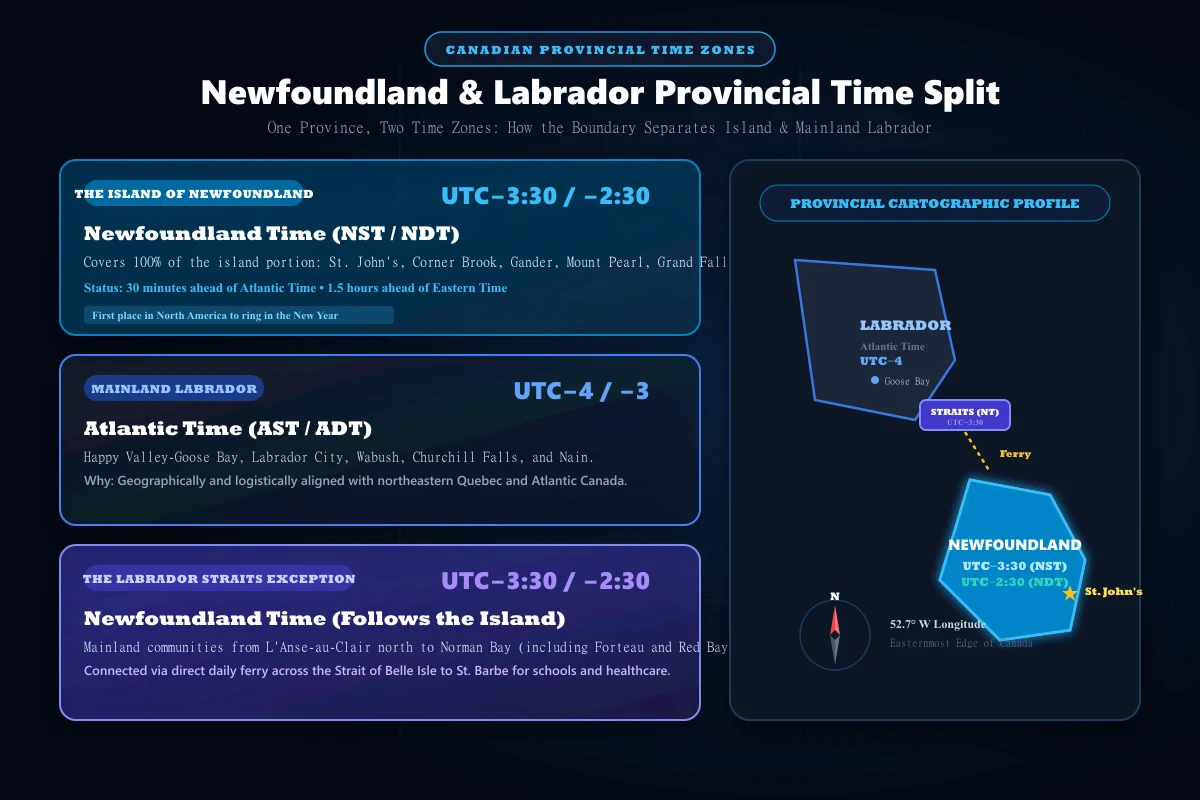
1. The Island of Newfoundland (100% Newfoundland Time)
The entire island of Newfoundland operates on Newfoundland Time (UTC−3:30 / UTC−2:30). This includes:
- St. John’s and Mount Pearl
- Conception Bay South and Paradise
- Corner Brook
- Gander (famous transatlantic aviation hub)
- Grand Falls-Windsor
- Gros Morne National Park
2. Mainland Labrador (Mostly Atlantic Time)
Mainland Labrador, which borders eastern Quebec, observes Atlantic Time (AST: UTC−4 / ADT: UTC−3). Key population centres on Atlantic Time include:
- Happy Valley-Goose Bay
- Labrador City and Wabush
- Churchill Falls
- Nain and northern coastal settlements
Because mainland Labrador is physically contiguous with continental Canada and trades closely with Quebec’s North Shore, Atlantic Time provides seamless regional coordination.
3. The Exception: The Labrador Straits
There is an important geographic exception: the Labrador Straits region in southeastern Labrador.
Communities running along the Strait of Belle Isle—from L’Anse-au-Clair north to Norman Bay, including Forteau and Red Bay—opted by provincial regulation to observe Newfoundland Time (UTC−3:30 / UTC−2:30).
Why? Because these coastal towns depend on the daily vehicle and passenger ferry connecting Blanc-Sablon/L’Anse-au-Clair to St. Barbe on the Island of Newfoundland for healthcare, secondary schooling, groceries, and commerce. Operating on identical clocks eliminates confusion for ferry schedules and medical appointments.
Practical Newfoundland Time Conversion Tables
Use these quick conversion reference charts for scheduling cross-border communications.
Newfoundland Time to Eastern Time (NT → EST / EDT)
Valid year-round (always subtract 1 hour 30 minutes):
| Newfoundland Time (NT) | Eastern Time (ET) | Practical Scheduling Context |
|---|---|---|
| 8:00 AM NT | 6:30 AM ET | Early morning in NL; Eastern teams are still offline |
| 9:30 AM NT | 8:00 AM ET | Eastern workday begins; ideal morning check-in window |
| 12:00 PM NT (Noon) | 10:30 AM ET | Prime joint collaboration window |
| 2:30 PM NT | 1:00 PM ET | Eastern teams return from lunch |
| 5:00 PM NT | 3:30 PM ET | Newfoundland end-of-day wrap-up |
| 6:00 PM NT | 4:30 PM ET | Eastern teams finish late-afternoon tasks |
| 10:00 PM NT | 8:30 PM ET | Evening broadcast and prime-time streaming sync |
Newfoundland Time to Central Time (NT → CST / CDT)
Valid year-round (always subtract 2 hours 30 minutes):
| Newfoundland Time (NT) | Central Time (CT) | Practical Scheduling Context |
|---|---|---|
| 8:00 AM NT | 5:30 AM CT | Early morning pre-commute in Central hub (Chicago/Winnipeg) |
| 10:30 AM NT | 8:00 AM CT | Central business day commences |
| 12:00 PM NT (Noon) | 9:30 AM CT | Morning team standups |
| 3:30 PM NT | 1:00 PM CT | Central post-lunch project sync |
| 6:00 PM NT | 3:30 PM CT | Central late-afternoon operations |
| 10:00 PM NT | 7:30 PM CT | Evening leisure & sports broadcasts |
Newfoundland Time to UTC / GMT
Unlike North American zones, Greenwich Mean Time (GMT) in the United Kingdom does not shift with Daylight Saving Time. Instead, the UK moves between GMT (UTC±0) in winter and BST (UTC+1) in summer.
Winter Conversion: NST (UTC−3:30) to GMT (UTC±0)
Add 3 hours 30 minutes to NST to get GMT:
| Newfoundland Standard Time (NST) | Greenwich Mean Time (GMT) | Day Transition |
|---|---|---|
| 8:00 AM NST | 11:30 AM GMT | Same day |
| 12:00 PM NST (Noon) | 3:30 PM GMT | Same day |
| 4:00 PM NST | 7:30 PM GMT | Same day |
| 6:00 PM NST | 9:30 PM GMT | Same day |
| 10:00 PM NST | 1:30 AM GMT (+1) | Next calendar day in London |
Summer Conversion: NDT (UTC−2:30) to UTC
Add 2 hours 30 minutes to NDT to get UTC:
| Newfoundland Daylight Time (NDT) | Coordinated Universal Time (UTC) | Day Transition |
|---|---|---|
| 8:00 AM NDT | 10:30 AM UTC | Same day |
| 12:00 PM NDT (Noon) | 2:30 PM UTC | Same day |
| 6:00 PM NDT | 8:30 PM UTC | Same day |
| 10:00 PM NDT | 12:30 AM UTC (+1) | Next calendar day in UTC |
Common Newfoundland Time Zone Mistakes to Avoid
Even seasoned project managers and frequent travellers make inadvertent scheduling errors. Watch out for these five common mistakes:
1. Confusing NST with NDT
- The Mistake: Using “NST” on invitations during July or August.
- The Impact: NST is strictly UTC−3:30 (winter). NDT is UTC−2:30 (summer). While calendar software often corrects user shorthand, quoting NST in international documentation can cause a 60-minute calculation discrepancy when interfacing with non-DST regions.
- The Fix: Use “Newfoundland Time (NT)” if referring to the region generally, or confirm whether daylight saving is active.
2. Assuming Newfoundland Follows Atlantic Time
- The Mistake: Booking appointments based on Halifax or Moncton clocks.
- The Impact: Atlantic Time is UTC−4 (winter), 30 minutes behind Newfoundland. If you tell a St. John’s vendor to meet at “Atlantic Time,” you will arrive half an hour late.
- The Fix: Remember: Atlantic Canada covers the Maritimes (NS, NB, PEI), while the Island of Newfoundland has its own standalone 30-minute clock.
3. Dropping the 30-Minute Fraction in Hand Calculations
- The Mistake: Rounding 1.5 hours up to 2 hours or down to 1 hour during quick mental math.
- The Impact: Meeting attendees will join 30 minutes early or 30 minutes late.
- The Fix: Always calculate the hour change first, then add or subtract the 30 minutes. Or verify using our live time conversion tools.
4. Overlooking Non-DST Jurisdictions
- The Mistake: Assuming the time difference between Newfoundland and places like Arizona, Saskatchewan, or Japan is constant all year.
- The Impact: Because Newfoundland shifts forward by one hour in spring while non-DST regions do not, the time gap expands or contracts by one hour twice every year.
- The Fix: Always verify whether both ends of your call observe daylight saving time on the target date.
5. Treating All of Labrador as Newfoundland Time
- The Mistake: Assuming a flight arriving in Goose Bay or Labrador City lands in the Newfoundland Time Zone.
- The Impact: Most of mainland Labrador operates on Atlantic Time. Only the southeastern Labrador Straits follow the Island’s time.
- The Fix: Check the municipality name rather than relying on the province name.
Frequently Asked Questions
What time zone is Newfoundland?
Newfoundland is in the Newfoundland Time Zone. It observes Newfoundland Standard Time (NST, UTC−3:30) during winter months and Newfoundland Daylight Time (NDT, UTC−2:30) during summer months.
Why is Newfoundland 30 minutes ahead of Atlantic Time?
Newfoundland is 30 minutes ahead because its standard time was established to match the local solar time of its capital, St. John’s, which sits at roughly 52.7° West longitude. Adopting Atlantic Time (centered at 60° W) would have left island clocks 30 minutes out of sync with natural solar noon.
Is Newfoundland on EST?
No. Newfoundland is not on Eastern Standard Time. It is 1 hour 30 minutes ahead of Eastern Time year-round. When it is 12:00 PM EST in Toronto or New York, it is 1:30 PM in St. John’s.
Is Newfoundland on Atlantic Time?
No. The island of Newfoundland uses its own dedicated time zone, 30 minutes ahead of Atlantic Time. However, most of mainland Labrador (such as Happy Valley-Goose Bay and Labrador City) does use Atlantic Time. The exception is the southeastern Labrador Straits region, which aligns with the Island on Newfoundland Time.
What is Newfoundland’s UTC offset?
Newfoundland’s standard UTC offset is UTC−3:30 during Newfoundland Standard Time (NST). During summer Daylight Saving Time (NDT), the offset advances to UTC−2:30.
Does Newfoundland observe Daylight Saving Time?
Yes. Newfoundland changes clocks on the same schedule as the rest of North America: advancing one hour on the second Sunday in March (at 2:00 AM NST to 3:00 AM NDT) and falling back one hour on the first Sunday in November (at 2:00 AM NDT to 1:00 AM NST).
What time is it in Newfoundland compared with EST?
Newfoundland is always 1.5 hours ahead of Eastern Time. For instance, 10:00 AM EST corresponds to 11:30 AM in Newfoundland, and 3:00 PM EST corresponds to 4:30 PM in Newfoundland.
Why does Newfoundland have a half-hour time zone?
Newfoundland has a half-hour time zone due to its unique geographical position in North America’s far east and its constitutional history. Before joining Canada in 1949, the independent Dominion of Newfoundland legally established UTC−3:30 to preserve solar noon alignment for its citizens.
Summary & Scheduling Takeaway
The Newfoundland time zone may seem like an anomaly on modern world maps, but it represents an elegant intersection of astronomical reality, maritime geography, and cultural identity.
Remember these key facts:
- Winter: NST = UTC−3:30
- Summer: NDT = UTC−2:30
- Difference from Atlantic: Newfoundland is 30 minutes ahead
- Difference from Eastern: Newfoundland is 1 hour 30 minutes ahead year-round
- Mainland Split: Most of Labrador is on Atlantic Time, while the Island and Labrador Straits observe Newfoundland Time
- Clock Changes: Second Sunday in March and first Sunday in November
Next time you arrange an interprovincial conference call, book a flight to St. John’s, or coordinate a maritime shipment across Atlantic Canada, simply factor in that crucial half-hour—and you will stay right on schedule.
Frequently Asked Questions (FAQ)
What time zone is Newfoundland?
Newfoundland is in the Newfoundland Time Zone. It uses Newfoundland Standard Time (NST, UTC−3:30) in winter and Newfoundland Daylight Time (NDT, UTC−2:30) in summer.
Why is Newfoundland 30 minutes ahead?
Newfoundland is 30 minutes ahead of Atlantic Time because its standard time was chosen to match the actual solar time of St. John's, which sits at about 52.7° west longitude. A full-hour offset would have left the island's clocks noticeably out of sync with the sun.
Is Newfoundland on EST?
No. Newfoundland is not on Eastern Time. It is 1 hour 30 minutes ahead of EST and EDT all year round.
Is Newfoundland on Atlantic Time?
No, with an exception. The island of Newfoundland uses its own zone, which is 30 minutes ahead of Atlantic Time. Most of Labrador, on the mainland, does use Atlantic Time, but the Labrador Straits area follows Newfoundland Time.
What is Newfoundland's UTC offset?
Newfoundland operates at UTC−3:30 in winter during Newfoundland Standard Time (NST) and UTC−2:30 in summer during Newfoundland Daylight Time (NDT).
Does Newfoundland observe Daylight Saving Time?
Yes. Clocks go forward by one hour on the second Sunday in March (at 2:00 AM NST to 3:00 AM NDT) and back by one hour on the first Sunday in November (at 2:00 AM NDT to 1:00 AM NST).
What time is it in Newfoundland compared with EST?
Newfoundland is 1 hour 30 minutes ahead of Eastern Standard Time (EST). If it is 10:00 AM EST in Toronto or New York, it is 11:30 AM in Newfoundland.
Why does Newfoundland have a half-hour time zone?
Because of its position in the far east of North America and because its standard time was established to reflect the solar noon of St. John's. The half-hour standard was formally adopted when Newfoundland was a self-governing British dominion prior to joining Canadian Confederation in 1949.
Sources & References
- Official Time Across Canada and Time Zones — National Research Council Canada (NRC)
- Standard Time Act (RSNL1990 Chapter S-23) — House of Assembly of Newfoundland and Labrador
- IANA Time Zone Database (America/St_Johns) — Internet Assigned Numbers Authority (IANA)
- Sir Sandford Fleming and the Creation of Standard Time — Royal Astronomical Society of Canada (RASC)