
Canada Time Zones Explained: Map, Provinces & UTC Offsets
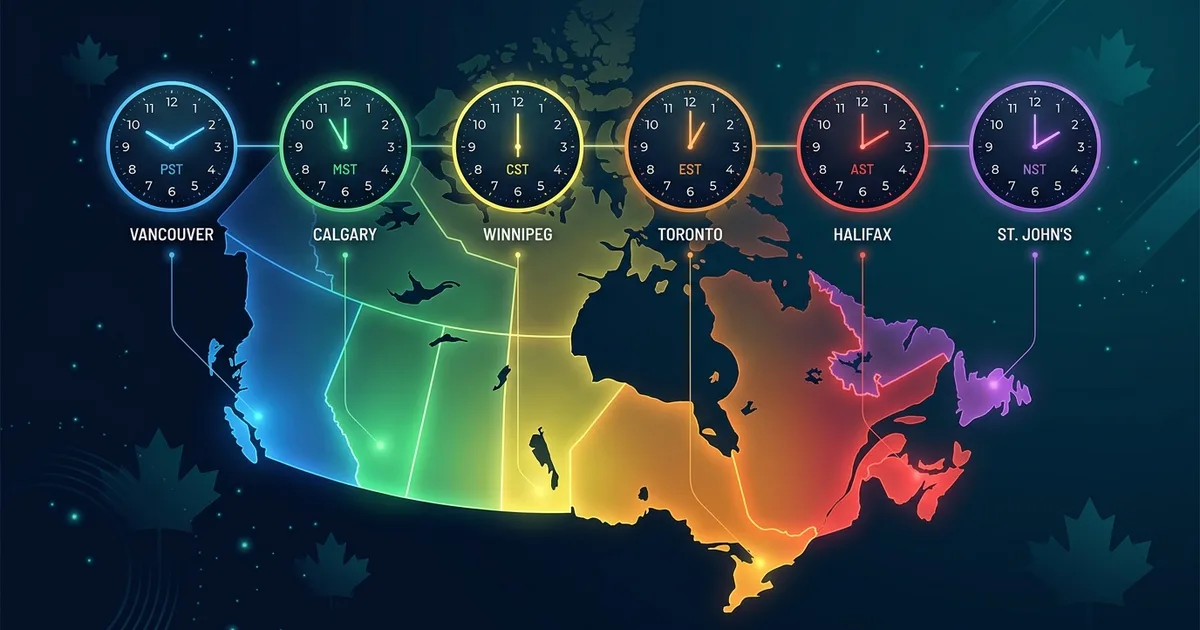
Canada stretches nearly 5,500 kilometres from the Atlantic coast of Newfoundland to the Pacific shores of British Columbia — and even further north to the Arctic. That enormous east-west span means a single national clock is impossible. Instead, Canada uses six standard time zones, each keyed to a different offset from Coordinated Universal Time (UTC).
Understanding Canadian time zones matters whether you are scheduling a cross-country business call, planning a road trip along the Trans-Canada Highway, converting times for an international meeting, or simply trying to figure out what time a hockey game starts in another province.
The landscape is more complex than a simple “six zones” answer suggests. Time rules are set at the provincial and territorial level, and 2026 has been a landmark year for Canadian timekeeping: British Columbia, Alberta, Manitoba, and the Northwest Territories have all enacted permanent-time legislation, joining Saskatchewan and Yukon as regions that no longer change their clocks.
This guide covers every Canadian time zone, province-by-province details, UTC offsets, the 2026 changes, and practical steps for converting Canadian time to GMT or EST.
How Many Time Zones Are There in Canada?
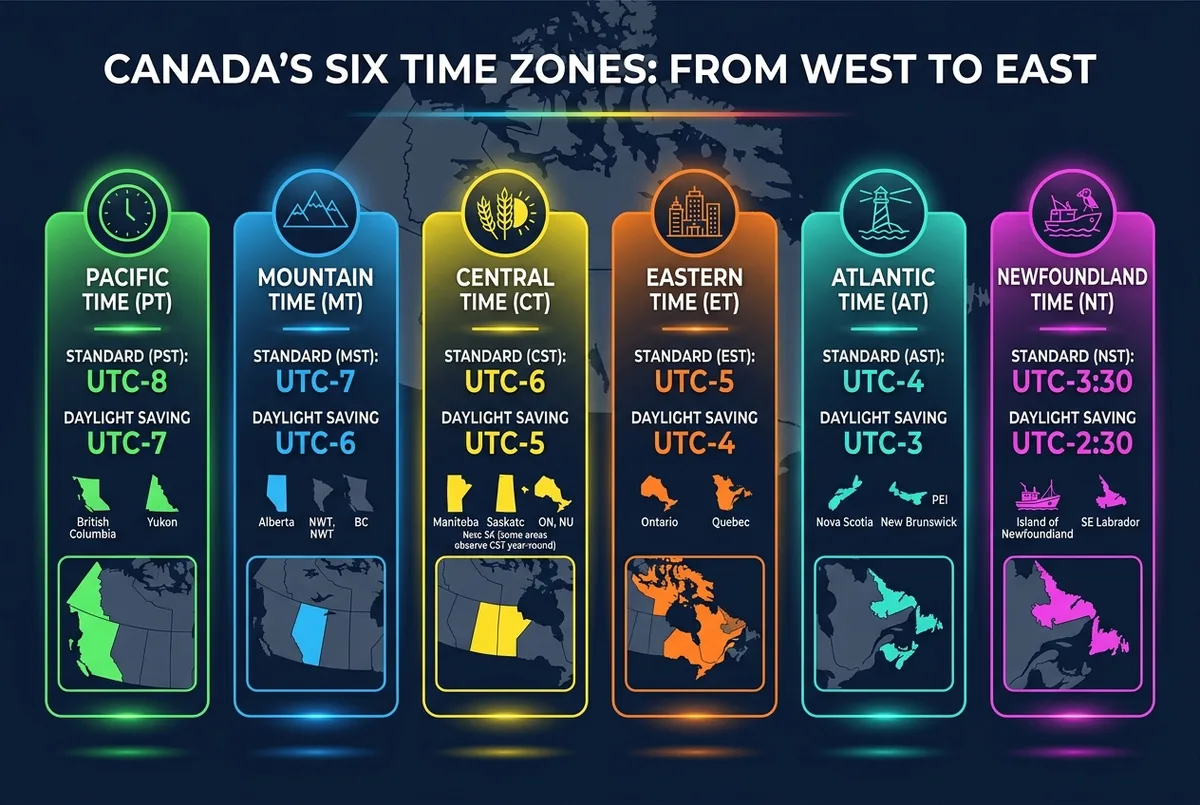
Canada has six standard time zones, progressing from west to east:
- Pacific Time (PT)
- Mountain Time (MT)
- Central Time (CT)
- Eastern Time (ET)
- Atlantic Time (AT)
- Newfoundland Time (NT)
| Canadian Time Zone | Standard Abbreviation | UTC Offset (Standard) |
|---|---|---|
| Pacific | PST | UTC−8 |
| Mountain | MST | UTC−7 |
| Central | CST | UTC−6 |
| Eastern | EST | UTC−5 |
| Atlantic | AST | UTC−4 |
| Newfoundland | NST | UTC−3:30 |
Not every province fits neatly into a single zone. Ontario, Quebec, British Columbia, and Nunavut each contain areas that observe a different time zone from the provincial majority. These exceptions are detailed in the sections below.
Canada Time Zone Map
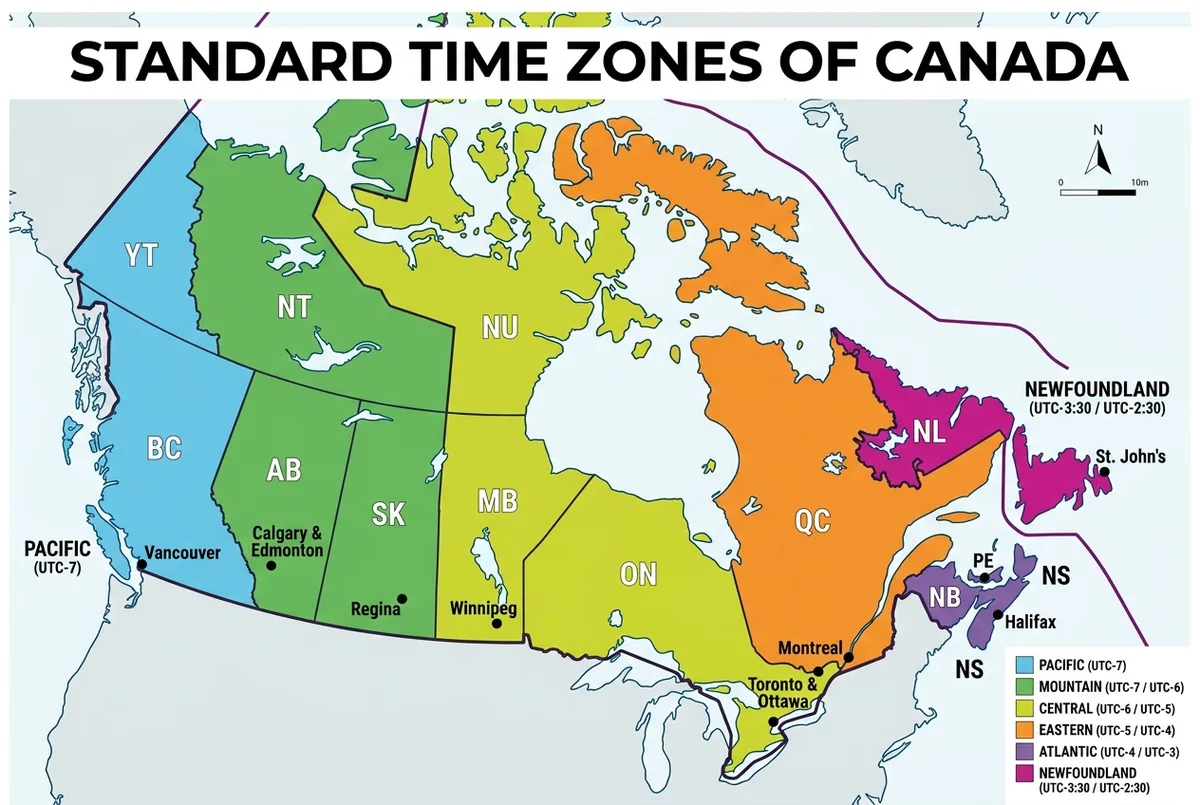
A common misconception is that Canada’s time zones split the country into six equal vertical strips. In reality, zone boundaries follow provincial and territorial borders, regional trade patterns, and local legislation rather than strict meridian lines. For example, northwestern Ontario observes Central Time to stay aligned with neighboring Manitoba, even though the rest of Ontario uses Eastern Time.
Canada Time Zones Map: Standard vs Daylight Time
In regions that still observe seasonal clock changes, the map shifts each spring and autumn. During Daylight Saving Time (DST), clocks move forward one hour:
- PST (UTC−8) → PDT (UTC−7)
- CST (UTC−6) → CDT (UTC−5)
- EST (UTC−5) → EDT (UTC−4)
- AST (UTC−4) → ADT (UTC−3)
- NST (UTC−3:30) → NDT (UTC−2:30)
However, several regions now use a fixed year-round offset, meaning their boundaries on a “current time” map do not shift at all. A 2026 Canadian time-zone map therefore looks different from older versions because British Columbia, Alberta, Manitoba, and the Northwest Territories have stopped changing their clocks.
Canada’s Six Time Zones Explained
Pacific Time Zone
Standard offset: UTC−8 (PST) · Daylight offset: UTC−7 (PDT)
The Pacific Time Zone covers most of British Columbia and, historically, parts of Yukon.
As of March 9, 2026, British Columbia officially moved to permanent Pacific Time (UTC−7) under the Interpretation Amendment Act (2019) and BC Regulation 20/2026. The final clock change occurred on March 8, 2026, when clocks sprang forward — and they will not fall back. Vancouver, Victoria, and Kelowna now remain at UTC−7 year-round.
Regional exceptions: The Peace River region (Dawson Creek, Fort St. John) and Creston observe Mountain Standard Time (UTC−7) year-round. The East Kootenay area (Cranbrook, Golden) follows Mountain Time with seasonal DST where applicable.
Major cities: Vancouver, Victoria, Kelowna, Prince George.
Mountain Time Zone
Standard offset: UTC−7 (MST) · Daylight offset: UTC−6 (MDT)
The Mountain Time Zone covers Alberta, Yukon, Northwest Territories, parts of British Columbia’s interior, and the Kitikmeot region of Nunavut.
- Alberta adopted permanent Mountain Daylight Time (UTC−6) effective November 1, 2026. Clocks will not fall back in autumn 2026.
- Yukon has observed permanent MST (UTC−7) since November 2020.
- Northwest Territories enacted permanent “NWT Time” (UTC−6) effective August 21, 2026, ending seasonal clock changes.
Major cities: Calgary, Edmonton, Whitehorse, Yellowknife.
Central Time Zone
Standard offset: UTC−6 (CST) · Daylight offset: UTC−5 (CDT)
The Central Time Zone covers Manitoba, Saskatchewan, northwestern Ontario, and the Kivalliq region of Nunavut.
- Saskatchewan has observed CST (UTC−6) year-round since 1966. The only major exception is the border city of Lloydminster, which follows Alberta’s time rules.
- Manitoba has adopted permanent Central Daylight Time (UTC−5) effective November 1, 2026, ending its seasonal clock changes.
Major cities: Winnipeg, Regina, Saskatoon, Brandon.
Eastern Time Zone
Standard offset: UTC−5 (EST) · Daylight offset: UTC−4 (EDT)
The Eastern Time Zone is Canada’s most populous, covering most of Ontario and most of Quebec, plus the Qikiqtaaluk region of Nunavut (including the capital, Iqaluit).
Ontario and Quebec continue to observe seasonal DST, switching to EDT (UTC−4) from the second Sunday of March to the first Sunday of November.
Regional exceptions: Northwestern Ontario (Kenora, Rainy River, Dryden) observes Central Time. Parts of eastern Quebec observe Atlantic Time.
Major cities: Toronto, Ottawa, Montreal, Quebec City, Iqaluit.
To understand the EST/EDT distinction in depth, see our guide on EST vs EDT.
Atlantic Time Zone
Standard offset: UTC−4 (AST) · Daylight offset: UTC−3 (ADT)
The Atlantic Time Zone covers New Brunswick, Nova Scotia, Prince Edward Island, most of Labrador, and small parts of eastern Quebec.
The Maritime provinces continue to observe seasonal DST. Eastern Quebec’s Blanc-Sablon area uses AST (UTC−4) year-round without changing clocks.
Major cities: Halifax, Moncton, Saint John, Fredericton, Charlottetown.
Newfoundland Time Zone
Standard offset: UTC−3:30 (NST) · Daylight offset: UTC−2:30 (NDT)
The Newfoundland Time Zone covers the island of Newfoundland and the southeastern tip of Labrador. It is one of the few half-hour-offset time zones in the world.
Newfoundland continues to observe seasonal DST, switching to NDT (UTC−2:30) each spring.
The half-hour offset exists because Newfoundland was an independent dominion before joining Canada in 1949 and set its standard meridian independently, resulting in a 30-minute difference from Atlantic Time.
Major cities: St. John’s, Mount Pearl, Corner Brook, Gander.
Canada Time Zones by Province and Territory
| Province / Territory | Main Time Zone(s) | Year-Round UTC Offset | Clock Change? |
|---|---|---|---|
| British Columbia | Pacific | UTC−7 (permanent) | No (since March 2026) |
| Alberta | Mountain | UTC−6 (permanent MDT) | No (effective Nov 2026) |
| Saskatchewan | Central | UTC−6 (permanent CST) | No (since 1966) |
| Manitoba | Central | UTC−5 (permanent CDT) | No (effective Nov 2026) |
| Ontario | Eastern / Central | UTC−5 or −4 / UTC−6 or −5 | Yes |
| Quebec | Eastern / Atlantic | UTC−5 or −4 / UTC−4 | Yes (most areas) |
| New Brunswick | Atlantic | UTC−4 or −3 | Yes |
| Nova Scotia | Atlantic | UTC−4 or −3 | Yes |
| Prince Edward Island | Atlantic | UTC−4 or −3 | Yes |
| Newfoundland & Labrador | Newfoundland / Atlantic | UTC−3:30 or −2:30 / UTC−4 or −3 | Yes |
| Yukon | Mountain | UTC−7 (permanent MST) | No (since 2020) |
| Northwest Territories | Mountain | UTC−6 (permanent NWT Time) | No (since Aug 2026) |
| Nunavut | Eastern / Central / Mountain | Varies by region | Yes (most areas) |
Important: Nunavut spans three time zones. The Qikiqtaaluk region uses Eastern Time, Kivalliq uses Central Time, and Kitikmeot uses Mountain Time. Coral Harbour (Southampton Island) observes EST (UTC−5) year-round without DST.
Canada UTC Offsets Explained
Standard-Time UTC Offsets
| Abbreviation | Full Name | UTC Offset |
|---|---|---|
| PST | Pacific Standard Time | UTC−8 |
| MST | Mountain Standard Time | UTC−7 |
| CST | Central Standard Time | UTC−6 |
| EST | Eastern Standard Time | UTC−5 |
| AST | Atlantic Standard Time | UTC−4 |
| NST | Newfoundland Standard Time | UTC−3:30 |
Daylight-Time UTC Offsets
Where seasonal DST is still observed, the daylight offsets are:
| Abbreviation | Full Name | UTC Offset |
|---|---|---|
| PDT | Pacific Daylight Time | UTC−7 |
| MDT | Mountain Daylight Time | UTC−6 |
| CDT | Central Daylight Time | UTC−5 |
| EDT | Eastern Daylight Time | UTC−4 |
| ADT | Atlantic Daylight Time | UTC−3 |
| NDT | Newfoundland Daylight Time | UTC−2:30 |
Not every Canadian region currently uses a seasonal DST shift. British Columbia, Alberta, Manitoba, NWT, Saskatchewan, and Yukon all use a fixed year-round offset as of 2026.
Does Canada Use Daylight Saving Time?
Not uniformly. DST in Canada is regulated at the provincial and territorial level, not federally.
Regions that NO LONGER change clocks (as of 2026):
- British Columbia — permanent UTC−7
- Alberta — permanent UTC−6
- Saskatchewan — permanent UTC−6 (since 1966)
- Manitoba — permanent UTC−5
- Yukon — permanent UTC−7 (since 2020)
- Northwest Territories — permanent UTC−6
- Coral Harbour, Nunavut — permanent UTC−5
Regions that STILL observe seasonal DST:
- Ontario (most areas)
- Quebec (most areas)
- New Brunswick
- Nova Scotia
- Prince Edward Island
- Newfoundland and Labrador
- Nunavut (most areas)
For background on how DST works globally, see our daylight saving time explained guide.
Canada Time Zone Changes Explained
When Do Canadian Clocks Change?
For the provinces and territories that still observe seasonal changes, the rules follow the same schedule as the United States:
- Spring forward: Second Sunday of March at 2:00 AM (clocks advance one hour)
- Fall back: First Sunday of November at 2:00 AM (clocks go back one hour)
In 2026, the relevant dates are March 8 (spring forward) and November 1 (fall back) — but these dates only apply to regions that still change clocks.
Why Are Canadian Time Zones Changing?
Several provinces have cited similar reasons for ending clock changes:
- Health and safety: Studies link clock transitions to increased heart attacks, traffic accidents, and sleep disruption.
- Public demand: Provincial polls consistently showed majority support for ending biannual changes.
- Cross-border coordination: British Columbia aimed to align with Washington, Oregon, and California (which have passed similar legislation contingent on US federal approval). Alberta and Manitoba chose to eliminate the scheduling friction with Saskatchewan, which has been on permanent CST since 1966.
- Legislative precedent: Yukon’s 2020 transition demonstrated that permanent time was practically feasible.
Do All Canadian Provinces Change Their Clocks?
No. As detailed above, six provinces and territories now use fixed year-round offsets. The remaining provinces — primarily in Eastern and Atlantic Canada — continue seasonal DST. Ontario has passed legislation enabling permanent EDT, but activation is contingent on Quebec and New York doing the same.
Canada Time Zones vs US Time Zones
Canada and the United States share several time-zone names: Pacific, Mountain, Central, and Eastern. For the most part, a Canadian city and a US city in the same named zone observe the same UTC offset at any given moment.
However, there are important differences:
- DST opt-outs differ. Arizona (except the Navajo Nation) stays on MST year-round. Saskatchewan stays on CST year-round. Alberta now uses permanent MDT, while neighbouring Montana still observes seasonal DST.
- Shared zone names do not guarantee identical current time. If Alberta is on permanent UTC−6 and Colorado is on MST (UTC−7) in winter, they are one hour apart despite both being “Mountain Time” jurisdictions.
- Atlantic Time has no major US equivalent for the contiguous states. Puerto Rico and the US Virgin Islands use AST year-round.
- Newfoundland Time has no US equivalent at all.
Always verify the specific offset for the date and location in question. Our CST to EST converter and PST to EST converter handle DST automatically.
For a detailed breakdown of US zones, see our US time zones guide.
Canada Time Zones and Major Cities
| City | Province | Time Zone | Current Year-Round Offset |
|---|---|---|---|
| Vancouver | BC | Pacific | UTC−7 (permanent) |
| Calgary | AB | Mountain | UTC−6 (permanent) |
| Edmonton | AB | Mountain | UTC−6 (permanent) |
| Winnipeg | MB | Central | UTC−5 (permanent) |
| Regina | SK | Central | UTC−6 (permanent CST) |
| Toronto | ON | Eastern | EST/EDT (seasonal) |
| Ottawa | ON | Eastern | EST/EDT (seasonal) |
| Montreal | QC | Eastern | EST/EDT (seasonal) |
| Halifax | NS | Atlantic | AST/ADT (seasonal) |
| St. John’s | NL | Newfoundland | NST/NDT (seasonal) |
How to Convert Canadian Time to GMT or EST
Follow this process for any conversion:
- Identify the city or province.
- Determine the applicable time zone from the tables above.
- Check whether the region observes seasonal DST — and whether DST is currently in effect for the date in question.
- Find the current UTC offset.
- Convert by adding or subtracting the difference.
Canada Time to GMT
GMT (UTC±0) is 5 to 8.5 hours ahead of Canadian local times, depending on the zone and season.
Example (summer): 2:00 PM EDT in Toronto → add 4 hours → 6:00 PM GMT.
Example (winter): 10:00 AM PST in a BC region still on PST → add 8 hours → 6:00 PM GMT. But since BC is now on permanent UTC−7, 10:00 AM Vancouver time → add 7 hours → 5:00 PM GMT.
Use our GMT to EST converter for instant calculations.
Canada Time to EST
- Vancouver (UTC−7) is 2 hours behind EST (UTC−5) in winter, or 3 hours behind EDT (UTC−4) in summer.
- Calgary (UTC−6 permanent) is 1 hour behind EST in winter, 2 hours behind EDT in summer.
- Halifax (AST/ADT) is 1 hour ahead of EST in winter and 1 hour ahead of EDT in summer.
- St. John’s (NST/NDT) is 1.5 hours ahead of EST in winter and 1.5 hours ahead of EDT in summer.
EST to Canadian Time
Example: A meeting at 3:00 PM EST in New York during winter:
- Vancouver (UTC−7): subtract 2 hours → 1:00 PM
- Winnipeg (UTC−5 permanent): same time → 3:00 PM
- Halifax (AST, UTC−4): add 1 hour → 4:00 PM
- St. John’s (NST, UTC−3:30): add 1.5 hours → 4:30 PM
Reminder: Conversion results change when the regions involved have different DST rules. Always confirm which offset applies on the specific date. Our EST to GMT converter handles this automatically.
Canada Time Zones at a Glance
| Zone | Standard | Daylight | UTC (Standard) | UTC (Daylight) |
|---|---|---|---|---|
| Pacific | PST | PDT | −8 | −7 |
| Mountain | MST | MDT | −7 | −6 |
| Central | CST | CDT | −6 | −5 |
| Eastern | EST | EDT | −5 | −4 |
| Atlantic | AST | ADT | −4 | −3 |
| Newfoundland | NST | NDT | −3:30 | −2:30 |
Note: The traditional six-zone framework with standard/daylight pairs still describes the zone names, but several provinces now use a single fixed offset year-round. Always check the specific province before assuming a zone switches between standard and daylight time.
Final Takeaway
Canada has six standard time zones spanning UTC−8 to UTC−3:30. In 2026, the timekeeping landscape shifted significantly: British Columbia, Alberta, Manitoba, and the Northwest Territories joined Saskatchewan and Yukon in abandoning seasonal clock changes. Meanwhile, Eastern and Atlantic Canada — including Ontario, Quebec, and the Maritime provinces — continue to observe DST.
The key takeaway for scheduling, travel, and international communication: never assume a Canadian province follows DST without checking. Always verify the specific city, province, and date. When in doubt, use our time zone converters for accurate, DST-aware results.
Frequently Asked Questions (FAQ)
How many time zones are there in Canada?
Canada has six standard time zones: Pacific (UTC−8), Mountain (UTC−7), Central (UTC−6), Eastern (UTC−5), Atlantic (UTC−4), and Newfoundland (UTC−3:30). However, recent permanent-time legislation means several provinces now use fixed year-round offsets that differ from the traditional standard.
What is Canada's main time zone?
Canada does not have a single main time zone. However, Eastern Time (EST/EDT) is the most widely used because it covers Ontario and Quebec — the two most populous provinces, including Toronto, Ottawa, and Montreal.
What time zone is Toronto in?
Toronto is in the Eastern Time Zone. It observes Eastern Standard Time (EST, UTC−5) in winter and Eastern Daylight Time (EDT, UTC−4) from the second Sunday of March to the first Sunday of November.
What time zone is Vancouver in?
Vancouver is in the Pacific Time Zone. As of March 2026, British Columbia observes permanent Pacific Time (UTC−7) year-round and no longer changes its clocks.
Does Canada have 6 or more time zones?
Canada has six standard time-zone designations. In practice, the number of distinct UTC offsets observed across the country can be higher because some regions use permanent standard time, others use permanent daylight time, and Newfoundland uses a half-hour offset.
Does all of Canada observe Daylight Saving Time?
No. As of 2026, British Columbia, Alberta, Manitoba, Northwest Territories, Saskatchewan, and Yukon do not change their clocks seasonally. Ontario, Quebec, New Brunswick, Nova Scotia, Prince Edward Island, Newfoundland and Labrador, and most of Nunavut still observe DST.
What is Canada's UTC offset?
Canada spans UTC offsets from UTC−8 (Pacific Standard Time) to UTC−3:30 (Newfoundland Standard Time). The exact offset for a specific location depends on the province or territory and whether seasonal DST is in effect.
Does Saskatchewan change its clocks?
No. Saskatchewan has observed Central Standard Time (CST, UTC−6) year-round since 1966. The only exception is the border city of Lloydminster, which follows Alberta's time rules.
What time zone is Newfoundland in?
Newfoundland is in the Newfoundland Time Zone — one of the few half-hour-offset zones in the world. Newfoundland Standard Time (NST) is UTC−3:30, and Newfoundland Daylight Time (NDT) is UTC−2:30.
Why does Newfoundland have a 30-minute time difference?
Before joining Canada in 1949, Newfoundland was an independent dominion that set its standard meridian to align local noon more closely with solar noon. The result was a half-hour offset from the adjacent Atlantic Time Zone, and the convention has been maintained ever since.
Sources & References
- Official Time Across Canada — National Research Council Canada (NRC)
- Interpretation Amendment Act (2019) – Permanent Time in British Columbia — Government of British Columbia
- Time Zone and Daylight Saving Time Data (IANA tzdb) — Internet Assigned Numbers Authority (IANA)
- Standard Time and Daylight Saving — Government of Alberta
- Daylight Saving Time in Canada — timeanddate.com