
US Time Zones: Complete Guide to All 6 Major Time Zones
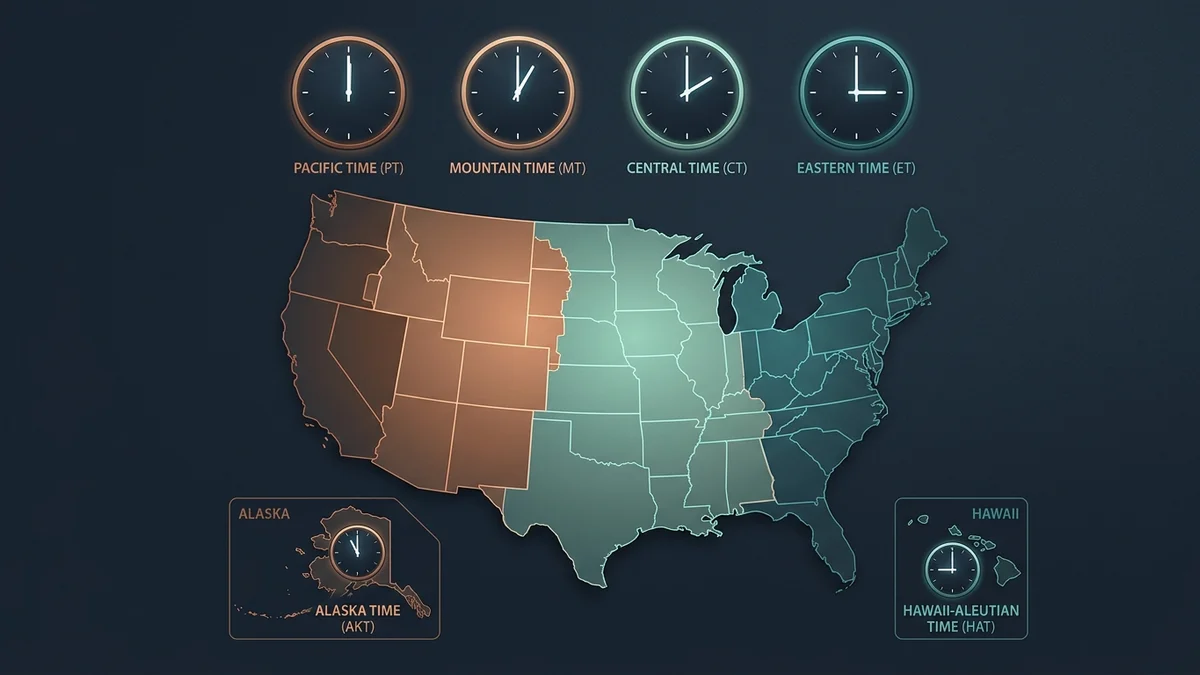
If you have ever booked a cross-country flight, dialed into a national conference call, or tuned in to a live broadcast, you have almost certainly encountered the rhythm of American time: “8:00 PM Eastern / 7:00 PM Central / 5:00 PM Pacific.”
Spanning more than 2,800 miles from the Atlantic coast of Maine to the Pacific shores of Washington, and reaching thousands of miles further across Alaska and the Hawaiian archipelago, the United States encompasses an extraordinary geographical breadth. Managing that vast territory requires a coordinated system of time zones that balances solar reality with modern commerce.
Yet navigating US time zones can be deceptively tricky. Seasonal clock changes transform EST into EDT and PST into PDT. Entire states like Arizona and Hawaii opt out of Daylight Saving Time, thirteen states are split between two time zones, and international abbreviations frequently clash with overseas standards.
This definitive guide provides an evergreen, practical reference to the United States time-zone system. You will learn the six major time-zone groupings, their exact UTC offsets, their standard and daylight abbreviations, how to convert between zones, and which states cross regional boundaries.
What Are the US Time Zones? (Quick Answer)
The 50 United States and the contiguous continent are commonly organized into six major time-zone groupings:
- Eastern Time (ET): Anchors the Atlantic seaboard and financial centers (EST UTC−5 / EDT UTC−4).
- Central Time (CT): Covers the Midwest, Great Plains, and Gulf Coast (CST UTC−6 / CDT UTC−5).
- Mountain Time (MT): Encompasses the Rocky Mountains and desert Southwest (MST UTC−7 / MDT UTC−6).
- Pacific Time (PT): Spans the West Coast tech hubs and Pacific Northwest (PST UTC−8 / PDT UTC−7).
- Alaska Time (AKT): Covers nearly the entire state of Alaska (AKST UTC−9 / AKDT UTC−8).
- Hawaii-Aleutian Time (HAT): Covers the Hawaiian Islands and the western Aleutian chain (HST UTC−10 / no DST in Hawaii).
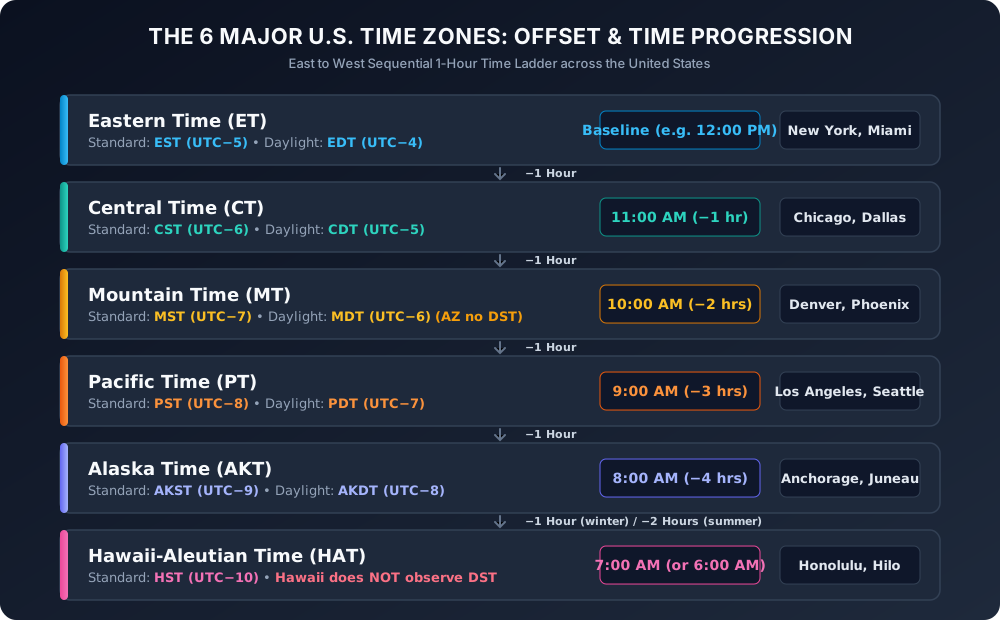
EAST TO WEST SEQUENTIAL PROGRESSION (Contiguous US):
[ Eastern Time ]  →  −1 hr  →  [ Central Time ]  →  −1 hr  →  [ Mountain Time ]  →  −1 hr  →  [ Pacific Time ]
   12:00 PM                     11:00 AM                       10:00 AM                       9:00 AM
Across the contiguous 48 states, each zone represents a clean one-hour sequential step backward as you travel from East to West.
Master US Time-Zone Reference Table
The following table provides the foundational baseline for all six major US time zones, including their standard-time and daylight-saving-time designations, typical UTC offsets, and representative metropolitan areas:
| Time Zone Grouping | Standard Time (Winter) | Daylight Time (Summer) | Typical UTC Offset | Population Centers | DST Observed? |
|---|---|---|---|---|---|
| Eastern Time (ET) | EST | EDT | UTC−5 / UTC−4 | New York, Miami, Atlanta, Boston, Washington D.C. | Yes |
| Central Time (CT) | CST | CDT | UTC−6 / UTC−5 | Chicago, Houston, Dallas, Minneapolis, Nashville | Yes |
| Mountain Time (MT) | MST | MDT | UTC−7 / UTC−6 | Denver, Salt Lake City, Albuquerque, Boise | Yes (except most of AZ) |
| Pacific Time (PT) | PST | PDT | UTC−8 / UTC−7 | Los Angeles, San Francisco, Seattle, Las Vegas | Yes |
| Alaska Time (AKT) | AKST | AKDT | UTC−9 / UTC−8 | Anchorage, Fairbanks, Juneau | Yes |
| Hawaii-Aleutian Time (HAT) | HST | HDT (Aleutians only) | UTC−10 / UTC−9 | Honolulu, Hilo, Kahului, Adak | Hawaii: No / Aleutians: Yes |
(Note: In addition to these six groupings, overseas U.S. territories observe separate standard offsets: Puerto Rico and the U.S. Virgin Islands observe Atlantic Standard Time at UTC−4; Guam and the Northern Mariana Islands observe Chamorro Standard Time at UTC+10; and American Samoa observes Samoa Standard Time at UTC−11. None of these territories observe Daylight Saving Time).
The Six Major US Time Zones Explained
1. Eastern Time (ET)
Eastern Time is the most populous US time zone, encompassing approximately 47% of the American population. It serves as the administrative, media, and financial benchmark for the nation, housing the federal government in Washington, D.C., Wall Street stock exchanges (NYSE and NASDAQ) in New York City, and major corporate hubs across the eastern seaboard.
- Standard Time: EST (Eastern Standard Time) = UTC−5 (observed early November to mid-March).
- Daylight Saving Time: EDT (Eastern Daylight Time) = UTC−4 (observed mid-March to early November).
- Geographic Reach: Covers 23 states (17 fully and 6 partially), spanning from Maine down to Florida and west to parts of Michigan, Indiana, Kentucky, and Tennessee.
- Conversion Anchor: Eastern Time is 1 hour ahead of Central Time, 2 hours ahead of Mountain Time, and 3 hours ahead of Pacific Time.
To explore Eastern Standard Time in depth, read our comprehensive guide on What Is EST? Eastern Standard Time Explained.
2. Central Time (CT)
Central Time is the second-largest US time zone by population, covering roughly 29% of Americans. It stretches across the agricultural heartland, the Great Lakes manufacturing corridor, and the Texas energy sector.
- Standard Time: CST (Central Standard Time) = UTC−6.
- Daylight Saving Time: CDT (Central Daylight Time) = UTC−5.
- Geographic Reach: Covers 20 states (10 fully and 10 partially), extending from Minnesota, Wisconsin, and Illinois south through Missouri, Tennessee, Arkansas, Louisiana, and the vast majority of Texas.
- Conversion Anchor: Central Time is 1 hour behind Eastern Time and 1 hour ahead of Mountain Time. When it is 12:00 PM EST in New York, it is 11:00 AM CST in Chicago.
To calculate specific schedules between these regions, use our dedicated CST to EST converter or CDT to EST converter.
3. Mountain Time (MT)
Mountain Time covers the widest land area in the contiguous United States but has the smallest population density, accounting for approximately 6.5% of the country’s population. It spans the rugged terrain of the Rocky Mountains, the Great Basin, and the desert Southwest.
- Standard Time: MST (Mountain Standard Time) = UTC−7.
- Daylight Saving Time: MDT (Mountain Daylight Time) = UTC−6.
- Geographic Reach: Covers all or parts of Colorado, Utah, Montana, Wyoming, New Mexico, Idaho, Nevada, Oregon, Kansas, Nebraska, North Dakota, South Dakota, Texas, and Arizona.
- The Critical Arizona Rule: As detailed below, most of Arizona remains on MST (UTC−7) year-round, creating a unique seasonal divergence.
- Conversion Anchor: Mountain Time is 2 hours behind Eastern Time and 1 hour behind Central Time. When it is 12:00 PM EST, it is 10:00 AM MST in Denver.
For direct conversions, consult our MST to EST converter or MDT to EST converter.
4. Pacific Time (PT)
Pacific Time is the economic powerhouse of the West Coast, encompassing approximately 16.5% of the US population. It is the temporal home of Silicon Valley’s tech giants, Hollywood’s entertainment industry, and major West Coast maritime ports.
- Standard Time: PST (Pacific Standard Time) = UTC−8.
- Daylight Saving Time: PDT (Pacific Daylight Time) = UTC−7.
- Geographic Reach: Encompasses California and Washington entirely, the vast majority of Nevada and Oregon, and the northern panhandle of Idaho.
- Conversion Anchor: Pacific Time is 3 hours behind Eastern Time, 2 hours behind Central Time, and 1 hour behind Mountain Time. When financial markets open at 9:30 AM EST on Wall Street, it is 6:30 AM PST in San Francisco.
To convert West Coast business hours seamlessly, use our PST to EST converter and PDT to EST converter.
5. Alaska Time (AKT)
Encompassing nearly 663,000 square miles, Alaska is the largest state in the union. Prior to 1983, Alaska was divided into four separate time zones. To streamline statewide commerce and broadcast coordination, the state consolidated into a single primary zone in 1983: Alaska Time.
- Standard Time: AKST (Alaska Standard Time) = UTC−9.
- Daylight Saving Time: AKDT (Alaska Daylight Time) = UTC−8.
- Geographic Reach: Covers virtually the entire Alaskan mainland, from Juneau in the southeast to Anchorage, Fairbanks, and Nome in the far west.
- Conversion Anchor: Alaska Time is 4 hours behind Eastern Time and 1 hour behind Pacific Time. When it is 12:00 PM EST, it is 8:00 AM AKST in Anchorage.
To coordinate with the far north, use our AKST to EST converter and AKDT to EST converter.
6. Hawaii-Aleutian Time (HAT)
The westernmost major grouping is Hawaii-Aleutian Time, which connects two vastly different island geographies: the tropical Hawaiian archipelago and the subarctic western islands of Alaska’s Aleutian chain.
- Standard Time: HST (Hawaii Standard Time) = UTC−10.
- Daylight Saving Time: HDT (Hawaii-Aleutian Daylight Time) = UTC−9 (Aleutian Islands west of 169°30’W only).
- The Vital Hawaii Distinction: The state of Hawaii does NOT observe Daylight Saving Time. Hawaii remains on HST (UTC−10) 365 days a year.
- Conversion Anchor: Hawaii is 5 hours behind Eastern Standard Time (winter) and 6 hours behind Eastern Daylight Time (summer). When it is 12:00 PM EST in New York in January, it is 7:00 AM HST in Honolulu. When it is 12:00 PM EDT in July, it is 6:00 AM HST.
To verify island conversions, see our HST to EST converter and HDT to EST converter.
Standard Time vs. Daylight Saving Time: EST, CST, MST, and PST Explained
The single greatest source of errors in American time conversion is treating time-zone abbreviations as static labels.
In the United States, time zones exist in two distinct seasonal operational modes under the federal Uniform Time Act of 1966:
- Standard Time: Observed for approximately 4 months (from the first Sunday of November to the second Sunday of March).
- Daylight Saving Time (DST): Observed for approximately 8 months (from the second Sunday of March to the first Sunday of November).
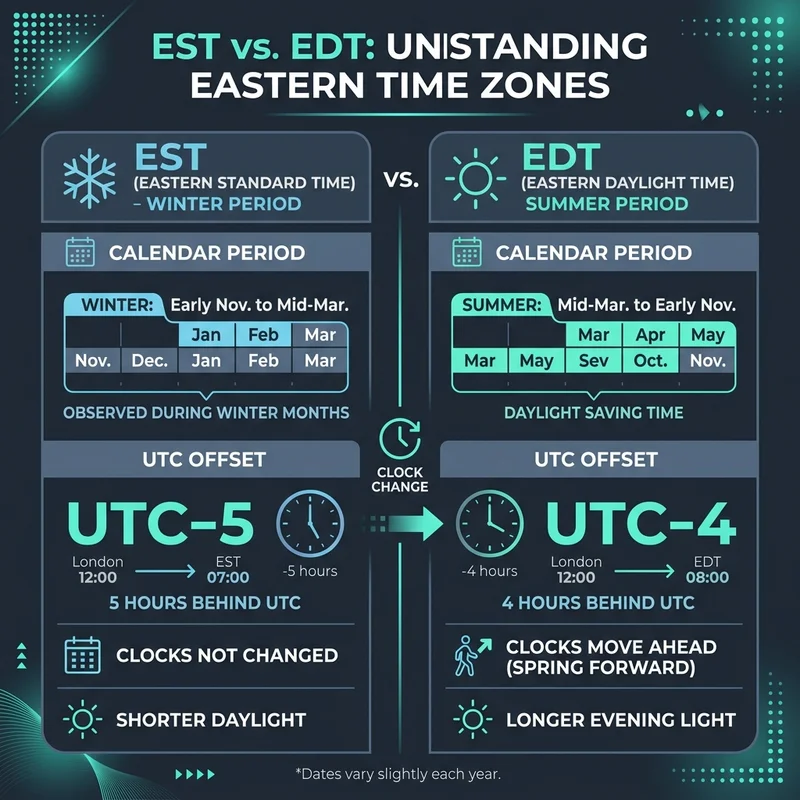
When clocks advance forward by one hour in spring (“Spring Forward”), the regional abbreviation changes because the underlying mathematical UTC offset changes:
| Region | Standard Abbreviation (Winter) | Standard UTC Offset | Daylight Abbreviation (Summer) | Daylight UTC Offset | Seasonal Clock Shift |
|---|---|---|---|---|---|
| Eastern | EST | UTC−5 | EDT | UTC−4 | +1 Hour in March |
| Central | CST | UTC−6 | CDT | UTC−5 | +1 Hour in March |
| Mountain | MST | UTC−7 | MDT | UTC−6 | +1 Hour in March |
| Pacific | PST | UTC−8 | PDT | UTC−7 | +1 Hour in March |
| Alaska | AKST | UTC−9 | AKDT | UTC−8 | +1 Hour in March |
| Hawaii | HST | UTC−10 | (No DST) | UTC−10 | None (Fixed) |
Why “EST” Does Not Equal “Eastern Time”
Saying “The meeting is at 3:00 PM EST” in the middle of July is technically incorrect. In July, New York is observing EDT (UTC−4).
Calling summer time “EST” introduces an unannounced one-hour mathematical error that derails international flight schedules and automated database jobs. For a full breakdown of this seasonal transition, see our guide on EST vs EDT: What’s the Difference? and our educational pillar on What Is Daylight Saving Time?.
Important Warning: The Ambiguity of Three-Letter Abbreviations
In international software engineering, aviation, and global logistics, relying on three-letter abbreviations like “CST” or “EST” is considered an anti-pattern.
The Problem of Shared Global Abbreviations
Multiple sovereign jurisdictions across the globe use identical three-letter acronyms for completely unrelated time zones:
- CST can mean:
- Central Standard Time in North America (UTC−6)
- China Standard Time in Beijing and Shanghai (UTC+8) — a 14-hour difference!
- Cuba Standard Time in Havana (UTC−5)
- EST can mean:
- Eastern Standard Time in North America (UTC−5)
- Eastern Standard Time in Queensland, Australia (AEST, UTC+10) — a 15-hour difference!
- BST can mean:
- British Summer Time in the UK (UTC+1)
- Bangladesh Standard Time in Dhaka (UTC+6)
The Solution: IANA Time Zone Identifiers
To eliminate ambiguity, modern computer operating systems, databases, and global scheduling platforms use the IANA Time Zone Database (tzdb). Instead of static three-letter codes, IANA identifiers use geographic Area/Location pairs that automatically resolve local daylight saving history:
- Use
America/New_Yorkinstead of “EST/EDT” - Use
America/Chicagoinstead of “CST/CDT” - Use
America/Denverinstead of “MST/MDT” - Use
America/Phoenixfor Arizona (which never shifts to MDT) - Use
America/Los_Angelesinstead of “PST/PDT” - Use
Pacific/Honoluluinstead of “HST”
US Time Zone Difference Matrix
When calculating differences across the contiguous United States, use this quick reference matrix:
| From / To | Eastern Time (ET) | Central Time (CT) | Mountain Time (MT) | Pacific Time (PT) | Alaska Time (AKT) | Hawaii Time (HST) |
|---|---|---|---|---|---|---|
| Eastern (ET) | Same Time | −1 Hour | −2 Hours | −3 Hours | −4 Hours | −5 Hrs (winter) / −6 (summer) |
| Central (CT) | +1 Hour | Same Time | −1 Hour | −2 Hours | −3 Hours | −4 Hrs (winter) / −5 (summer) |
| Mountain (MT) | +2 Hours | +1 Hour | Same Time | −1 Hour | −2 Hours | −3 Hrs (winter) / −4 (summer) |
| Pacific (PT) | +3 Hours | +2 Hours | +1 Hour | Same Time | −1 Hour | −2 Hrs (winter) / −3 (summer) |
| Alaska (AKT) | +4 Hours | +3 Hours | +2 Hours | +1 Hour | Same Time | −1 Hr (winter) / −2 (summer) |
| Hawaii (HST) | +5 Hrs (win) / +6 (sum) | +4 Hrs (win) / +5 (sum) | +3 Hrs (win) / +4 (sum) | +2 Hrs (win) / +3 (sum) | +1 Hr (win) / +2 (sum) | Same Time |
(Note: Hawaii calculations change by one hour between winter and summer because the continental zones spring forward by one hour while Hawaii’s clocks remain static).
Practical US Time Zone Conversion Examples
To see how these offsets function in everyday scheduling, examine these verified real-world scenarios:
Example 1: Central to Eastern (CST → EST)
- Scenario: A client in Dallas schedules a call for 12:00 PM CST in January.
- Calculation: Eastern Time is 1 hour ahead of Central Time.
- Result:
12:00 PM CST + 1 Hour = 1:00 PM ESTin New York. - Tool: Calculate instant conversions with our CST to EST converter.
Example 2: Pacific to Eastern (PST → EST / PDT → EDT)
- Scenario: A tech team in San Francisco hosts a webinar at 10:00 AM Pacific Time.
- Winter (PST → EST):
10:00 AM PST + 3 Hours = 1:00 PM EST. - Summer (PDT → EDT): Both locations advance by one hour, preserving the 3-hour difference:
10:00 AM PDT + 3 Hours = 1:00 PM EDT. - Tool: Plan cross-country meetings using our PST to EST converter or PDT to EST converter.
Example 3: Mountain to Eastern with Arizona DST Nuance
- Scenario: Coordinating between Phoenix, Arizona and New York at 12:00 PM local Phoenix time.
- In Winter (January): Denver is on MDT (off), observing MST (UTC−7). Phoenix is on MST (UTC−7). New York is on EST (UTC−5). New York is 2 hours ahead of Phoenix (
12:00 PM MST = 2:00 PM EST). - In Summer (July): New York advances to EDT (UTC−4). Denver advances to MDT (UTC−6). But Phoenix remains on MST (UTC−7). New York is now 3 hours ahead of Phoenix (
12:00 PM MST = 3:00 PM EDT). - Tool: Verify Mountain conversions with our MST to EST converter.
Which US States Span Multiple Time Zones?
A widespread misconception is that time-zone borders strictly follow state borders. In reality, thirteen US states are legally split across two time zones.
Under federal law, the Department of Transportation establishes time-zone boundaries based on local convenience and commerce—frequently placing border counties into the zone of the nearest major metropolitan trade center:
| State | Primary Time Zone | Secondary Time Zone | Details of Boundary Split |
|---|---|---|---|
| Florida | Eastern (ET) | Central (CT) | Most of the state is on Eastern; 10 counties in the western Florida Panhandle (west of the Apalachicola River) observe Central. |
| Indiana | Eastern (ET) | Central (CT) | 80 counties observe Eastern; 6 northwestern counties (near Chicago) and 6 southwestern counties (near Evansville) observe Central. |
| Kentucky | Eastern (ET) | Central (CT) | The eastern half (42% of state land, including Louisville and Lexington) observes Eastern; western Kentucky observes Central. |
| Tennessee | Central (CT) | Eastern (ET) | Middle and West Tennessee (including Nashville and Memphis) observe Central; East Tennessee (including Knoxville and Chattanooga) observes Eastern. |
| Michigan | Eastern (ET) | Central (CT) | Nearly the entire state observes Eastern; 4 counties in the Upper Peninsula bordering Wisconsin observe Central. |
| Texas | Central (CT) | Mountain (MT) | Over 95% of Texas observes Central; El Paso County and Hudspeth County in the far western tip observe Mountain. |
| Kansas | Central (CT) | Mountain (MT) | The vast majority of Kansas observes Central; 4 western border counties (Sherman, Wallace, Greeley, Hamilton) observe Mountain. |
| Nebraska | Central (CT) | Mountain (MT) | The eastern two-thirds (including Omaha and Lincoln) observe Central; the western Panhandle observes Mountain. |
| South Dakota | Central (CT) | Mountain (MT) | Eastern South Dakota (including Sioux Falls) observes Central; western South Dakota (west of the Missouri River) observes Mountain. |
| North Dakota | Central (CT) | Mountain (MT) | Eastern and northern North Dakota observe Central; southwestern counties (south of the Missouri River) observe Mountain. |
| Idaho | Mountain (MT) | Pacific (PT) | Southern Idaho (including Boise) observes Mountain; the northern Idaho Panhandle (north of the Salmon River) observes Pacific. |
| Oregon | Pacific (PT) | Mountain (MT) | Most of Oregon observes Pacific; the majority of Malheur County on the eastern Idaho border observes Mountain. |
| Alaska | Alaska (AKT) | Hawaii-Aleutian (HAT) | Almost the entire state observes Alaska Time; the Aleutian Islands west of 169°30’W observe Hawaii-Aleutian Time. |
U.S. Daylight Saving Time Exceptions: Why Arizona and Hawaii Opt Out
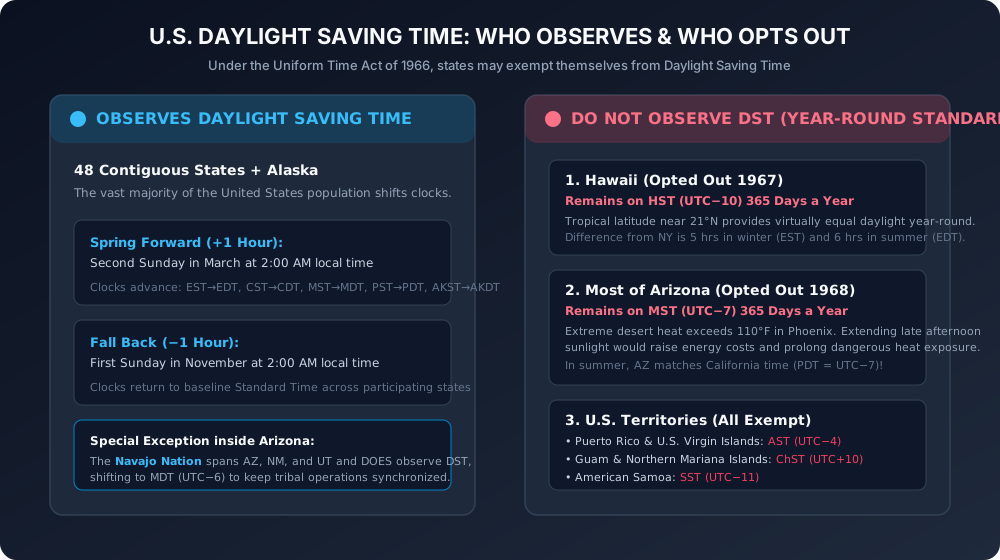
Under Section 3(a) of the Uniform Time Act of 1966, any state may choose to exempt its entire territory from Daylight Saving Time by state statute. Two states have taken advantage of this provision:
Why Arizona Does Not Observe DST
Arizona enacted its statutory exemption in 1968. In desert communities like Phoenix, Yuma, and Tucson, summer temperatures frequently exceed 115°F (46°C).
If Arizona observed Daylight Saving Time, the sun would not set until after 8:30 PM, extending scorching heat into late evening hours and drastically increasing air conditioning electricity costs. By staying on Mountain Standard Time (MST, UTC−7) year-round, the sun sets earlier, allowing temperatures to begin cooling sooner.
The Navajo Nation Exception: The Navajo Nation reservation spans northeastern Arizona, northwestern New Mexico, and southeastern Utah. To maintain consistent operational hours across tribal government offices, schools, and health facilities in all three states, the Navajo Nation DOES observe Daylight Saving Time (shifting to MDT, UTC−6). However, the Hopi Reservation, which is completely surrounded by the Navajo Nation, does not observe DST.
Why Hawaii Does Not Observe DST
Hawaii opted out of DST in 1967. Situated in the tropics at roughly 21° north latitude, Hawaii experiences minimal seasonal variance in solar daylight—sunrise occurs around 5:50 AM in June and 7:00 AM in January. Advancing clocks by an hour would offer zero tangible benefit while causing unnecessary disruption. Hawaii remains on Hawaii Standard Time (HST, UTC−10) year-round.
Why Do US Time Zones Exist? The Railroad Revolution of 1883
Before standardized time zones, time in the United States was entirely local. Every municipality set its clocks to local solar noon—the precise moment the sun reached its zenith directly overhead.
Because the sun moves across the sky from east to west at approximately 15 degrees per hour (one degree every four minutes), local clocks varied continuously across the map:
- When it was 12:00 PM in Washington, D.C., it was 12:12 PM in New York, 12:24 PM in Boston, and 11:48 AM in Philadelphia.
- In the mid-19th century, the United States had more than 300 conflicting local solar times.
The Day of Two Noons: November 18, 1883
The expansion of the transcontinental railroad transformed local time from an inconvenience into a catastrophic hazard. Rail dispatchers attempting to schedule two-way train traffic on single tracks faced conflicting timetables, leading to frequent station delays and deadly head-on train collisions.
Led by William F. Allen, secretary of the General Time Convention, the major American and Canadian railroad companies coordinated a nationwide reset. On Sunday, November 18, 1883—remembered historically as “The Day of Two Noons”—railroads established four standardized continental time zones anchored to Greenwich meridians:
- Eastern: 75°W Meridian (UTC−5)
- Central: 90°W Meridian (UTC−6)
- Mountain: 105°W Meridian (UTC−7)
- Pacific: 120°W Meridian (UTC−8)
At exactly 12:00 PM on that Sunday, telegraph signals broadcast from naval and university observatories synchronized train station clocks across the continent.
Congress formally legalized the system 35 years later with the Standard Time Act of March 19, 1918, establishing federal time-zone authority under the Interstate Commerce Commission (later transferred to the U.S. Department of Transportation in 1966).
How US Time Zones Relate to UTC and GMT
All world time zones are calculated mathematically as positive or negative offsets from Coordinated Universal Time (UTC), the international atomic time standard centered on the Prime Meridian (0° longitude):
- EST: UTC − 5 Hours | EDT: UTC − 4 Hours
- CST: UTC − 6 Hours | CDT: UTC − 5 Hours
- MST: UTC − 7 Hours | MDT: UTC − 6 Hours
- PST: UTC − 8 Hours | PDT: UTC − 7 Hours
- AKST: UTC − 9 Hours | AKDT: UTC − 8 Hours
- HST: UTC − 10 Hours | (No DST)
Because Greenwich Mean Time (GMT) shares the same zero-offset baseline as UTC, GMT conversions follow the exact same numerical relationships. When it is 5:00 PM GMT in London, it is 12:00 PM EST (5 hours behind) in New York, 11:00 AM CST in Chicago, 10:00 AM MST in Denver, and 9:00 AM PST in Los Angeles.
To explore the atomic and astronomical distinction between global standards, read our guide on UTC vs GMT: What’s the Difference?.
How to Determine Which US Time Zone Someone Is In
When coordinating across the United States, follow this 4-step checklist:
- Identify the Exact City and County: Do not rely solely on the state. If scheduling with someone in Indiana, Florida, Tennessee, or Kentucky, check whether their specific county sits in Eastern or Central Time.
- Determine the Baseline Zone: Identify the regional classification (Eastern, Central, Mountain, Pacific, Alaska, or Hawaii).
- Verify Daylight Saving Status:
- If the date falls between the second Sunday of March and the first Sunday of November, the region observes Daylight Time (EDT, CDT, MDT, PDT, or AKDT).
- If the location is in Arizona (excluding the Navajo Nation) or Hawaii, use the permanent standard offset (MST at UTC−7 or HST at UTC−10).
- Use a Date-Aware Converter: For critical meetings, flight bookings, or digital product releases, use an automated tool like our GMT to EST converter that detects historical and future daylight saving shifts automatically.
Frequently Asked Questions
Summary: US Time Zones at a Glance
Navigating American time zones comes down to understanding the continental progression:
- Four Contiguous Zones: The 48 lower states step sequentially from Eastern (UTC−5/−4) to Central (UTC−6/−5), Mountain (UTC−7/−6), and Pacific (UTC−8/−7) in clean one-hour increments.
- Alaska (UTC−9/−8) is 1 hour behind Pacific; Hawaii (UTC−10) is 2 hours behind Pacific in winter (and 3 hours behind in summer).
- Abbreviations Shift Seasonally: EST/CST/MST/PST apply in winter; EDT/CDT/MDT/PDT apply in summer.
- Two States Opt Out: Hawaii and most of Arizona remain on Standard Time year-round.
- Thirteen States Are Split: Always verify the county when scheduling near regional borders.
With this foundational knowledge, you can coordinate across all fifty states with precision, avoiding scheduling surprises no matter where your colleagues, clients, or travel plans take you.
Frequently Asked Questions (FAQ)
How many time zones are in the United States?
The contiguous United States, Alaska, and Hawaii are organized into six major standard time-zone groupings. When including uninhabited islands and overseas territories (such as Puerto Rico, Guam, and American Samoa), the United States officially spans nine standard time zones (and up to eleven counting minor outlying islands).
What are the six major US time zones?
The six major time zones covering the 50 states are Eastern Time (ET), Central Time (CT), Mountain Time (MT), Pacific Time (PT), Alaska Time (AKT), and Hawaii-Aleutian Time (HAT).
What is the difference between EST and EDT?
EST (Eastern Standard Time) is UTC-5, observed during autumn and winter. EDT (Eastern Daylight Time) is UTC-4, observed during spring and summer when Daylight Saving Time is active. They are seasonal phases of the same Eastern Time Zone.
What is the time difference between Eastern and Pacific Time?
Pacific Time is normally three hours behind Eastern Time. When it is 3:00 PM Eastern Time in New York, it is 12:00 PM (noon) Pacific Time in Los Angeles.
What is the difference between CST and CDT?
CST (Central Standard Time) is UTC-6, observed during winter. CDT (Central Daylight Time) is UTC-5, observed during summer. Central Time advances by one hour during Daylight Saving Time.
Does every US state observe Daylight Saving Time?
No. Hawaii does not observe Daylight Saving Time and remains on Hawaii Standard Time (HST, UTC-10) year-round. Most of Arizona also does not observe DST, remaining on Mountain Standard Time (MST, UTC-7) year-round.
Why doesn't Arizona observe Daylight Saving Time?
Arizona opted out of DST in 1968 under the Uniform Time Act to avoid extending late afternoon summer heat, which regularly exceeds 110°F (43°C) in Phoenix and Tucson. However, the Navajo Nation in northeastern Arizona does observe DST.
Does Hawaii observe Daylight Saving Time?
No. Hawaii opted out of Daylight Saving Time in 1967. Due to its tropical latitude near 21°N, daylight hours vary by only about 2.5 hours between winter and summer, making clock shifts unnecessary.
Which US states span more than one time zone?
Thirteen US states span multiple time zones: Florida, Indiana, Kentucky, Tennessee, Michigan, Nebraska, Kansas, North Dakota, South Dakota, Texas, Idaho, Oregon, and Alaska.
What is the time difference between Eastern and Central Time?
Central Time is typically one hour behind Eastern Time. When it is 12:00 PM Eastern Time in New York, it is 11:00 AM Central Time in Chicago or Dallas.
What is the difference between MST and MDT?
MST (Mountain Standard Time) is UTC-7, used in winter (and year-round in most of Arizona). MDT (Mountain Daylight Time) is UTC-6, used in summer across participating Mountain states like Colorado, Utah, and Montana.
Why are time-zone abbreviations like CST ambiguous internationally?
Abbreviations like CST can refer to Central Standard Time in North America (UTC-6), China Standard Time (UTC+8), or Cuba Standard Time (UTC-5). For international programming and scheduling, location-based IANA identifiers like America/Chicago or America/New_York eliminate ambiguity.
Sources & References
- U.S. Time Zones and Daylight Saving Time Overview — National Institute of Standards and Technology (NIST)
- Time Zone Boundaries & Standard Time Act Administration — U.S. Department of Transportation (DOT)
- IANA Time Zone Database (tzdb) — Internet Assigned Numbers Authority (IANA)
- The History of Standard Time in the United States — U.S. Naval Observatory (USNO)