Los Angeles Time: Complete Guide to Time in Los Angeles (2026)
Welcome to the ultimate guide to Los Angeles Time. Whether you are scheduling a business call with a Hollywood studio, coordinating code deployments with a West Coast engineering team, mapping out flight connections through LAX, or simply double-checking what time it is in Southern California, this guide provides all the answers.
Quick Time Summary for Los Angeles
America/Los_Angeles Key Fact Check
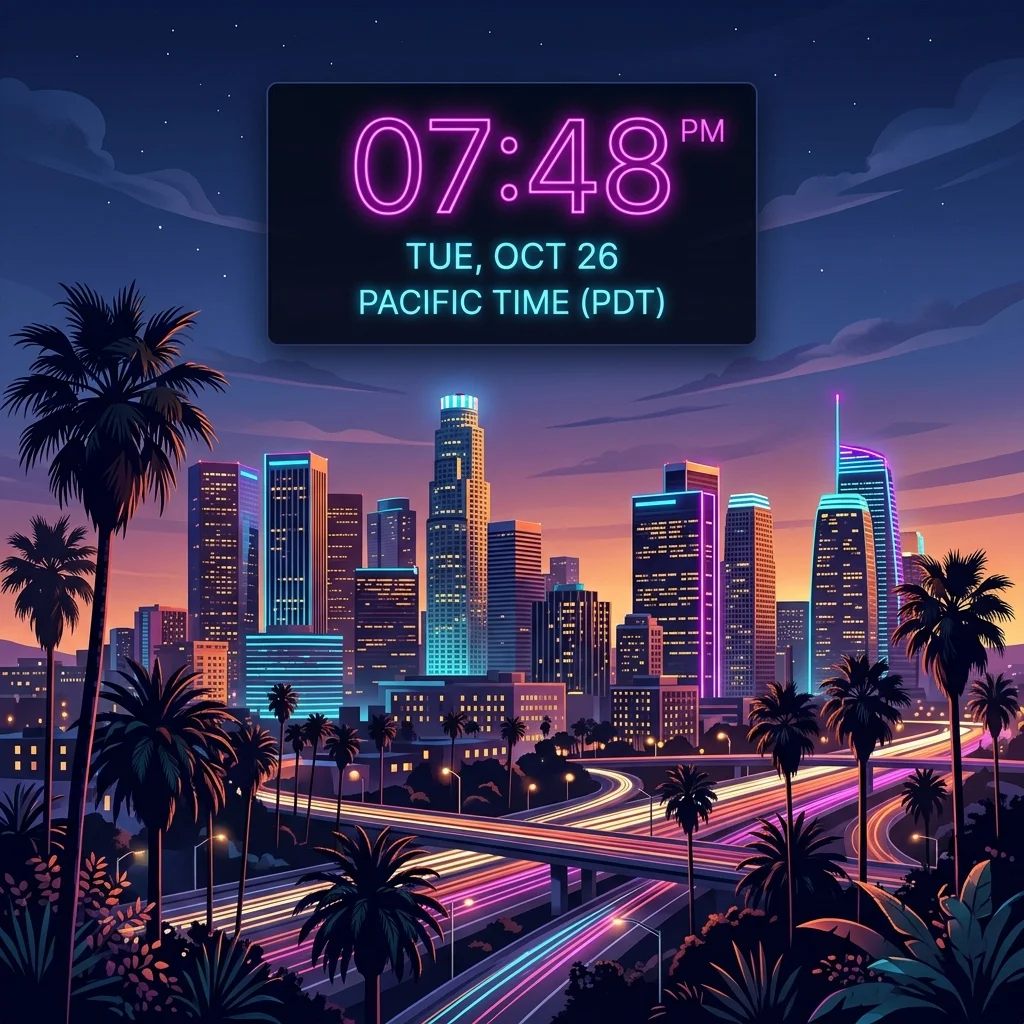
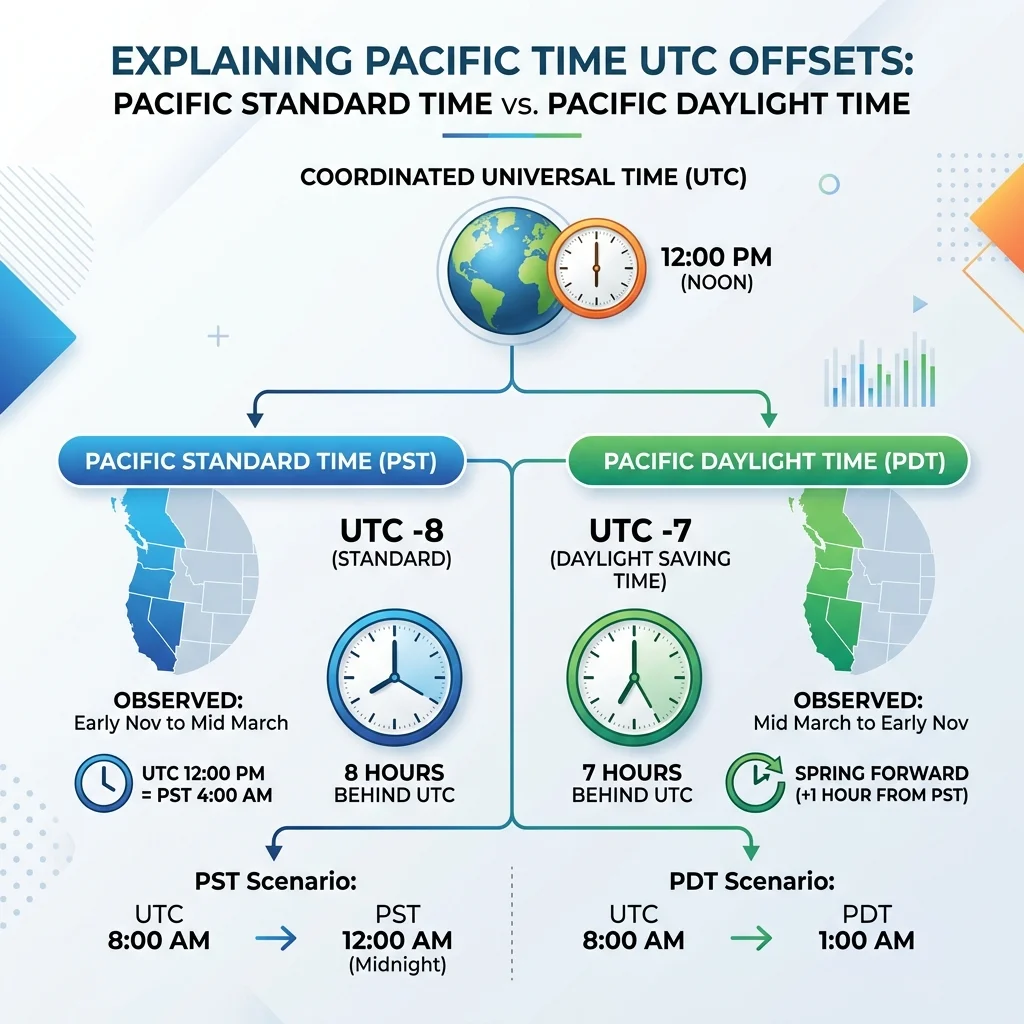
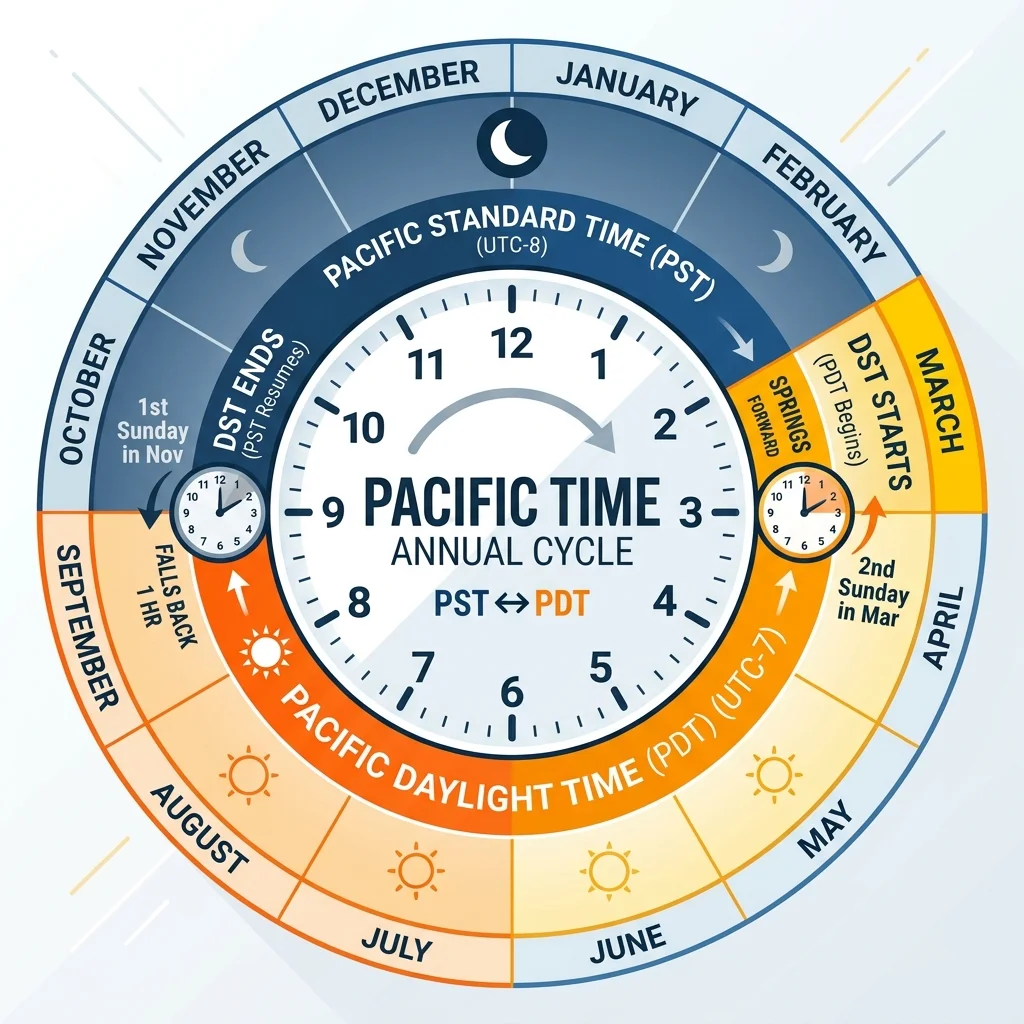
During the summer months, Los Angeles is in Pacific Daylight Time (PDT) which represents a UTC offset of UTC-7. In winter, the city reverts to Pacific Standard Time (PST), dropping to UTC-8. The transition is standardized federally across the United States.
1. Understanding Los Angeles Time
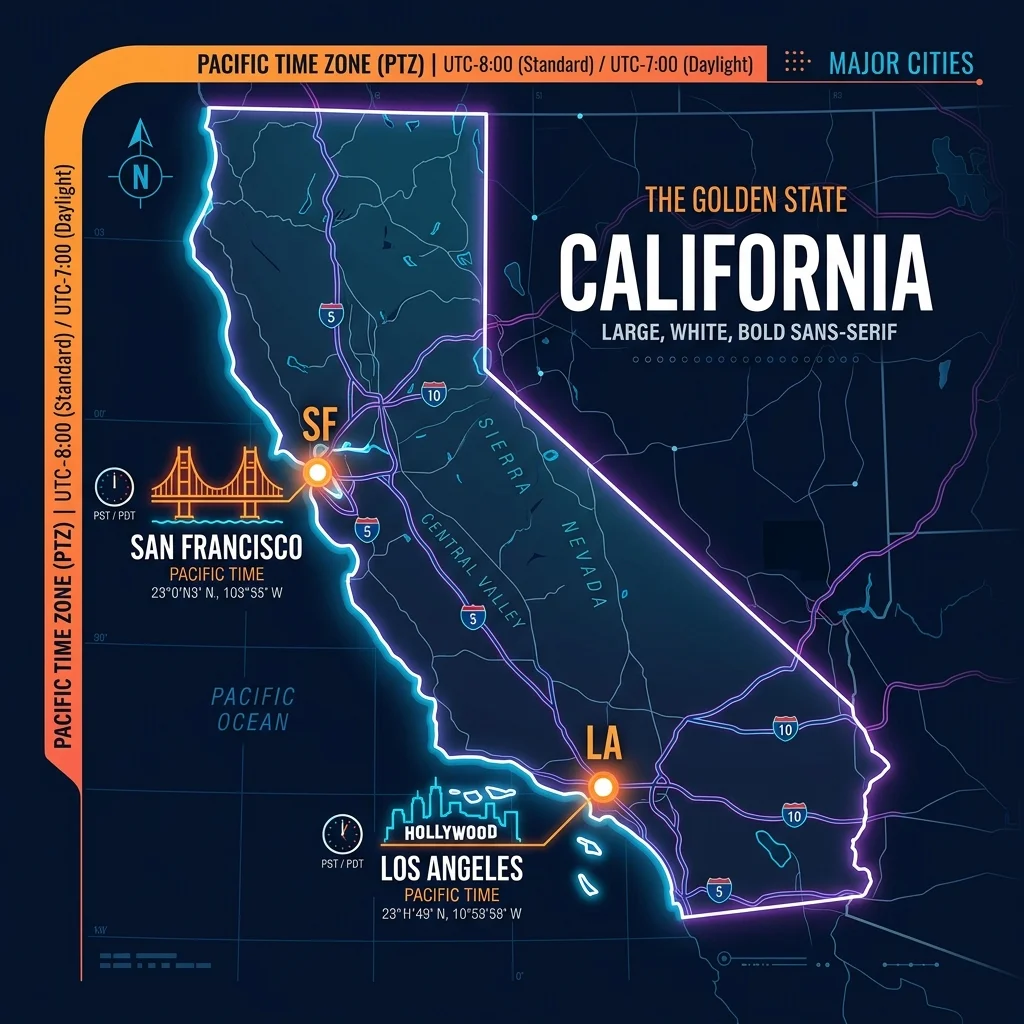
Located on the west coast of North America, Los Angeles is the second-most populous city in the United States and the cultural capital of the Western region. Its local time dictates the tempo of major global industries, particularly modern entertainment, digital tech startups, aerospace engineering, and international shipping.
The term Pacific Time (PT) is a general designation representing the active offset inside the Pacific Time Zone. It adapts to seasonal changes, using two distinct offsets:
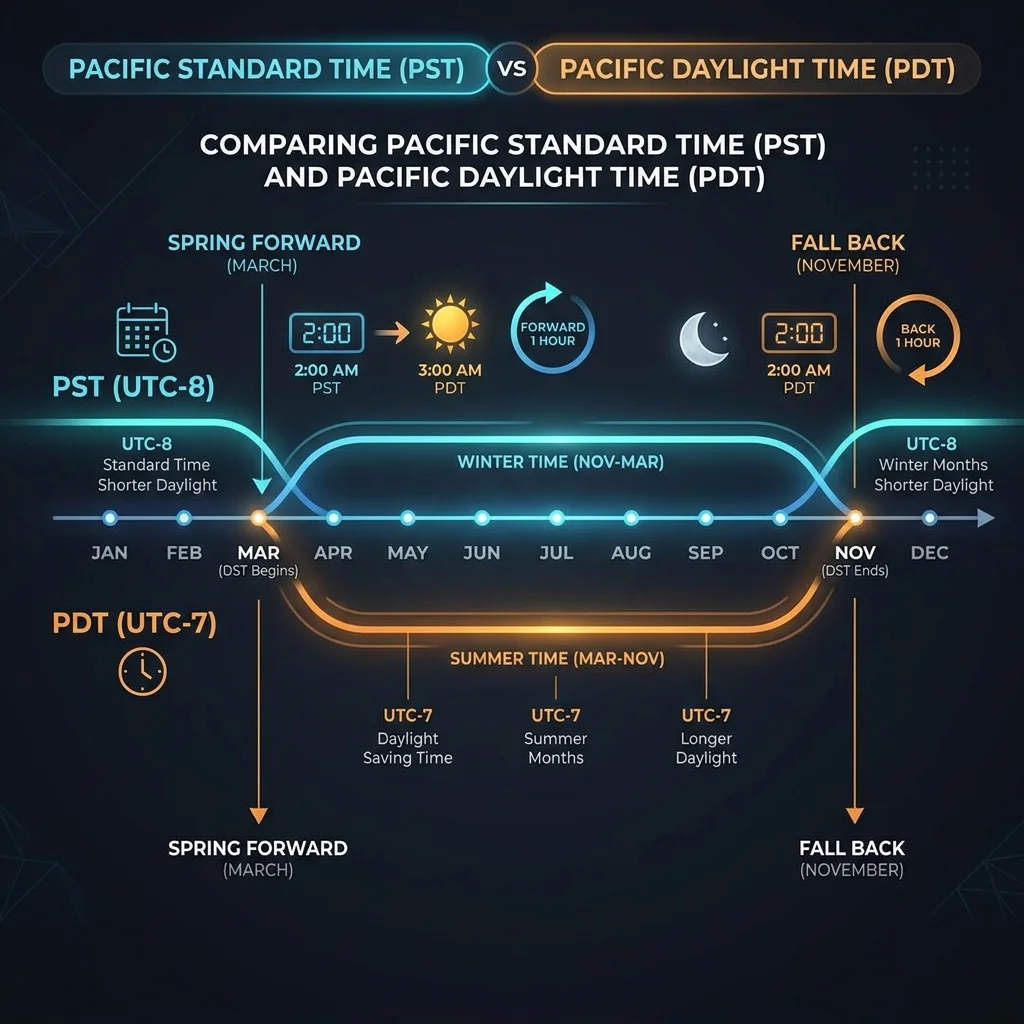
- Pacific Standard Time (PST): Used during the autumn and winter months. It is 8 hours behind Coordinated Universal Time (UTC-8).
- Pacific Daylight Time (PDT): Used during the spring and summer months. It is 7 hours behind Coordinated Universal Time (UTC-7).
Did You Know?
The entire state of California operates under Pacific Time. The boundary lines for Pacific Time extend north through Oregon and Washington, east to the borders of Idaho and Nevada, and south to the Mexican border.
2. PST vs PDT Explained
The distinction between Pacific Standard Time (PST) and Pacific Daylight Time (PDT) is crucial for accurate scheduling. Applying the wrong term can cause significant confusion, as standard and daylight offsets represent a difference of exactly one hour.
| Time Type | Abbreviation | UTC Offset | Typical Months of Observance | Clock Action |
|---|---|---|---|---|
| Pacific Standard Time | PST | UTC-8 | November to March | Standard winter time (Clocks fall back 1 hour) |
| Pacific Daylight Time | PDT | UTC-7 | March to November | Daylight saving time (Clocks spring forward 1 hour) |
Daylight Saving Time Transition Dates
Under federal law in the United States (the Uniform Time Act of 1966), clock changes occur at 2:00 a.m. local time:
- Spring Transition (DST Starts): On the second Sunday of March, clocks are advanced from 2:00 a.m. to 3:00 a.m. local standard time, transitioning the region into Pacific Daylight Time (PDT, UTC-7).
- Autumn Transition (DST Ends): On the first Sunday of November, clocks are set back from 2:00 a.m. to 1:00 a.m. local daylight time, returning the region to Pacific Standard Time (PST, UTC-8).
Watch Out for The Offset Change
Writing "PST" in July is technically incorrect and can cause confusion for automated systems or international schedulers. During the summer, Los Angeles is strictly on PDT.
3. Why Los Angeles Uses Pacific Time
The establishment of standard time zones was not an overnight decision. Prior to the late 19th century, cities across North America calculated local time by observing noon (when the sun reached its highest point). This created hundreds of localized offsets, rendering railroad coordination almost impossible and leading to numerous accidents.
In 1883, the major railroad companies of North America collaborated to split the continent into four primary time zones: Eastern, Central, Mountain, and Pacific. Los Angeles was placed in the Pacific zone due to its longitude, which sits close to the 120th meridian west of Greenwich. The International Meridian Conference of 1884 solidified these zones globally, anchoring them to the prime meridian at Greenwich, London.
Today, California maintains this alignment under the oversight of the U.S. Department of Transportation, which regulates standard time and DST transition rules to facilitate national commerce, air travel, and interstate shipping.
Expert Tip: Permanent DST Debates
While voters in California approved Proposition 7 in 2018 (which cleared the path to establish permanent Daylight Saving Time), any permanent change requires a change in federal law. The federal Sunshine Protection Act has been proposed but not enacted, meaning the biannual clock changes remain active.
4. Los Angeles Business & Industry Scheduling
As a major global commercial hub, Los Angeles houses specific business cultures with strict scheduling cycles. Navigating these cycles is vital for partnerships, communications, and logistical planning.
Hollywood & The Entertainment Industry
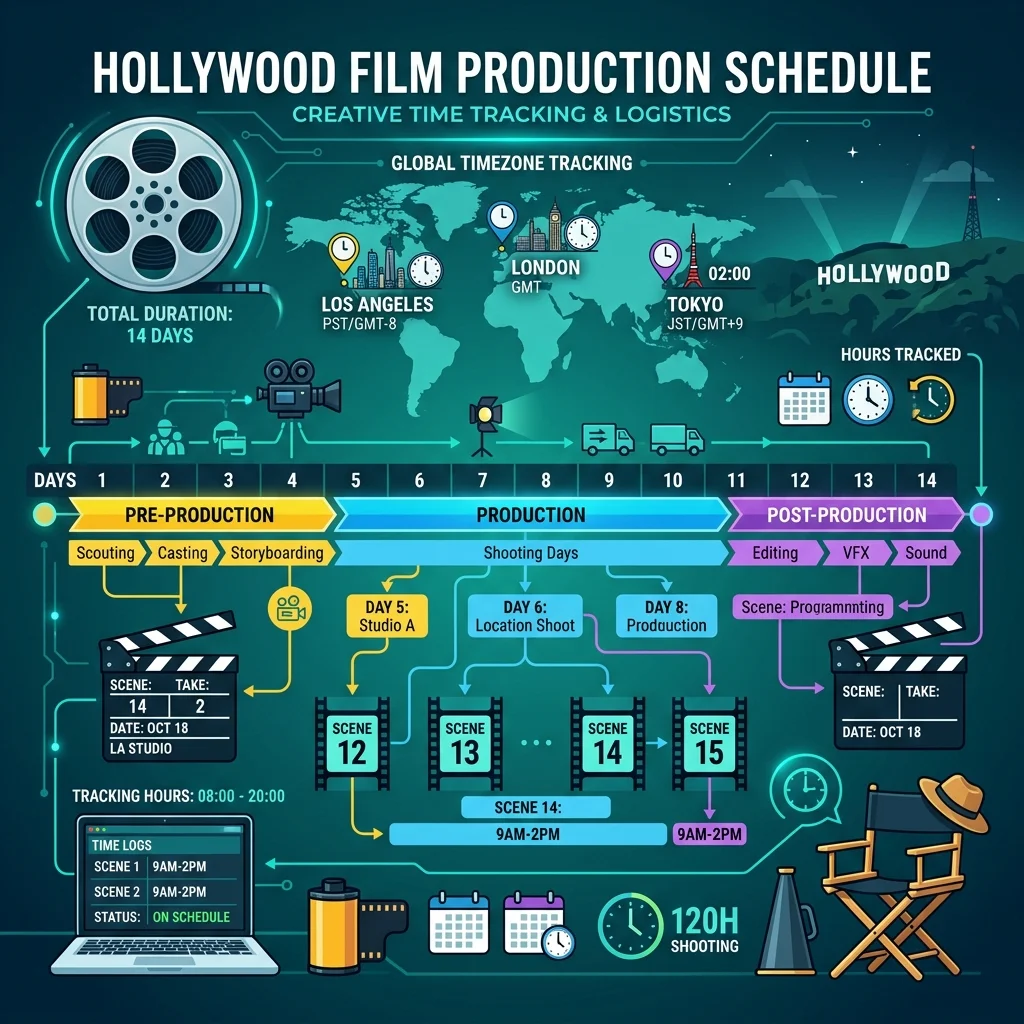
Hollywood operates on a fast-paced scheduling model governed by "call times." Call sheets are distributed in Pacific Time (PT), indicating when actors, technicians, and crew members must report to set. These call times are determined based on local sunrise and sunset to ensure optimal natural light for filming.
For international co-productions (e.g., coordinating between a soundstage in London and a post-production house in Santa Monica), directors and coordinators must convert times between BST/GMT and PDT/PST to avoid crew downtime and scheduling clashes.
Silicon Beach & Technology Companies
West Los Angeles (including Venice, Santa Monica, and Playa Vista) is known as Silicon Beach, home to thousands of digital startups and global tech campuses.
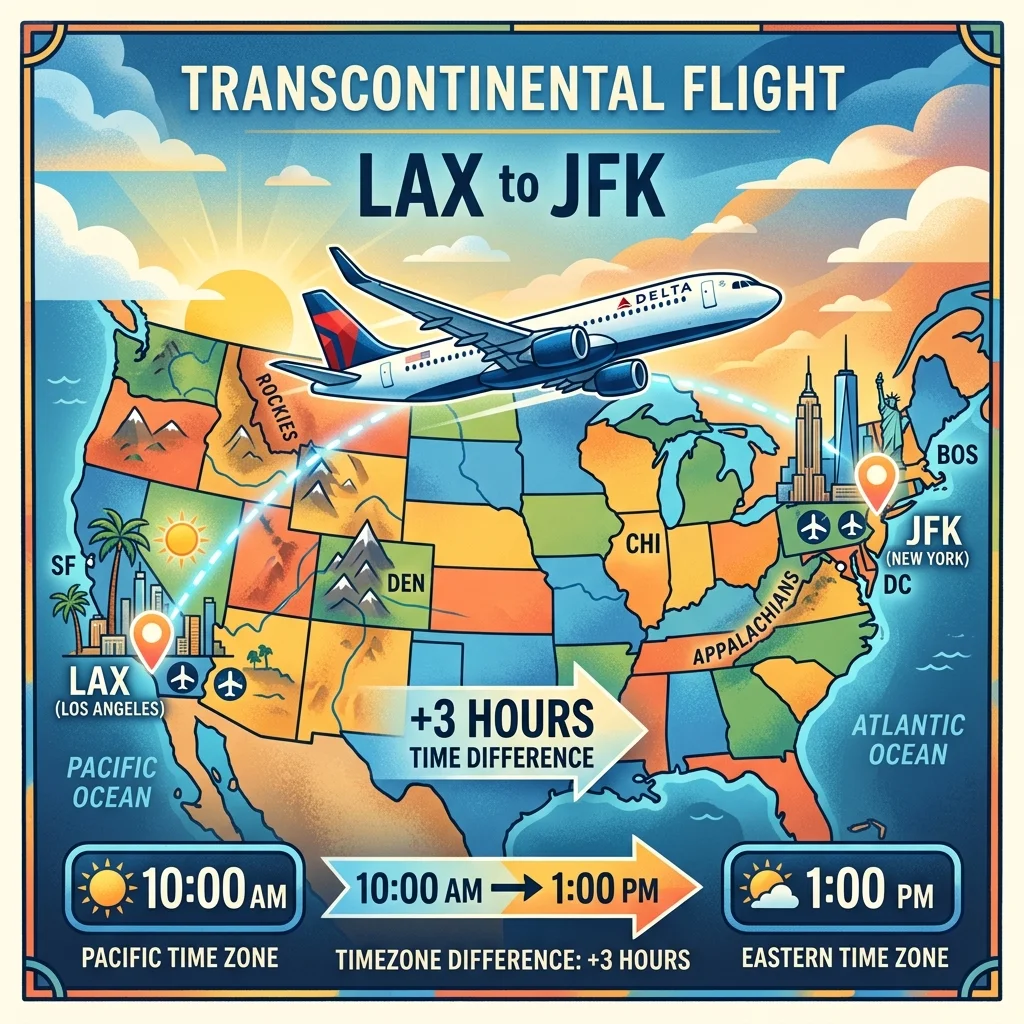
Tech operations typically utilize core working hours from 9:00 a.m. to 6:00 p.m. Pacific Time. Startup teams and engineers coordinate daily with Silicon Valley (sharing the same time zone) and New York (3 hours ahead). For remote developer coordination in other regions, understanding West Coast business hours is critical to establishing overlapping collaboration windows.

5. Los Angeles vs. The World (Time Comparison)
To coordinate international meetings, financial trading, and flight connections, you must understand how Los Angeles Time compares with other global centers.
Time Comparison Table
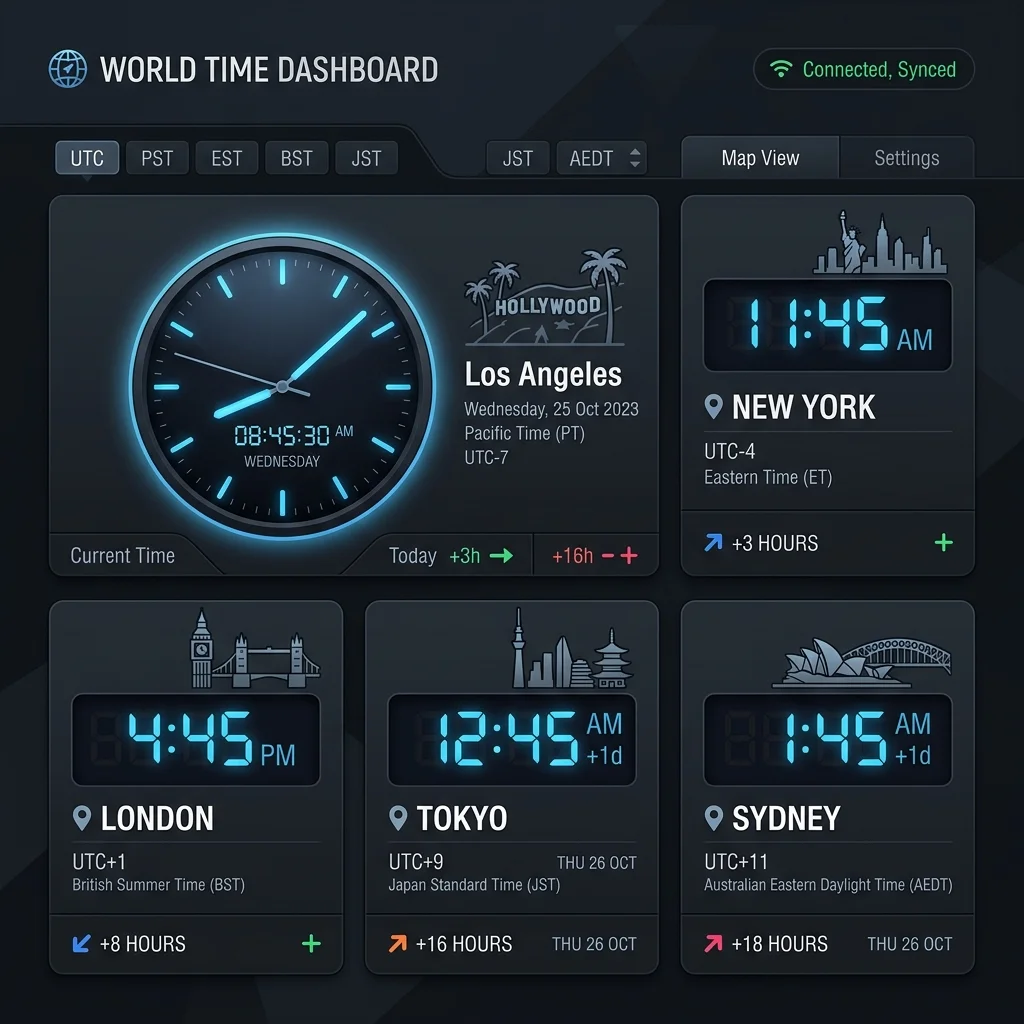
| City | Summer Offset | Summer Difference (vs. LA) | Winter Offset | Winter Difference (vs. LA) |
|---|---|---|---|---|
| New York | EDT (UTC-4) | +3 hours | EST (UTC-5) | +3 hours |
| Toronto | EDT (UTC-4) | +3 hours | EST (UTC-5) | +3 hours |
| London | BST (UTC+1) | +8 hours | GMT (UTC+0) | +8 hours |
| Tokyo | JST (UTC+9) | +16 hours | JST (UTC+9) | +17 hours |
| Sydney | AEST (UTC+10) | +17 hours | AEDT (UTC+11) | +19 hours |
Recommended Communication Windows
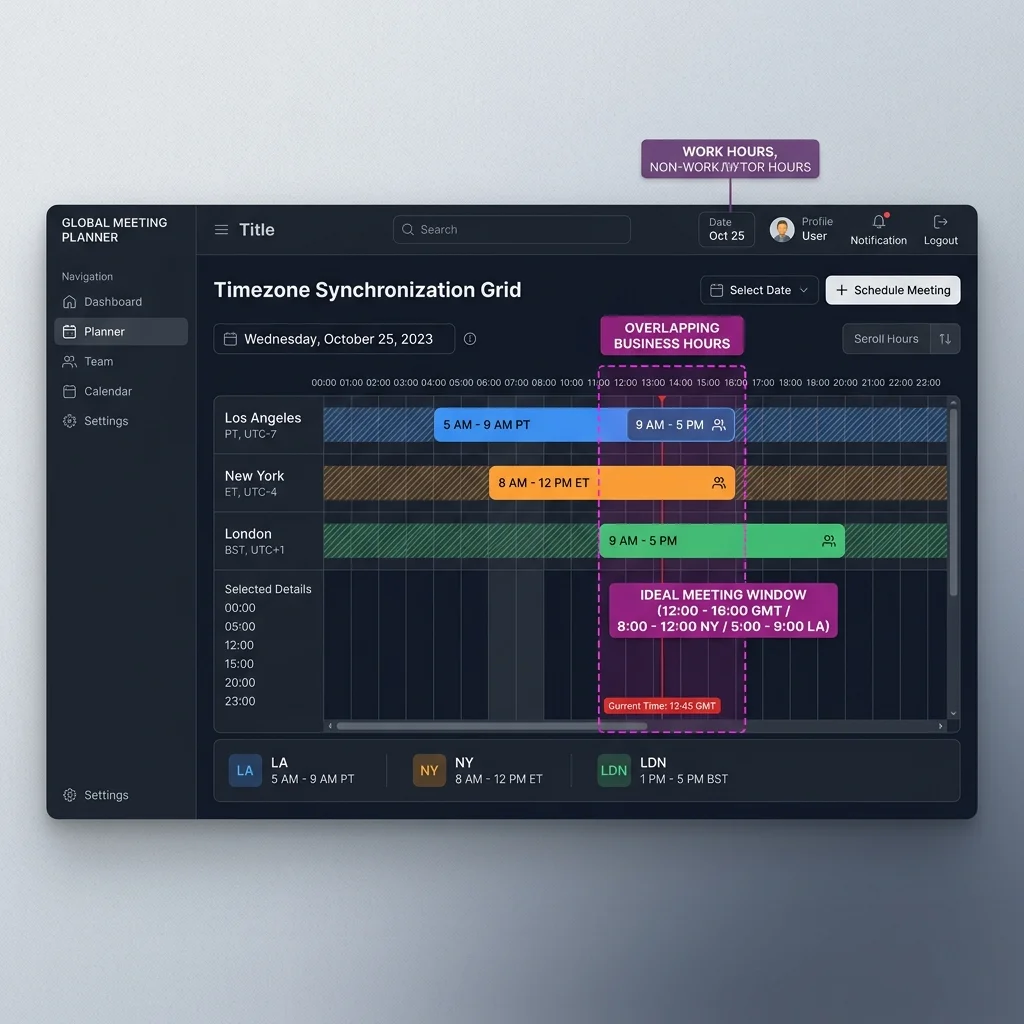
- Los Angeles to New York: Best window is 9:00 a.m. to 2:00 p.m. PT (12:00 p.m. to 5:00 p.m. ET). This aligns with standard working hours on both coasts.
- Los Angeles to London: Best window is 8:00 a.m. to 10:00 a.m. PT (4:00 p.m. to 6:00 p.m. UK time). This brief overlap is vital for live voice/video calls.
- Los Angeles to Tokyo: Best window is 4:00 p.m. to 6:00 p.m. PT, which corresponds to 8:00 a.m. to 10:00 a.m. JST the next day.
6. Travel Planning & Jet Lag
Traveling through different time zones can impact physical well-being. Navigating the timezone transitions correctly is the key to maintaining energy levels, avoiding missed flights, and staying on schedule.
Jet Lag Adjustment Strategies
When flying into Los Angeles from the East Coast or international cities, your internal circadian rhythm will be desynchronized from local solar cycles. Use these expert strategies to adapt quickly:
- Pre-adjust your schedule: Shift your bedtime by 1–2 hours toward Pacific Time several days before departure.
- Control light exposure: Seek bright California sunlight in the morning if you are arriving from Asia, or in the late afternoon if you are arriving from Europe.
- Stay hydrated: Air cabin pressure accelerates dehydration, which worsens the physical symptoms of jet lag.
- Align meals: Force yourself to eat meals according to local Los Angeles time upon landing, helping reset your peripheral body clocks.
7. Programming, Databases & Cloud Infrastructure
For developers and cloud engineers, managing local timezones in software logic requires discipline. Incorrect scheduling can lead to broken database records, logging conflicts, and failing cron jobs during Daylight Saving Time transition windows.
Cloud Server Location Offsets
Many major cloud platforms host resources on the West Coast of the United States (such as AWS us-west-1 in Northern California or us-west-2 in Oregon). Servers running within these regions are often set to UTC by default. Setting servers to localized Pacific Time can introduce issues when calculating database logs, making UTC the standard choice for runtime environments.
ISO 8601 Format Representation
When passing timestamps in APIs, always use ISO 8601 formatting. The correct representations for Pacific Standard and Pacific Daylight times are:
- Standard Time Offset (PST):
2026-12-15T09:30:00-08:00 - Daylight Saving Time Offset (PDT):
2026-06-15T09:30:00-07:00
Database Tip
Always store timestamp data in UTC within your database tables (e.g., using TIMESTAMP WITH TIME ZONE in PostgreSQL). Perform the conversion to America/Los_Angeles only in the application presentation layer to ensure that DST changes are resolved dynamically based on historical and current rules.
8. Common Time Zone Mistakes to Avoid
Coordinating with Los Angeles requires close attention to detail. Avoid these frequent errors:
- Confusing PST with PDT: Using PST during the summer (when Los Angeles is on PDT) indicates a UTC-8 offset, which is incorrect by one hour. Refer to local time as Pacific Time (PT) if you are unsure.
- Assuming Arizona Shares California's Time Zone: Arizona operates on Mountain Standard Time (MST, UTC-7) year-round and does not observe DST. While Arizona and California share the same clock time in summer, Arizona is one hour ahead in winter.
- Forgetting the Transition Gaps: Europe and North America switch to and from DST on different dates. The time gap between London and Los Angeles changes from 8 hours to 7 hours for a few weeks in March and October.
9. Frequently Asked Questions
Review these comprehensive answers to common questions about Los Angeles time zone offsets and schedules:
What time zone does Los Angeles use?
Los Angeles is located in the Pacific Time Zone (PT) of North America. It alternates between Pacific Standard Time (PST) in the winter and Pacific Daylight Time (PDT) in the summer.
Is Los Angeles currently on PST or PDT?
Los Angeles observes Pacific Daylight Time (PDT, UTC-7) from the second Sunday in March until the first Sunday in November. From the first Sunday in November until the second Sunday in March, it observes Pacific Standard Time (PST, UTC-8).
What is the UTC offset for Los Angeles?
During standard time (winter), the UTC offset is UTC-8. During daylight saving time (summer), the UTC offset is UTC-7.
When does Daylight Saving Time begin and end in Los Angeles?
Daylight Saving Time (DST) begins on the second Sunday of March at 2:00 a.m. local standard time (clocks jump forward to 3:00 a.m. PDT). It ends on the first Sunday of November at 2:00 a.m. local daylight time (clocks fall back to 1:00 a.m. PST).
Why does California observe Daylight Saving Time?
California observes DST under the Uniform Time Act of 1966 to maximize daylight hours during summer evenings, theoretically reducing energy consumption and aligning local schedules with federal commerce standards.
What is the time difference between Los Angeles and New York?
New York (Eastern Time) is always 3 hours ahead of Los Angeles (Pacific Time). Both regions transition to and from Daylight Saving Time on the same dates.
What is the time difference between Los Angeles and London?
During the winter, London (GMT, UTC+0) is 8 hours ahead of Los Angeles (PST, UTC-8). During the summer, London (BST, UTC+1) is 8 hours ahead of Los Angeles (PDT, UTC-7). In late March and late October, there is a brief transition gap of 7 hours due to different DST changeover dates.
What is the time difference between Los Angeles and Tokyo?
During the summer, Tokyo (JST, UTC+9) is 16 hours ahead of Los Angeles (PDT, UTC-7). During the winter, Tokyo is 17 hours ahead of Los Angeles (PST, UTC-8). Japan does not observe Daylight Saving Time.
What is the time difference between Los Angeles and Sydney?
During the Northern Hemisphere summer (Southern winter), Sydney (AEST, UTC+10) is 17 hours ahead of Los Angeles (PDT, UTC-7). During the Northern Hemisphere winter (Southern summer), Sydney (AEDT, UTC+11) is 19 hours ahead of Los Angeles (PST, UTC-8).
What is Silicon Beach and how do its business hours operate?
Silicon Beach is the technology hub of West Los Angeles. Tech companies typically operate on core hours from 9:00 a.m. to 6:00 p.m. Pacific Time, coordinating daily with partners in Silicon Valley, New York, and overseas.
How does the entertainment industry schedule shoots in Los Angeles?
Hollywood production schedules revolve around 'call times' determined by local sunrise and sunset. Shoots are coordinated using local Pacific Time, with daily production updates distributed worldwide using standardized timestamps.
What is the IANA database identifier for Los Angeles time?
The IANA Time Zone Database identifier for Los Angeles is America/Los_Angeles.
Is all of California in the Pacific Time Zone?
Yes. The entire state of California, from the Oregon border in the north to the Mexican border in the south, operates under Pacific Time (PST or PDT).
How does DST affect flights arriving in Los Angeles?
Flight schedules are always published in local times. When Los Angeles switches between PST and PDT, international arrival windows shift relative to locations that do not observe DST, requiring airlines to update timetables.
How do I schedule a meeting between Los Angeles and London?
Target the morning window in Los Angeles (9:00 a.m. to 10:00 a.m. PT), which corresponds to the late afternoon in London (5:00 p.m. to 6:00 p.m. GMT/BST), to stay within standard working hours.
Does Los Angeles use Military Time?
Military time (24-hour clock) is widely used by aviation, logistics, emergency services, and software logs in Los Angeles to eliminate AM/PM ambiguity.
What is the Sunshine Protection Act and does it affect California?
The Sunshine Protection Act is a proposed federal bill to make Daylight Saving Time permanent. If passed, Los Angeles would remain on PDT (UTC-7) year-round. It has not yet been signed into law.
How should software databases store Los Angeles timestamps?
Databases should store timestamps in UTC. To display the time to a Los Angeles user, convert the UTC value using the America/Los_Angeles timezone rule to handle DST transitions automatically.
What is the difference between PST and PDT?
PST stands for Pacific Standard Time (UTC-8) and is used in winter. PDT stands for Pacific Daylight Time (UTC-7) and is used in summer.
Does Arizona observe the same time as Los Angeles?
Arizona operates on Mountain Standard Time (MST, UTC-7) year-round and does not observe DST. As a result, Arizona shares the exact same time as Los Angeles (PDT) during the summer, but is 1 hour ahead during the winter.
Explore Time Zone Converters & Guides
Use our free, daylight-saving-aware converters and timezone guides to calculate offsets and plan meetings: