
Central Time to Eastern Time: Conversion Guide + Examples
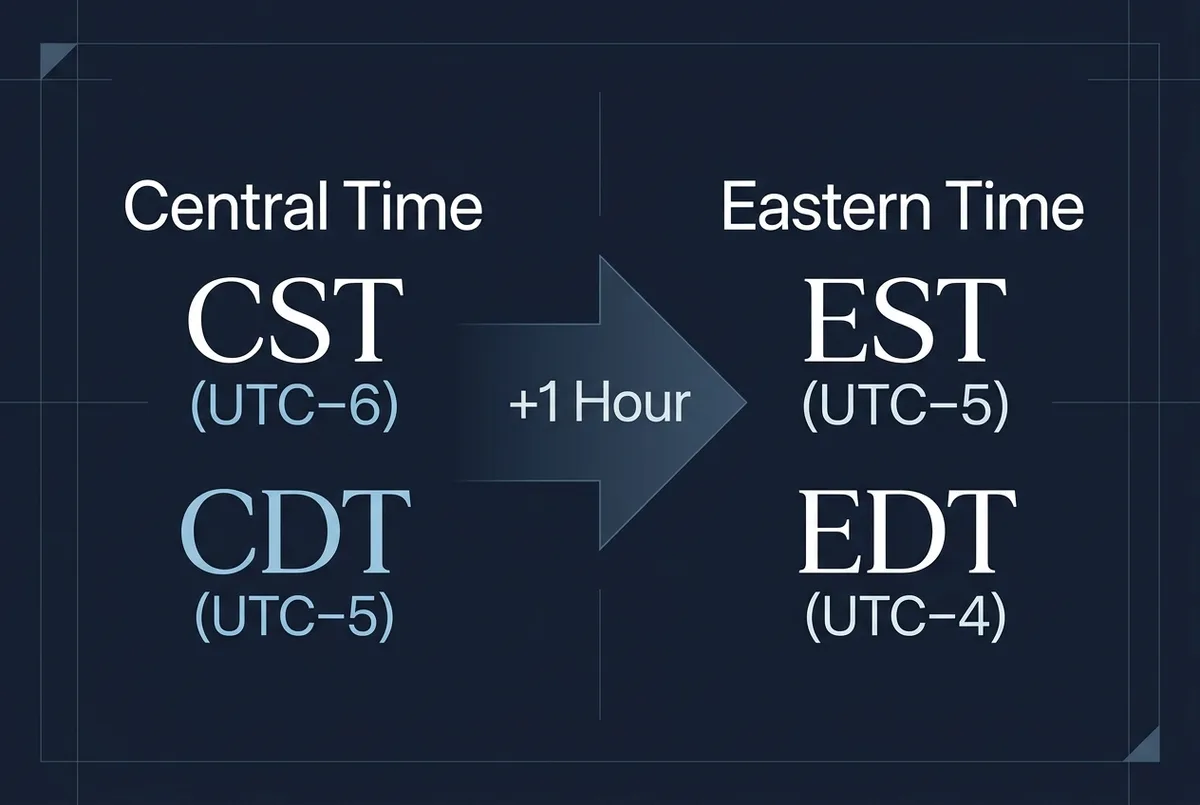
Eastern Time is 1 hour ahead of Central Time. To convert Central Time to Eastern Time, add 1 hour. For example, 2:00 PM Central Time = 3:00 PM Eastern Time. This one-hour difference stays the same all year long.
What Is Central Time?
Central Time (CT) is the time zone covering the central corridor of North America, including major cities like Chicago, Dallas, Houston, Minneapolis, and New Orleans. It is anchored near the 90th meridian west of Greenwich.
Central Time operates at two seasonal offsets:
- CST (Central Standard Time): UTC−6 — used from early November through early March.
- CDT (Central Daylight Time): UTC−5 — used from mid-March through early November.
The season-neutral label CT covers both modes and is the safest abbreviation for scheduling.
Central Time also applies to the Canadian province of Manitoba, parts of western Ontario, and several Central American nations that observe UTC−6 year-round without daylight saving adjustments.
What Is Eastern Time?
Eastern Time (ET) covers the eastern seaboard of North America, including New York City, Washington D.C., Atlanta, Miami, Toronto, and Montreal. It is anchored near the 75th meridian west.
Eastern Time operates at two seasonal offsets:
- EST (Eastern Standard Time): UTC−5 — used during standard time months.
- EDT (Eastern Daylight Time): UTC−4 — used during daylight saving months.
The season-neutral label ET covers both. Eastern Time defines the benchmark for Wall Street equity markets, federal government operations, and most national broadcast schedules in the United States.
Central Time vs Eastern Time: What’s the Difference?
The core difference is straightforward:
Eastern Time is always 1 hour ahead of Central Time.
When it’s noon in Chicago (Central), it’s 1:00 PM in New York (Eastern).
| Attribute | Central Time (CT) | Eastern Time (ET) |
|---|---|---|
| Standard Abbreviation | CST | EST |
| Daylight Abbreviation | CDT | EDT |
| Standard UTC Offset | UTC−6 | UTC−5 |
| Daylight UTC Offset | UTC−5 | UTC−4 |
| Relationship | 1 hour behind Eastern | 1 hour ahead of Central |
| Major US Cities | Chicago, Dallas, Houston, Minneapolis | New York, Atlanta, Miami, Boston |
| Major Canadian Cities | Winnipeg (MB) | Toronto (ON), Montreal (QC) |
How to Convert Central Time to Eastern Time
The Rule
Add 1 hour to Central Time to get Eastern Time.
$$\text{Eastern Time} = \text{Central Time} + 1\text{ hour}$$
This formula works in both directions of the seasonal cycle:
- Winter: CST (UTC−6) + 1 hour = EST (UTC−5)
- Summer: CDT (UTC−5) + 1 hour = EDT (UTC−4)
Quick Examples
- 9:00 AM CT → 10:00 AM ET
- 12:00 PM CT → 1:00 PM ET
- 4:00 PM CT → 5:00 PM ET
- 7:00 PM CT → 8:00 PM ET
To convert back from Eastern to Central, subtract 1 hour.
Central Time to Eastern Time Conversion Chart
The table below covers a full day of Central Time to Eastern Time conversions. All times remain on the same calendar day unless noted.
| Central Time (CT) | Eastern Time (ET) | Scheduling Context |
|---|---|---|
| 6:00 AM CT | 7:00 AM ET | Early morning; Eastern financial desks begin prep |
| 7:00 AM CT | 8:00 AM ET | Morning commute in both zones |
| 8:00 AM CT | 9:00 AM ET | Eastern business day opens |
| 9:00 AM CT | 10:00 AM ET | Central business day opens; cross-zone sync window |
| 10:00 AM CT | 11:00 AM ET | Peak morning collaboration hours |
| 11:00 AM CT | 12:00 PM ET | Eastern lunch hour begins |
| 12:00 PM CT | 1:00 PM ET | Central lunch; Eastern afternoon block |
| 1:00 PM CT | 2:00 PM ET | Afternoon meetings and project check-ins |
| 2:00 PM CT | 3:00 PM ET | Mid-afternoon collaboration |
| 3:00 PM CT | 4:00 PM ET | Wall Street markets close (4:00 PM ET) |
| 4:00 PM CT | 5:00 PM ET | Eastern business day ends |
| 5:00 PM CT | 6:00 PM ET | Central business day ends |
| 6:00 PM CT | 7:00 PM ET | Evening hours begin |
| 7:00 PM CT | 8:00 PM ET | Prime-time broadcasts and sports events |
| 8:00 PM CT | 9:00 PM ET | Evening entertainment |
| 9:00 PM CT | 10:00 PM ET | Late evening programming |
| 10:00 PM CT | 11:00 PM ET | Late-night window |
| 11:00 PM CT | 12:00 AM ET ★ | ★ Crosses midnight into the next calendar day |
Common Central Time to Eastern Time Conversions
These are the most frequently searched specific conversions between Central and Eastern Time.
1 PM Central Time to Eastern
1:00 PM CT = 2:00 PM ET
This is one of the highest-volume searches because 1:00 PM Central represents the start of the afternoon workday in Chicago and Dallas, corresponding to 2:00 PM in New York and Atlanta. It’s the prime window for cross-regional project check-ins.
2 PM Central Time to Eastern
2:00 PM CT = 3:00 PM ET
A common time for mid-afternoon meetings and conference calls that bridge Central and Eastern teams.
5 PM Central Time to Eastern
5:00 PM CT = 6:00 PM ET
End of the Central business day. Eastern colleagues have already wrapped up their workday by this point.
7 PM Central Time to Eastern
7:00 PM CT = 8:00 PM ET
Widely searched for entertainment, live sports, and webinars. An NFL or NBA game scheduled for 7:00 PM Central kicks off at 8:00 PM for East Coast viewers.
8 PM Central Time to Eastern
8:00 PM CT = 9:00 PM ET
Prime-time television scheduling. Many national broadcasts advertised at “8/9 Central” use this exact conversion.
10 PM Central Time to Eastern
10:00 PM CT = 11:00 PM ET
Late-evening events. Note that this is still on the same calendar day in Eastern Time — midnight rollover only occurs at 11:01 PM CT and later.
CST to EST vs. CDT to EDT
Understanding the abbreviations prevents scheduling errors:
Standard Time (Winter)
- CST = Central Standard Time = UTC−6
- EST = Eastern Standard Time = UTC−5
- Difference: 1 hour
Daylight Time (Summer)
- CDT = Central Daylight Time = UTC−5
- EDT = Eastern Daylight Time = UTC−4
- Difference: 1 hour
The key insight: CDT (UTC−5) and EST (UTC−5) share the same numerical UTC offset, but they are used in different seasons. CDT applies in summer while EST applies in winter, so they rarely overlap in practice.
Why CT and ET Are Safer
Many people write “CST” or “EST” all year long out of habit. Technically, using “CST” in July is incorrect — the proper term during summer is “CDT.” To avoid this confusion entirely, use the season-neutral labels CT (Central Time) and ET (Eastern Time). These are accurate regardless of the date.
Does Daylight Saving Time Change the Difference?
No. The one-hour difference between Central Time and Eastern Time remains constant as long as both regions follow standard North American daylight saving time rules.
Here’s why:
- Winter (Standard Time): CST is UTC−6, EST is UTC−5. Difference: (−5) − (−6) = +1 hour.
- Summer (Daylight Saving Time): CDT is UTC−5, EDT is UTC−4. Difference: (−4) − (−5) = +1 hour.
Both time zones spring forward on the same Sunday in March (2:00 AM local time) and fall back on the same Sunday in November. The synchronized transition preserves the one-hour gap.
The Saskatchewan Exception
Most of Saskatchewan observes CST (UTC−6) year-round and does not spring forward to CDT. This creates a variable gap with Eastern Time:
- Winter: Saskatchewan (CST, UTC−6) is 1 hour behind Toronto (EST, UTC−5) — the normal difference.
- Summer: Saskatchewan stays at UTC−6 while Toronto moves to EDT (UTC−4). The gap widens to 2 hours.
This is why time-zone rules ultimately depend on the specific location and date. The “always 1 hour apart” rule applies when both the Central and Eastern locations participate in daylight saving time on the same schedule.
Similarly, most of Mexico abolished seasonal DST in October 2022. Mexican cities on UTC−6 (like Mexico City) are 2 hours behind EDT during summer months.
Central Time to Eastern Time Examples in Real Life
Business Meetings
A project kickoff scheduled for 1:00 PM CT starts at 2:00 PM ET. When inviting participants across both zones, write: “Thursday at 1:00 PM CT / 2:00 PM ET.”
Live Sports Broadcasts
An NFL game listed as 7:30 PM CT kicks off at 8:30 PM ET for viewers on the East Coast. The familiar TV disclaimer “8/7 Central” reflects this one-hour offset.
Flight Departures
A flight departing Chicago O’Hare at 3:15 PM CT and arriving in New York after a 2-hour flight lands at approximately 6:15 PM ET (3:15 + 1 hour for the time zone shift + 2 hours of flight time).
Stock Market Correlation
The New York Stock Exchange opens at 9:30 AM ET, which is 8:30 AM CT for traders in Chicago. The closing bell at 4:00 PM ET corresponds to 3:00 PM CT.
What Happens When the Conversion Crosses Midnight?
When you convert late Central Time hours, the Eastern result can cross into the next calendar day. This matters for deadlines, event bookings, and server maintenance windows.
Central times from 11:01 PM to 11:59 PM CT convert to 12:01 AM to 12:59 AM ET the next day. Any Central time at or before 11:00 PM stays on the same calendar day in Eastern Time.
Examples:
- 10:45 PM CT → 11:45 PM ET — same day ✓
- 11:00 PM CT → 12:00 AM ET (midnight) — technically the start of the next day
- 11:30 PM CT → 12:30 AM ET — next calendar day
- 11:45 PM CT → 12:45 AM ET — next calendar day
This is critical for deadline submissions. A document due by “midnight Eastern” on Friday must be submitted by 11:00 PM Central on Friday.
Central Time vs Eastern Time by Major Cities
| Central Time City | Eastern Time City | Time Difference |
|---|---|---|
| Chicago, IL | New York, NY | +1 hour |
| Dallas, TX | Atlanta, GA | +1 hour |
| Houston, TX | Miami, FL | +1 hour |
| Minneapolis, MN | Boston, MA | +1 hour |
| New Orleans, LA | Washington, D.C. | +1 hour |
| San Antonio, TX | Charlotte, NC | +1 hour |
| Winnipeg, MB | Toronto, ON | +1 hour |
| Kansas City, MO | Philadelphia, PA | +1 hour |
Common Mistakes When Converting Central to Eastern Time
Mistake 1: Using CST in Summer
Writing “Our webinar starts at 1:00 PM CST” in July is technically stating a UTC−6 event. If an automated scheduling tool parses the abbreviation literally, the meeting could be scheduled an hour off. In summer, use CDT — or simply CT.
Mistake 2: Forgetting the Date Change
Booking a red-eye flight or server maintenance window at 11:15 PM CT? That’s 12:15 AM ET the next calendar day. Failing to update the date in documentation leads to missed appointments.
Mistake 3: Assuming All Central Locations Observe DST
Not every location in the Central Time Zone advances clocks in March. Saskatchewan and most of Mexico do not participate in daylight saving time, which can alter the expected one-hour difference with Eastern cities during summer.
Mistake 4: Confusing CST with China Standard Time
Within North America, “CST” universally means Central Standard Time. However, in international contexts, CST can also refer to China Standard Time (UTC+8) — a 14-hour difference from North American CST. When working with global teams, specify the reference city (e.g., “Chicago time”) or use IANA identifiers like America/Chicago.
Central Time to Eastern Time for Scheduling
Because Central and Eastern are separated by only 60 minutes, cross-zone scheduling is straightforward. Here are practical tips:
-
7-hour overlap window: Standard business hours (9 AM–5 PM) overlap almost completely. Teams spanning both zones share 7 out of 8 working hours daily (9:00 AM–4:00 PM CT / 10:00 AM–5:00 PM ET).
-
Use CT and ET in invitations: Write
"Project Kickoff: Thursday at 1:00 PM CT / 2:00 PM ET"to eliminate mental arithmetic. -
Enable dual time zones in your calendar: Google Calendar, Outlook, and Apple Calendar support secondary time zone displays. Set your secondary zone to
America/ChicagoorAmerica/New_York. -
Double-check international participants: If your Central/Eastern meeting includes colleagues in London, consult the GMT vs EST comparison guide to account for the 5–6 hour transatlantic offset.
-
Use USA time zone references when onboarding new team members unfamiliar with American time zone geography.
Need to Convert a Specific Central Time?
If you’d rather skip the math, try our CST to EST Converter for an instant answer. The converter features live side-by-side digital clocks, an interactive slider, and a complete 24-hour conversion schedule that automatically handles daylight saving time transitions.
Central Time to Eastern Time: Quick Summary
- Eastern Time is 1 hour ahead of Central Time — always.
- To convert: add 1 hour to any Central Time.
- CST (UTC−6) and EST (UTC−5) apply during standard time (November–March).
- CDT (UTC−5) and EDT (UTC−4) apply during daylight saving time (March–November).
- The 1-hour difference is constant year-round for regions following standard DST schedules.
- CT and ET are the preferred season-neutral labels for accuracy.
- 11:01 PM–11:59 PM CT crosses midnight into the next day in Eastern Time.
- Saskatchewan and parts of Mexico are notable exceptions to the standard DST schedule.
- For Canada time zones, always verify DST participation by province.
Frequently Asked Questions (FAQ)
How many hours ahead is Eastern Time from Central Time?
Eastern Time is exactly 1 hour ahead of Central Time. This one-hour difference applies year-round, whether both regions are on standard time (CST/EST) or daylight saving time (CDT/EDT).
How do I convert Central Time to Eastern Time?
Add 1 hour to any Central Time to get Eastern Time. For example, 3:00 PM Central Time becomes 4:00 PM Eastern Time.
What is 1 PM Central Time in Eastern Time?
1:00 PM Central Time is 2:00 PM Eastern Time on the same calendar day.
What is 7 PM Central Time in Eastern Time?
7:00 PM Central Time is 8:00 PM Eastern Time on the same calendar day.
Does the time difference between Central and Eastern change during daylight saving time?
No. Both Central and Eastern Time zones spring forward and fall back on the same dates, so the one-hour difference remains constant year-round in regions that follow standard North American DST rules.
What is the UTC offset for Central Time and Eastern Time?
Central Standard Time (CST) is UTC−6 and Eastern Standard Time (EST) is UTC−5. During daylight saving time, Central Daylight Time (CDT) shifts to UTC−5 and Eastern Daylight Time (EDT) shifts to UTC−4.
What does CT and ET mean?
CT stands for Central Time and ET stands for Eastern Time. These season-neutral abbreviations automatically encompass both standard and daylight saving modes, making them safer to use in scheduling than CST or EST.
Can the Central-to-Eastern difference ever be something other than 1 hour?
Yes, in limited cases. Saskatchewan observes Central Standard Time (UTC−6) year-round without daylight saving. During summer, Saskatchewan is 2 hours behind Eastern Daylight Time (EDT, UTC−4) instead of the usual 1 hour.
What happens when a Central Time conversion crosses midnight?
When converting Central times between 11:01 PM and 11:59 PM, the Eastern Time result crosses into the next calendar day. For example, 11:30 PM CT becomes 12:30 AM ET the following day.
Is Central Time ahead of or behind Eastern Time?
Central Time is behind Eastern Time. Central clocks show an earlier hour than Eastern clocks because the sun rises later in the Central Time Zone.
Sources & References
- Uniform Time Act and Time Zone Regulatory Overview — U.S. Department of Transportation
- Daylight Saving Time Rules and Explanations — National Institute of Standards and Technology (NIST)
- IANA Time Zone Database (America/Chicago & America/New_York) — Internet Assigned Numbers Authority (IANA)
- Official Time Across Canada — National Research Council Canada (NRC)