
What Is Daylight Saving Time? A Complete Guide
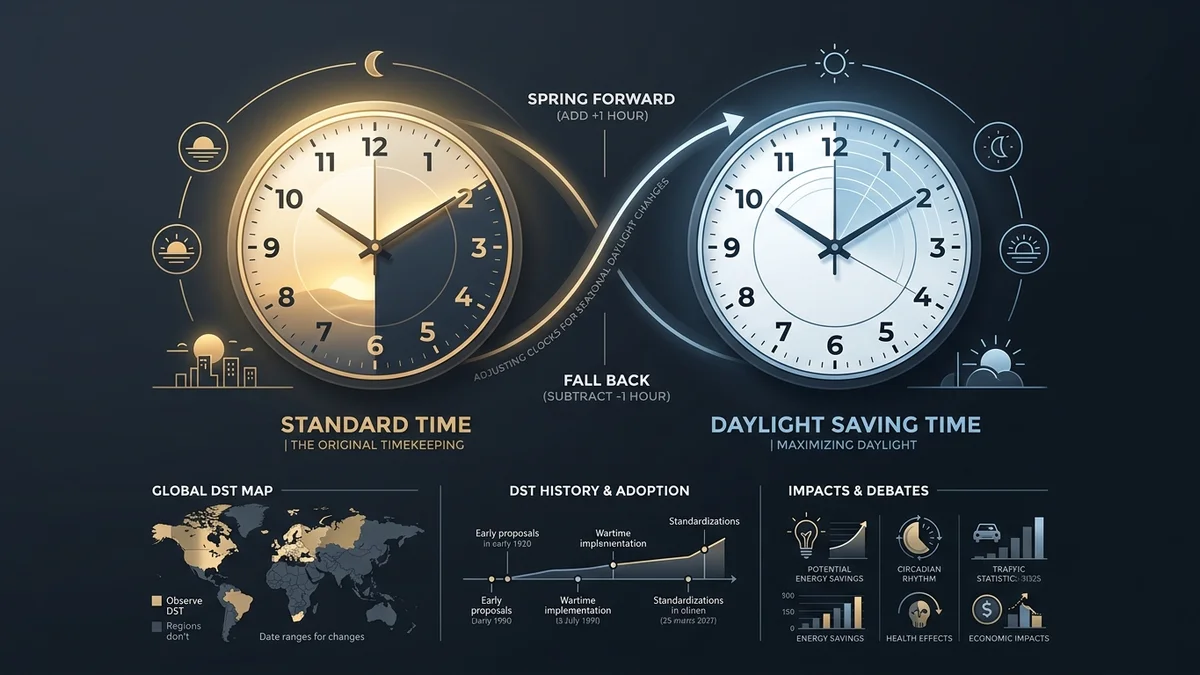
Every year, hundreds of millions of people across North America, Europe, and parts of the Southern Hemisphere adjust their clocks by one hour, participating in a century-old practice known as Daylight Saving Time (DST).
Yet despite its global reach, Daylight Saving Time remains one of the most misunderstood systems in modern life. Calendar invites are scheduled an hour off, international conference calls turn into confusion, and travelers wonder why their smartphones changed time overnight while their colleagues abroad did not.
This guide provides a comprehensive, evergreen breakdown of Daylight Saving Time: what it is, why clocks change, how Standard Time and Daylight Time differ, how regional designations like EST/EDT and GMT/BST work, and how seasonal time shifts affect global scheduling. Whether you are coordinating a cross-border meeting using our GMT to EST converter or simply trying to make sense of your alarm clock, here is everything you need to know.
What Is Daylight Saving Time?
Daylight Saving Time (DST) is the seasonal practice of advancing civil clocks forward by one hour during spring and summer, then shifting them backward by one hour in autumn to return to Standard Time.
The primary objective is straightforward: to shift an hour of natural daylight from the early morning—when most people are asleep—to the evening, when people are awake, commuting, socializing, and engaging in outdoor activities.
SPRING: Clocks advance 1 hour  (+1 hr) → Daylight lasts later into the evening
AUTUMN: Clocks retreat 1 hour  (-1 hr) → Clocks return to Standard Time
To understand DST accurately, four foundational principles must be kept in mind:
- DST does not create daylight: The total amount of sunlight on any given calendar day is dictated purely by Earth’s 23.5-degree axial tilt and its orbit around the Sun. DST merely re-labels the hours during which that daylight occurs on our wristwatches and computer screens.
- The shift is typically one hour: Where observed, regional legislation mandates an adjustment of exactly 60 minutes.
- Not all countries observe DST: Less than 40% of countries worldwide currently change their clocks. Tropical regions near the equator experience nearly constant 12-hour daylight year-round, rendering seasonal clock shifts pointless.
- Terminology varies geographically: In North America, the practice is called Daylight Saving Time (DST). In the United Kingdom and continental Europe, it is officially known as Summer Time.
Why Do Clocks Change for Daylight Saving Time?
The practice of changing clocks arose from the intersection of astronomical seasons and modern industrial society.
In the Northern Hemisphere, the duration between sunrise and sunset expands significantly between the spring equinox in March and the summer solstice in June. In London, for example, midsummer provides nearly 17 hours of daylight, compared to less than 8 hours in late December. In New York, summer daylight approaches 15 hours.
Without Daylight Saving Time, sunrise in June would occur before 4:30 AM in parts of the northeastern United States and western Europe. Because most of the workforce does not wake up until 6:30 AM or 7:00 AM, several hours of prime morning daylight would be “wasted” while people are indoors sleeping behind blackout curtains.
By advancing clocks by 60 minutes in spring:
- Sunrise shifts from 4:30 AM to 5:30 AM.
- Sunset shifts from 7:30 PM to 8:30 PM.
The practical result is an extra hour of usable sunlight at the end of the workday.
The Evolution of the Reasoning Behind DST
The motivations behind changing clocks have evolved through three distinct eras:
- Wartime Energy Conservation (1916–1945): Germany introduced DST in April 1916 during World War I to conserve coal used for electric lighting, a strategy quickly copied by Britain and the United States. During World War II, nations enacted year-round “War Time.”
- Post-War Commerce and Recreation (1960s–1990s): Retailers, golf courses, sporting leagues, and barbecue manufacturers realized that an extra hour of light after work prompted consumers to spend money outdoors before going home.
- Modern Lifestyle and Public Safety: Advocates argue that brighter evening commutes reduce pedestrian traffic fatalities and lower outdoor opportunistic crime rates during evening rush hours.
Standard Time vs. Daylight Time
To understand how Daylight Saving Time works, you must first understand Standard Time.
Standard Time is the official baseline local civil time of a geographical region when Daylight Saving Time is not in effect. It is defined as a fixed offset relative to Coordinated Universal Time (UTC), the international atomic time standard.
When a government enacts Daylight Saving Time, it does not permanently relocate the region to a new time zone. Instead, it temporarily applies a seasonal one-hour positive offset to that baseline.
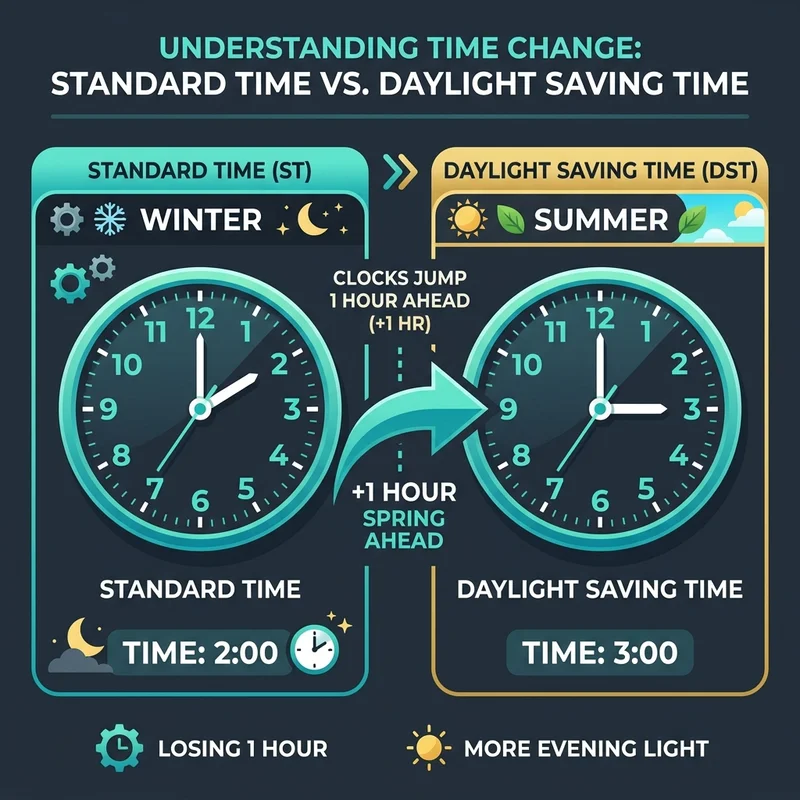
| Dimension | Standard Time | Daylight Time (DST / Summer Time) |
|---|---|---|
| Legal Role | Baseline geographical time standard | Temporary seasonal modification |
| Seasonal Window | Autumn and Winter | Spring and Summer |
| UTC Relationship | Baseline offset (e.g., UTC−5 for Eastern) | Baseline + 1 Hour (e.g., UTC−4 for Eastern) |
| Sun Position | Solar noon closer to 12:00 PM clock noon | Solar noon pushed back toward 1:00 PM |
| Evening Light | Earlier sunset | Later sunset (extended evening daylight) |
| Morning Light | Earlier sunrise | Later sunrise |
Standard Time represents the astronomically grounded baseline. Daylight Time is an artificial administrative shift overlaid onto that baseline for part of the year.
How Does Daylight Saving Time Work? The Annual Cycle
The operational rhythm of Daylight Saving Time follows a predictable annual loop:
[ STANDARD TIME ]  (Baseline Civil Time)
        │
        ▼
   SPRING SHIFT    ("Spring Forward" — Clocks advance by 1 hour)
        │
        ▼
 [ DAYLIGHT TIME ]  (Standard Time + 1 Hour)
        │
        ▼
   AUTUMN SHIFT    ("Fall Back" — Clocks retreat by 1 hour)
        │
        ▼
[ STANDARD TIME ]  (Return to Baseline)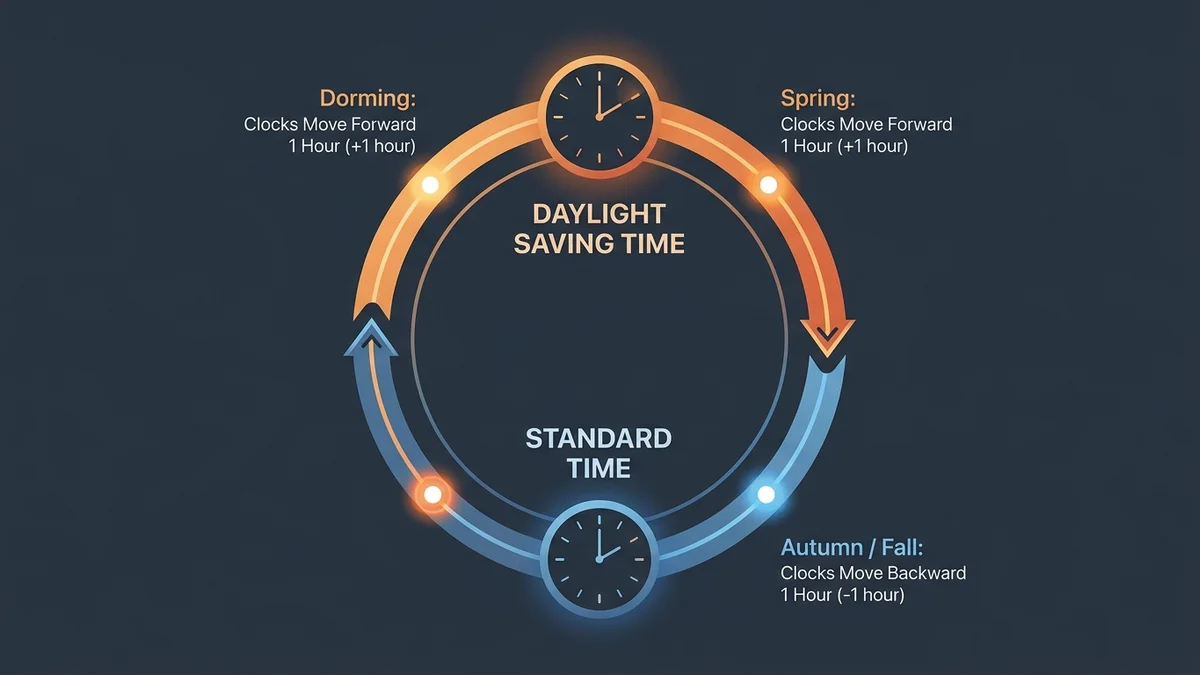
The Spring Transition (“Spring Forward”)
- The Action: Clocks advance forward by 60 minutes (typically at 2:00 AM, skipping immediately to 3:00 AM).
- The Immediate Effect: Society “loses” one hour of clock time that night. An individual sleeping for eight hours gets only seven hours of physical rest unless they go to bed earlier.
- The Seasonal Result: Mornings become darker for several weeks, while evenings immediately gain an extra hour of natural sunlight.
The Autumn Transition (“Fall Back”)
- The Action: Clocks fall back by 60 minutes (typically at 2:00 AM, repeating the hour from 1:00 AM to 2:00 AM).
- The Immediate Effect: Society “gains” an extra hour of sleep on transition night.
- The Seasonal Result: Mornings become brighter, while darkness falls noticeably earlier in the late afternoon.
EST vs. EDT: How Daylight Saving Time Changes Eastern Time
The most common point of confusion among international business professionals, software developers, and travelers occurs within North America’s Eastern Time Zone.
Many people refer to New York, Atlanta, or Toronto time as “EST” all year long. This is technically incorrect.
Eastern Time exists in two distinct seasonal states:
- EST (Eastern Standard Time): The baseline winter standard time, fixed at UTC−5.
- EDT (Eastern Daylight Time): The summer daylight saving time, fixed at UTC−4.
Eastern Time (ET) in Winter (Nov – Mar): EST = UTC−5
Eastern Time (ET) in Summer (Mar – Nov): EDT = UTC−4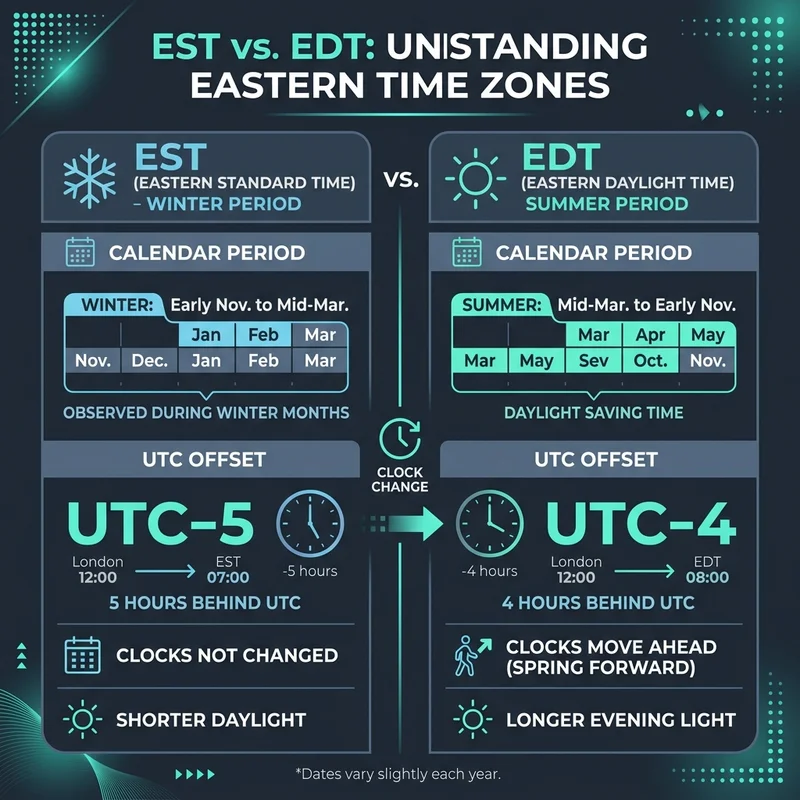
| Attribute | Eastern Standard Time (EST) | Eastern Daylight Time (EDT) |
|---|---|---|
| Full Name | Eastern Standard Time | Eastern Daylight Time |
| UTC Offset | UTC−5 | UTC−4 |
| GMT Difference | 5 hours behind GMT | 4 hours behind GMT |
| Seasonal Window | Early November to Mid-March | Mid-March to Early November |
| DST Status | Standard Time (Off) | Daylight Saving Time (Active) |
| Major Cities | New York, Toronto, Miami, Boston | Same cities during summer |
Calling summer time in New York “EST” introduces an unannounced one-hour mathematical error into international scheduling. When setting up cross-border meetings or writing software documentation, refer to the overarching regional label Eastern Time (ET) or verify whether the date falls during EST or EDT.
For a complete breakdown of North American winter time, see our dedicated guide: What Is EST? Eastern Standard Time Explained.
GMT vs. BST: How Daylight Saving Time Works in the UK
A parallel confusion exists across the Atlantic regarding the United Kingdom’s civil time.
Many people believe the UK remains on Greenwich Mean Time (GMT) 365 days a year. However, British civil clocks step away from GMT for seven months of every year:
- GMT (Greenwich Mean Time): The UK’s baseline standard time at UTC+0, observed during autumn and winter.
- BST (British Summer Time): The UK’s daylight saving time at UTC+1, observed from late March to late October.
UK Local Time in Winter: GMT = UTC+0
UK Local Time in Summer: BST = UTC+1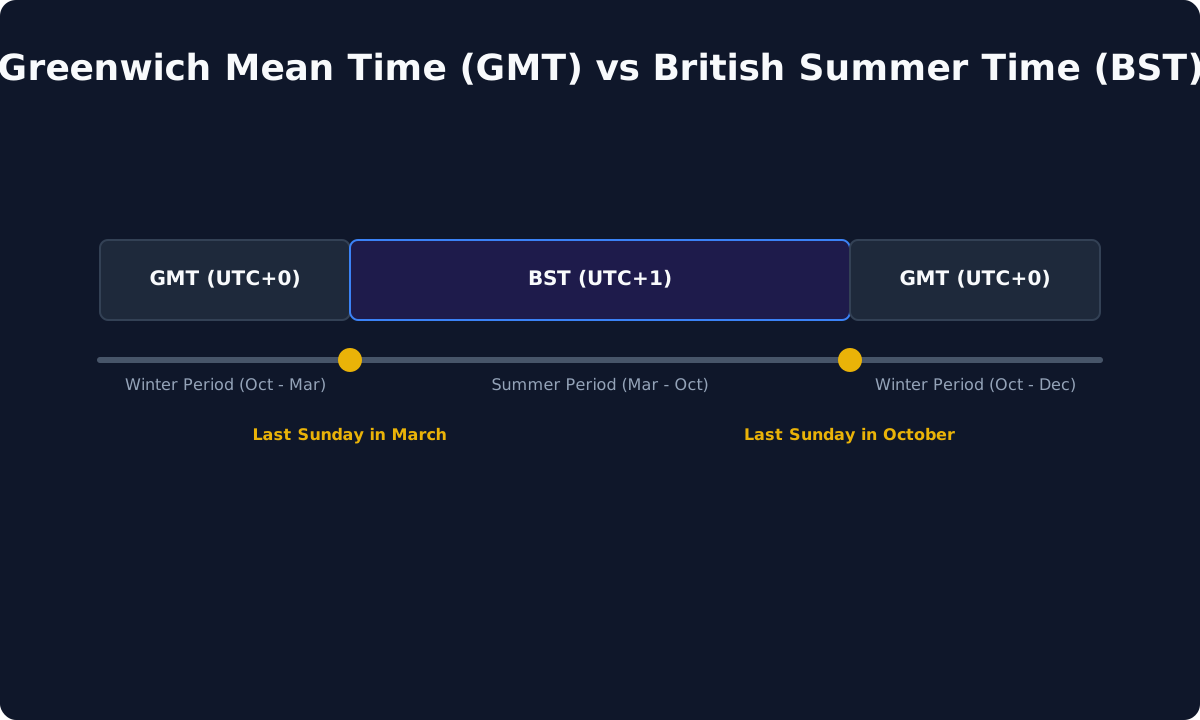
| Attribute | Greenwich Mean Time (GMT) | British Summer Time (BST) |
|---|---|---|
| Full Name | Greenwich Mean Time | British Summer Time |
| UTC Offset | UTC+0 | UTC+1 |
| Seasonal Window | Late October to Late March | Late March to Late October |
| Legal Basis | Interpretation Act 1978 | Summer Time Act 1972 |
| DST Status | Standard Time (Off) | Daylight Saving Time (Active) |
| Relation to London | London winter clock time | London summer clock time |
A Crucial Distinction: GMT Itself Never Changes
It is vital to understand that GMT does not “turn into” BST.
Greenwich Mean Time is an immutable zero-offset baseline (UTC+0). GMT itself never advances or retreats. Rather, the United Kingdom as a sovereign nation legally changes its local civil time by switching from the GMT standard to the BST standard.
When you convert time between London and another city in June or July, you are converting against BST (UTC+1), not GMT. For a historical exploration of the Royal Observatory and its global anchor role, read What Is GMT? Greenwich Mean Time Explained.
Daylight Saving Time in the United States
Daylight Saving Time in the United States is governed at the federal level by the Uniform Time Act of 1966, overseen by the U.S. Department of Transportation (DOT), and amended by the Energy Policy Act of 2005.
Under modern federal law, DST in the U.S. follows a synchronized national timetable:
- Starts: The second Sunday in March at 2:00 AM (clocks move to 3:00 AM).
- Ends: The first Sunday in November at 2:00 AM (clocks move back to 1:00 AM).
This schedule means the United States spends approximately eight months (around 65% of the year) on Daylight Time, and only four months on Standard Time.
Jurisdictions That Opt Out of DST
The Uniform Time Act permits individual states to exempt themselves from Daylight Saving Time by enacting state legislation—provided the entire state remains on Standard Time year-round. (States are not permitted under current federal law to adopt permanent Daylight Saving Time without congressional approval).
Two U.S. states and several territories remain on permanent Standard Time:
- Hawaii: Hawaii opted out in 1967. Situated at tropical latitudes near 21°N, Hawaii has minimal seasonal variation in daylight, making clock adjustments unnecessary.
- Arizona (most of the state): Arizona enacted an exemption in 1968. With extreme summer temperatures regularly exceeding 110°F (43°C) in Phoenix and Tucson, residents prefer earlier sunsets so outdoor temperatures begin cooling down earlier in the evening.
- Exception: The Navajo Nation, which spans northeastern Arizona, parts of New Mexico, and Utah, does observe Daylight Saving Time to maintain consistent time across its multi-state territory. The Hopi Reservation, situated entirely inside the Navajo Nation, does not observe DST.
- U.S. Territories: Puerto Rico, the U.S. Virgin Islands, American Samoa, Guam, and the Northern Mariana Islands do not observe DST, remaining on their respective standard offsets year-round.
Other North American time zones follow the same annual transition rules as Eastern Time, shifting seasonally between standard and daylight modes, such as CST to EST and CDT to EST transitions across the Midwest.
Daylight Saving Time in the United Kingdom
In the United Kingdom, Daylight Saving Time is legally designated as British Summer Time (BST) and governed by the Summer Time Act 1972.
The UK transition schedule is tied to European calendar conventions:
- Starts: The last Sunday in March at 01:00 UTC (clocks move to 02:00 BST).
- Ends: The last Sunday in October at 02:00 BST (clocks move back to 01:00 GMT).
All parts of the United Kingdom—England, Scotland, Wales, and Northern Ireland—as well as the Crown Dependencies (Jersey, Guernsey, Isle of Man) observe BST synchronously.
US vs. UK Daylight Saving Time: The Seasonal Gap
A critical scheduling hazard for international teams is assuming that the United States and the United Kingdom change clocks on the same weekend. They do not.
Because U.S. and UK laws specify different calendar Sundays, an asynchronous transition occurs twice every year:
| Feature | United States (Eastern Time) | United Kingdom |
|---|---|---|
| Standard-Time Label | EST (Eastern Standard Time) | GMT (Greenwich Mean Time) |
| Standard UTC Offset | UTC−5 | UTC+0 |
| Daylight-Time Label | EDT (Eastern Daylight Time) | BST (British Summer Time) |
| Daylight UTC Offset | UTC−4 | UTC+1 |
| Spring Transition Rule | Second Sunday in March | Last Sunday in March |
| Autumn Transition Rule | First Sunday in November | Last Sunday in October |
| Normal Offset Difference | 5 Hours (London is 5 hrs ahead of NY) | 5 Hours (London is 5 hrs ahead of NY) |
| Gap Period Offset Difference | 4 Hours during transition weeks | 4 Hours during transition weeks |
The Two Annual “Gap Weeks”
- The Spring Gap (Mid-to-Late March): The U.S. springs forward on the second Sunday of March, but the UK waits until the last Sunday of March. For approximately two to three weeks, New York is on EDT (UTC−4) while London is still on GMT (UTC+0). The transatlantic time difference temporarily shrinks from 5 hours to 4 hours.
- The Autumn Gap (Late October to Early November): The UK turns its clocks back on the last Sunday of October, while the U.S. waits until the first Sunday of November. For about one week, London is on GMT (UTC+0) while New York is still on EDT (UTC−4). Again, the difference temporarily shrinks to 4 hours.
For confirmed current-year transition dates and a detailed timeline of this seasonal phenomenon, consult our date-specific guide on when clocks change in 2026, or explore our technical overview of Daylight Saving Time explained.
Why Doesn’t Every Country Use DST?
Globally, only about 70 countries—roughly one-third of sovereign nations—observe Daylight Saving Time. The distribution is heavily skewed toward mid-to-high latitudes.
       90°N (North Pole) ── 24-hr light in summer; 24-hr dark in winter (DST irrelevant)
              │
       45°N (Mid-Latitudes: US, UK, Europe) ── Marked seasonal variance (DST widely used)
              │
        0°  (Equator) ── Steady 12-hr daylight year-round (DST completely useless)
              │
       45°S (Mid-Latitudes: Australia, NZ, Chile) ── Opposite seasonal cycle (DST used in parts)
              │
       90°S (South Pole) ── 24-hr light / dark cycles (DST irrelevant)
1. The Equatorial Reality
Near the equator (between 0° and 20° latitude), the length of day and night barely changes throughout the year. Sunrise and sunset vary by only a few minutes from January to July. Nations in Central America, northern South America, Central Africa, and Southeast Asia (such as Colombia, Kenya, Singapore, and Indonesia) have no physical reason to adjust clocks.
2. The Polar Reality
At extreme polar latitudes, summer brings perpetual daylight (the “Midnight Sun”), while winter brings months of twilight or darkness. Shifting clocks by one hour produces no meaningful benefit when the sun does not set at all.
3. Deliberate Policy Abandonment
Several prominent countries previously observed DST but intentionally repealed it:
- Russia: Russia experimented with year-round DST in 2011, but public complaints about dark winter mornings led the government to switch to permanent Standard Time in 2014.
- China: China observed DST from 1986 to 1991 but abandoned it to reduce administrative complexity across its single nationwide time zone (UTC+8).
- India & Japan: Neither country observes DST, relying on consistent year-round standard offsets (IST at UTC+5:30 and JST at UTC+9).
- Brazil: Brazil abolished DST in 2019, concluding that air conditioning usage patterns rendered energy savings negligible.
A Brief History of Daylight Saving Time
The concept of aligning human waking hours with daylight has ancient roots, but its modern mechanical implementation arose during the Industrial Revolution.
Benjamin Franklin (1784): The Satirical Essay
A persistent popular myth claims that American founding father Benjamin Franklin invented Daylight Saving Time. In truth, while serving as U.S. envoy to France in 1784, Franklin published a satirical letter in the Journal de Paris titled “An Economical Project.”
Noticing that Parisians slept past noon and burned candles late into the night, Franklin humorously calculated that firing church bells and cannons at sunrise to wake citizens early would save 64 million pounds of candle wax. Franklin proposed waking up earlier with the sun, not manipulating mechanical clocks.
George Hudson (1895): The Bug-Collecting Entomologist
The true father of modern clock-shift DST was George Vernon Hudson, an English-born entomologist and astronomer living in Wellington, New Zealand. Working as a postal clerk, Hudson wanted more daylight after his shift ended at 5:00 PM to catch insects. In 1895, he presented a paper to the Wellington Philosophical Society proposing a two-hour seasonal clock advance.
William Willett (1907): The British Campaigner
In England, a builder named William Willett independently conceived the idea while riding his horse early on summer mornings, noticing shuttered window blinds across town. In 1907, he published a pamphlet titled The Waste of Daylight, proposing four separate 20-minute clock advances throughout April (an 80-minute total shift). Willett spent the rest of his life and fortune lobbying the British Parliament, but died of influenza in 1915 without seeing his idea enacted.
Wartime Realization (1916)
Facing severe coal shortages during World War I, the German Empire enacted the world’s first national daylight saving law on April 30, 1916, advancing clocks by one hour (Sommerzeit).
Recognizing Germany’s wartime resource efficiency, the United Kingdom adopted British Summer Time just three weeks later on May 21, 1916. The United States enacted its first federal time zones and “Daylight Saving Time” in March 1918 through the Standard Time Act.
Does Daylight Saving Time Actually Save Energy?
The foundational justification for DST has always been energy conservation: extending evening daylight reduces the need for artificial electric lighting. But does modern research support this claim?
The short answer: in modern society, energy savings from DST are negligible or nonexistent.
Why Historical Assumptions No Longer Hold
When DST was codified during the early-to-mid 20th century, electric lighting accounted for a massive portion of domestic and commercial electricity demand. Incandescent bulbs were inefficient and generated high electrical loads.
In the 21st century:
- LED Lighting: Modern solid-state LED lighting consumes up to 85% less energy than old incandescent bulbs. Lighting now represents a much smaller slice of overall household power consumption.
- Air Conditioning (HVAC): When people return home to brighter, hotter summer evenings, air conditioners run longer and harder.
- Morning Heating: Pushing sunrise back by an hour in early spring and late autumn means homes must run heating systems longer during chilly morning hours.
Authoritative Modern Findings
- The Indiana Natural Experiment (2006): Prior to 2006, only 15 of Indiana’s 92 counties observed DST. When state legislation mandated DST statewide, researchers from the University of California, Santa Barbara conducted a landmark study analyzing over 7 million monthly electricity bills. They found that DST increased residential electricity consumption by 1% to 4%, costing Indiana households an additional $9 million annually due to higher afternoon cooling and morning heating costs.
- U.S. Department of Energy (DOE) 2008 Report: A nationwide study mandated by Congress following the 2005 expansion of DST found an overall electricity reduction of roughly 0.03%—a statistically marginal figure easily swayed by weather variations.
- European Commission Meta-Analyses: European studies have consistently concluded that energy savings from Summer Time are minimal, typically ranging between 0.5% and 2.5%, largely cancelled out by increased fuel consumption from evening leisure driving.
Why Daylight Saving Time Is Controversial
What began as an emergency wartime measure has transformed into a contentious public debate. In the U.S. Congress, state legislatures, and the European Parliament, proposals to abolish the biannual clock change are regularly introduced.
┌───────────────────────────────────────┬───────────────────────────────────────┐
│     ARGUMENTS IN FAVOR OF DST         │       ARGUMENTS AGAINST DST           │
├───────────────────────────────────────┼───────────────────────────────────────┤
│ • Brighter evening hours encourage    │ • Circadian rhythm disruption and     │
│   outdoor sports, exercise, and       │   acute sleep loss on spring shift    │
│   family recreation                   │ • Measurable spikes in workplace      │
│ • Retail sales, restaurant dining,    │   accidents and traffic collisions    │
│   and tourism revenues increase       │   in the days following spring shift  │
│ • Pedestrian traffic fatalities drop  │ • Dark morning commutes pose risks to │
│   during evening commuter peak hours  │   schoolchildren and outdoor workers  │
│ • Opportunistic street crime drops    │ • Administrative and software bugs    │
│   during daylight evening hours       │   across global IT infrastructures    │
└───────────────────────────────────────┴───────────────────────────────────────┘
The Health and Sleep Debate
Medical organizations—including the American Academy of Sleep Medicine (AASM) and the Sleep Research Society—officially advocate for eliminating seasonal clock changes in favor of permanent Standard Time.
Their reasoning centers on the biological circadian clock:
- Human internal physiology is calibrated by morning blue sunlight entering the eye, which halts melatonin production and promotes alertness.
- Standard Time aligns clock noon closely with solar noon.
- Daylight Time artificially delays both sunrise and sunset, creating chronic “social jetlag” where individuals must wake up before natural dawn while struggling to fall asleep under late evening light.
Peer-reviewed studies have documented short-term spikes in cardiovascular events (including myocardial infarctions), ischemic strokes, and vehicular crashes during the immediate Monday and Tuesday following the springtime “spring forward” transition.
Common Daylight Saving Time Misconceptions
Because Daylight Saving Time is taught informally, numerous misconceptions persist:
1. “Farmers lobbied for Daylight Saving Time.”
False. Farmers have historically been DST’s fiercest opponents. Agricultural work is dictated by the natural sun and animal biology, not mechanical clocks. Dairy cows produce milk on their own metabolic schedules; shifting civil clocks by an hour meant farmworkers had to harvest crops in dark morning dew and wait longer for morning sun to dry plants before shipping goods to early morning markets.
2. “Daylight Saving Time adds an hour of sunlight.”
False. DST creates zero extra solar energy. It simply relabels 7:00 PM as 8:00 PM on civil clocks.
3. “It is spelled ‘Daylight Savings Time’ with an ‘s’.”
False. The correct legal and grammatical name is Daylight Saving Time (singular). “Saving” functions as a present participle modifying “time,” comparable to “labor-saving device” or “time-saving process.”
4. “Every state and country changes clocks at the same time.”
False. As detailed earlier, the U.S. and UK change clocks on different weekends. Furthermore, Southern Hemisphere countries that observe DST (such as parts of Australia and New Zealand) change clocks in the opposite direction—advancing clocks in October (their spring) and setting them back in April (their autumn).
5. “EST is just another name for Eastern Time.”
False. EST is solely the winter standard phase (UTC−5). During summer, the region is on EDT (UTC−4). Referring to New York time in July as “EST” is mathematically inaccurate.
6. “GMT changes to BST in the summer.”
False. GMT is an unchanging zero-offset astronomical baseline. It never changes. The United Kingdom changes its civil time from GMT to BST.
Does DST Change UTC?
One of the most essential rules in modern digital timekeeping is:
Daylight Saving Time NEVER alters Coordinated Universal Time (UTC).
UTC is an absolute, non-shifting scientific time scale derived from a worldwide ensemble of atomic clocks maintained by the BIPM. It has no physical location, belongs to no country, and ignores all political legislation.
UTC Baseline: Always fixed. Does not shift for summer or winter.

Winter (Standard Time):
  EST = UTC − 5 Hours
  GMT = UTC + 0 Hours

Summer (Daylight Saving Time):
  EDT = UTC − 4 Hours
  BST = UTC + 1 Hour
When New York transitions from EST to EDT in March, UTC does not move. Rather, the relative offset of New York’s local clocks adjusts from UTC−5 to UTC−4.
For a complete technical breakdown of how UTC functions and how it relates to GMT, read our in-depth comparison: UTC vs GMT: What’s the Difference?.
Time Zones, UTC Offsets, and DST Explained
To prevent confusion when scheduling across borders, keep these distinct concepts clear:
┌─────────────────┬─────────────────────────────────────────────────────────────┐
│ Term            │ Definition & Practical Meaning                              │
├─────────────────┼─────────────────────────────────────────────────────────────┤
│ Time Zone       │ A legal geographical boundary that shares uniform civil     │
│                 │ time (e.g., Eastern Time, Central European Time).           │
├─────────────────┼─────────────────────────────────────────────────────────────┤
│ UTC Offset      │ The exact mathematical hours and minutes added to or        │
│                 │ subtracted from UTC (e.g., UTC−5, UTC+0, UTC+5:30).         │
├─────────────────┼─────────────────────────────────────────────────────────────┤
│ Standard Time   │ The permanent baseline offset of a zone when DST is off     │
│                 │ (e.g., EST at UTC−5, GMT at UTC+0).                         │
├─────────────────┼─────────────────────────────────────────────────────────────┤
│ Daylight Time   │ The seasonal advance offset applied during summer           │
│                 │ (e.g., EDT at UTC−4, BST at UTC+1).                         │
├─────────────────┼─────────────────────────────────────────────────────────────┤
│ DST             │ The overall legal practice of shifting between the two.     │
└─────────────────┴─────────────────────────────────────────────────────────────┘
A time zone is a place. A UTC offset is a formula. Standard Time and Daylight Time are the modes that place adopts depending on the calendar date.
Practical Daylight Saving Time Conversion Examples
To see how Daylight Saving Time impacts everyday international time conversions, examine these verified scenarios:
Example 1: Standard Time (Winter Coordination)
Date: January 15 (Standard Time active in both US and UK)
- Universal Reference: 12:00 PM UTC
- London (GMT): 12:00 PM (12:00 UTC + 0 = 12:00 PM GMT)
- New York (EST): 07:00 AM (12:00 UTC − 5 = 7:00 AM EST)
- Offset Difference: London is 5 hours ahead of New York.
Example 2: Daylight Saving Time (Summer Coordination)
Date: July 15 (Daylight Time active in both US and UK)
- Universal Reference: 12:00 PM UTC
- London (BST): 1:00 PM (12:00 UTC + 1 = 1:00 PM BST)
- New York (EDT): 08:00 AM (12:00 UTC − 4 = 8:00 AM EDT)
- Offset Difference: London is still 5 hours ahead of New York (1:00 PM vs. 8:00 AM).
Example 3: The Asynchronous Gap Week
Date: October 28 (UK has returned to GMT, but US is still on EDT)
- Universal Reference: 12:00 PM UTC
- London (GMT): 12:00 PM (12:00 UTC + 0 = 12:00 PM GMT)
- New York (EDT): 08:00 AM (12:00 UTC − 4 = 8:00 AM EDT)
- Offset Difference: London is temporarily only 4 hours ahead of New York. A scheduled 3:00 PM London call will occur at 11:00 AM in New York rather than the usual 10:00 AM.
For instant, date-aware conversions that automatically resolve whether EST, EDT, GMT, or BST is in effect on any given day, use our primary GMT to EST converter or EST to GMT converter.
Frequently Asked Questions
Final Takeaway
Daylight Saving Time was created to make better use of evening daylight in an era powered by coal and gas. Over a century later, it remains one of the world’s most pervasive yet contested civil timekeeping practices.
The key points to remember:
- Standard Time is your region’s baseline civil time; Daylight Time is the seasonal one-hour advance.
- EST (UTC−5) is winter time; EDT (UTC−4) is summer time.
- GMT (UTC+0) is winter time in the UK; BST (UTC+1) is summer time in the UK.
- UTC itself never changes. Only regional offsets change relative to UTC.
- The U.S. and UK change clocks on different dates, creating seasonal 4-hour gap windows twice every year.
By keeping these foundational rules in mind and using date-aware conversion tools, you can navigate global timekeeping with complete confidence.
Frequently Asked Questions (FAQ)
What is Daylight Saving Time?
Daylight Saving Time (DST) is the seasonal practice of advancing civil clocks forward by one hour during warmer months so that natural daylight lasts later into the evening according to clock time, then moving clocks back one hour in autumn to return to Standard Time.
Why do clocks change for Daylight Saving Time?
Clocks change to redistribute human waking hours relative to natural daylight. By advancing clocks by 60 minutes in spring, society shifts an hour of daylight from early morning—when most people are asleep—to the evening, when outdoor recreation, retail activity, and travel peak.
What is the difference between Standard Time and Daylight Time?
Standard Time is the baseline civil time of a geographic zone determined by its legal offset from Coordinated Universal Time (UTC). Daylight Time is the temporary seasonal advance—typically Standard Time plus one hour—applied during spring and summer.
What is the difference between EST and EDT?
EST (Eastern Standard Time) is UTC-5, observed during autumn and winter. EDT (Eastern Daylight Time) is UTC-4, observed during spring and summer. They are the standard and daylight saving phases of the same North American Eastern Time Zone.
What is the difference between GMT and BST?
GMT (Greenwich Mean Time) is UTC+0, the UK's legal standard time during winter. BST (British Summer Time) is UTC+1, the UK's daylight saving time during summer. The UK switches from GMT to BST in late March and returns to GMT in late October.
Does Daylight Saving Time change UTC?
No. Coordinated Universal Time (UTC) is a fixed atomic standard that never shifts for Daylight Saving Time anywhere in the world. Only regional civil times change their relative mathematical offsets to UTC.
Does every country use Daylight Saving Time?
No. Less than 40% of the world's countries currently observe Daylight Saving Time. Most nations near the equator, as well as large parts of Asia and Africa, do not observe DST because daylight hours do not vary drastically across seasons.
Does Daylight Saving Time actually save energy?
Modern scientific studies show mixed results. While DST slightly reduces evening electricity used for incandescent lighting, increased air conditioning usage in warmer regions and morning heating demands often offset those savings, resulting in negligible net energy changes.
Why do some US states not observe Daylight Saving Time?
Under the US Uniform Time Act of 1966, states can legally exempt themselves from DST by state statute. Hawaii chose exemption due to its tropical latitude, while most of Arizona opted out to avoid extending blistering afternoon heat during summer.
Do the US and UK change their clocks on the same date?
No. The US transitions to EDT on the second Sunday of March and returns to EST on the first Sunday of November. The UK transitions to BST on the last Sunday of March and returns to GMT on the last Sunday of October. This creates seasonal gap weeks where the transatlantic time difference shifts.
Does Daylight Saving Time create more sunlight?
No. DST does not alter the total amount of sunlight planet Earth receives. The astronomical duration of daylight is governed strictly by planetary axial tilt and solar orbit. DST merely changes the numbers displayed on our clocks when the sun rises and sets.
Why is it called Daylight Saving Time and not Daylight Savings Time?
'Daylight Saving Time' (singular) is the grammatically and legally accurate term. 'Saving' functions as a participle modifying 'time.' While 'Daylight Savings Time' is widely used in colloquial speech, official statutes in both the US and UK use the singular form.
Sources & References
- Daylight Saving Time Rules and Regulations — National Institute of Standards and Technology (NIST)
- Uniform Time Act Regulatory Overview — U.S. Department of Transportation
- When do the clocks change in the UK? — GOV.UK
- British Summer Time and the Prime Meridian — Royal Museums Greenwich
- Coordinated Universal Time (UTC) Time Scales — Bureau International des Poids et Mesures (BIPM)