
EST vs EDT: What's the Difference? (With Time Chart & Examples)
When coordinating across time zones, few abbreviations cause as much frustration as EST and EDT. You will see calendar invites labeled “3:00 PM EST” in the middle of July, flight schedules marked “EDT” in October, and colleagues arguing over whether New York is four or five hours behind London.
The confusion stems from a simple misunderstanding: people often treat EST and EDT as two independent time zones located in different parts of the world. In reality, they are two seasonal operating modes of the exact same geographic region—the Eastern Time Zone.
Understanding the distinction is not merely an academic exercise. Writing “EST” when a region is observing “EDT” creates an unannounced one-hour discrepancy that can derail global conference calls, lead to missed international flights, and introduce calculation errors into time-sensitive business operations.
EST vs EDT: The Quick Difference
If you need an immediate answer for a meeting or conversion, here is the essential rule:
The Quick Rule:
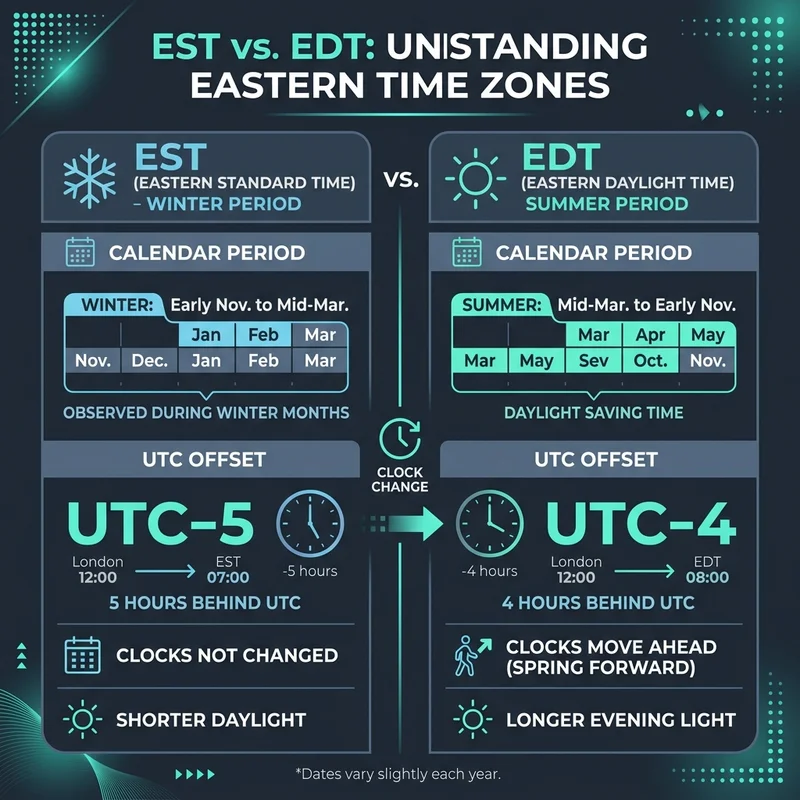
- EST stands for Eastern Standard Time and equals UTC−5 (observed in late autumn and winter).
- EDT stands for Eastern Daylight Time and equals UTC−4 (observed in spring, summer, and early autumn).
- EDT is 1 hour ahead of EST. When clocks switch to EDT, 12:00 PM UTC becomes 8:00 AM local time instead of 7:00 AM.
| Feature | Eastern Standard Time (EST) | Eastern Daylight Time (EDT) |
|---|---|---|
| Full Name | Eastern Standard Time | Eastern Daylight Time |
| UTC Offset | UTC−5 | UTC−4 |
| GMT Difference | GMT minus 5 hours | GMT minus 4 hours |
| Daylight Saving Active? | No (Standard Time) | Yes (Daylight Saving Time) |
| Active Period (US/Canada) | First Sunday in Nov to Second Sunday in Mar | Second Sunday in Mar to First Sunday in Nov |
| Duration per Year | ~4 months (~18 weeks) | ~8 months (~34 weeks) |
| Example Local Time at 12:00 GMT | 7:00 AM | 8:00 AM |
EST and EDT are never observed at the same moment in the same city. A city like New York or Toronto operates on EST for part of the year and on EDT for the remainder.
What Is EST?
EST stands for Eastern Standard Time. It is the baseline civil time observed across the eastern portion of North America when Daylight Saving Time is not in effect.
Mathematically, Eastern Standard Time is fixed at UTC−5 (Coordinated Universal Time minus 5 hours). This means that solar noon in the center of the zone occurs approximately five hours after solar noon at the Prime Meridian in Greenwich, London.
Prime Meridian (UTC / GMT ±0)
         │
         ▼  (Subtract 5 Hours)
Eastern Standard Time (EST = UTC−5)
Geographic Reach of EST
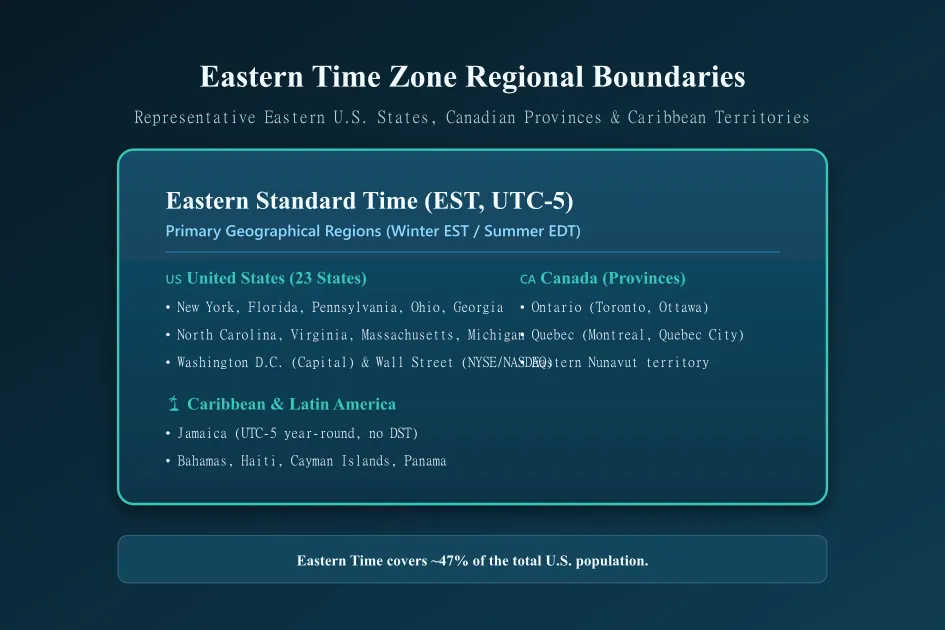
In North America, EST applies during the standard winter window across:
- United States: 17 eastern states (including New York, Florida, Georgia, North Carolina, Pennsylvania, Ohio, Massachusetts, and Virginia) and parts of 6 additional states (such as Indiana, Kentucky, and Tennessee).
- Canada: Major population centers in Ontario, Quebec, and parts of Nunavut.
- The Caribbean & Latin America: Several jurisdictions operate on UTC−5 year-round without ever shifting to daylight time. Countries such as Jamaica, Panama, Colombia, and Peru share the physical offset of EST all twelve months of the year.
Because EST represents winter standard time, local clocks are synchronized with standard astronomical time zones established by the U.S. Department of Transportation under the Standard Time Act.
For a comprehensive breakdown of standard time boundaries and historical origin, see our in-depth guide on what is EST.
What Is EDT?
EDT stands for Eastern Daylight Time. It is the daylight-saving variant of Eastern Time, operating at UTC−4 (Coordinated Universal Time minus 4 hours).
When Eastern Daylight Time is active, clocks are advanced by one hour relative to standard time. Because the clock is advanced, local time is closer to the Prime Meridian:
Prime Meridian (UTC / GMT ±0)
         │
         ▼  (Subtract 4 Hours)
Eastern Daylight Time (EDT = UTC−4)
Why EDT Exists
EDT is enacted under national energy conservation and civil uniformity statutes, such as the Uniform Time Act in the United States. By pushing the clock forward by 60 minutes during the warmer months of the year, sunrise and sunset both occur one hour later by clock time. This transfers an hour of daylight from the early morning (when most people are asleep) to the evening (when commercial, leisure, and domestic activities are peak).
During EDT, the Eastern Time Zone is only 4 hours behind Greenwich Mean Time (GMT) instead of its standard 5-hour lag.
If you want to explore the daylight counterpart in detail, visit our dedicated resource on what is EDT.
EST vs EDT Comparison
The fundamental reality that resolves most scheduling confusion is this:
EST and EDT are not competing geographic time zones. They are two temporal states of the single Eastern Time (ET) Zone.
When journalists, broadcasters, or sports networks say “Eastern Time,” they are referring to whichever offset is currently valid: EST in the winter or EDT in the summer.
                         THE EASTERN TIME ZONE (ET)
                                      │
            ┌─────────────────────────┴─────────────────────────┐
            ▼                                                   ▼
   Standard Phase: EST                                 Daylight Phase: EDT
   Offset: UTC−5 (GMT−5)                               Offset: UTC−4 (GMT−4)
   Months: November to March                           Months: March to November
   Clock: "Standard Clock"                             Clock: 1 Hour Ahead
Key Differences at a Glance
- The Offset Shift: EST is five hours behind zero meridian time; EDT is four hours behind zero meridian time.
- The Duration Imbalance: Although often called “standard” time, EST is only in effect for approximately 4 months (18 weeks) of the year in the United States and Canada. EDT occupies the remaining 8 months (34 weeks). Consequently, the Eastern Time Zone spends twice as much of the year on EDT as it does on EST.
- The Nomenclature Trap: Labeling a summer meeting as “EST” is technically an error. If an event in July is listed as 2:00 PM EST, an automated system programmed strictly to UTC standards will translate that to 7:00 PM UTC (2:00 PM + 5 hours), whereas the host in New York actually intended 6:00 PM UTC (2:00 PM EDT + 4 hours). That mistake results in a 60-minute scheduling clash.
How Daylight Saving Time Changes Eastern Time
The mechanism governing the transition between EST and EDT is Daylight Saving Time (DST). To understand why your clock changes, it helps to review the regulatory rules, the transition moments, and the arithmetic involved.
For a broader conceptual explanation of how seasonal clock shifts function globally, review our guide to Daylight Saving Time explained.
The North American DST Schedule
Under the U.S. Energy Policy Act of 2005 (codified under 15 U.S.C. § 260a) and harmonized across Canadian provincial legislation:
- Spring Forward (EST → EDT): On the second Sunday in March at 2:00 AM local time, clocks jump forward by one hour to 3:00 AM EDT. The 2:00 AM hour is skipped entirely. The local offset changes from UTC−5 to UTC−4.
- Fall Back (EDT → EST): On the first Sunday in November at 2:00 AM local time, clocks fall back by one hour to 1:00 AM EST. The hour between 1:00 AM and 2:00 AM is repeated. The local offset reverts from UTC−4 to UTC−5.
MARCH: Second Sunday at 2:00 AM
[ 1:59 AM EST ] ──> [ 3:00 AM EDT ]  (1 Hour Lost; Spring Forward)

NOVEMBER: First Sunday at 2:00 AM
[ 1:59 AM EDT ] ──> [ 1:00 AM EST ]  (1 Hour Gained; Fall Back)
Transition Calendar Through 2028
The exact calendar dates for the EST/EDT transitions change annually because they are pegged to specific Sundays rather than calendar dates:
| Year | Daylight Saving Begins (Clocks Turn Forward to EDT) | Daylight Saving Ends (Clocks Turn Back to EST) |
|---|---|---|
| 2025 | Sunday, March 9, 2025 (2:00 AM → 3:00 AM) | Sunday, November 2, 2025 (2:00 AM → 1:00 AM) |
| 2026 | Sunday, March 8, 2026 (2:00 AM → 3:00 AM) | Sunday, November 1, 2026 (2:00 AM → 1:00 AM) |
| 2027 | Sunday, March 14, 2027 (2:00 AM → 3:00 AM) | Sunday, November 7, 2027 (2:00 AM → 1:00 AM) |
| 2028 | Sunday, March 12, 2028 (2:00 AM → 3:00 AM) | Sunday, November 5, 2028 (2:00 AM → 1:00 AM) |
Reference: Official time dissemination standards maintained by the National Institute of Standards and Technology (NIST).
Exceptions to the Rule
Not every region within the geographic boundaries of UTC−5 follows this transition cycle:
- The Caribbean & Central America: Nations like Jamaica, the Cayman Islands, the Bahamas (partially), and Panama operate on UTC−5 year-round. They remain permanently on standard offset time and never switch to EDT.
- The State of Quintana Roo (Mexico): Home to Cancún and the Riviera Maya, Quintana Roo adopted UTC−5 (Southeastern Zone) in 2015 to synchronize tourism with the US East Coast, but it opted out of daylight saving time. It stays on UTC−5 all year.
- Southampton Island (Nunavut, Canada): Coral Harbour in Nunavut maintains UTC−5 year-round and does not observe daylight saving.
- Indiana’s Historical Complexity: Historically, Indiana was famous for fractured time zones, with some counties observing EST without DST and others switching. Since 2006, however, the entire state of Indiana observes Daylight Saving Time uniformly, with the majority in Eastern Time (EST/EDT) and twelve counties in Central Time (CST/CDT).
Eastern Time Annual Cycle and Timeline
To visualize how the year unfolds for someone living or doing business in the Eastern Time Zone, consider this linear progression through the four seasons:
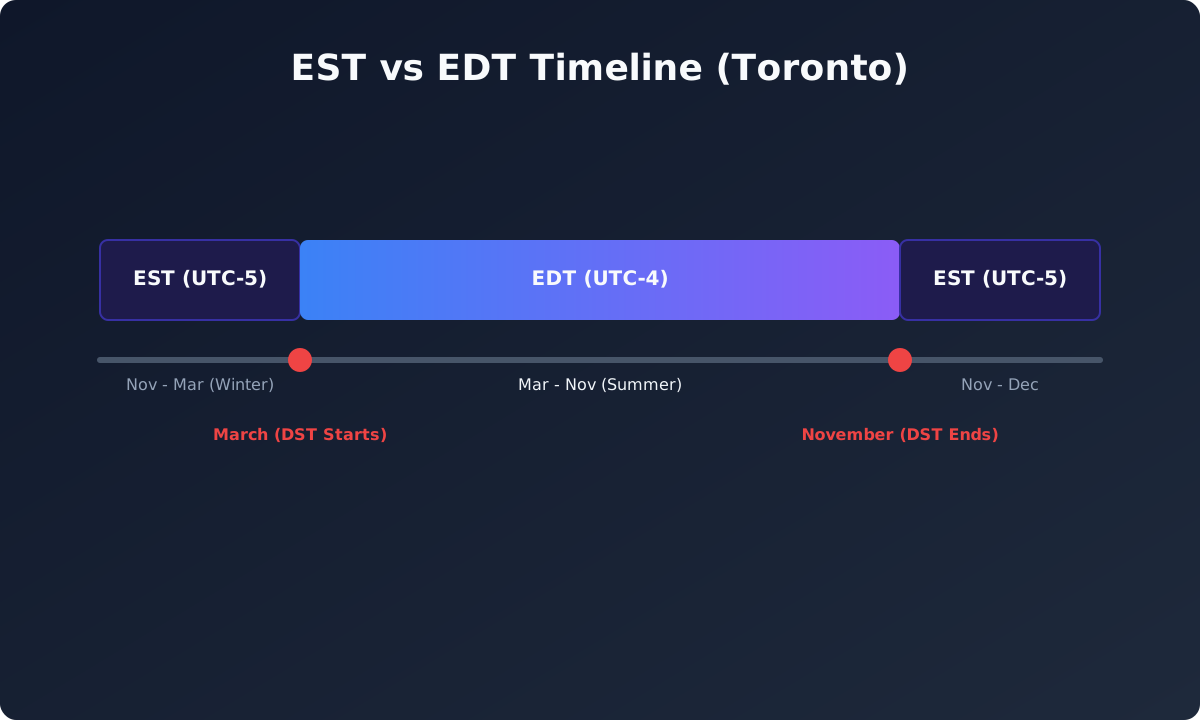
┌─────────────────────────────────────────────────────────────────────────────┐
│                       ANNUAL EASTERN TIME CYCLE                             │
├───────────────┬─────────────────────────────────────────────┬───────────────┤
│    WINTER     │            SPRING & SUMMER & AUTUMN         │    WINTER     │
│   Jan - Mar   │                   Mar - Nov                 │   Nov - Dec   │
├───────────────┼─────────────────────────────────────────────┼───────────────┤
│      EST      │                      EDT                    │      EST      │
│     UTC−5     │                     UTC−4                   │     UTC−5     │
│  (18 Weeks)   │                  (34 Weeks)                 │  (Continued)  │
└───────────────┴─────────────────────────────────────────────┴───────────────┘
                ▲                                             ▲
           2nd Sunday                                    1st Sunday
            in March                                     in November
"Spring Forward" "Fall Back"- January to Mid-March (Winter Standard): The region observes EST (UTC−5). Days are shorter, solar noon is earlier, and London is 5 hours ahead.
- Mid-March (The Spring Transition): At 2:00 AM on the second Sunday of March, the clock jumps to 3:00 AM. EDT (UTC−4) begins.
- Mid-March to Early November (Daylight Saving): The region observes EDT (UTC−4). Business hours overlap an hour earlier with Europe. London is now only 4 hours ahead (subject to Europe’s own DST transitions).
- Early November (The Autumn Transition): At 2:00 AM on the first Sunday of November, the clock falls back to 1:00 AM. EST (UTC−5) resumes.
- November to December (Winter Standard): The region closes out the year on EST (UTC−5).
If you ever need to calculate time differences between standard and daylight periods directly, try our dedicated EST vs EDT conversion tool.
GMT to EST vs GMT to EDT
Because this website specializes in transatlantic and international time synchronization, understanding how Greenwich Mean Time interacts with EST versus EDT is essential.
Greenwich Mean Time (GMT) is an absolute astronomical time standard based at zero degrees longitude. Unlike Eastern Time, GMT never observes daylight saving time. Its offset is always UTC±0.
Therefore, when Eastern Time alters its clock, the mathematical difference between London’s winter time and Eastern Time changes:
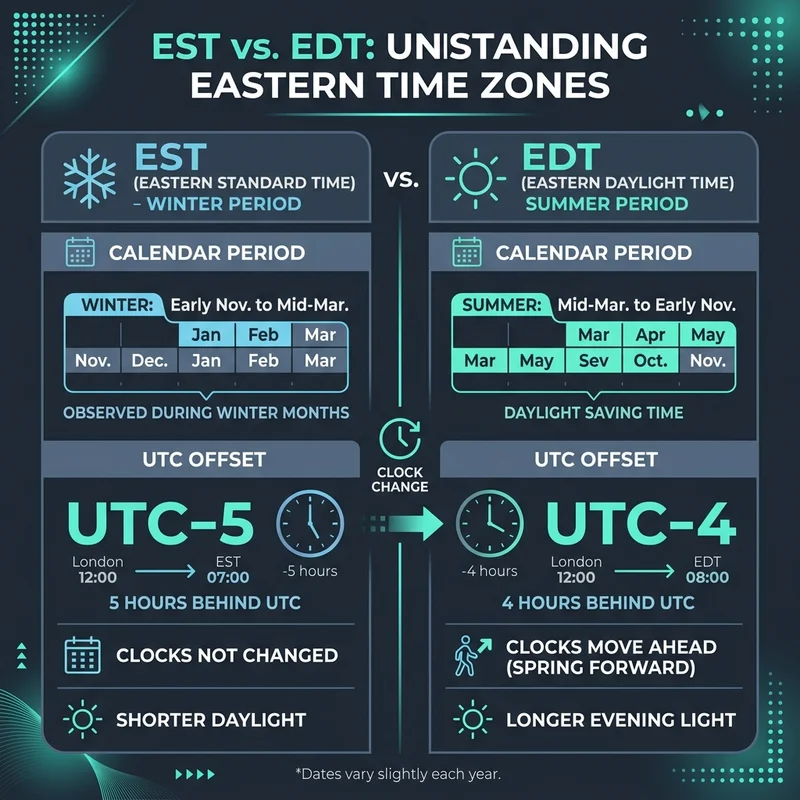
- GMT to EST: GMT is 5 hours ahead of EST.
- GMT to EDT: GMT is 4 hours ahead of EDT.
During EST (Winter):
12:00 GMT  ──(minus 5 hours)──>  07:00 AM EST

During EDT (Summer):
12:00 GMT  ──(minus 4 hours)──>  08:00 AM EDT
Side-by-Side Conversion Matrix
To see how standard clock hours map across both phases of Eastern Time, consult this comparison table:
| GMT (UTC±0) | EST (Winter Phase, UTC−5) | EDT (Summer Phase, UTC−4) | Impact on Working Hours |
|---|---|---|---|
| 00:00 GMT | 7:00 PM (previous day) | 8:00 PM (previous day) | Evening leisure |
| 04:00 GMT | 11:00 PM (previous day) | 12:00 AM (Midnight) | Overnight |
| 08:00 GMT | 3:00 AM | 4:00 AM | Early dawn |
| 12:00 GMT | 7:00 AM | 8:00 AM | Beginning of East Coast workday |
| 13:00 GMT | 8:00 AM | 9:00 AM | NYC market prep / London afternoon |
| 14:30 GMT | 9:30 AM | 10:30 AM | Wall Street opening bell (Winter) |
| 17:00 GMT | 12:00 PM (Noon) | 1:00 PM | Lunchtime East Coast / London end of day |
| 21:00 GMT | 4:00 PM | 5:00 PM | Wall Street closing bell (Winter) |
| 23:00 GMT | 6:00 PM | 7:00 PM | Evening wrap-up |
Notice the consequence: at 12:00 GMT, an office worker in New York starting work at 8:00 AM is already at their desk during EDT, but during EST, 8:00 AM does not arrive until 13:00 GMT.
For real-time automated calculations that account for current calendar dates without manual math, use our interactive GMT to EST Converter or reverse conversions via EST to GMT.
UTC vs GMT vs EST vs EDT
People frequently encounter four time acronyms in international communications: UTC, GMT, EST, and EDT. While they are closely related, they represent two different types of concepts: reference standards versus civil regional offsets.
┌─────────────────────────────────────────────────────────────────────────────┐
│                         GLOBAL TIME REFERENCE SCALES                        │
├─────────────────────────────────────────────────────────────────────────────┤
│  UTC (Coordinated Universal Time) : Scientific atomic standard (UTC±0)       │
│  GMT (Greenwich Mean Time)        : Historical solar reference (UTC±0)       │
├─────────────────────────────────────────────────────────────────────────────┤
│                         REGIONAL CIVIL TIME OFFSETS                         │
├─────────────────────────────────────────────────────────────────────────────┤
│  EST (Eastern Standard Time)      : UTC−5 (Standard winter offset)          │
│  EDT (Eastern Daylight Time)      : UTC−4 (Summer daylight saving offset)    │
│  ET  (Eastern Time)               : Umbrella term for EST or EDT            │
└─────────────────────────────────────────────────────────────────────────────┘
Reference Standards: UTC vs GMT
- UTC (Coordinated Universal Time): The ultra-precise global time standard maintained by international atomic clocks (BIPM). It is the baseline from which all global civil time zones are measured. UTC has no daylight saving shifts.
- GMT (Greenwich Mean Time): Originally the mean solar time measured at the Royal Observatory in Greenwich, London. Today, in civil time usage, GMT shares the exact same time as UTC (UTC±0). However, the United Kingdom switches from GMT to BST (British Summer Time, UTC+1) in the summer.
Regional Offsets: EST vs EDT
- EST (UTC−5): A specific regional time offset that is five hours behind UTC.
- EDT (UTC−4): A specific regional time offset that is four hours behind UTC.
- ET (Eastern Time): The physical zone encompassing both EST and EDT.
For an in-depth analysis of how Greenwich Mean Time interacts with the winter standard offset, read our article on understanding the difference between GMT and EST.
Comprehensive EST vs EDT Comparison Table
This quick reference summarizes the technical, geographic, and operational dimensions of Eastern Time:
| Dimension | Eastern Standard Time (EST) | Eastern Daylight Time (EDT) | Eastern Time (ET) |
|---|---|---|---|
| Official Name | Eastern Standard Time | Eastern Daylight Time | North American Eastern Time |
| Abbreviation | EST | EDT | ET |
| UTC Offset | UTC−5:00 | UTC−4:00 | Variable (UTC−5 or UTC−4) |
| Offset in Seconds | −18,000 seconds | −14,400 seconds | −18,000 or −14,400 |
| Status | Standard Winter Time | Daylight Saving Summer Time | Comprehensive Zone Name |
| Annual Duration | ~18 weeks | ~34 weeks | 52 weeks (Year-Round) |
| Starts | First Sunday in November | Second Sunday in March | Permanent |
| Ends | Second Sunday in March | First Sunday in November | Permanent |
| Representative Cities | New York, Toronto, Miami, Atlanta | New York, Toronto, Miami, Atlanta | All Eastern Zone Cities |
| Non-DST Exceptions | Jamaica, Panama, Cancún (all year) | None (EDT is seasonal only) | Same |
| Difference from GMT | 5 hours behind | 4 hours behind | 4 or 5 hours behind |
| Military Time Designator | R (“Romeo” Time) | Q (“Quebec” Time) | Context dependent |
| IANA Time Zone Identifier | America/New_York | America/New_York | America/New_York, America/Toronto |
Real-World EST vs EDT Scheduling Examples
To appreciate how these differences function in practice, let us walk through four realistic scheduling scenarios.
Example 1: Scheduling an International Meeting in January (EST)
A team in London wants to hold an all-hands call with colleagues in New York on January 15:
- Date Check: January is in the middle of standard time. New York is observing EST (UTC−5). London is observing GMT (UTC±0).
- Time Difference: Exactly 5 hours.
- Calculation: If the London host schedules the meeting for 3:00 PM GMT: $$\text{Local Time in New York} = 15:00 - 5\text{ hours} = 10:00\text{ AM EST}$$
- Result: The New York team joins at 10:00 AM EST.
Example 2: Scheduling an International Meeting in June (EDT)
The same team schedules an all-hands call on June 15:
- Date Check: June is in the middle of daylight saving time. New York is observing EDT (UTC−4). London is observing BST (British Summer Time, UTC+1).
- Time Difference: $$\text{Difference} = (\text{UTC}+1) - (\text{UTC}-4) = 5\text{ hours}$$ (Note: Because both the UK and US have shifted their clocks by one hour, the relative difference between London and New York remains 5 hours, but the individual offsets relative to UTC have both advanced).
- Calculation relative to GMT (UTC±0): If someone sets a meeting for 3:00 PM GMT (15:00 UTC): $$\text{Local Time in New York} = 15:00 - 4\text{ hours} = 11:00\text{ AM EDT}$$
- Result: At 3:00 PM GMT, New York is at 11:00 AM EDT, not 10:00 AM! If you mistakenly subtracted 5 hours, you would expect the meeting at 10:00 AM and show up an hour early.
Example 3: The Stock Market Opening Bell
Financial institutions worldwide structure automated algorithmic trading around the opening bell of the New York Stock Exchange (NYSE) and NASDAQ:
- The opening bell is fixed at 9:30 AM Eastern Time every trading day.
- During EST (Winter): $$9:30\text{ AM EST} + 5\text{ hours} = 14:30\text{ GMT (2:30 PM GMT)}$$
- During EDT (Summer): $$9:30\text{ AM EDT} + 4\text{ hours} = 13:30\text{ GMT (1:30 PM GMT)}$$
- Trading Impact: European traders observing UTC must adjust their trading schedules by one hour depending on whether Wall Street is on EST or EDT.
Example 4: The 2-Week European/North American Discrepancy
One of the most dangerous scheduling traps of the year occurs in late March and late October:
- The United States and Canada switch to EDT on the second Sunday of March.
- The United Kingdom and the European Union do not switch to summer time until the last Sunday of March.
- For approximately two to three weeks in March, the US has moved its clock forward, but the UK has not. During this brief window, London (GMT) is only 4 hours ahead of New York (EDT) instead of the usual 5 hours!
- A parallel synchronization window happens in the autumn when Europe returns to standard time on the last Sunday in October, while North America remains on EDT until the first Sunday in November.
Common EST vs EDT Confusions
1. “Is EST the same as Eastern Time?”
No. Eastern Time (ET) is the overarching regional designation. EST is only the winter half of that designation. Using “EST” when referring to a summer date is technically incorrect and causes software integration errors.
2. “Is EDT one hour ahead of EST?”
Yes. EDT (UTC−4) is mathematically 1 hour ahead of EST (UTC−5). When New York shifts from EST to EDT in the spring, the local clock jumps from 1:59 AM to 3:00 AM, skipping an hour.
3. “Does EDT mean a different geographical location?”
No. EDT and EST cover the same North American territory. Manhattan, Boston, Washington D.C., Toronto, and Montreal all operate on EST in January and on EDT in July.
4. “Is EST always UTC−5?”
Yes. By statutory definition, Eastern Standard Time is always UTC−5. It never shifts. When clocks move forward in the spring, the location leaves EST and enters EDT.
5. “Is EDT always UTC−4?”
Yes. Eastern Daylight Time is perpetually UTC−4. It never changes its offset. When clocks move back in the fall, the location leaves EDT and returns to EST.
6. “Why does Eastern Time change?”
Eastern Time changes because the federal and provincial governments of the United States and Canada mandate Daylight Saving Time to maximize evening daylight hours during the spring, summer, and autumn months.
7. “Why does my time conversion result change during the year?”
If you convert a fixed UTC or GMT timestamp to Eastern Time, the result varies by one hour depending on the month. A 12:00 UTC event is 7:00 AM in January (EST), but 8:00 AM in July (EDT).
8. “Does GMT to EST always mean subtracting 5 hours?”
Yes. The mathematical operation $\text{GMT} - 5 = \text{EST}$ is always true. However, if you are converting GMT to current local time in New York during July, applying $\text{GMT} - 5$ produces the wrong local time because New York is observing EDT ($\text{GMT} - 4$).
9. “Does GMT to EDT always mean subtracting 4 hours?”
Yes. Subtracting 4 hours from GMT always yields EDT. But you should only apply this calculation when converting for dates during the daylight saving window (March to November).
How to Know Which Eastern Time Offset to Use
When organizing an event, drafting a press release, or configuring a remote calendar invite, follow this 3-step decision framework:
                          DECISION FRAMEWORK
                                  │
                                  ▼
                     What is the target date?
                                  │
         ┌────────────────────────┴────────────────────────┐
         ▼                                                 ▼
   March to November                               November to March
 (2nd Sun Mar - 1st Sun Nov)                     (1st Sun Nov - 2nd Sun Mar)
         │                                                 │
         ▼                                                 ▼
 Does the location observe DST?                  Does the location observe DST?
         │                                                 │
    ┌────┴────┐                                            │
   YES        NO                                           ▼
    │          │                                      Use EST (UTC−5)
    ▼          ▼
 Use EDT    Use EST
(UTC−4)    (UTC−5)
Best Practices for Global Communicators
- Use “ET” for General Scheduling: When announcing webinar dates, podcast recordings, or customer service hours, use ET (Eastern Time) rather than EST or EDT. This communicates that the schedule follows prevailing local time across New York and Toronto without risking a seasonal mismatch.
- Include the UTC Offset: When communicating with international participants outside North America, write the exact offset:
“Meeting scheduled for 2:00 PM Eastern Time (UTC−4).” - Rely on IANA Timezone Identifiers in Code: In software, JavaScript (
Intl.DateTimeFormat), Python (zoneinfo), or calendar applications, never hardcode"EST"or"EDT". Always use location-based IANA strings such asAmerica/New_York,America/Toronto, orAmerica/Jamaica. The database will automatically compute the correct UTC−5 or UTC−4 offset for any past, present, or future date.
If your team coordinates with colleagues in other North American zones, check our comparative guides for Central to Eastern conversions and Pacific to Eastern conversions.
Practical Guidance for International Remote Teams and Schedulers
For distributed remote companies operating across time zones, the EST vs EDT divide is a common source of missed meetings and operational friction. Here are proven workplace strategies:
- Automate Calendar Invites via ICS Links: Never rely on team members doing mental math. Distribute calendar invitations using
.icsfiles or direct Google Calendar / Outlook links. Modern calendar software translatesAmerica/New_Yorkto the recipient’s local time zone automatically. - Audit Recurring Meeting Series in March and November: Semi-annual clock transitions often shift recurring daily standups for offshore engineering teams in India, the Philippines, or Europe. If a recurring meeting is pegged to 9:00 AM Eastern Time, its local time in London or Bangalore will shift by one hour twice a year.
- Specify Regional Variations: When working with Latin American contractors in Panama or Colombia, remember that although they share the winter offset with New York (UTC−5), they do not move to EDT in March. During the North American summer, New York is one hour ahead of Bogotá and Panama City.
Frequently Asked Questions
What is the difference between EST and EDT?
EST (Eastern Standard Time) is UTC−5, observed during autumn and winter. EDT (Eastern Daylight Time) is UTC−4, observed during spring and summer when Daylight Saving Time is active. They represent two seasonal phases of the same geographic Eastern Time Zone.
Is EST UTC−5?
Yes. Eastern Standard Time is fixed at Coordinated Universal Time minus 5 hours (UTC−5) and operates 5 hours behind Greenwich Mean Time (GMT).
Is EDT UTC−4?
Yes. Eastern Daylight Time is fixed at Coordinated Universal Time minus 4 hours (UTC−4) and operates 4 hours behind Greenwich Mean Time (GMT).
Is EDT one hour ahead of EST?
Yes. EDT is exactly one hour ahead of EST. When a region shifts from EST to EDT in March, local clocks jump forward by 60 minutes (2:00 AM becomes 3:00 AM).
When does Eastern Time use EST?
In the United States and Canada, Eastern Time observes EST from the first Sunday in November until the second Sunday in March.
When does Eastern Time use EDT?
Eastern Time observes EDT from the second Sunday in March until the first Sunday in November, covering approximately eight months of the year.
Is EST the same as Eastern Time?
No. Eastern Time (ET) is the overall regional time zone, whereas EST is only the standard-time variant (UTC−5). Calling summer Eastern Time “EST” is technically incorrect because the region observes EDT (UTC−4) during those months.
Does GMT to EST change during Daylight Saving Time?
The mathematical definition of EST (UTC−5) never changes, but the operational clock in New York or Toronto shifts to EDT (UTC−4). As a result, the practical time difference between GMT and Eastern Time shrinks from 5 hours in winter to 4 hours in summer.
How do I know whether a time is EST or EDT?
Check the calendar date. If the date falls between the second Sunday of March and the first Sunday of November, most North American Eastern locations observe EDT. Otherwise, they observe EST. Locations that do not observe DST, such as Jamaica and Panama, remain on UTC−5 year-round.
Why does Eastern Time change by one hour?
Eastern Time changes by one hour under federal Daylight Saving Time statutes to shift daylight from early morning hours to late afternoon and evening during the warmer months.
Final Takeaway
Remembering the difference between EST and EDT comes down to three fundamental facts:
- EST is UTC−5 (observed during winter).
- EDT is UTC−4 (observed from March to November during Daylight Saving Time).
- They represent the same location at different times of the year.
Whenever you are unsure which abbreviation applies, use the inclusive term Eastern Time (ET) or verify the current date using an automated, date-aware conversion utility like our GMT to EST Converter. By specifying the right offset, you eliminate confusion, protect your calendar, and ensure smooth scheduling with colleagues around the globe.
Frequently Asked Questions (FAQ)
What is the difference between EST and EDT?
EST (Eastern Standard Time) is UTC-5, observed during autumn and winter. EDT (Eastern Daylight Time) is UTC-4, observed during spring and summer when Daylight Saving Time is active. They represent two seasonal phases of the same geographic Eastern Time Zone.
Is EST UTC−5?
Yes. Eastern Standard Time is fixed at Coordinated Universal Time minus 5 hours (UTC-5) and operates 5 hours behind Greenwich Mean Time (GMT).
Is EDT UTC−4?
Yes. Eastern Daylight Time is fixed at Coordinated Universal Time minus 4 hours (UTC-4) and operates 4 hours behind Greenwich Mean Time (GMT).
Is EDT one hour ahead of EST?
Yes. EDT is exactly one hour ahead of EST. When a region shifts from EST to EDT in March, local clocks jump forward by 60 minutes (2:00 AM becomes 3:00 AM).
When does Eastern Time use EST?
In the United States and Canada, Eastern Time observes EST from the first Sunday in November until the second Sunday in March.
When does Eastern Time use EDT?
Eastern Time observes EDT from the second Sunday in March until the first Sunday in November, covering approximately eight months of the year.
Is EST the same as Eastern Time?
No. Eastern Time (ET) is the overall regional time zone, whereas EST is only the standard-time variant (UTC-5). Calling summer Eastern Time 'EST' is technically incorrect because the region observes EDT (UTC-4) during those months.
Does GMT to EST change during Daylight Saving Time?
The mathematical definition of EST (UTC-5) never changes, but the operational clock in New York or Toronto shifts to EDT (UTC-4). As a result, the practical time difference between GMT and Eastern Time shrinks from 5 hours in winter to 4 hours in summer.
How do I know whether a time is EST or EDT?
Check the calendar date. If the date falls between the second Sunday of March and the first Sunday of November, most North American Eastern locations observe EDT. Otherwise, they observe EST. Locations that do not observe DST, such as Jamaica and Panama, remain on UTC-5 year-round.
Why does Eastern Time change by one hour?
Eastern Time changes by one hour under federal Daylight Saving Time statutes to shift daylight from early morning hours to late afternoon and evening during the warmer months.
Sources & References
- Uniform Time Act and Time Zone Regulatory Overview — U.S. Department of Transportation
- Daylight Saving Time Rules and Explanations — National Institute of Standards and Technology (NIST)
- Coordinated Universal Time (UTC) Reference Scales — Bureau International des Poids et Mesures (BIPM)
- IANA Time Zone Database (America/New_York) — Internet Assigned Numbers Authority (IANA)