
CST vs EST: What's the Difference?
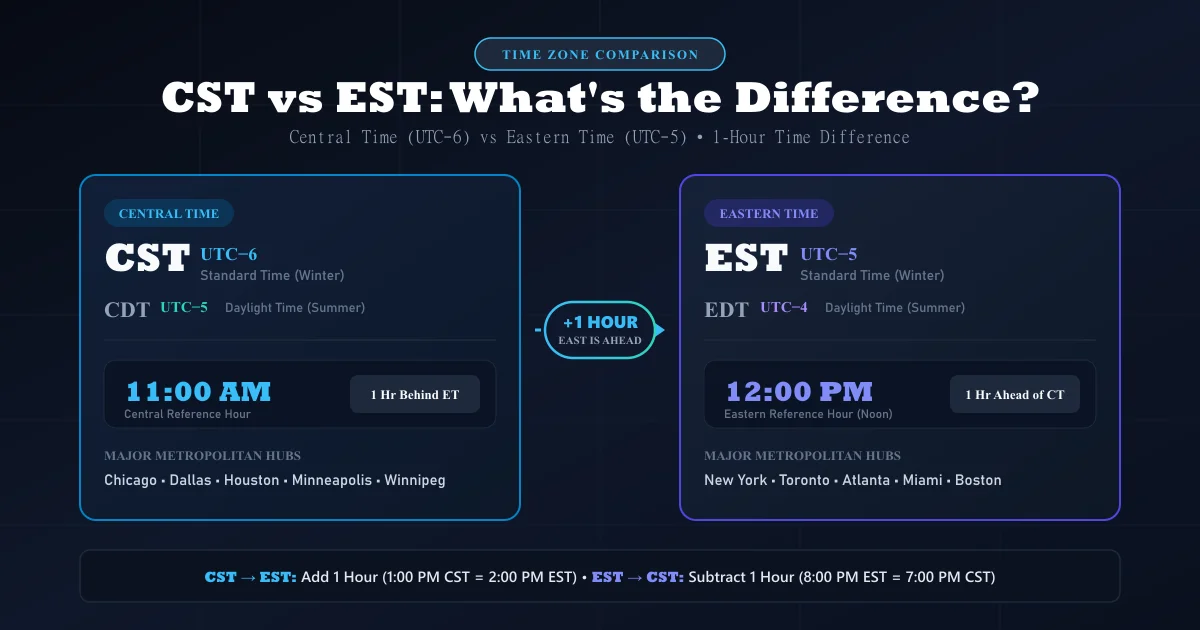
If you need a quick answer for a meeting or flight, here is the essential rule:
CST is one hour behind EST. CST (Central Standard Time) operates at UTC−6, while EST (Eastern Standard Time) operates at UTC−5. When it is 12:00 PM in Chicago (CST), it is 1:00 PM in New York (EST).
To convert from Central Standard Time to Eastern Standard Time, add one hour. To convert from Eastern Standard Time back to Central Standard Time, subtract one hour.
The calculation becomes slightly more nuanced when Daylight Saving Time (DST) begins. During warmer months, most North American jurisdictions shift from standard time to daylight time: Central Standard Time becomes Central Daylight Time (CDT, UTC−5), and Eastern Standard Time becomes Eastern Daylight Time (EDT, UTC−4). Because both regions advance their clocks simultaneously, the operational time difference between the Central and Eastern corridors remains one hour year-round.
However, it is crucial not to confuse the abbreviations CST vs EST with the regional concepts of Central Time vs Eastern Time. CST and EST strictly represent standard winter offsets, whereas Central Time (CT) and Eastern Time (ET) encompass both standard and daylight modes.
What Is CST?
CST stands for Central Standard Time. It is the standard civil time observed in the Central Time Zone of North America during late autumn and winter when Daylight Saving Time is not in effect.
Coordinated Universal Time (UTC ±0)
                │
                ▼  (Subtract 6 Hours)
Central Standard Time (CST = UTC−6)
Geographically, CST is centered along the 90th meridian west of Greenwich. In this longitudinal belt, mean solar time aligns closely with civil clocks: solar noon (the moment the sun reaches its zenith) occurs approximately six hours after solar noon at the Prime Meridian in London.
Key Characteristics of CST
- Standard UTC Offset: UTC−6 (6 hours behind Greenwich Mean Time / UTC).
- Daylight Variant: CDT (Central Daylight Time, UTC−5), observed from the second Sunday of March to the first Sunday of November.
- Season-Neutral Label: Central Time (CT).
- Major US Metropolitan Areas: Chicago, Dallas-Fort Worth, Houston, Austin, San Antonio, Minneapolis-St. Paul, Milwaukee, Kansas City, St. Louis, New Orleans, Memphis, and Nashville.
- Canadian Coverage: Manitoba, parts of western Ontario, and Nunavut (Kivalliq region).
- Latin American Coverage: Several Central American nations (including Guatemala, Belize, Costa Rica, El Salvador, Honduras, and Nicaragua) observe UTC−6 year-round without daylight saving adjustments.
It is important to avoid assuming that every location in the Central Time Zone observes identical seasonal rules. For example, most of the Canadian province of Saskatchewan observes Central Standard Time (UTC−6) permanently without ever advancing to CDT. Similarly, the vast majority of Mexico abolished seasonal daylight saving time in October 2022 and remains on permanent standard time.
What Is EST?
EST stands for Eastern Standard Time. It is the standard civil time observed across the eastern seaboard of North America during late autumn and winter.
Coordinated Universal Time (UTC ±0)
                │
                ▼  (Subtract 5 Hours)
Eastern Standard Time (EST = UTC−5)
EST is anchored to the 75th meridian west, which passes near Philadelphia and Washington, D.C. It represents the official baseline for the economic and political centers of North America, including Wall Street equity markets and federal government operations.
Key Characteristics of EST
- Standard UTC Offset: UTC−5 (5 hours behind UTC/GMT).
- Daylight Variant: EDT (Eastern Daylight Time, UTC−4), observed during spring, summer, and early autumn. Read our complete guide to the difference between EST and EDT for transition mechanics.
- Season-Neutral Label: Eastern Time (ET).
- Major US Metropolitan Areas: New York City, Boston, Philadelphia, Washington, D.C., Atlanta, Miami, Charlotte, Orlando, Detroit, Pittsburgh, and Cleveland.
- Canadian Coverage: The economic heartland of Ontario (including Toronto and Ottawa), Quebec (Montreal), and eastern Nunavut.
- Year-Round UTC−5 Jurisdictions: Several tropical nations and territories—including Panama, Colombia, Peru, Ecuador, Jamaica, and the Cayman Islands—operate at UTC−5 all twelve months of the year without seasonal clock shifts.
Learn more about the history and longitudinal definition of this zone in our comprehensive Eastern Standard Time (EST) explainer.
CST vs EST Comparison Table
The following comparison matrix breaks down the standard offsets, daylight saving variants, and operational differences between Central Time and Eastern Time:
| Attribute | Central Time (CT) | Eastern Time (ET) |
|---|---|---|
| Standard Time Abbreviation | CST (Central Standard Time) | EST (Eastern Standard Time) |
| Daylight Time Abbreviation | CDT (Central Daylight Time) | EDT (Eastern Daylight Time) |
| Standard UTC Offset | UTC−6 | UTC−5 |
| Daylight UTC Offset | UTC−5 | UTC−4 |
| Time Difference | 1 hour behind Eastern | 1 hour ahead of Central |
| Active Standard Window | Nov to Mar (~18 weeks) | Nov to Mar (~18 weeks) |
| Active Daylight Window | Mar to Nov (~34 weeks) | Mar to Nov (~34 weeks) |
| Example Metros (US) | Chicago, Dallas, Houston, Minneapolis | New York, Atlanta, Miami, Boston |
| Example Metros (Canada) | Winnipeg (MB) | Toronto (ON), Montreal (QC) |
| Stock Market Benchmark | Chicago Mercantile Exchange (CME) | New York Stock Exchange (NYSE) |
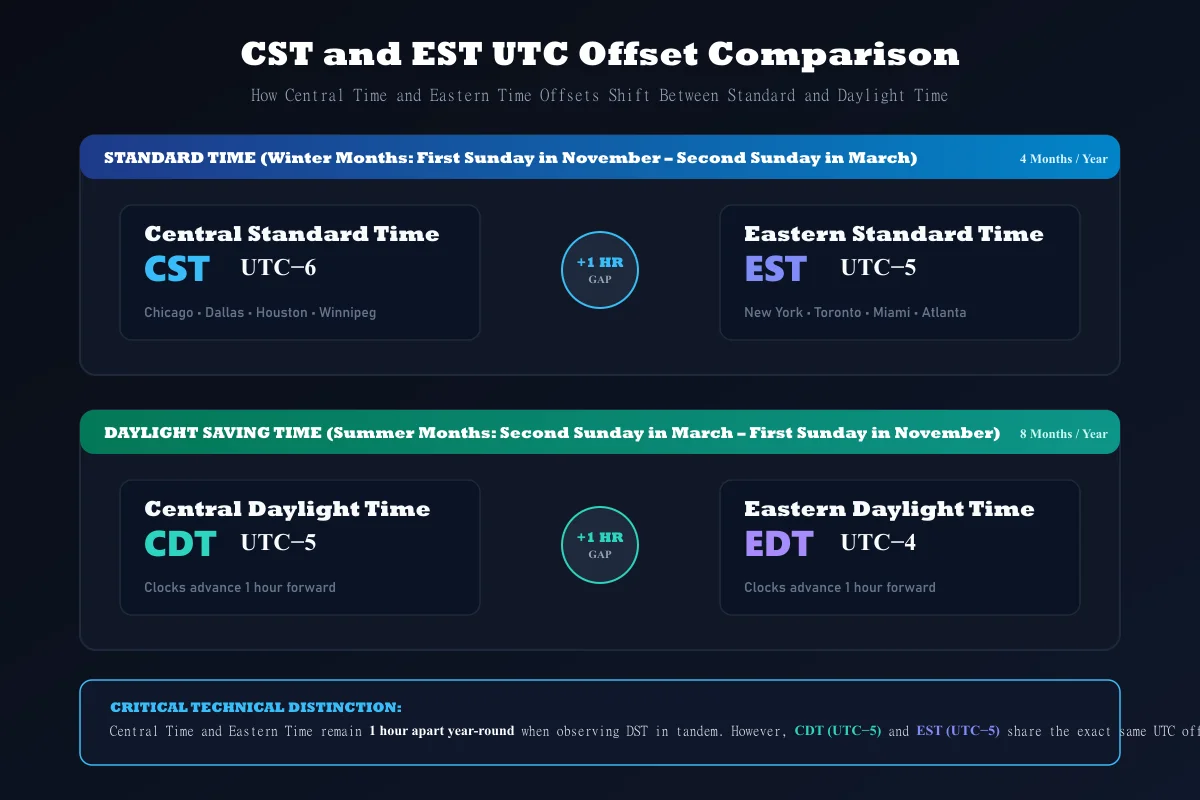
Notice the fascinating technical overlap highlighted in Figure 1: CDT (UTC−5) and EST (UTC−5) share the exact same numerical offset from UTC! However, because CDT is used during summer and EST is used during winter, they rarely overlap in North America.
CST to EST Time Difference
Converting between Central Standard Time and Eastern Standard Time follows an elementary mathematical formula:
$$ \text{EST} = \text{CST} + 1\text{ hour} $$ $$ \text{CST} = \text{EST} - 1\text{ hour} $$
Because Eastern Time is east of Central Time, the sun rises earlier on the East Coast, and civil clocks in Eastern cities are always one hour ahead.
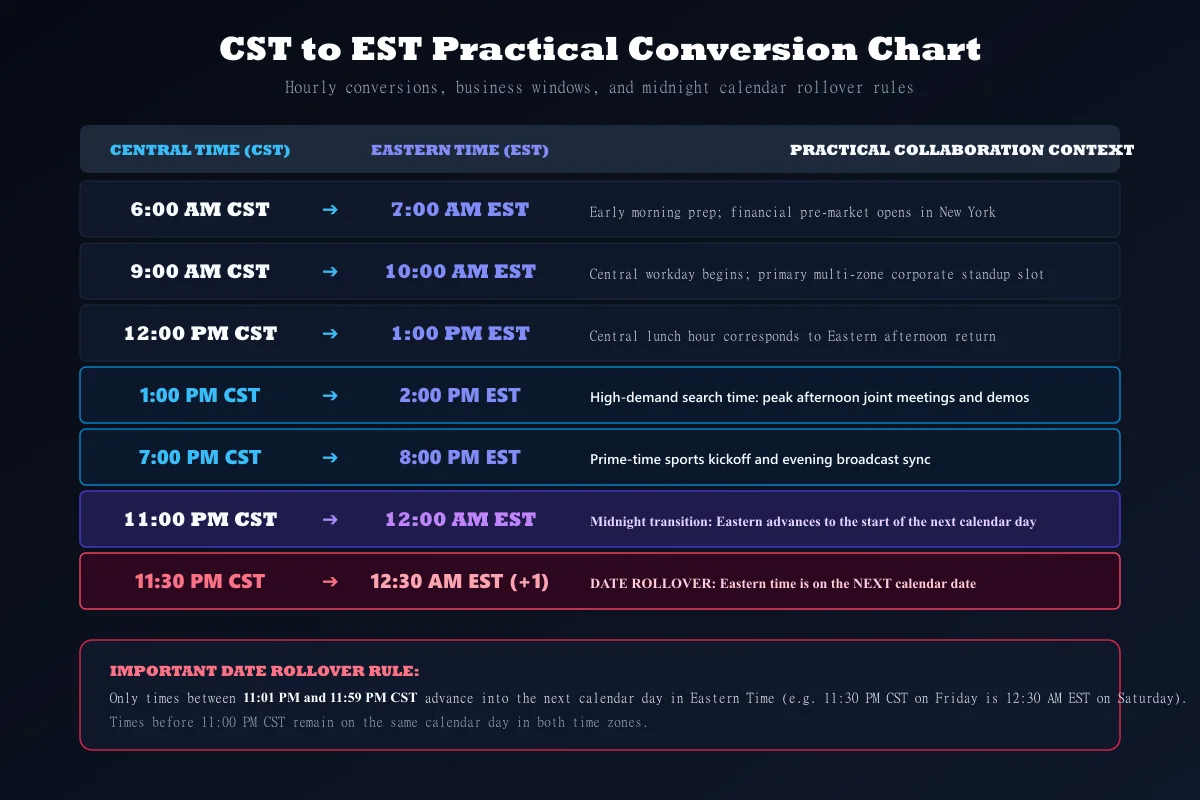
The table below outlines common hourly conversions across a typical workday and evening schedule:
| Central Standard Time (CST) | Eastern Standard Time (EST) | Everyday Scheduling Context |
|---|---|---|
| 6:00 AM CST | 7:00 AM EST | Early morning commute; New York financial desks begin morning prep |
| 9:00 AM CST | 10:00 AM EST | Central business day opens; peak morning corporate sync window |
| 12:00 PM CST | 1:00 PM EST | Central lunch hour aligns with Eastern afternoon meeting restart |
| 1:00 PM CST | 2:00 PM EST | Primary cross-regional collaboration and product demonstration slot |
| 3:00 PM CST | 4:00 PM EST | Wall Street equity markets close (4:00 PM EST / 3:00 PM CST) |
| 5:00 PM CST | 6:00 PM EST | Central business day ends; Eastern evening commute underway |
| 7:00 PM CST | 8:00 PM EST | Prime-time television broadcasts and national sporting event kickoffs |
| 11:00 PM CST | 12:00 AM EST (Midnight) | Eastern Time crosses into the start of the next calendar day |
Practical Conversion Examples
Here are the most frequently searched specific hour conversions between Central and Eastern Time, along with practical tips on date rollovers:
1 PM CST to EST
- 1:00 PM CST = 2:00 PM EST
- Context: This is one of the highest-volume search queries because 1:00 PM Central represents the start of the afternoon workday in Chicago and Dallas, corresponding to 2:00 PM Eastern in New York and Atlanta. It is an optimal window for inter-office project check-ins.
7 PM CST to EST
- 7:00 PM CST = 8:00 PM EST
- Context: Widely used for entertainment, webinars, and live sports broadcasts. An NFL or NBA game scheduled for 7:00 PM Central kicks off at 8:00 PM for East Coast viewers.
12 PM CST to EST
- 12:00 PM CST (Noon) = 1:00 PM EST
- Context: Midday lunch coordination. When team members in Houston break for lunch at noon, team members in Toronto and Miami are returning to their desks for the 1:00 PM afternoon block.
11:30 PM CST to EST (Date Rollover)
- 11:30 PM CST = 12:30 AM EST (Next Calendar Day)
- Context: Handling late-evening conversions requires vigilance regarding calendar date changes.
A common misconception is that "anything late at night automatically advances to tomorrow." In reality, only Central times between 11:01 PM and 11:59 PM CST cross midnight into the next day in Eastern Time. For instance, 11:30 PM CST on a Friday night is 12:30 AM EST on Saturday morning. By contrast, 10:45 PM CST is 11:45 PM EST on the very same calendar day.
Need to convert an exact or non-standard time? Use our dedicated CST to EST converter for real-time calculations with live interactive clocks.
Does Daylight Saving Time Change the Difference?
A frequent source of anxiety for project managers and travel planners is whether Daylight Saving Time widens or narrows the gap between Chicago and New York.
The short answer is no:
The time difference between Central Time and Eastern Time remains exactly one hour all year long as long as both locations follow standard North American daylight saving schedules.
Here is why:
- In winter (Standard Time): Central is CST (UTC−6) and Eastern is EST (UTC−5).
Difference: $(-5) - (-6) = \mathbf{+1\text{ hour}}$. - In summer (Daylight Saving Time): Central is CDT (UTC−5) and Eastern is EDT (UTC−4).
Difference: $(-4) - (-5) = \mathbf{+1\text{ hour}}$.
Because both time zones advance their clocks by 60 minutes on the exact same Sunday in March at 2:00 AM local time, and set their clocks back by 60 minutes on the exact same Sunday in November, the one-hour difference never fluctuates.
Important Geographic Exceptions
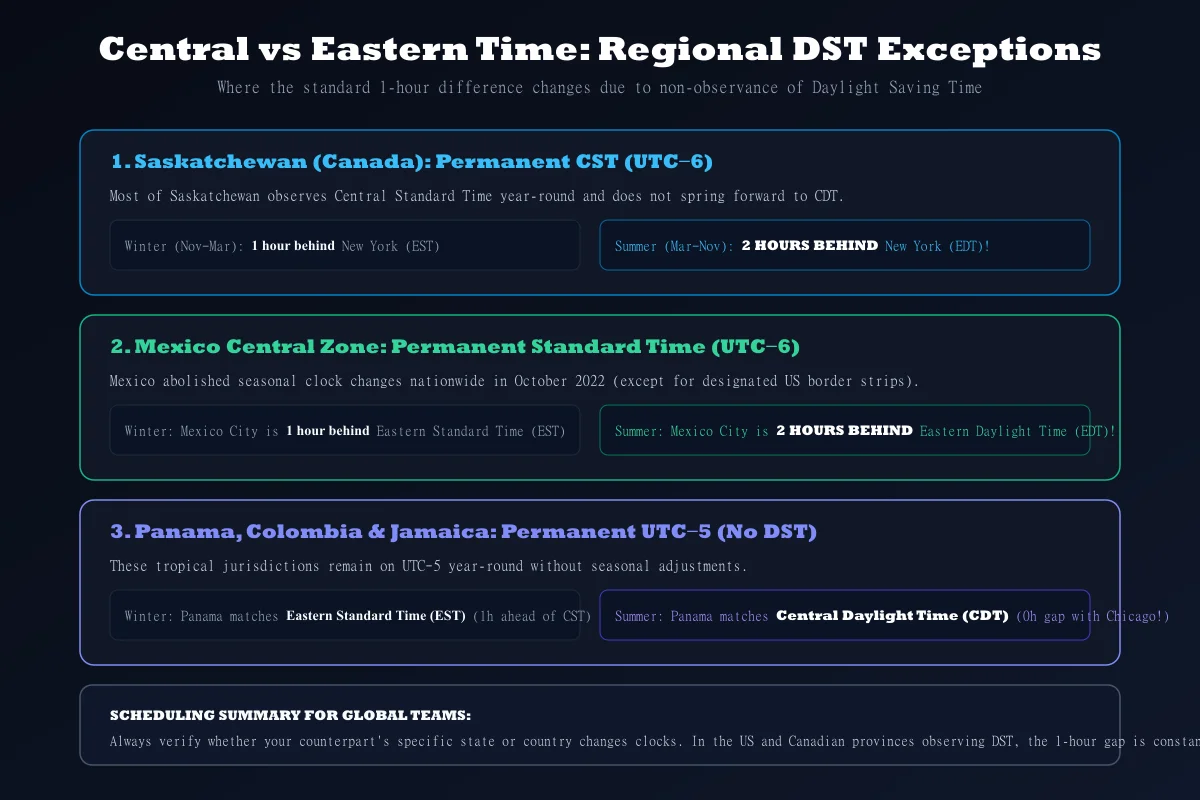
While the one-hour rule holds true for synchronized regions, significant regional opt-outs exist across North and Central America (Figure 3):
- Saskatchewan (Canada): Most of Saskatchewan remains on CST (UTC−6) year-round. During the winter, Saskatchewan is 1 hour behind Toronto (EST). But in the summer, when Toronto moves to EDT (UTC−4), Saskatchewan is 2 hours behind Toronto!
- Mexico Central Zone: In October 2022, Mexico enacted federal legislation eliminating seasonal daylight saving time across most of the republic. As a result, Mexico City and Guadalajara remain on permanent UTC−6 year-round. During the summer, Mexico City is 2 hours behind Eastern Daylight Time (EDT).
- Panama & Colombia (UTC−5): These equatorial nations never change their clocks. In winter, Panama aligns with Eastern Standard Time (EST). In summer, when Eastern shifts forward to EDT (UTC−4), Panama aligns with Central Daylight Time (CDT), resulting in a 0-hour difference with Chicago!
For a broader look at national clock patterns, explore our guide to US time zones and Daylight Saving Time rules.
2026 Daylight Saving Information
For jurisdictions in the United States and Canada that observe seasonal clock changes, the official daylight saving dates for 2026 are:
- Daylight Saving Time Begins (“Spring Forward”):
Sunday, March 8, 2026 at 2:00 AM local time.- Action: Clocks advance one hour from 2:00 AM to 3:00 AM.
- Central Time transitions from CST (UTC−6) to CDT (UTC−5).
- Eastern Time transitions from EST (UTC−5) to EDT (UTC−4).
- Daylight Saving Time Ends (“Fall Back”):
Sunday, November 1, 2026 at 2:00 AM local time.- Action: Clocks shift backward one hour from 2:00 AM to 1:00 AM.
- Central Time transitions from CDT (UTC−5) back to CST (UTC−6).
- Eastern Time transitions from EDT (UTC−4) back to EST (UTC−5).
Geographic Scope: These dates are governed by the U.S. Uniform Time Act and parallel provincial legislation across Canada. They do not apply to Arizona (which stays on Mountain Standard Time), Hawaii (Hawaii Standard Time), Saskatchewan, or non-participating Mexican municipalities.
Why Everyone Still Says CST and EST
If “CST” and “EST” are only technically accurate for approximately four months of the year (mid-November to early March), why do millions of professionals continue to write “Meeting at 2 PM CST” in the middle of July?
There are three primary reasons:
- Habit and Familiarity: “EST” and “CST” have been embedded in North American vernacular for over a century. Many people treat them as proper names for the geographical regions rather than technical offset indicators.
- Visual Brevity: Broadcasters and marketing materials frequently default to CST/EST because audiences immediately recognize them, whereas “CDT” or “EDT” occasionally confuses casual viewers who wonder whether the letter “D” signifies a different territory.
- Lack of Awareness: Many casual calendar users do not realize that the “S” stands specifically for Standard and the “D” stands for Daylight.
The Professional Recommendation: Use CT and ET
To maintain accuracy without having to check whether Daylight Saving Time is active on a given date, industry professionals and international organizations recommend using season-neutral labels:
- CT = Central Time (automatically encompasses CST in winter and CDT in summer).
- ET = Eastern Time (automatically encompasses EST in winter and EDT in summer).
Writing "10:00 AM CT / 11:00 AM ET" is mathematically bulletproof on any day of the year.
Common Mistakes When Converting Between CST and EST
Even seasoned remote workers occasionally stumble when scheduling across North American zones. Here are four common pitfalls to avoid:
Mistake 1: Specifying CST in Mid-Summer
Writing “Our webinar starts at 1:00 PM CST” in July is technically stating an event at UTC−6. If an international developer or automated scheduling tool parses the abbreviation literally, the invitation will be scheduled one hour late! In July, the correct acronym is CDT (or simply CT).
Mistake 2: Overlooking the Midnight Date Rollover
When booking red-eye flights, night-shift handovers, or server maintenance windows, remember that an 11:15 PM CST scheduled task occurs at 12:15 AM EST the following calendar day. Failing to increment the date in documentation leads to missed appointments.
Mistake 3: Assuming All Central Locations Observe DST
As noted earlier, assuming that every city in the Central Time Zone advances clocks in March will cause scheduling headaches with partners in Saskatchewan or Mexico. Always verify whether your counterpart’s specific municipality observes seasonal time changes.
Mistake 4: Acronym Ambiguity on Global Teams
Within North America, “CST” universally means Central Standard Time. However, in international aviation, telecommunications, and global supply chains:
- CST also stands for China Standard Time (UTC+8), which is 14 hours ahead of North American CST!
- CST can also refer to Cuba Standard Time (UTC−5).
When working with global teams, always specify the reference city (e.g., Chicago Time, New York Time) or use standard IANA timezone identifiers such as America/Chicago and America/New_York.
Which Is Ahead: CST or EST?
EST is ahead of CST.
Because the Earth rotates from west to east, the sun rises first over the Atlantic Ocean and the Eastern Seaboard before illuminating the Midwest and Great Plains. Consequently, civil time in the Eastern corridor is always one hour ahead of the Central corridor:
- When it is 11:00 AM Central, it is 12:00 PM Eastern.
- When it is 4:00 PM Central, it is 5:00 PM Eastern.
A simple mnemonic memory aid to remember the direction:
Think of the United States map from right to left: New York is on the right (East = ahead in time), while Chicago is further left (Central = behind in time).
Practical Scheduling Tips for Remote Teams
Because Central and Eastern Time are adjacent zones separated by only 60 minutes, cross-zone scheduling is remarkably easy compared to transatlantic or transpacific collaboration. Here are five best practices to ensure seamless coordination:
- Leverage the 7-Hour Common Business Window: Standard business hours (9:00 AM to 5:00 PM) overlap almost completely. A team spanning Chicago and New York shares 7 out of 8 working hours daily (9:00 AM–4:00 PM Central / 10:00 AM–5:00 PM Eastern).
- Adopt Season-Neutral Abbreviations: In email signatures, project roadmaps, and client contracts, write CT and ET rather than CST and EST to avoid seasonal inaccuracies.
- Include Both Time Zones in Group Invites: When emailing multiple stakeholders, state both zones explicitly:
"Project Kickoff: Thursday at 1:00 PM CT / 2:00 PM ET". This eliminates mental arithmetic for recipients. - Use Calendar Applications with Dual Timezone Displays: Modern calendar platforms (such as Google Calendar, Microsoft Outlook, and Apple Calendar) allow you to display secondary time zones alongside your primary schedule. Setting your secondary zone to
America/ChicagoorAmerica/New_Yorkprevents scheduling errors during booking. - Double-Check International Participants: If your Central/Eastern project involves team members in London or Europe, consult our GMT vs EST comparison guide to account for European summer time desynchronization weeks in March and October.
Convert CST to EST Instantly
Need to convert an upcoming meeting, flight departure, or broadcast time?
Use our free, interactive CST to EST converter to calculate the exact Eastern Time equivalent instantly. The converter features live side-by-side digital clocks, an interactive slider, and an exhaustive 24-hour conversion schedule that automatically handles Daylight Saving Time transitions.
Summary: Key Takeaways
- CST is one hour behind EST (EST is one hour ahead of CST).
- CST operates at UTC−6, representing Central Standard Time in winter.
- EST operates at UTC−5, representing Eastern Standard Time in winter.
- CDT (UTC−5) and EDT (UTC−4) apply during Daylight Saving Time (second Sunday of March to first Sunday of November).
- The one-hour difference remains constant year-round between regions that participate in seasonal daylight saving time.
- CT and ET are the preferred season-neutral labels for year-round accuracy.
- To convert CST to EST, add 1 hour.
- Only times between 11:01 PM and 11:59 PM CST advance to the next calendar date in Eastern Time.
Frequently Asked Questions (FAQ)
What is the difference between CST and EST?
CST (Central Standard Time) operates at UTC−6, while EST (Eastern Standard Time) operates at UTC−5. EST is exactly one hour ahead of CST. When it is 12:00 PM CST in Chicago, it is 1:00 PM EST in New York.
Is CST ahead of or behind EST?
CST is one hour behind EST (and conversely, EST is one hour ahead of CST). To convert Central Time to Eastern Time, add one hour.
What is 1 PM CST in EST?
1:00 PM CST corresponds to 2:00 PM EST on the same calendar day.
What is 7 PM CST in EST?
7:00 PM CST corresponds to 8:00 PM EST on the same calendar day.
What is Central Time in Eastern Time?
Central Time is one hour behind Eastern Time year-round when both regions observe their matching seasonal rules (CST is 1 hour behind EST in winter; CDT is 1 hour behind EDT in summer).
What is the UTC offset for CST and EST?
The standard UTC offset for CST is UTC−6 (six hours behind Coordinated Universal Time). The standard UTC offset for EST is UTC−5 (five hours behind Coordinated Universal Time).
Do CST and EST change with daylight saving time?
Yes. In participating jurisdictions, Central Time advances by one hour in spring to Central Daylight Time (CDT, UTC−5), and Eastern Time advances to Eastern Daylight Time (EDT, UTC−4). The one-hour gap between the two regions remains identical.
Which states are in Central Time and Eastern Time?
Central Time covers all or part of 20 US states, including Illinois, Texas, Minnesota, Wisconsin, Missouri, Louisiana, and Tennessee. Eastern Time covers all or part of 23 US states, including New York, Florida, Georgia, Pennsylvania, Ohio, North Carolina, and Massachusetts.
Sources & References
- Uniform Time Act and Time Zone Regulatory Overview — U.S. Department of Transportation
- Daylight Saving Time Rules and Explanations — National Institute of Standards and Technology (NIST)
- IANA Time Zone Database (America/Chicago & America/New_York) — Internet Assigned Numbers Authority (IANA)
- Official Time Across Canada — National Research Council Canada (NRC)