
Understanding the GMT to JST Conversion
Coordinating international corporate operations, global tech sprint reviews, gaming tournaments, livestock dispatches, and travel itineraries between Greenwich Mean Time (GMT) regions and Japan demands precise time management. When converting from Greenwich Mean Time (GMT) to Japan Standard Time (JST), the foundational rule is that Japan operates 9 hours ahead of the Prime Meridian baseline.
Greenwich Mean Time represents the zero-degree longitudinal reference point (UTC+0). Japan Standard Time is centered at 135° East longitude (passing through Akashi City in Hyogo Prefecture), positioning it in the ninth eastern time zone (UTC+9). Because Japan does not observe seasonal daylight saving time adjustments, this 9-hour gap remains constant 365 days a year.
Whether you are scheduling video calls with partners in Tokyo, Osaka, or Kyoto, configuring server backup jobs, organizing esports streams, or booking flights to Narita (NRT) or Haneda (HND), using a date-aware converter ensures midnight calendar shifts are never missed.
GMT to JST Time Difference
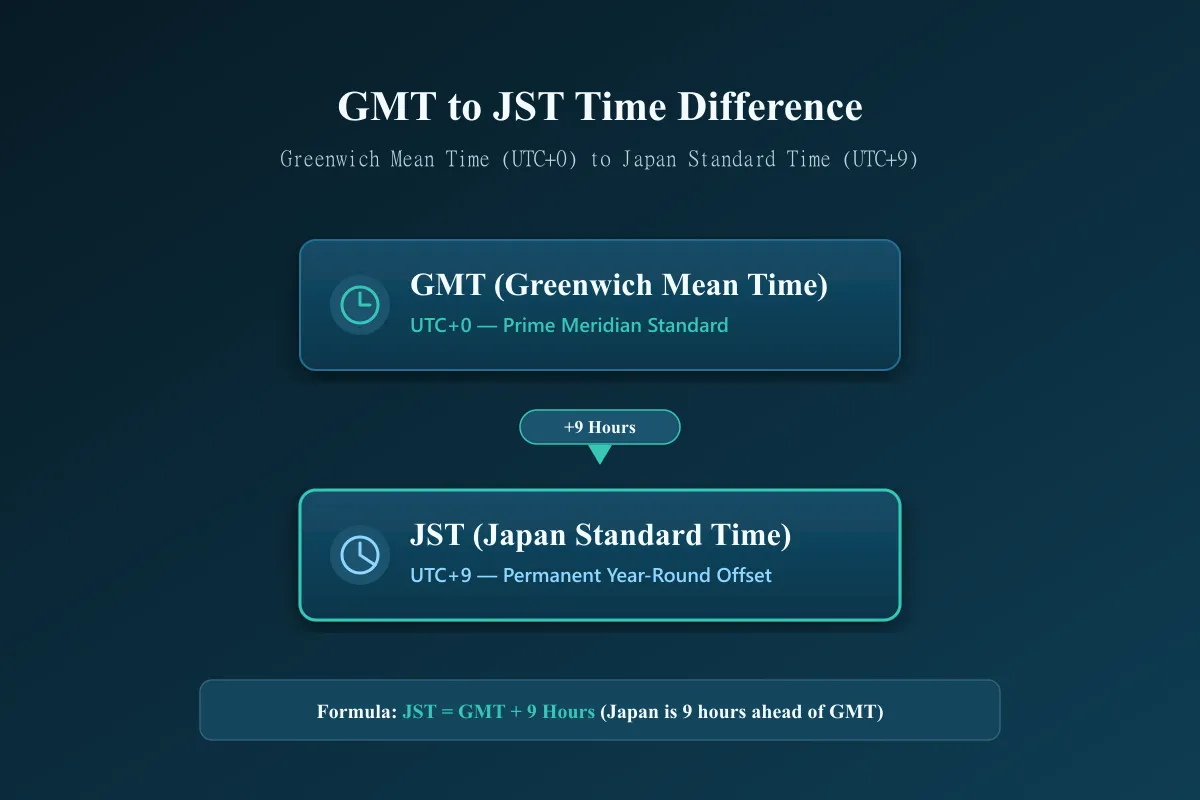
The precise time difference between Greenwich Mean Time and Japan Standard Time is 9 hours. Japan Standard Time is permanently 9 hours ahead of Greenwich Mean Time.
The conversion mathematical equation is expressed as:
JST = GMT + 9 Hours
UTC+0 (Prime Meridian) → UTC+9 (Japan Standard Time)
Because the offset is positive (+9), locations in Japan experience daylight and calendar dates hours before Greenwich observatory coordinates do. When London or Greenwich marks 09:00 AM GMT in the morning, Tokyo has already reached 18:00 (6:00 PM) JST in the early evening.
How to Convert GMT to JST
Converting Greenwich Mean Time to Japan Standard Time manually is straightforward when following a 7-step procedure:
- Start with the GMT date and time: Identify the clock time in GMT (e.g., 14:30 GMT).
- Verify the GMT baseline: Confirm that the baseline uses UTC+0 without daylight saving modifications.
- Identify JST's offset: Note that Japan Standard Time uses UTC+9 year-round.
- Add nine hours: Sum the GMT hour figure with 9 (14:30 + 9 hours = 23:30).
- Check whether the result passes midnight: If your calculated hour reaches or exceeds 24:00, subtract 24 hours from the total.
- Adjust the calendar date if needed: If the result rolled over 24:00, advance the calendar day, month, or year by one.
- Confirm the final JST time: Record the resulting hour, minute, date, and JST timezone label (e.g., 23:30 JST).
For instance, converting 14:30 GMT yields 23:30 JST (11:30 PM JST) on the exact same date. However, converting 16:30 GMT yields 16:30 + 9 = 25:30. Subtracting 24 hours results in 01:30 JST (1:30 AM JST) on the next calendar day.
GMT to JST 24-Hour Conversion Table
The standard reference table below provides a complete hour-by-hour map converting Greenwich Mean Time (00:00 through 23:00) to Japan Standard Time. Rows highlighted in colored styling indicate times where adding 9 hours advances the clock into the next calendar day in Japan.
| GMT (12-Hour) | GMT (24-Hour) | JST (12-Hour) | JST (24-Hour) | Calendar Status |
|---|---|---|---|---|
| 12:00 AM | 00:00 | 9:00 AM | 09:00 | Same day |
| 1:00 AM | 01:00 | 10:00 AM | 10:00 | Same day |
| 2:00 AM | 02:00 | 11:00 AM | 11:00 | Same day |
| 3:00 AM | 03:00 | 12:00 PM | 12:00 | Same day |
| 4:00 AM | 04:00 | 1:00 PM | 13:00 | Same day |
| 5:00 AM | 05:00 | 2:00 PM | 14:00 | Same day |
| 6:00 AM | 06:00 | 3:00 PM | 15:00 | Same day |
| 7:00 AM | 07:00 | 4:00 PM | 16:00 | Same day |
| 8:00 AM | 08:00 | 5:00 PM | 17:00 | Same day |
| 9:00 AM | 09:00 | 6:00 PM | 18:00 | Same day |
| 10:00 AM | 10:00 | 7:00 PM | 19:00 | Same day |
| 11:00 AM | 11:00 | 8:00 PM | 20:00 | Same day |
| 12:00 PM | 12:00 | 9:00 PM | 21:00 | Same day |
| 1:00 PM | 13:00 | 10:00 PM | 22:00 | Same day |
| 2:00 PM | 14:00 | 11:00 PM | 23:00 | Same day |
| 3:00 PM | 15:00 | 12:00 AM | 00:00 | Next day |
| 4:00 PM | 16:00 | 1:00 AM | 01:00 | Next day |
| 5:00 PM | 17:00 | 2:00 AM | 02:00 | Next day |
| 6:00 PM | 18:00 | 3:00 AM | 03:00 | Next day |
| 7:00 PM | 19:00 | 4:00 AM | 04:00 | Next day |
| 8:00 PM | 20:00 | 5:00 AM | 05:00 | Next day |
| 9:00 PM | 21:00 | 6:00 AM | 06:00 | Next day |
| 10:00 PM | 22:00 | 7:00 AM | 07:00 | Next day |
| 11:00 PM | 23:00 | 8:00 AM | 08:00 | Next day |
Note: Starting from 15:00 GMT (3:00 PM GMT), every subsequent GMT hour translates to the next calendar date in Japan.
GMT to JST Conversion Examples
Review these 15 detailed conversion scenarios with explicit clock and calendar date breakdowns:
Example 1: Midnight GMT
00:00 GMT → 09:00 JST (Same Day)
When a new calendar day starts at midnight in Greenwich (00:00 GMT), citizens in Japan are opening morning offices at 09:00 AM JST on the exact same date.
Example 2: Early Morning GMT
03:00 GMT → 12:00 JST (Same Day)
An early 03:00 AM GMT automated build aligns with 12:00 PM (noon) JST lunch hour in Tokyo.
Example 3: Morning Dispatch
06:00 GMT → 15:00 JST (Same Day)
A 06:00 AM GMT dispatch arrives at 15:00 (3:00 PM) JST during mid-afternoon office hours in Osaka.
Example 4: Mid-Morning GMT
09:00 GMT → 18:00 JST (Same Day)
When London offices open at 09:00 AM GMT, Japanese teams are wrapping up their business day at 18:00 (6:00 PM) JST.
Example 5: Noon GMT
12:00 GMT → 21:00 JST (Same Day)
12:00 PM (noon) GMT translates to 21:00 (9:00 PM) JST in the evening across Japan.
Example 6: Mid-Afternoon GMT
14:00 GMT → 23:00 JST (Same Day)
14:00 (2:00 PM) GMT equals 23:00 (11:00 PM) JST, the final hour before midnight in Japan on the same date.
Example 7: Midnight Rollover Threshold
15:00 GMT → 00:00 JST (Next Day)
At exactly 15:00 (3:00 PM) GMT, Japan reaches 00:00 midnight, advancing the calendar date into the next day.
Example 8: Late Afternoon Rollover
16:00 GMT → 01:00 JST (Next Day)
A 16:00 (4:00 PM) GMT meeting on October 14 takes place at 01:00 AM JST on October 15 in Tokyo.
Example 9: Evening GMT
18:00 GMT → 03:00 JST (Next Day)
18:00 (6:00 PM) GMT translates to 03:00 AM JST pre-dawn hours on the next calendar day.
Example 10: Night GMT
20:00 GMT → 05:00 JST (Next Day)
20:00 (8:00 PM) GMT equals 05:00 AM JST on the next calendar day in Japan.
Example 11: Half-Hour GMT
21:30 GMT → 06:30 JST (Next Day)
21:30 (9:30 PM) GMT translates to 06:30 AM JST early morning on the next day.
Example 12: Late Night GMT
23:30 GMT → 08:30 JST (Next Day)
23:30 (11:30 PM) GMT equals 08:30 AM JST right as morning commutes begin in Tokyo on the next day.
Example 13: New Year Eve Date Shift
23:00 GMT (Dec 31, 2026) → 08:00 JST (Jan 1, 2027)
A 23:00 GMT timestamp on New Year's Eve 2026 in Greenwich occurs at 08:00 AM JST on New Year's Day 2027 in Tokyo!
Example 14: Month Boundary Shift
16:00 GMT (Jan 31) → 01:00 JST (Feb 1)
16:00 GMT on the last day of January advances the calendar to February 1 in Japan.
Example 15: Leap Year Date Boundary
17:00 GMT (Feb 28, 2028) → 02:00 JST (Feb 29, 2028)
On a leap year, 17:00 GMT on February 28 advances to 02:00 AM JST on Leap Day (February 29) in Japan.
What Is GMT?
Greenwich Mean Time (GMT) historically represents mean solar time calculated at the Royal Observatory situated on the Prime Meridian (0° longitude) in Greenwich, London, United Kingdom.
Established as an international standard in 1884 at the International Meridian Conference, GMT served for decades as the foundational benchmark against which all global time zones were calibrated. In modern aviation, telecommunications, and computer software architectures, Coordinated Universal Time (UTC) has superseded GMT as the high-precision atomic standard. However, GMT remains the standard civil time zone name for the UK, West Africa, and global conversion tools.
Crucially, GMT operates at UTC+0. Unlike the United Kingdom's civil time (which shifts to British Summer Time / BST UTC+1 between March and October), standard GMT itself maintains a static zero offset throughout the year. You can learn more about GMT baseline logic on our What Is GMT guide or explore our primary GMT to EST Converter.
What Is JST?
Japan Standard Time (JST), known natively in Japanese as 日本標準時 (Nihon Hyōjunji) or 中央標準時 (Chūō Hyōjunji), is the official time zone governing the nation of Japan. JST is defined strictly as UTC+9 (Coordinated Universal Time plus 9 hours).
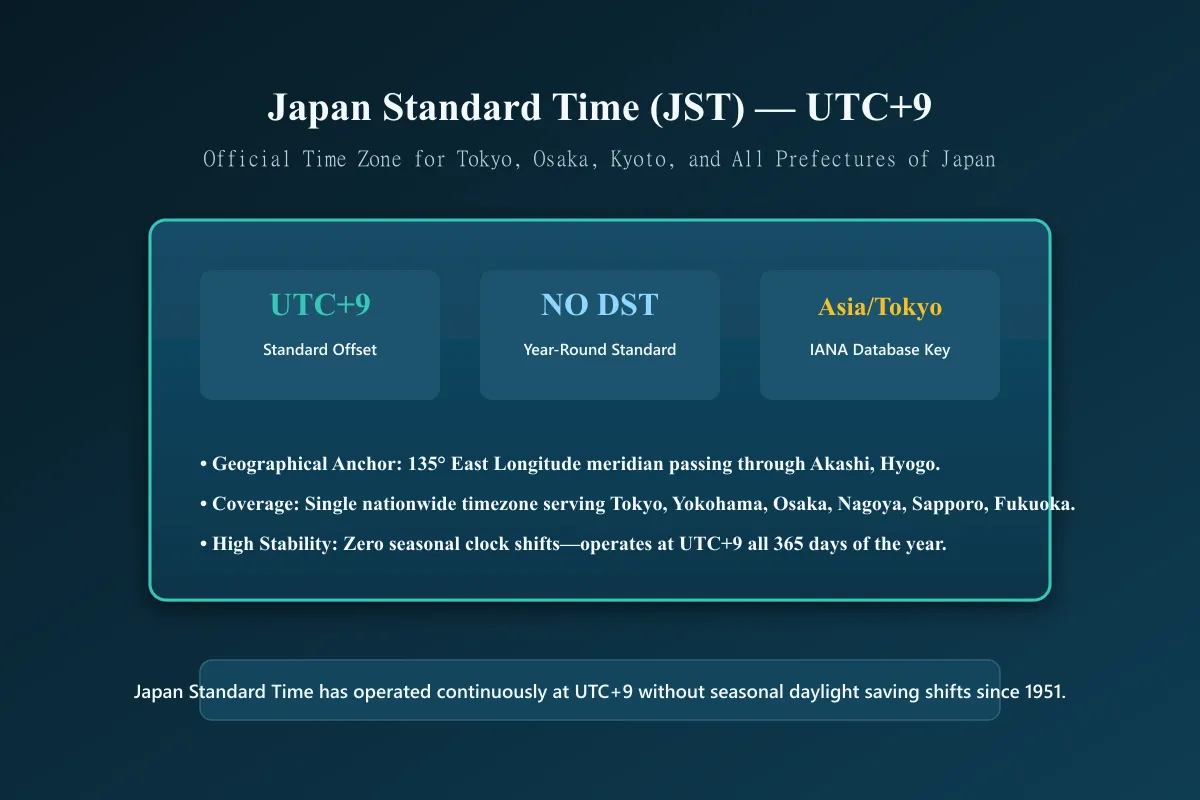
Centering on 135° East longitude near Akashi City in Hyogo Prefecture, Japan Standard Time has been synchronized at UTC+9 since 1888 under Imperial Ordinance No. 51. In global computing and time database systems (the IANA Time Zone Database), Japan Standard Time is designated by the location string Asia/Tokyo.
Does Japan Use Daylight Saving Time?
No. Japan does NOT currently observe seasonal Daylight Saving Time (DST).
Although Japan temporarily implemented daylight saving time between 1948 and 1951 during the post-WWII Allied occupation, the practice was unpopular among agricultural workers and the general public, leading to its complete repeal in 1952. Since 1951, Japan has operated on a permanent, static UTC+9 offset all 365 days of the year.
Because Japan does not shift clocks, you never need to worry about seasonal "JST Daylight Time" or "JDT" changes. The offset between Greenwich Mean Time (UTC+0) and Japan Standard Time (UTC+9) is permanently fixed at +9 hours.
GMT vs JST Comparison
Review the structural attributes comparing Greenwich Mean Time and Japan Standard Time:
| Feature | Greenwich Mean Time (GMT) | Japan Standard Time (JST) |
|---|---|---|
| Full Name | Greenwich Mean Time | Japan Standard Time (日本標準時) |
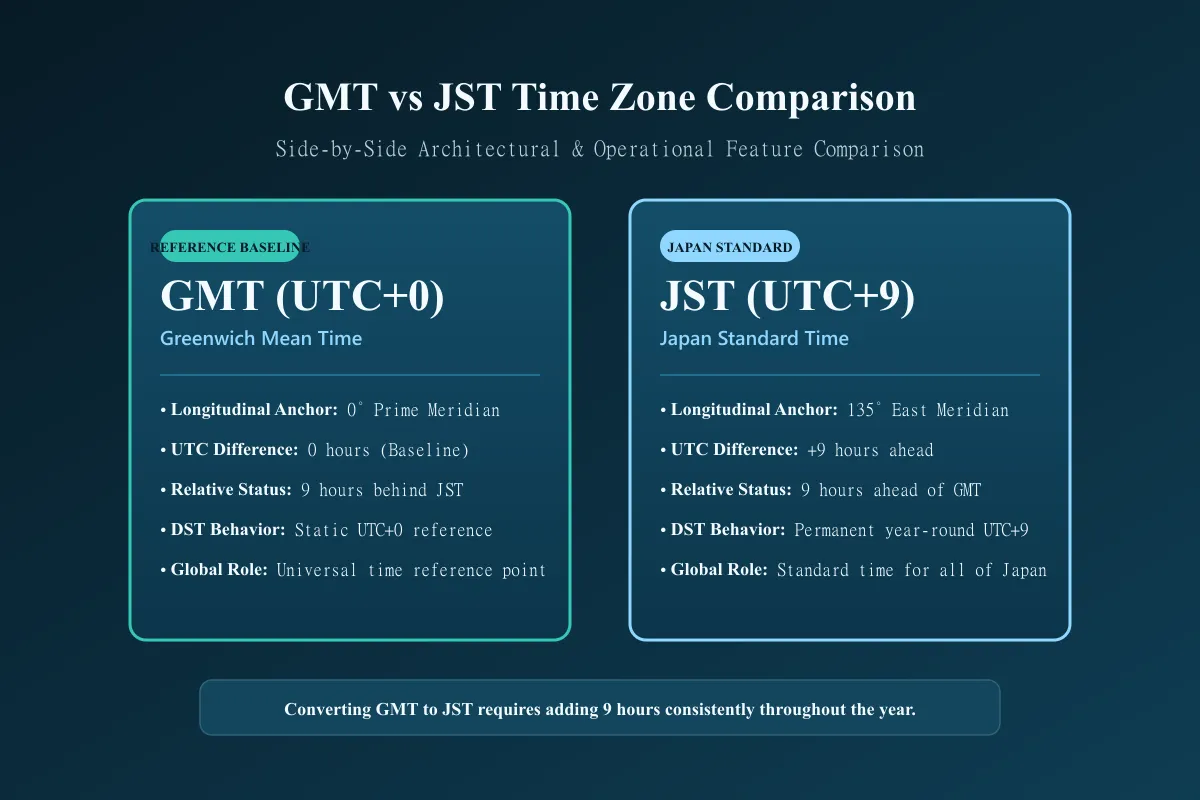
| UTC Offset | UTC+0 | UTC+9 |
| Relative Difference | 9 hours behind JST | 9 hours ahead of GMT |
| Daylight Saving Time | Reference time (UK shifts to BST in summer) | Does NOT observe DST (Fixed UTC+9) |
| Primary Region | Royal Observatory, Greenwich / UK standard | Japan (Tokyo, Osaka, Kyoto, Nagoya) |
| IANA Key | Etc/GMT or UTC | Asia/Tokyo |
GMT, UTC and JST Explained
To avoid technical ambiguity when handling cross-border schedules:
- GMT (Greenwich Mean Time): A historic solar time zone and standard operating at UTC+0.
- UTC (Coordinated Universal Time): The atomic time standard that anchors all world civil time offsets. GMT and UTC share the exact same clock time for conversion purposes.
- JST (Japan Standard Time): The civil time zone of Japan, defined as UTC+9.
GMT to JST Date and Day Changes
Yes. Because JST is 9 hours ahead of GMT, afternoon and evening hours in GMT roll into the next calendar day in Japan.
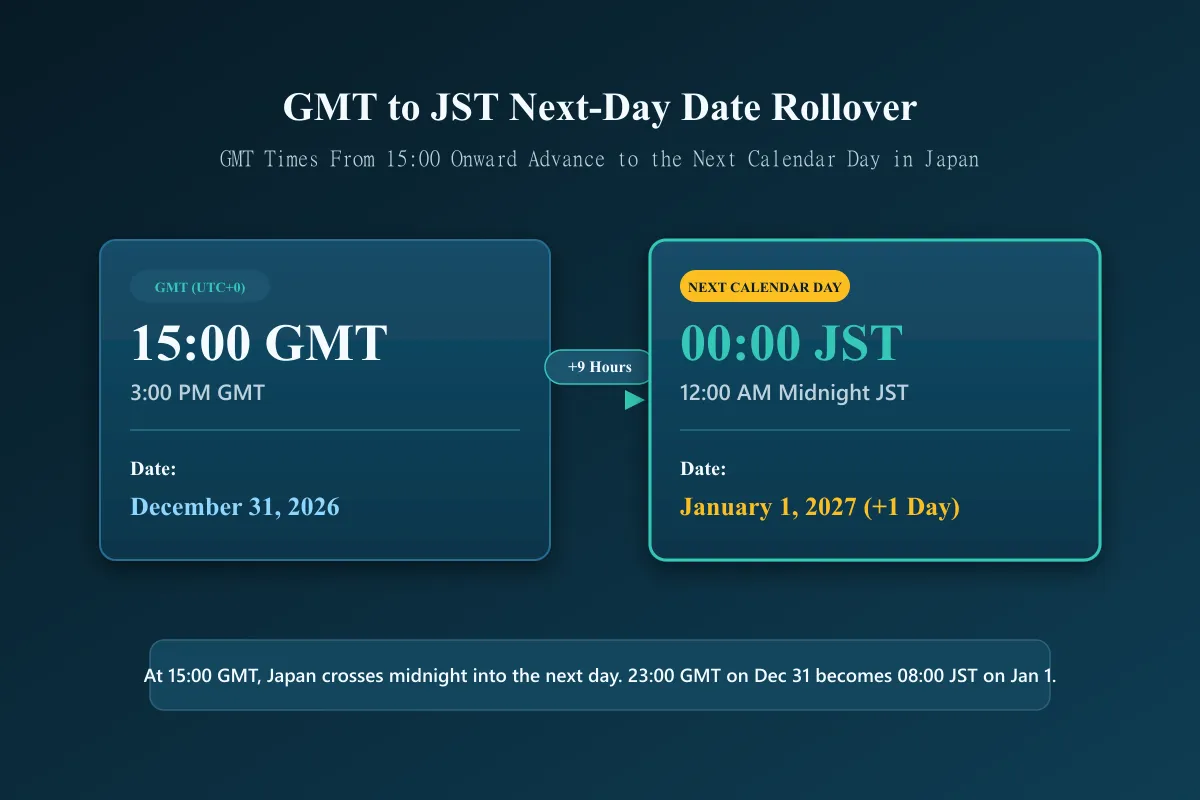
Any GMT time occurring between 15:00 (3:00 PM GMT) and 23:59 (11:59 PM GMT) falls after midnight local time in Japan, advancing the JST calendar date by +1 day.
Date Transition Thresholds
- GMT 00:00 to 14:59: Results in JST 09:00 to 23:59 on the SAME calendar date.
- GMT 15:00: Results in JST 00:00 (midnight) on the NEXT calendar date.
- GMT 18:00: Results in JST 03:00 AM on the NEXT calendar date.
- GMT 23:00: Results in JST 08:00 AM on the NEXT calendar date.
For instance, an online tech summit taking place at 16:00 GMT on Thursday, March 18 occurs at 01:00 AM JST on Friday, March 19 in Tokyo.
GMT to JST for Business Meetings
Coordinating business operations between European or GMT-based organizations and Japanese enterprise hubs (Tokyo, Osaka, Nagoya) requires strategic planning due to the 9-hour time gap.
Overlap Windows & Business Hours
Standard office working hours in Japan run from 09:00 to 18:00 JST. Converting this range to GMT shows:
Japanese Workday (09:00–18:00 JST) = 00:00–09:00 GMT
The prime live overlapping meeting window occurs between 08:00 GMT and 09:00 GMT (17:00 JST to 18:00 JST), giving a 1-hour end-of-day overlap window for live syncs.
Best GMT Times for JST Meetings
- 07:00 GMT → 16:00 JST: Great early morning slot in GMT / late afternoon in Tokyo.
- 08:00 GMT → 17:00 JST: Optimal start of joint European/Japanese live standups.
- 09:00 GMT → 18:00 JST: Final business hour meeting slot before office close in Japan.
GMT to JST Working Hours Comparison
| Phase of Day | GMT Time | JST Time | Collaboration Feasibility |
|---|---|---|---|
| Overnight GMT | 00:00 – 05:00 GMT | 09:00 – 14:00 JST | Japan Morning / GMT Night |
| Prime Overlap | 07:00 – 09:00 GMT | 16:00 – 18:00 JST | Optimal Live Meeting Window |
| GMT Working Day | 10:00 – 17:00 GMT | 19:00 – 02:00 JST | GMT Working / Japan Night |
GMT to JST for Remote Work
Working in distributed teams between Europe and Japan relies heavily on asynchronous communication:
- End-of-Day Handoffs: Japanese teams ending their workday at 18:00 JST pass code commits to GMT teams starting at 09:00 GMT.
- Explicit Invites: Always append exact date, time, and timezone abbreviations (e.g., "Please submit report by Nov 10, 09:00 GMT / 18:00 JST").
GMT to JST for Travel
Travelers flying between European airports and Japan (Tokyo Narita NRT, Tokyo Haneda HND, Kansai KIX) must note that flight itineraries are printed in local airport time:
If a flight departs London Heathrow at 12:00 GMT and takes 14 hours, it will land in Tokyo at 11:00 AM JST on the next calendar day.
GMT to JST for Online Events
Webinars, gaming livestreams, anime conventions, and esports tournaments hosted in Europe or Japan attract global audiences across both timezones:
A gaming stream commencing at 15:00 GMT will air at 00:00 midnight JST in Japan as the next calendar date begins.
GMT to JST for Developers and Technology
Software engineers, DevOps architects, and database administrators regularly perform timezone conversions when parsing logs, configuring cron jobs, or scheduling maintenance:
- ISO 8601 Strings: Express GMT as
2026-10-14T10:00:00Zand JST as2026-10-14T19:00:00+09:00. - Cron Jobs: A maintenance cron configured for 03:00 AM JST daily must run at
18:00 UTCon the previous calendar day. - Database Timestamp Storage: Always store timestamps in UTC in backend databases, applying the
Asia/Tokyotimezone dynamically at the UI presentation layer.
Common GMT to JST Conversion Mistakes
1. Adding Only 8 Hours
Confusing JST (UTC+9) with China/Singapore time (UTC+8) creates a 1-hour calculation error.
2. Forgetting Next-Day Rollover
Failing to advance the calendar date for GMT times from 15:00 onward causes wrong-day scheduling.
3. Assuming Japan Observes DST
Japan does NOT alter its clock seasonally. JST remains permanently at UTC+9.
4. Subtracting Instead of Adding
Subtracting 9 hours instead of adding 9 hours creates an 18-hour calculation error.
GMT to JST Conversion Tips
📌 Memory Rule: +9 Hours
Always add 9 hours to move from Greenwich Mean Time forward to Japan Standard Time.
📅 Check Date After 15:00 GMT
Any GMT time equal to or greater than 15:00 belongs to the next calendar date in JST.
🌐 Use 24-Hour Format
Utilizing 24-hour military notation (e.g., 15:00 vs 03:00) eliminates AM/PM confusion.
⚡ Use Our Interactive Converter
Rely on our automated tool at the top of this page for accurate date-aware conversions.
Frequently Asked Questions (FAQ)
Related Time Zone Converters
Explore other verified time zone conversion tools across our platform: