Time zone abbreviations are short alphabetical codes (usually three to five letters) representing specific local time offsets relative to Coordinated Universal Time (UTC).
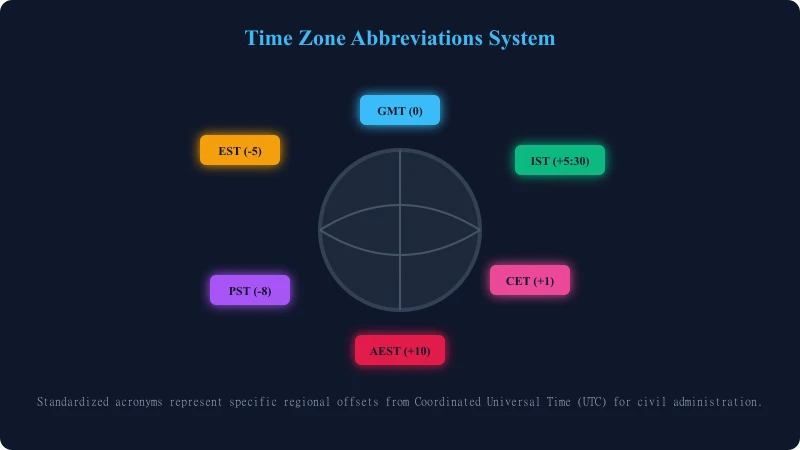
For instance, Eastern Standard Time is abbreviated as **EST** (UTC-5), Greenwich Mean Time as **GMT** (UTC+0), and Central European Summer Time as **CEST** (UTC+2).
Because these codes are created regionally rather than by a single international authority, some acronyms are identical across different continents.
For example, **IST** represents Indian Standard Time (UTC+5:30), Irish Standard Time (UTC+1 in summer), and Israel Standard Time (UTC+2).
Time zone abbreviations are alphabetic codes designed to summarize numerical offsets in daily communication.
Instead of telling a colleague that you live in a region that is five hours behind Greenwich, you simply use the acronym **EST** (Eastern Standard Time).
These codes provide an efficient way to establish regional time scales.
Figure 1: Global Abbreviations. Infographic illustrating how common alphabetical acronyms represent specific regional time offsets relative to Coordinated Universal Time (UTC).
These acronyms arose during the late 19th century with the expansion of railway networks and telegraph lines.
Prior to standardization, every town used its own solar time, which made long-distance travel and communication extremely difficult.
Railway systems adopted standard time corridors, which were later codified into civil law.
Today, the official list of offsets is maintained in the IANA Time Zone Database and referenced against global standards like Coordinated Universal Time (UTC) and Greenwich Mean Time (GMT).
Pro Tip: Time zone abbreviations are not legally binding standards; they are conventions of common usage.
As a result, some countries use identical acronyms for completely different offsets, requiring software developers and schedulers to verify the exact geographical location.
2. Standard vs. Daylight Saving Acronyms
One of the most common errors in schedule planning is confusing standard time abbreviations with daylight saving time abbreviations.
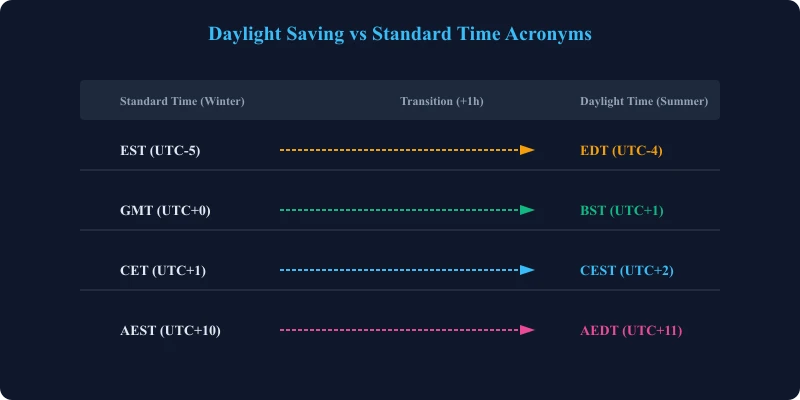
Standard time abbreviations are used during the winter months, while daylight saving time abbreviations are used during the summer months when clocks are set forward by one hour.
Figure 3: Daylight Saving vs Standard Abbreviations. Diagram showing the standard transitions between winter standard acronyms and summer daylight saving acronyms across major zones.
For example, in eastern North America, the winter clock is **EST** (Eastern Standard Time, UTC-5).
In the spring, when clocks advance by one hour, the region observes **EDT** (Eastern Daylight Time, UTC-4).
Using these terms incorrectly can lead to scheduling errors.
For example, using AEST (Australian Eastern Standard Time) in summer will cause you to schedule a meeting one hour late compared to AEDT (Australian Eastern Daylight Time).
To understand this concept further, read our guides on Daylight Saving Time Explained and EST vs EDT.
3. Complete A–Z Reference Database
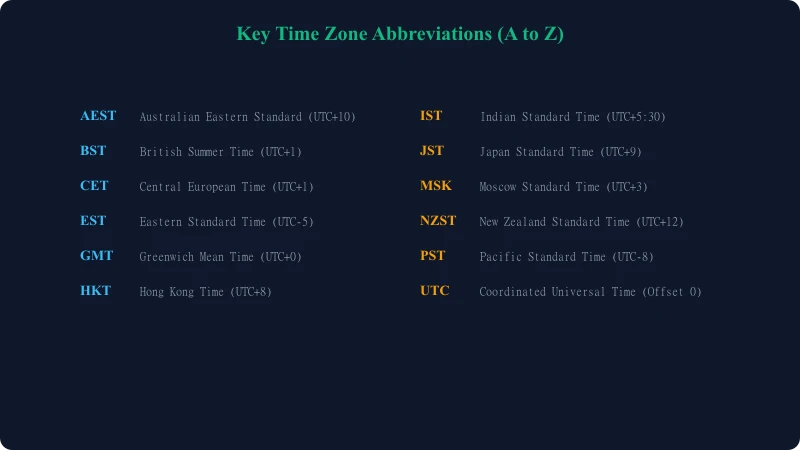
Explore our comprehensive database of major global time zone abbreviations, including their full names, offsets, daylight saving variations, and major hubs.
Figure 7: A–Z Abbreviation Reference. Visual overview of the most frequently searched time zone abbreviations and their standard UTC offsets.
ACST & ACDT
Full Names: Australian Central Standard Time (ACST) / Central Daylight Time (ACDT)
Winter Offset: UTC+9:30
Summer Offset: UTC+10:30
Major Cities: Adelaide, Darwin, Alice Springs, Broken Hill.
Usage Note: South Australia and Broken Hill observe ACDT in summer, while the Northern Territory remains on ACST year-round.
AST & ADT
Full Names: Atlantic Standard Time (AST) / Atlantic Daylight Time (ADT)
Winter Offset: UTC-4
Summer Offset: UTC-3
Major Cities: Halifax, Saint John, San Juan (Puerto Rico), Hamilton (Bermuda).
Usage Note: Used in eastern Canada and the Caribbean. Some Caribbean islands remain on AST year-round.
AEST & AEDT
Full Names: Australian Eastern Standard Time (AEST) / Eastern Daylight Time (AEDT)
Winter Offset: UTC+10
Summer Offset: UTC+11
Major Cities: Sydney, Melbourne, Brisbane, Canberra, Hobart.
Usage Note: Queensland remains on AEST year-round. New South Wales, Victoria, Tasmania, and the ACT switch to AEDT in summer.
AKST & AKDT
Full Names: Alaska Standard Time (AKST) / Alaska Daylight Time (AKDT)
Winter Offset: UTC-9
Summer Offset: UTC-8
Major Cities: Anchorage, Fairbanks, Juneau.
Usage Note: Observed in almost all of the state of Alaska, except for the Aleutian Islands.
AWST
Full Name: Australian Western Standard Time
Offset: UTC+8 year-round (No DST)
Major Cities: Perth, Fremantle, Bunbury, Broome.
Usage Note: Observed across Western Australia, aligning WA with major Asian business centers like Singapore and Hong Kong.
BST
Full Name: British Summer Time
Offset: UTC+1 (Daylight Saving version of GMT)
Major Cities: London, Manchester, Edinburgh, Cardiff, Belfast.
Usage Note: Observed in the United Kingdom from the last Sunday of March to the last Sunday of April. Wait, let's verify if they transition to standard time on the last Sunday of October. Yes, the UK transitions from BST back to GMT on the last Sunday of October.
CAT, EAT & WAT
Full Names: Central Africa Time (CAT) / East Africa Time (EAT) / West Africa Time (WAT)
Offsets: WAT (UTC+1), CAT (UTC+2), EAT (UTC+3)
Major Cities: Lagos (WAT), Cairo (CAT), Nairobi (EAT), Johannesburg (CAT).
Usage Note: These African time zones are observed year-round with no Daylight Saving Time changes.
CCT
Full Name: Cocos Islands Time
Offset: UTC+6:30 year-round (No DST)
Coverage: The Cocos (Keeling) Islands, an external territory of Australia.
CET & CEST
Full Names: Central European Time (CET) / Central European Summer Time (CEST)
Winter Offset: UTC+1
Summer Offset: UTC+2
Major Cities: Paris, Berlin, Rome, Madrid, Amsterdam, Brussels, Vienna, Warsaw.
Usage Note: Observed in the majority of Western and Central European countries during their respective seasons.
CST & CDT
Full Names: Central Standard Time (CST) / Central Daylight Time (CDT)
Winter Offset: UTC-6
Summer Offset: UTC-5
Major Cities: Chicago, Houston, Dallas, Winnipeg, Mexico City.
Usage Note: In international databases, CST is also used to represent China Standard Time (UTC+8, year-round). Be careful to distinguish them.
EET & EEST
Full Names: Eastern European Time (EET) / Eastern European Summer Time (EEST)
Winter Offset: UTC+2
Summer Offset: UTC+3
Major Cities: Athens, Helsinki, Kiev, Bucharest, Sofia, Tallinn.
Usage Note: Observed in Eastern Europe and parts of the Middle East.
EST & EDT
Full Names: Eastern Standard Time (EST) / Eastern Daylight Time (EDT)
Winter Offset: UTC-5
Summer Offset: UTC-4
Major Cities: New York, Toronto, Washington D.C., Boston, Miami, Atlanta.
Usage Note: Observed in eastern North America. For details, read our What is EST? guide.
GMT
Full Name: Greenwich Mean Time
Offset: UTC+0 year-round
Major Cities: London (winter), Dublin (winter), Accra, Reykjavik.
Usage Note: GMT is observed as a standard civil time zone in winter in the UK and Ireland, and year-round in Iceland and several West African countries.
GST
Full Name: Gulf Standard Time
Offset: UTC+4 year-round (No DST)
Major Cities: Dubai, Abu Dhabi, Muscat.
Usage Note: Observed in the United Arab Emirates and Oman.
HKT, SGT, JST & KST
Full Names: Hong Kong Time (HKT) / Singapore Time (SGT) / Japan Standard Time (JST) / Korea Standard Time (KST)
Offsets: HKT (UTC+8), SGT (UTC+8), JST (UTC+9), KST (UTC+9)
Major Cities: Hong Kong, Singapore, Tokyo, Seoul.
Usage Note: These East Asian time zones are observed year-round with no Daylight Saving Time changes.
HST
Full Name: Hawaii Standard Time
Offset: UTC-10 year-round (No DST)
Major Cities: Honolulu, Hilo, Lahaina.
Usage Note: Observed across Hawaii and parts of French Polynesia.
ICT, WIB, WITA & WIT
Full Names: Indochina Time (ICT) / Western Indonesian Time (WIB) / Central Indonesian Time (WITA) / Eastern Indonesian Time (WIT)
Offsets: ICT (UTC+7), WIB (UTC+7), WITA (UTC+8), WIT (UTC+9)
Major Cities: Bangkok (ICT), Jakarta (WIB), Denpasar (WITA), Jayapura (WIT).
Usage Note: Observed year-round in Southeast Asia and Indonesia.
IRST & IRDT
Full Names: Iran Standard Time (IRST) / Iran Daylight Time (IRDT)
Winter Offset: UTC+3:30
Summer Offset: UTC+4:30
Major Cities: Tehran, Mashhad, Isfahan.
Usage Note: Iran abolished Daylight Saving Time in September 2022, and now observes UTC+3:30 year-round.
IST
Full Names: Indian Standard Time (IST) / Irish Standard Time (IST) / Israel Standard Time (IST)
Offsets: Indian IST (UTC+5:30 year-round), Irish IST (UTC+1 in summer), Israel IST (UTC+2 in winter)
Major Cities: New Delhi, Dublin (summer), Tel Aviv (winter).
Usage Note: Extremely prone to scheduling errors. Ensure you verify the offset based on the country.
MSK
Full Name: Moscow Standard Time
Offset: UTC+3 year-round (No DST)
Major Cities: Moscow, St. Petersburg, Sochi.
Usage Note: Observed in western Russia and Belarus.
MST & MDT
Full Names: Mountain Standard Time (MST) / Mountain Daylight Time (MDT)
Winter Offset: UTC-7
Summer Offset: UTC-6
Major Cities: Denver, Salt Lake City, Calgary, Edmonton, Phoenix.
Usage Note: Arizona (except for the Navajo Nation) remains on MST (UTC-7) year-round and does not observe MDT.
NST & NDT
Full Names: Newfoundland Standard Time (NST) / Newfoundland Daylight Time (NDT)
Winter Offset: UTC-3:30
Summer Offset: UTC-2:30
Major Cities: St. John's, Corner Brook, Gander.
Usage Note: Observed in the province of Newfoundland and Labrador in eastern Canada.
NZST & NZDT
Full Names: New Zealand Standard Time (NZST) / New Zealand Daylight Time (NZDT)
Winter Offset: UTC+12
Summer Offset: UTC+13
Major Cities: Auckland, Wellington, Christchurch.
Usage Note: Observed in New Zealand. Clocks shift on the last Sunday of September and the first Sunday of April.
PST & PDT
Full Names: Pacific Standard Time (PST) / Pacific Daylight Time (PDT)
Winter Offset: UTC-8
Summer Offset: UTC-7
Major Cities: Los Angeles, San Francisco, Seattle, Vancouver, Las Vegas.
Usage Note: Observed in western North America.
WET & WEST
Full Names: Western European Time (WET) / Western European Summer Time (WEST)
Winter Offset: UTC+0
Summer Offset: UTC+1
Major Cities: Lisbon, Funchal, Las Palmas.
Usage Note: Observed in Portugal (mainland), Canary Islands, and Faroe Islands.
UTC
Full Name: Coordinated Universal Time
Offset: Reference baseline (UTC+0) year-round
Usage Note: The scientific, highly precise time standard used to calculate all global offsets. It does not observe Daylight Saving Time.
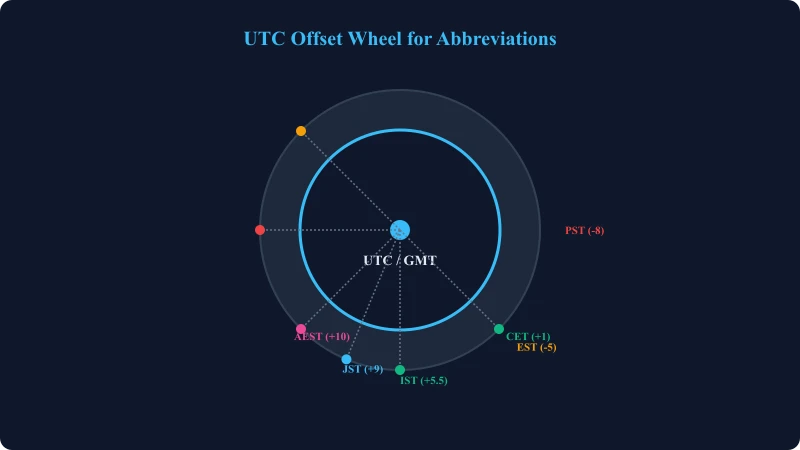
Figure 4: UTC Offset Wheel. Wheel diagram displaying standard abbreviations mapped to their exact numerical offsets from Coordinated Universal Time.
4. Regional Abbreviation Comparison Tables
Review these regional tables to understand timezone alignments across continents:
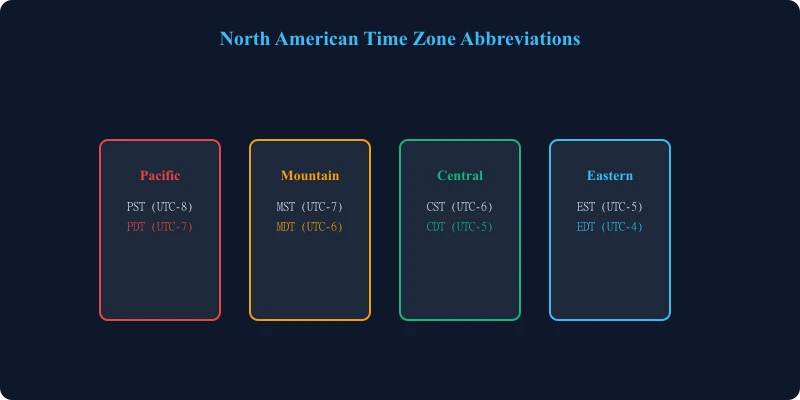
Figure 6: North American Time Zones. Comparison displaying the offsets and abbreviation transitions observed in North American regions.
North America
Region
Standard Acronym
Standard Offset
Daylight Acronym
Daylight Offset
Major Hubs
Pacific
PST
UTC-8
PDT
UTC-7
Los Angeles, Vancouver
Mountain
MST
UTC-7
MDT
UTC-6
Denver, Edmonton, Phoenix (no DST)
Central
CST
UTC-6
CDT
UTC-5
Chicago, Dallas, Winnipeg
Eastern
EST
UTC-5
EDT
UTC-4
New York, Toronto, Miami
Atlantic
AST
UTC-4
ADT
UTC-3
Halifax, San Juan
Newfoundland
NST
UTC-3:30
NDT
UTC-2:30
St. John's
Europe
Region
Standard Acronym
Standard Offset
Daylight Acronym
Daylight Offset
Major Hubs
Western Europe / UK
GMT / WET
UTC+0
BST / WEST
UTC+1
London, Lisbon, Dublin
Central Europe
CET
UTC+1
CEST
UTC+2
Paris, Berlin, Rome, Madrid
Eastern Europe
EET
UTC+2
EEST
UTC+3
Athens, Kiev, Helsinki
Moscow Time
MSK
UTC+3
MSK
UTC+3
Moscow, Minsk (no DST)
Asia & Oceania
Region
Standard Acronym
Standard Offset
Daylight Acronym
Daylight Offset
Major Hubs
India
IST
UTC+5:30
IST
UTC+5:30
New Delhi, Mumbai (no DST)
Singapore / Hong Kong
SGT / HKT
UTC+8
SGT / HKT
UTC+8
Singapore, Hong Kong (no DST)
Japan / Korea
JST / KST
UTC+9
JST / KST
UTC+9
Tokyo, Seoul (no DST)
Australia Eastern
AEST
UTC+10
AEDT
UTC+11
Sydney, Melbourne, Brisbane (no DST)
New Zealand
NZST
UTC+12
NZDT
UTC+13
Auckland, Wellington
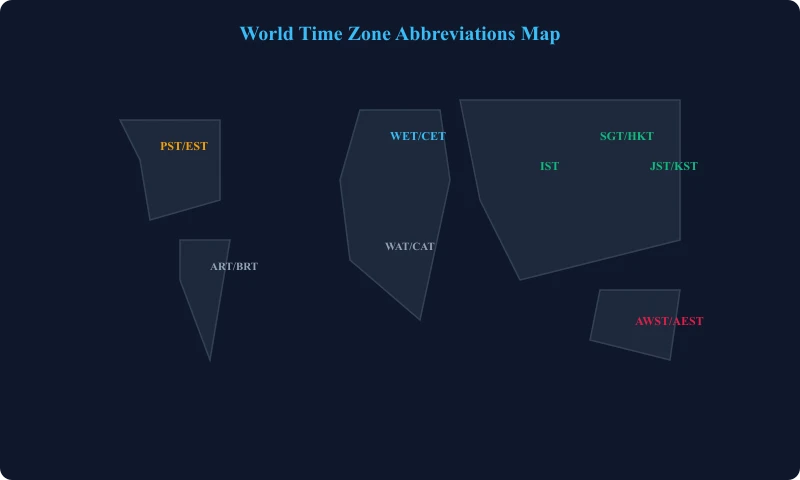
Figure 2: World Abbreviation Map. Global layout demonstrating which alphabetical timezone acronyms are observed across different continents.
5. Business Operations & Meeting Coordination
Coordinating international corporate activities requires matching standard and daylight abbreviations to establish clear communication corridors.
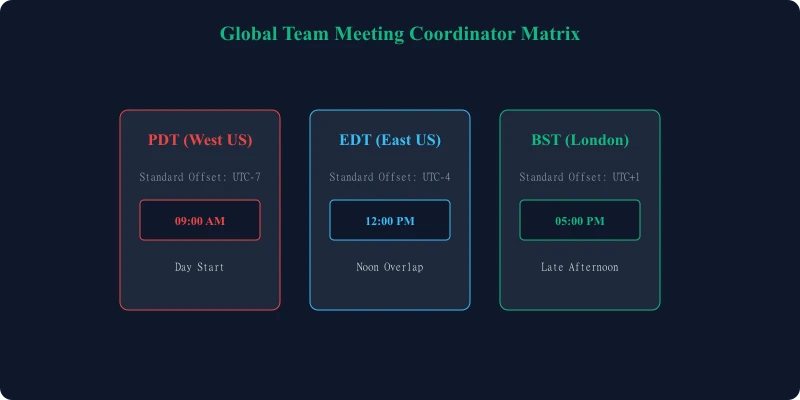
Figure 10: Multi-Timezone Collaboration. Matrix demonstrating working hour overlaps between PDT, EDT, and BST for remote teams.
PDT, EDT, and BST Overlap: During summer, a meeting scheduled at 9:00 a.m. in San Francisco (PDT, UTC-7) corresponds to 12:00 p.m. in New York (EDT, UTC-4) and 5:00 p.m. in London (BST, UTC+1).
This represents the optimal daily collaboration window for trans-Atlantic corporate teams.
Daylight Saving Transitions: Clocks in North America (switching EST to EDT) change on different dates compared to Europe (switching CET to CEST).
During the 2-to-3 week gap in March and October, meeting times will shift by one hour, requiring close attention.
Half-Hour Offsets: When scheduling calls with India (IST, UTC+5:30) or Newfoundland (NST, UTC-3:30), meetings scheduled on the hour in standard zones will land on the half-hour in these regions, making careful calendar booking essential.
6. Programming & Technology Guidelines
In software engineering, relying on timezone abbreviations inside databases or network APIs is considered a critical error.
Acronyms are ambiguous and do not correspond to unique numerical offsets.
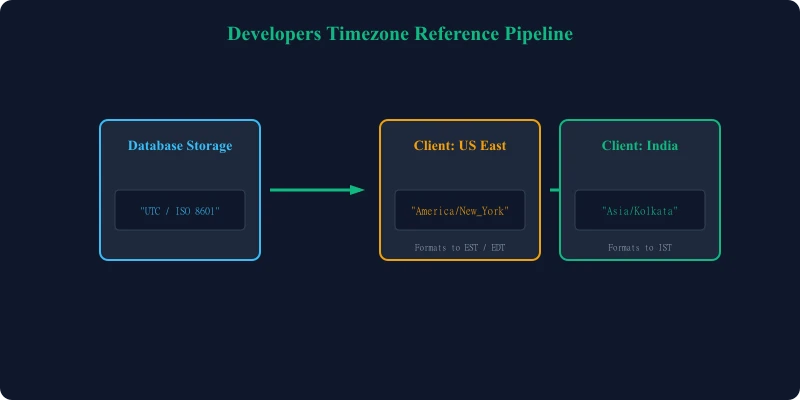
Figure 8: Developer Timezone Pipeline. Diagram showing the standard database pipeline: storing time in UTC and formatting to local abbreviations at the client rendering layer using IANA location databases.
1. Never Store Abbreviations in Databases
Do not store dates as "2026-07-15 10:00:00 EST".
The acronym "EST" can map to Eastern Standard Time (UTC-5) or Australian Eastern Standard Time (AEST/EST, UTC+10) depending on server environment settings.
Always store timestamps in Coordinated Universal Time (UTC) using the ISO 8601 formatting: `YYYY-MM-DDTHH:MM:SSZ`.
2. Use IANA Identifiers
Use the official IANA location identifiers (like `America/New_York` or `Europe/Paris`) to format UTC dates into localized abbreviations.
These databases contain complete historical records of DST changes and local law changes.
3. JavaScript Formatter Example
To display a UTC date as a localized abbreviation in the user interface, utilize the `Intl.DateTimeFormat` API:
const date = new Date('2026-07-15T12:00:00Z');
const formatter = new Intl.DateTimeFormat('en-US', {
  timeZone: 'America/New_York',
  timeZoneName: 'short'
});
console.log(formatter.format(date));
// Output will render with EDT/EST abbreviation based on the date
7. Common Timezone Acronym Pitfalls
Avoid these frequent errors when managing global travel, itineraries, or calendar schedules:
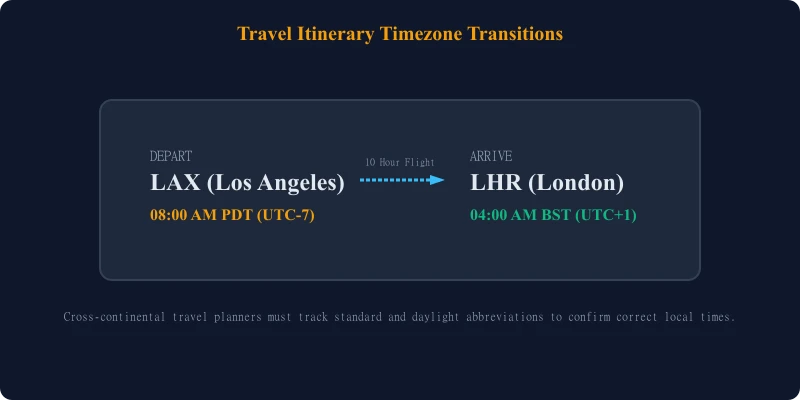
Figure 9: Travel Timezone Planning. Boarding card and timeline details illustrating the importance of checking local offsets during transcontinental travel.
The IST Confusion: If a client in Dublin says "let's meet at 10:00 a.m. IST," they may be referring to Irish Standard Time (UTC+1 in summer).
If a team member in New Delhi assumes Indian Standard Time (UTC+5:30), they will miss the meeting by 4.5 hours.
Always clarify the country.
Assuming All Regions Observe DST: Not all states in North America observe daylight saving.
Arizona remains on MST (UTC-7) year-round, meaning it does not transition to MDT.
Ensure your itineraries reflect these local exceptions.
The CST Ambiguity: CST represents Central Standard Time (UTC-6) in North America, China Standard Time (UTC+8) in Asia, and Cuba Standard Time (UTC-5) in the Caribbean.
Always verify the geographical context.
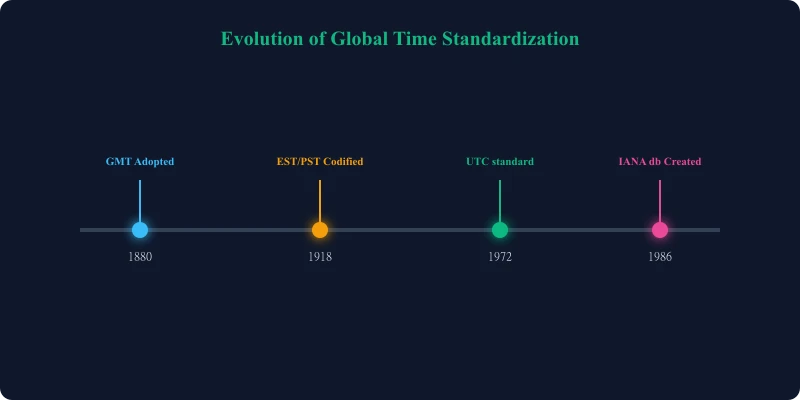
Figure 5: Time Standard Development. Timeline outlining the historical development of global time coordination, from regional railway standards to the IANA database.
8. Frequently Asked Questions (FAQ)
Review these comprehensive answers to resolve common questions about global time zone abbreviations:
What is a time zone abbreviation?
A time zone abbreviation is an alphabetic acronym used to represent a specific civil time zone and offset relative to Coordinated Universal Time (UTC). For example, 'EST' represents Eastern Standard Time (UTC-5).
Why are some time zone abbreviations identical for different regions?
Because there is no central international authority regulating time zone abbreviations, different regions have historically created identical acronyms. For example, 'IST' stands for Indian Standard Time (UTC+5:30), Irish Standard Time (UTC+1), and Israel Standard Time (UTC+2). Similarly, 'CST' stands for US Central Standard Time (UTC-6), China Standard Time (UTC+8), and Cuba Standard Time (UTC-5).
What is the difference between standard and daylight abbreviations?
Standard abbreviations (like PST, EST, AEST) are used during winter or standard time periods. Daylight abbreviations (like PDT, EDT, AEDT) are used during summer daylight saving periods when clocks are set one hour ahead.
What does EST stand for?
EST stands for Eastern Standard Time. It is observed in eastern North America and has an offset of UTC-5.
What does PST stand for?
PST stands for Pacific Standard Time. It is observed in western North America and has an offset of UTC-8.
What does CST stand for?
CST stands for Central Standard Time. In North America, it has an offset of UTC-6. In China, it represents China Standard Time (UTC+8).
What does GMT stand for?
GMT stands for Greenwich Mean Time. Historically, it was used as the prime global solar time standard. Today, it operates as a standard civil time zone at UTC+0, primarily in the UK and parts of Africa.
What is the difference between GMT and UTC?
UTC (Coordinated Universal Time) is a highly precise scientific time standard maintained by atomic clocks, serving as the global reference point for all time zones. GMT (Greenwich Mean Time) is a civil time zone with an offset of UTC+0, which is determined by the Earth's rotation.
What does IST stand for?
IST most commonly stands for Indian Standard Time (UTC+5:30). It can also represent Irish Standard Time (UTC+1 in summer) or Israel Standard Time (UTC+2).
What does CET stand for?
CET stands for Central European Time. It is observed in most parts of Western and Central Europe during the winter and has an offset of UTC+1.
What does JST stand for?
JST stands for Japan Standard Time. It has an offset of UTC+9 and is observed year-round without any seasonal Daylight Saving Time changes.
What does AEST stand for?
AEST stands for Australian Eastern Standard Time. It is observed in the eastern states of Australia during the winter and has an offset of UTC+10.
Does India use Daylight Saving Time abbreviations?
No. India does not observe Daylight Saving Time. Therefore, Indian Standard Time (IST, UTC+5:30) is used year-round with no summer daylight saving abbreviation.
What abbreviation does the United Kingdom use in summer?
During the summer, the UK observes Daylight Saving Time and switches from Greenwich Mean Time (GMT, UTC+0) to British Summer Time (BST, UTC+1).
What does SGT stand for?
SGT stands for Singapore Time, which is observed year-round in Singapore with an offset of UTC+8.
What does MSK stand for?
MSK stands for Moscow Standard Time, which has an offset of UTC+3 and is observed year-round in Moscow and western Russia.
What is UTC offset?
A UTC offset is the difference in hours and minutes that a specific time zone is ahead of (+) or behind (-) Coordinated Universal Time (UTC).
What does NZST stand for?
NZST stands for New Zealand Standard Time (UTC+12). In summer, New Zealand shifts to New Zealand Daylight Time (NZDT, UTC+13).
What does HST stand for?
HST stands for Hawaii Standard Time. It has an offset of UTC-10 and is observed year-round without Daylight Saving Time adjustments.
How should timezone abbreviations be handled in database logs?
They should not be used in database logs. Abbreviations are ambiguous and lack unique numerical mapping. Instead, logs should be stored in UTC format, and localized offsets can be rendered in the user interface using IANA location names like `America/New_York` or `Asia/Kolkata`.
Understanding these details is critical for web development, server coordination, international business operations, and general navigation. Utilizing standard international time formats (such as the 24-hour clock and ISO 8601 specifications) guarantees that your schedules, communications, and database logs remain accurate and free from timezone errors.
Explore Time Zone Converters & Guides
Use our free, daylight-saving-aware tools to calculate global offsets and schedule meetings across regions: