
Understanding the GMT to WAT Conversion
Coordinating travel itineraries, commercial trade, remote work workflows, and international communications between European/African Greenwich Mean Time (GMT) regions and West-Central African commerce hubs requires accurate timezone calculations. When converting from Greenwich Mean Time (GMT) to West Africa Time (WAT), the foundational rule is that WAT operates 1 hour ahead of the Prime Meridian baseline.
Greenwich Mean Time represents the zero-degree longitudinal reference point (UTC+0). West Africa Time is defined at UTC+1.
Whether you are scheduling business calls with Lagos, Abuja, Luanda, or Douala, planning flights to Murtala Muhammed International Airport (LOS), or configuring server cron jobs, using a date-aware converter ensures midnight calendar shifts are calculated accurately.
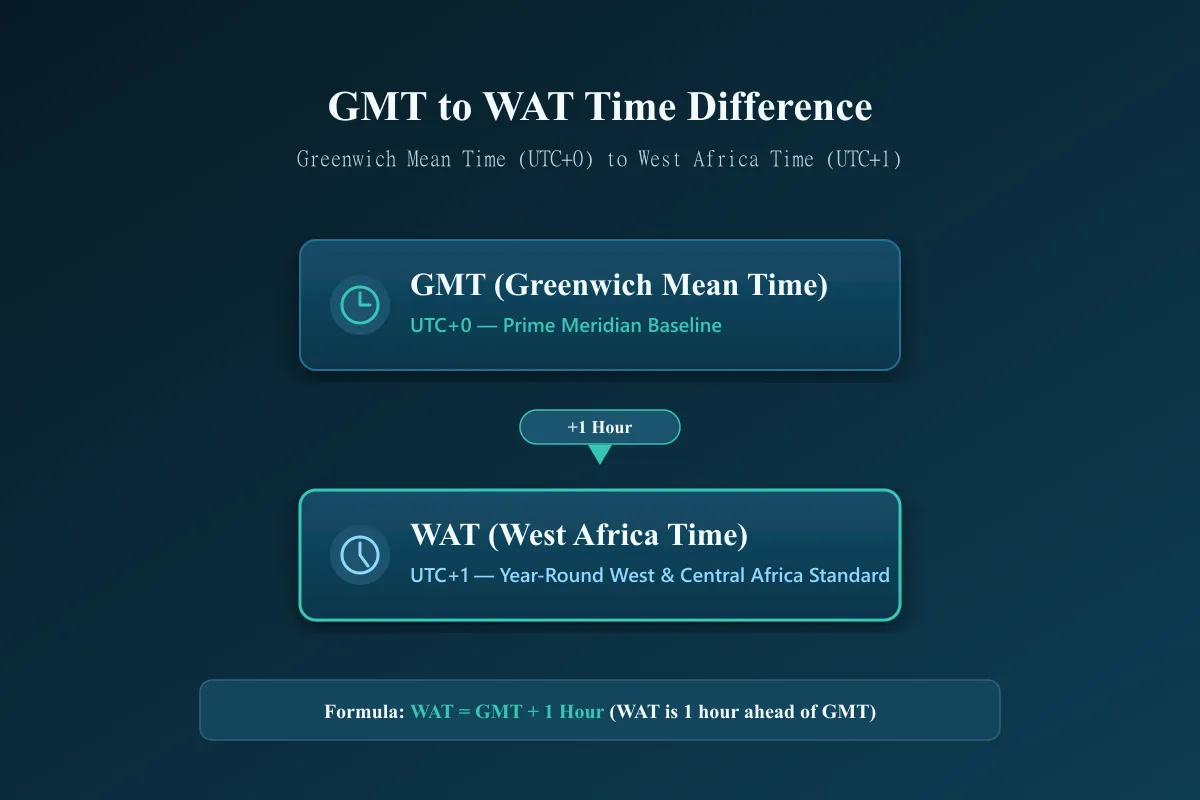
GMT to WAT Time Difference
The precise time difference between Greenwich Mean Time and West Africa Time is 1 hour. West Africa Time is permanently 1 hour ahead of Greenwich Mean Time.
The conversion mathematical equation is expressed as:
WAT = GMT + 1 Hour
UTC+0 (Prime Meridian) → UTC+1 (West Africa Time)
Because the offset is positive (+1), locations in West Africa Time experience clock hours 1 hour earlier in the day than Greenwich observatory coordinates do. When London or Greenwich marks 12:00 PM (noon) GMT, Lagos and Luanda are at 01:00 PM (13:00) WAT.
How to Convert GMT to WAT
Converting Greenwich Mean Time to West Africa Time manually is straightforward when following a 6-step procedure:
- Start with the GMT date and time: Identify the clock time in GMT (e.g., 18:30 GMT).
- Verify the GMT baseline: Confirm that the baseline uses UTC+0.
- Identify WAT's offset: Note that West Africa Time operates at UTC+1.
- Add one hour: Add 1 to the GMT hour figure (18:30 plus 1 hour = 19:30).
- Check whether the result reaches or exceeds 24:00: If adding 1 hour reaches 24:00 (midnight), subtract 24 hours (24:00 minus 24 = 00:00) and advance the calendar day by one.
- Confirm the final WAT time: Record the resulting hour, minute, date, and WAT label (e.g., 19:30 WAT).
For instance, converting 18:30 GMT yields 19:30 WAT (7:30 PM WAT) on the exact same date. However, converting 23:30 GMT yields 23:30 plus 1 hour = 24:30. Subtracting 24 hours results in 00:30 WAT (12:30 AM WAT) on the next calendar day.
GMT to WAT 24-Hour Conversion Table
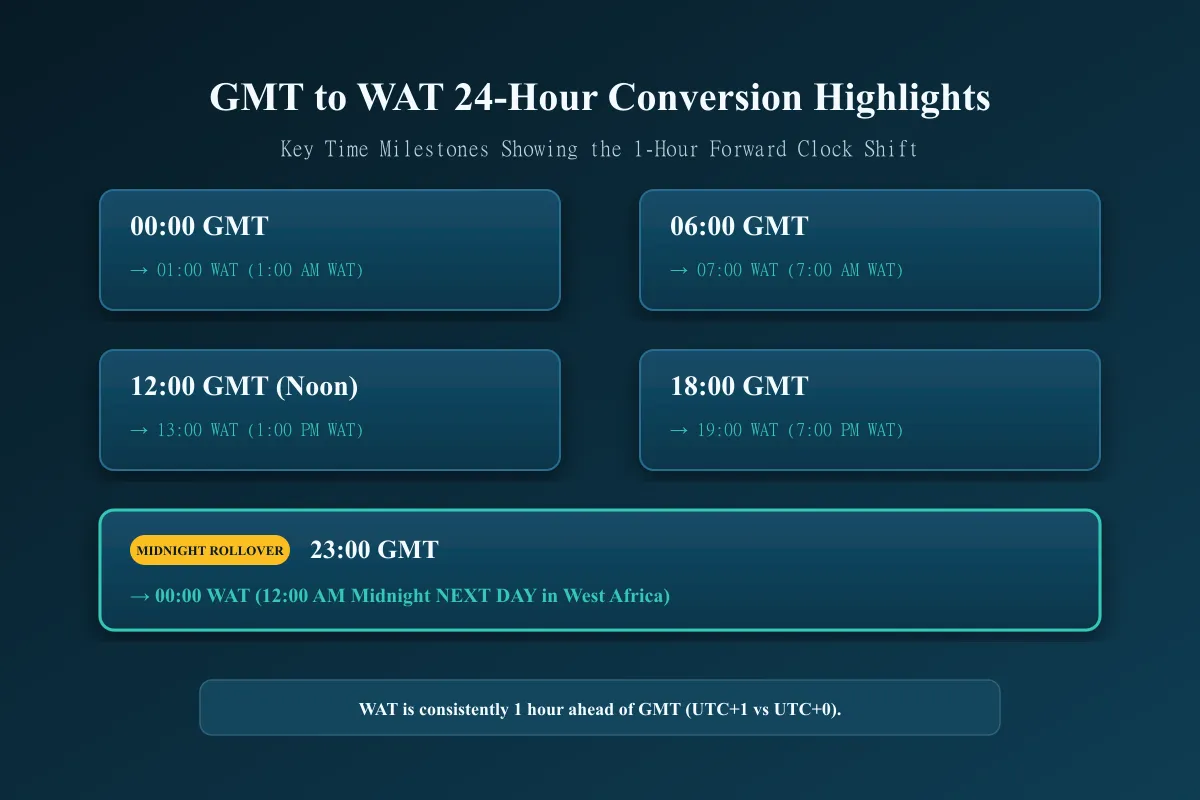
The standard reference table below provides a complete hour-by-hour map converting Greenwich Mean Time (00:00 through 23:00) to West Africa Time. Rows highlighted in colored styling indicate times where adding 1 hour rolls the clock into the next calendar day in West Africa.
| GMT (12-Hour) | GMT (24-Hour) | WAT (12-Hour) | WAT (24-Hour) | Calendar Status |
|---|---|---|---|---|
| 12:00 AM | 00:00 | 1:00 AM | 01:00 | Same day |
| 1:00 AM | 01:00 | 2:00 AM | 02:00 | Same day |
| 2:00 AM | 02:00 | 3:00 AM | 03:00 | Same day |
| 3:00 AM | 03:00 | 4:00 AM | 04:00 | Same day |
| 4:00 AM | 04:00 | 5:00 AM | 05:00 | Same day |
| 5:00 AM | 05:00 | 6:00 AM | 06:00 | Same day |
| 6:00 AM | 06:00 | 7:00 AM | 07:00 | Same day |
| 7:00 AM | 07:00 | 8:00 AM | 08:00 | Same day |
| 8:00 AM | 08:00 | 9:00 AM | 09:00 | Same day |
| 9:00 AM | 09:00 | 10:00 AM | 10:00 | Same day |
| 10:00 AM | 10:00 | 11:00 AM | 11:00 | Same day |
| 11:00 AM | 11:00 | 12:00 PM | 12:00 | Same day |
| 12:00 PM | 12:00 | 1:00 PM | 13:00 | Same day |
| 1:00 PM | 13:00 | 2:00 PM | 14:00 | Same day |
| 2:00 PM | 14:00 | 3:00 PM | 15:00 | Same day |
| 3:00 PM | 15:00 | 4:00 PM | 16:00 | Same day |
| 4:00 PM | 16:00 | 5:00 PM | 17:00 | Same day |
| 5:00 PM | 17:00 | 6:00 PM | 18:00 | Same day |
| 6:00 PM | 18:00 | 7:00 PM | 19:00 | Same day |
| 7:00 PM | 19:00 | 8:00 PM | 20:00 | Same day |
| 8:00 PM | 20:00 | 9:00 PM | 21:00 | Same day |
| 9:00 PM | 21:00 | 10:00 PM | 22:00 | Same day |
| 10:00 PM | 22:00 | 11:00 PM | 23:00 | Same day |
| 11:00 PM | 23:00 | 12:00 AM | 00:00 | Next day |
Note: 23:00 GMT occurs at 00:00 midnight on the next calendar day in West Africa Time.
GMT to WAT Conversion Examples
Review these 15 detailed conversion scenarios with explicit clock and calendar date breakdowns:
Example 1: Midnight GMT
00:00 GMT → 01:00 WAT (Same Day)
When midnight arrives in Greenwich (00:00 GMT), West Africa is at 01:00 AM in the early morning of the same calendar day.
Example 2: Early Morning GMT
01:00 GMT → 02:00 WAT (Same Day)
01:00 AM GMT corresponds to 02:00 AM WAT on the same morning.
Example 3: Pre-Dawn GMT
03:30 GMT → 04:30 WAT (Same Day)
03:30 AM GMT equals 04:30 AM WAT pre-dawn.
Example 4: Morning GMT
05:00 GMT → 06:00 WAT (Same Day)
A 05:00 AM GMT system job runs at 06:00 AM WAT as West African cities awaken.
Example 5: Morning Shift GMT
07:15 GMT → 08:15 WAT (Same Day)
07:15 AM GMT equals 08:15 AM WAT as offices open in Lagos and Cotonou.
Example 6: Mid-Morning GMT
09:00 GMT → 10:00 WAT (Same Day)
09:00 AM GMT equals 10:00 AM WAT mid-morning.
Example 7: Late Morning GMT
10:30 GMT → 11:30 WAT (Same Day)
10:30 AM GMT translates to 11:30 AM WAT.
Example 8: Noon GMT
12:00 GMT → 13:00 WAT (Same Day)
12:00 PM (noon) GMT translates to 13:00 (1:00 PM) WAT lunch hour.
Example 9: Early Afternoon GMT
13:45 GMT → 14:45 WAT (Same Day)
13:45 (1:45 PM) GMT equals 14:45 (2:45 PM) WAT.
Example 10: Mid-Afternoon GMT
15:00 GMT → 16:00 WAT (Same Day)
15:00 (3:00 PM) GMT equals 16:00 (4:00 PM) WAT.
Example 11: Late Afternoon GMT
17:30 GMT → 18:30 WAT (Same Day)
17:30 (5:30 PM) GMT translates to 18:30 (6:30 PM) WAT evening.
Example 12: Evening GMT
18:00 GMT → 19:00 WAT (Same Day)
18:00 (6:00 PM) GMT equals 19:00 (7:00 PM) WAT.
Example 13: Late Evening GMT
22:00 GMT → 23:00 WAT (Same Day)
22:00 (10:00 PM) GMT equals 23:00 (11:00 PM) WAT.
Example 14: New Year's Eve Midnight Rollover
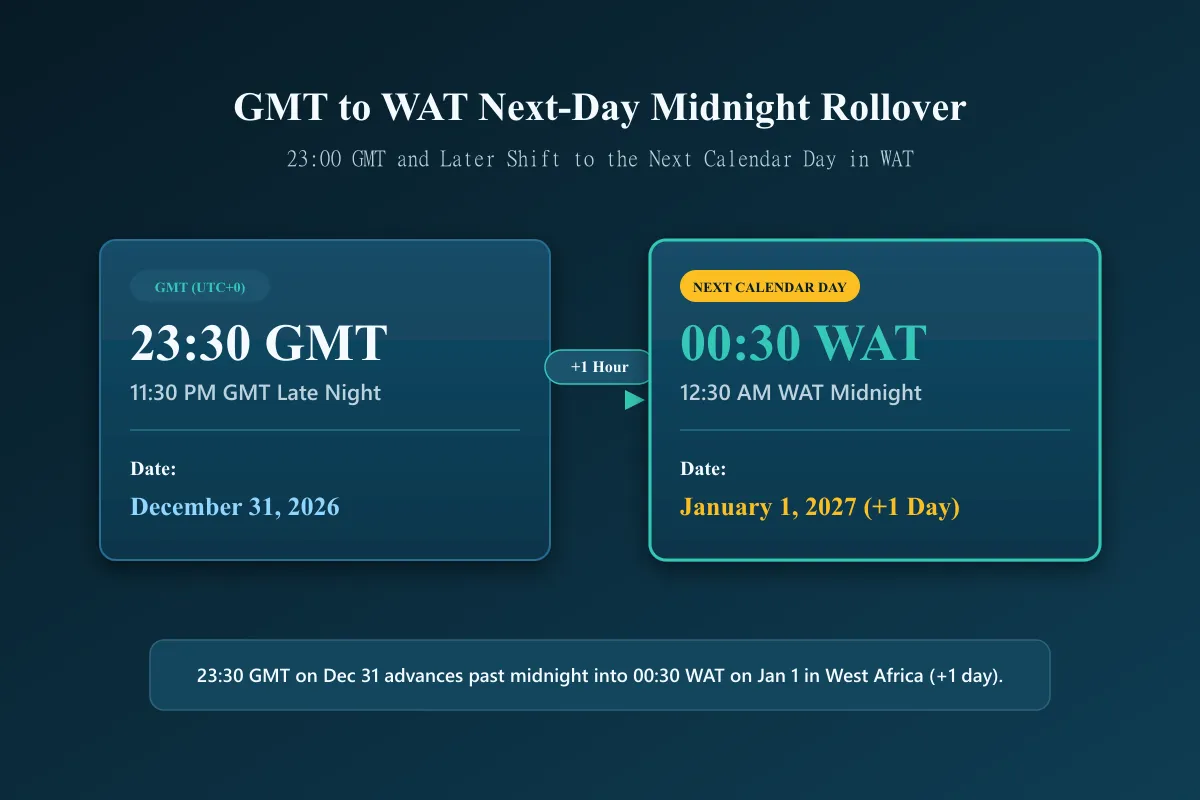
23:30 GMT (Dec 31, 2026) → 00:30 WAT (Jan 1, 2027)
A 23:30 (11:30 PM) GMT timestamp on New Year's Eve 2026 in London takes place at 00:30 AM WAT on New Year's Day 2027 in Lagos (+1 day)!
Example 15: Leap Year Date Shift
23:30 GMT (Feb 28, 2028) → 00:30 WAT (Feb 29, 2028)
On a leap year, 23:30 GMT on February 28 falls on 00:30 AM WAT on Leap Day (February 29) in West Africa.
What Is GMT?
Greenwich Mean Time (GMT) represents mean solar time calculated at the Royal Observatory in Greenwich, London, situated on the Prime Meridian (0° longitude).
Established at the 1884 International Meridian Conference, GMT served as the foundational global timekeeping baseline for over a century. While atomic Coordinated Universal Time (UTC) has replaced GMT in scientific and computer system standards, GMT remains the standard civil time zone name for the UK, West Africa (such as Ghana), and global conversion tools.
GMT operates at UTC+0. Standard GMT maintains a static zero offset throughout the year. You can learn more about GMT baseline logic on our What Is GMT guide or explore our primary GMT to EST Converter.
What Is WAT?
West Africa Time (WAT) is the standard time zone observed across a broad territory in West and Central Africa. WAT is defined strictly as UTC+01:00 (Coordinated Universal Time plus 1 hour).
In computer systems and IANA timezone databases, West Africa Time is represented by location keys such as Africa/Lagos, Africa/Luanda, and Africa/Douala. Explore our dedicated WAT to EST Converter for West Africa to US Eastern Time conversions.
Countries That Use West Africa Time
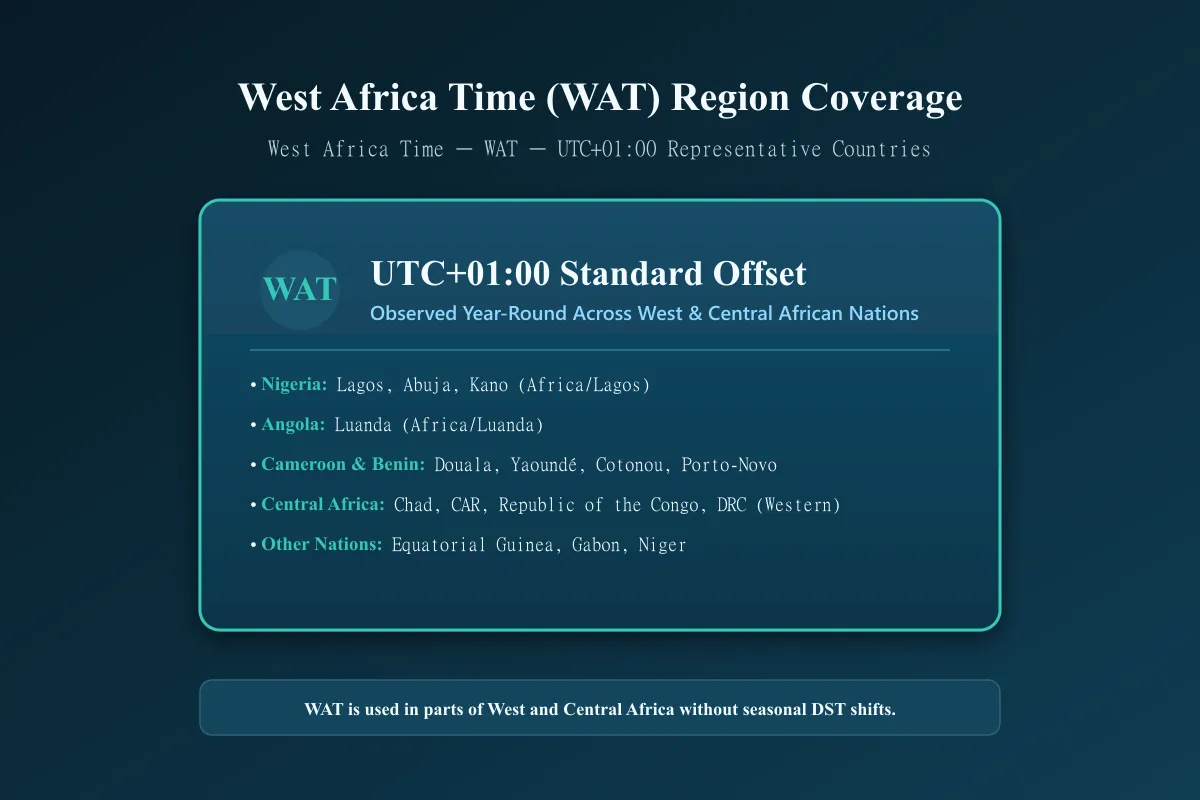
WAT is observed as standard time across eleven African nations:
- Nigeria: Lagos, Abuja, Kano, Ibadan, Port Harcourt
- Angola: Luanda, Huambo, Lobito
- Cameroon: Douala, Yaoundé, Garoua
- Benin: Cotonou, Porto-Novo
- Chad: N'Djamena, Moundou
- Central African Republic: Bangui
- Republic of the Congo: Brazzaville, Pointe-Noire
- Democratic Republic of the Congo (Western Region): Kinshasa, Matadi
- Equatorial Guinea: Malabo, Bata
- Gabon: Libreville, Port-Gentil
- Niger: Niamey, Zinder
Note: Not all West African nations use WAT. Neighboring countries like Ghana, Senegal, and Ivory Coast operate on GMT (UTC+0).
GMT vs WAT Comparison
Review the structural attributes comparing Greenwich Mean Time and West Africa Time:
| Feature | Greenwich Mean Time (GMT) | West Africa Time (WAT) |
|---|---|---|
| Full Name | Greenwich Mean Time | West Africa Time |
| UTC Offset | UTC+00:00 | UTC+01:00 |
| Relative Difference | 1 hour behind WAT | 1 hour ahead of GMT |
| Daylight Saving Status | Reference baseline (UK uses BST in summer) | No DST (Year-Round UTC+1) |
| Primary Region | Royal Observatory, Greenwich / UK baseline | Nigeria, Angola, Cameroon, Benin, Congo |
| IANA Key | Etc/GMT or UTC | Africa/Lagos, Africa/Luanda |
Why Is WAT One Hour Ahead of GMT?
The 1-hour difference between GMT and WAT is determined by longitudinal spacing across the globe:
GMT is centered at 0° longitude on the Prime Meridian. West Africa Time covers meridians centered near 15°E longitude. Because the Earth rotates 360 degrees in 24 hours (or 15 degrees per hour), the longitudinal gap of 15 degrees corresponds directly to 15° ÷ 15° per hour = 1 hour.
Does WAT Observe Daylight Saving Time?
No. Countries operating on West Africa Time do NOT observe Daylight Saving Time.
Major nations in this region (such as Nigeria, Angola, and Cameroon) remain on West Africa Time (WAT, UTC+1) all 365 days of the year without turning clocks forward or back.
GMT to WAT Date Changes
Yes. Because WAT is 1 hour ahead of GMT, late night GMT hours roll forward into the next calendar day in West Africa.
Any GMT time occurring between 23:00 (11:00 PM GMT) and 23:59 (11:59 PM GMT) takes place during midnight or early morning hours of the next calendar date in WAT.
Date Transition Thresholds
- GMT 00:00 to 22:59: Results in WAT 01:00 to 23:59 on the SAME calendar date.
- GMT 23:00: Results in WAT 00:00 (midnight) at the start of the NEXT calendar date.
- GMT 23:30: Results in WAT 00:30 AM on the NEXT calendar date.
For instance, a system deployment scheduled for 23:30 GMT on Thursday, December 31 takes place at 00:30 AM WAT on Friday, January 1 in Lagos.
GMT to WAT for Business Meetings
Coordinating business meetings between European or UK organizations and West African business hubs is seamless due to the minimal 1-hour time gap.
Overlap Windows & Business Hours
Standard office working hours in Lagos and Luanda run from 08:00 to 17:00 WAT. Converting this range to GMT shows:
West African Workday (08:00–17:00 WAT) = 07:00–16:00 GMT
There is virtually an entire workday overlap between GMT and WAT, enabling real-time collaboration with minimal friction.
GMT to WAT Working Hours Comparison
| Phase of Day | GMT Time | WAT Time | Collaboration Feasibility |
|---|---|---|---|
| Morning Opening | 08:00 GMT | 09:00 WAT | High Overlap |
| Midday Sync | 12:00 GMT | 13:00 WAT | Optimal Live Meeting Window |
| Afternoon Closing | 16:00 GMT | 17:00 WAT | High Overlap |
GMT to WAT for Remote Work
Remote software teams operating across Europe and West Africa benefit from almost full working hour alignment:
- Real-Time Standups: Daily standup calls can easily take place at 09:00 GMT (10:00 WAT).
- Explicit Invites: Always include exact date, time, and timezone labels in calendar invites (e.g., "Sprint planning meeting on Nov 10, 14:00 GMT / 15:00 WAT").
GMT to WAT for Travel
Travelers flying between European airports and West African airports (Lagos LOS, Abuja ABV, Luanda LAD, Douala DLA) experience minimal jet lag due to the 1-hour difference:
If a flight departs London Heathrow at 12:00 GMT, it lands in Lagos adjusted for 1 hour forward plus flight duration.
GMT to WAT for Online Events
Webinars, virtual conferences, gaming streams, and keynotes broadcast globally attract audiences in WAT:
A livestream broadcast at 18:00 GMT airs at 19:00 WAT in Nigeria and Angola.
GMT to WAT for Developers and Technology
Software engineers, DevOps leads, and database administrators handle timezone conversions when parsing logs, APIs, and scheduled tasks:
- ISO 8601 Strings: Express GMT as
2026-11-14T18:00:00Zand WAT as2026-11-14T19:00:00+01:00. - Cron Jobs: A database backup cron scheduled for 00:30 WAT daily runs at
23:30 UTCon the preceding calendar day. - Database Timestamp Storage: Always store timestamps in UTC within database schemas, converting to location keys like
Africa/LagosorAfrica/Luandadynamically at the UI presentation layer.
Common GMT to WAT Conversion Mistakes
1. Subtracting Hours Instead of Adding
Subtracting 1 hour instead of adding 1 hour creates a 2-hour calculation error.
2. Confusing WAT with UTC+2
Confusing West Africa Time (UTC+1) with Central Africa Time (CAT, UTC+2) or South Africa Standard Time (SAST, UTC+2).
3. Assuming DST Applies
Assuming WAT countries adjust clocks for summer daylight saving time. WAT remains at UTC+1 year-round.
4. Forgetting Midnight Rollover
Failing to move 23:00 GMT forward to 00:00 midnight on the next calendar day in WAT.
GMT to WAT Conversion Tips
📌 Memory Rule: +1 Hour
Always add 1 hour when converting Greenwich Mean Time to West Africa Time.
📅 Watch Midnight Rollover
Any GMT hour from 23:00 to 23:59 belongs to the next calendar date in WAT.
🌐 Use 24-Hour Format
Utilizing 24-hour military notation (e.g., 18:00 vs 06:00) prevents AM/PM confusion.
⚡ Use Our Interactive Converter
Rely on our automated tool at the top of this page for accurate date-aware conversions.
Frequently Asked Questions (FAQ)
Related Time Zone Converters
Explore other verified time zone conversion tools across our platform: